
Hudson River Almanac 6/12/16 - 6/18/16
The New York State Department of Environmental Conservation sent this bulletin on 06/24/2016 03:43 PM EDT |
| DEC Delivers - Information to keep you connected and informed from the NYS Department of Environmental Conservation |
| Share or view as a web page || Update preferences or unsubscribe |
|
|
|
There were more black bears, baby eagles, and great blue herons this week, as there should be. The Almanac tries to feature events that define the season, and late spring is often all about these and others. This is also the season for female snapping turtles, as they trudge inland from the water to lay their eggs against all odds that many will survive. However, after millions of years of adapting, they do just enough to ensure their success. HIGHLIGHT OF THE WEEK
[Goldfish (Carassius auratus), are native to East Asia. While they were widely introduced into North America in the early nineteenth century, their presence in the watershed is most often attributed to aquaria release. Domesticated and bred for color, often hybridizing with koi (carp), Hudson River goldfish range from orange to burnished-gold, often mottled with black. In the wild, goldfish can grow to 14 inches and weigh a couple of pounds. Riverman Everett Nack used to capture and raise wild goldfish for backyard fish ponds. Tom Lake.] NATURAL HISTORY NOTES 6/12 - Ulster County, HRM 73: The very white snowy owl discovered yesterday on the grounds of the Shawangunk and Wallkill Correctional facilities to the east of the Shawangunk Grasslands was still there today. [The Raptor Trust released a rehabilitated snowy owl (Bubo scandiacus) in the Shawangunk Grasslands on March 29, 2016. If this is the same bird, it was originally picked up near LaGuardia Airport with a gunshot wound. It was first rehabilitated at the Wild Bird Fund and then taken to the Raptor Trust. The bird was named “Hedwig” and had many followers on Facebook. Ardith Bondi.] 6/12 - Beacon, HRM 61: This was our 32nd year of Hudson River Foundation-sponsored “shad bakes” along the Hudson River, featuring smoked and baked fish, discussions on estuarine ecology, and reconnecting people to their river. The river’s American shad fishery was closed in 2010 due to the effects of over-harvesting; presently a coast-wide species recovery plan is in effect. Twenty-five years ago we used to run 14 shad bakes each spring. As a result of the closure, we now plank (bake on 90-year-old oak planks) and smoke steelhead (rainbow) trout marinated in Hudson valley maple syrup. Today we were at Pete and Toshi Seeger Riverfront Park as part of the Beacon Sloop Club’s Strawberry Festival, where the smell of wood smoke and the sweet texture of the golden fillets were all a part of springtime. Sheltered among the trees from 44 mile-per-hour west wind gusts, we invited hundreds of festival-goers for free samples of our savory fish. [The Hudson River shad bake has its historical origins in Colonial times. Other than keeping a wary eye for British warships, commercial shad fishing was hardly disrupted by the American Revolution. Europeans had been introduced to American shad by Algonquian people (river Indians) who lived along the estuary. For many millennia, they had celebrated the annual return of shad from the sea by baking fish on huge riverside roasting platforms, some of which were a half-acre in size. Fires, hot coals and cobbles were set around flat rocks upon which shad and other fish were placed for slow cooking and smoking. We have always wondered if they saw this as a festive occasion, with song, dance, and laughter. How could they not? Tom Lake.]
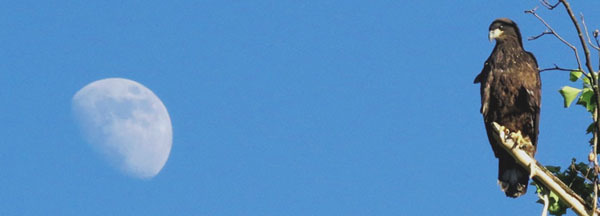
6/13 - Town of Poughkeepsie: This was Day 79 for the nestling in bald eagle nest NY62. He was becoming much more adventurous, climbing, scrambling, or flying up to a perch about 15 feet above the nest. Mama brought in a fish, dropped it into the nest, and the nestling dived head-first down to get it. A short while later he scrambled back up to his perch. As we left for the day, “Peep” looked very ready. [Bald eagle nest NY62 is frequently featured in the Hudson River Almanac primarily because it is accessible at a non-intrusive distance to a team of dedicated monitors and top-notch photographers. Day-to-day behavior is easily documented and we believe that NY62 is a good representative of the other three dozen eagle nests in the watershed. The time-line from egg-laying to hatching to fledging is very similar for all of them. Tom Lake.] 6/14 - Town of Poughkeepsie: It was Day 80 for the bald eagle nestling in NY62, and he took his first flight, became a fledgling, before we arrived early this morning [dawn fledges are common]. He was gone, but where? After an exhaustive all day search, we found him on a ridge east of the nest tree where he put on a good show of wing flapping. By evening, the moon had aligned behind him, giving us nice photo ops. After a while he turned and flew to the next tree over. It was a beautiful evening with “Peep.” [See banner photo of fledged bald eagle with rising moon, courtesy of Mark Courtney.] [For this pair, across sixteen years with sixteen nestlings, the average fledge date has been 79.6 days. Tom Lake.] 6/14 - Peekskill, HRM 43: Since I had good luck two weeks ago at the Peekskill waterfront, I decided to try there again today for carp. Alas, it was not banner day. I caught and released three channel catfish (largest of which weighed three pounds) and lost a large carp when it threw the hook. Nine miles downriver, I noticed that carp spawning was building in Croton Bay with giant swirls and splashes. 6/15 - Town of Poughkeepsie: It was a long day of watching and waiting. After our encounter with the fledgling from bald eagle nest NY62 last evening, he had moved off and seemingly disappeared. We listened for calls, not only from the nestling but from crows, blue jays, and mockingbirds, all of which have a tendency to harass immature eagles. By day’s end we were still looking at an empty nest tree. [In the sixteen years we have been monitoring this bald eagle pair, we have come to appreciate the rewards of hours spent watching and waiting. This spring we have had many bluebirds, Baltimore orioles, American goldfinches, American redstarts, and other colorful birds brighten up otherwise uneventful days. Tom Lake.] 6/15 - Croton Point, HRM 34: It was dawn when I came upon a big mama snapping turtle in the process of laying her eggs right on the edge of the lower road on the Point. She was well on her way when I got there and was so close to the edge of the road I was immediately concerned that the eggs had little chance of hatching. The eggs were about four inches deep under loose soil. I contacted John Phillips, the naturalist on the Point, and he was able to remove 40 eggs to a safer location closer to the water.
6/15 - Manhattan, HRM 1: We checked our sampling gear at the River Project’s station on the lighthouse tender Lilac at Pier 25 in Hudson River Park and found a variety of animals in our crab pots: white perch 250 millimeters [mm] long, oyster toadfish (65 mm), rock gunnel (125 mm), and one blue crab (75 mm). In the killifish traps we found five black sea bass (65-90 mm), an Atlantic tomcod (65 mm), and four oyster toadfish (40-60 mm). The rock gunnels were at their comfort limit for water temperature. 6/16 - Wallkill River, HRM 77: As I walked along the edge of a fallow cornfield 17 years ago today, listening to the “witchity-witchity-witchity” of the common yellowthroat, I spotted a piece of gray stone (chert) protruding slightly from a crack in the dry earth. It was the thin edge of a small stone tool, a projectile point staring up at me, having eroded from the soil. I had found a very old Indian artifact, later dated to c. 12,000 calendar years ago. [This stone artifact, a Barnes-type fluted spear point, reminded us of the great time-depth of humans in the Hudson Valley. The style originated in southwestern Ontario and is a diagnostic tool of what archaeologists believe were the first people, called Paleoindian, to enter the Hudson Valley. The Wallkill River Valley was a seasonal passageway for these hunter-gatherers from Ontario, through the Mohawk River Valley, then south through Greene, Ulster, Orange and Rockland Counties stopping at stone quarries along the way. This artifact was made from a rosy-white, high quality chert that came from a quarry 55 miles south of where it was found, at the lower end of the Wallkill Valley near Branchville, Sussex County, New Jersey. Tom Lake.] 6/16 - Town of Poughkeepsie: Two days after fledging, Peep was back in the nest tree (NY62), perched in the shade on the horizontal limb 15 feet above the nest. With a cool westerly breeze he had a perfect view out to the river where he could see Mom and Dad when they returned from hunting with his next meal. We could tell he was hungry since he kept up an almost continuous “chortling” - a bellyache of a call. During the day Dad dropped fish, among them a channel catfish, into the nest after which the fledgling would fly down and feed. 6/16 - Crugers, HRM 39: While we were disappointed that no hummingbirds had come to our feeders yet, we did have a pair of unlikely visitors: downy woodpeckers. Last evening, after both woodpeckers took a drink of the sugar-water, they landed nearby and began feeding one another. We watched them do it again this morning. 6/16 - Manhattan, HRM 1: We checked our sampling gear at the River Project’s station on the lighthouse tender Lilac at Pier 25 and found two black sea bass (85-90 mm) in our killifish traps. Later, at the River Project’s WetLab at Pier 40 [HRM 2] at high tide, we did a surface and benthic (bottom) test in 17-18 feet of water, recording a water temperature of 68 degrees Fahrenheit, salinity of 11.0 parts-per-thousand [ppt], and dissolved oxygen of 4.8 parts-per-million [ppm] at the surface, and a temperature of 66 degrees F, salinity of 15.0 ppt, and dissolved oxygen of 4.7 ppm at the bottom. 6/17 - Ulster County, HRM 102: The black bear we have seen this year in Shady, as opposed to every previous year's bear, has managed to take down my entire bird feeding operation that I have had in place for more than ten years. I hang the feeders from a wire attached high in a tree on one end, and to a pulley at the top of the house on the other. This year's bear figured out how to climb the tree and break the wire. He took all five feeders so far away that I haven't been able to find any of them. This has happened twice, ten feeders in all. I realize that henceforth I will have to take them down every night. Before the take-downs, I had two pairs of both orioles and rose-breasted grosbeaks coming all day to the feeders. So I am very upset with this bear. 6/17 - Ulster Park, HRM 87: I was woken up at midnight by a crash outside caused by a small black bear at the bird feeders. This is the first one we have had here in five years. He got one feeder before I chased him off and brought the others in. 6/17 - Town of Poughkeepsie: After an absence of several days, Mom, the female in bald eagle nest NY62, returned. We had not seen here during the day but she might have visited at first or last light. When she flew in she was carrying a fish and the fledgling hopped up and down excitedly on his perch above the nest. After circling over several times, trying to get the fledgling to follow her, she gave up and dropped the fish in the nest. The nestling was there in a flash. No lessons learned today. [Bald eagle monitoring is never for the faint of heart. They can delight you one moment and have you terribly worried the next. Several years ago, Mama was missing shortly after her nestling had fledged. Then we received a report that an adult bald eagle had been struck and killed by a train two miles south. Our anxiety could not have been overstated. The next day, however, we learned that it was not Mama (N42) and within hours she returned to the nest tree (NY62). Tom Lake.] 6/17 - Bedford, HRM 35: There was a lot of activity in the great blue heron rookery today as the juveniles were now nearing adult size. Crowding in the nests was obviously an issue; several juveniles were hopping from nests to nearby branches to get some space.
[“Sumer Is Icumen In” is a fragment of the lyrics of a mid-13th century medieval English song, translating to “Summer Has Come In.” Tom Lake.] 6/18 - Norrie Point, HRM 85: Two dozen anglers of all ages gave it their best at our public fishing program today. The result, after three hours, was a very modest catch of seven fish - four species of sunfish: redbreast, pumpkinseed, bluegill, and green sunfish (the green sunfish showed some indications of being a hybrid redbreast x green). Five of them were caught by Andrew Hanscom (three years old) and his sister, Emily Hanscom (two). As we fished, we watched huge schools of tiny fish swimming along the pier. Jim Herrington stuck a dip net in the water and pulled out a dozen young-of-the-year spottail shiners [12-13 mm]. 6/18 - Beacon, HRM 61-60: At high tide I paddled in my kayak from Long Dock to the mouth of Fishkill Creek. Although I saw a pair of pileated woodpeckers feeding near the shore, the usual host of great blue herons, Canada geese and their goslings, cormorants, ducks, and spawning carp, the highlight was an osprey. It circled overhead and then dove to grab a fish just 30 feet from my kayak. HUDSON RIVER MILES The Hudson is measured north from Hudson River Mile 0 at the Battery at the southern tip of Manhattan. The George Washington Bridge is at HRM 12, the Tappan Zee 28, Bear Mountain 47, Beacon-Newburgh 62, Mid-Hudson 75, Kingston-Rhinecliff 95, Rip Van Winkle 114, and the Federal Dam at Troy, the head of tidewater, at 153. The tidal section of the Hudson constitutes a bit less than half the total distance – 315 miles – from Lake Tear of the Clouds to the Battery. Entries from points east and west in the watershed reference the corresponding river mile on the mainstem. TO CONTRIBUTE YOUR OBSERVATIONS OR TO SUBSCRIBE Discover New York State Conservationist - the award-winning, advertisement-free magazine focusing on New York State's great outdoors and natural resources. Conservationist features stunning photography, informative articles and around-the-state coverage. Visit the Conservationist webpage for more information. Smartphone app available for New York outdoor enthusiasts! Copies of past issues of the Hudson River Almanac, Volumes II-VIII, are available for purchase from the publisher, Purple Mountain Press, (800) 325-2665, or email purple@catskill.net |
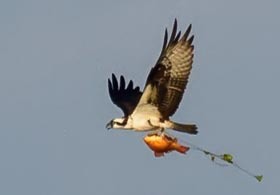 6/18 - Ulster County, HRM 91.5: I watched an osprey hunting the mud flats at Sleightsburg Spit this evening. It went down and got a large goldfish, but when the bird came back up it was tangled in water chestnut. After being pulled back down two or three times, the osprey managed to get away with the fish and flew up the river trailing long streamers of water chestnut behind. [Photo of osprey clutching goldfish and trailing water chestnut courtesy of Jim Yates.]
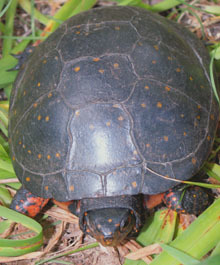 6/13 - Saugerties, HRM 102: I came upon a spotted turtle today coming from a stream and crossing Dutchtown Road. Its carapace length was just under four inches. At the same crossing, on both sides of road, were six or seven very large snapping turtle digs, some more than a foot long. However, I could not see any eggs in the nests. It is possible that the eggs were well hidden, or they had been raided by skunks or raccoons. [Photo of spotted turtle courtesy of Dan Marazita.}
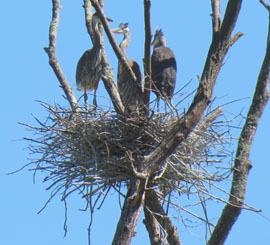 6/15 - Bedford, HRM 35: The wing feathers of the juveniles at the great blue heron rookery were still growing and they seemed to be continually flapping their wings and preening. For the most part they were showing patience waiting for food to arrive. As their bills grow longer and their body proportions mature, they will begin to look like smaller versions of their parents. [Photo of young great blue herons in nest courtesy of Jim Steck.]
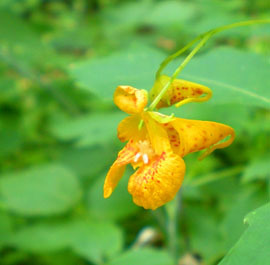 6/17 – Inwood Hill Park, HRM 13.5: “Sumer is icumen in!” Along the inlet of Spuyten Duyvil Creek, curly dock was now fruiting, red and white mulberries were ripening, yam-leaved clematis, white sweet-clover, triangle orache were leavy [archaic word, but lovely], and field bindweed had its first blossoms. False indigo was budding, and the saltwater cordgrass was knee-high. The little patch of horse nettle had abruptly filled out and flowered (it’s really a nightshade; the flowers, except for color, are just like tomato flowers). In the Clove, jewelweed had its first lovely blossoms and clearweed was coming up. Up on the ridge, everything was in full leaf, creating a sense of deep woods. Common enchanter’s-nightshade, motherwort and the bedstraw, called cleavers, were much more extensive than in past years; where there were three or four field garlic plants, there were now three dozen. I saw no stinging nettle. Most striking was that the day-lilies were suddenly resplendent in big patches, with a few white fleabanes for contrast and just one anise-root plant. Herb-Robert and celandine were blooming and false Solomon’s seal had berries. Honeysuckle had blossoms but the lilac bush at the Overlook was already finished. [Photo of jewelweed blossom courtesy of Thomas Shoesmith.]