
Hudson River Almanac 5/22/16 - 5/28/16
The New York State Department of Environmental Conservation sent this bulletin on 06/03/2016 05:21 PM EDT |
| DEC Delivers - Information to keep you connected and informed from the NYS Department of Environmental Conservation |
| Share or view as a web page || Update preferences or unsubscribe |
|
|
|
This week was filled with tales of nestlings, ducklings, and colorful male and gravid female fishes, all signs of the season. HIGHLIGHT OF THE WEEK
[Observational records of bird and mammal species have been kept for the Huntington Wildlife Forest since the SUNY College of Environmental Science and Forestry acquired the property in 1932. There was no record of either a Baltimore oriole or a red-bellied woodpecker in those observations. I looked on e-bird and found nothing there for the oriole and only one other observation of a red-bellied in Newcomb, one that I saw in April of 2012. Charlotte Demers.]
NATURAL HISTORY NOTES 5/22 - Town of Poughkeepsie: The nestling in bald eagle nest NY62 was 57 days old today. Mom spent much time today with her nestling and we watched her feed it several times. The nestling was getting big and rambunctious. It will not be long before the young eagle tries out its new wings, exploring the nest tree with short hops, jumps, and mini-flights. [Bald eagles in our area fledge, or take their first flight after hatching, between days 72-90 on average. Offspring of this pair, in their first 15 years of nesting, have averaged 79.6 days. For this nestling, that figures out to be sometime between June 5 and June 23, with the average falling on June 13. Tom Lake.] 5/22 - Town of Wappinger, HRM 67: It had been eight years since I last had a red fox family under my tool shed. In April 2008, a female and her two kits delighted us before she moved them off into the woods. She had four kits the previous year (2007) in a close-by compacted brush pile maternity den. Today, a female red fox (I assume a different family) emerged from under the shed with three kits that were big enough for me to think they will be leaving soon. 5/23 - Palisades, HRM 23: I saw my first five-lined skink of the season this morning at the Lamont Doherty Earth Observatory. It crawled out of a crack in the concrete steps to sun itself. It was an adult so it did not have the diagnostic blue tail of the immatures. [Five-lined skinks (Plestiodon fasciatus) are small lizards. As reptiles, skinks have limited physiological means of maintaining a constant body temperature and often favor sunny, rocky places to warm up. The bright blue tail of the immatures may serve as a survival strategy: Predators grabbing the skink by its colorful tail will find that it breaks off. The skink escapes and eventually regenerates another. Tom Lake.] 5/23 - Manhattan, HRM 1: Today, from The River Project’s fish traps at our sampling station on the lighthouse tender Lilac at Pier 25, we caught one each of four interesting and resident fishes: grubby, oyster toadfish, blackfish (tautog), and black sea bass. [On June 4 at Pier 25, the River Project’s educators will be leading one of 15 Great Fish Count programs offered in the NYC metro area by the World Science Festival in partnership with DEC’s Hudson River Estuary Program and the Lamont-Doherty Earth Observatory of Columbia University. For a listing of all the sites, check out the calendar below. Steve Stanne.] 5/24 - Albany County: I spent some time today watching five white-winged scoters and several common loons on Alcove Reservoir. The scoters were all far out but after some observation I could make out the head shape and white eye spot, and several times they stretched their wings showing off their bold white wing spots. [White winged scoters (Melanitta fusca) are often called “sea ducks.” This species is the largest of the three scoters in our area, the others being black scoter and surf scoter. Scoters are Arctic breeders and are seen in the watershed almost exclusively in migration. Their presence reminds us how we are connected to faraway places by the Hudson River flyway. Tom Lake.] 5/24 - Town of Coeymans, HRM 133: I was driving home just north of Stanton Pond, having already spotted two greater yellowlegs on a little mud flat, when a large furry mammal ran across the road. At first I thought it was the biggest dog I have ever seen, but the small tail and overall appearance gave it away. It was a black bear and it quickly ran down the hill and into the woods. 5/24 - Clinton Point, HRM 69: An early morning downpour beat a monotonous symphony on our hard hats (required by Tilcon Industries for seining at Clinton Point). While our seine haul was unremarkable, it did define the season: We caught more than a hundred each of banded killifish 54-108 millimeters [mm] long and spottail shiners. Females of both species were gravid (with eggs) and the male banded killifish were resplendent in their breeding colors. A few yearling striped bass (118 mm) were mixed in. The river was 63 degrees Fahrenheit; surprisingly, the water exiting the Casperkill (from Cobalt Lake) was warmer at 65. 5/25 - New Scotland, HRM 143: I watched some interesting behavior in our backyard today. A crow had been walking around, as they often do, looking for food. A cottontail rabbit chased the crow away from a certain area each time it approached. We are guessing that the cottontails may have had a nest of young nearby. It was amazing watching the bunny really go after the crow until it finally flew off. 5/25 - Rosendale, HRM 84: This evening’s summer-like weather compelled us to stop while crossing Saint Peter’s Bridge over the Rondout Creek. A hen common merganser was swimming downstream below us, followed by her 15-20 ducklings. She led them to a rocky beach where they all went ashore to investigate.
[In a world often overflowing with alien, invasive species, we often speak of “native species” as a counterpoint. When we ask students what we mean by native, we get all the right answers, such as “it has always been here.” But always is an inexact word. Since the Hudson Valley was covered with more than a mile of ice 20,000 years ago (no one was home), perhaps a better measure is to ask “Was the plant, bird, fish, flower, or mammal here when the first Europeans arrived?” If so, it is native; if not it was introduced later on, thus nonnative. Tom Lake.] 5/25 - Westchester County, HRM 51: As I hiked the Muscoot Farm Trail, I admired and photographed the usual wildflowers and chipmunks and, as I passed by a pond, I noticed that pumpkinseed sunfish were beginning to claim their nesting spots in the warming shallow areas. Later, by a rocky area, I spotted a black racer snake, about five feet long. 5/25 - Bedford, HRM 35: The nestlings at the great blue heron rookery were growing quickly; some I would judge to be about the size of a bantam chicken. The number of nestlings ranges from two to four per nest. I watched an adult fly in and feed the young. Herons do not feed bill-to-bill as other birds do, but rather regurgitate partially digested food into the bottom of the nest for the nestlings to feed. Some of the nests did not have a guardian and the nestlings were left alone while the adults were off hunting. Even though the nestlings are getting larger, they still are vulnerable to predators. One nest had a pair of red-tailed hawks perched on the rim. I did not see any nestlings so there was a strong possibly they were lost to the hawks. 5/25 - Manhattan, HRM 2: We checked the river chemistry at The River Project’s site on Pier 40 in midday and found the salinity to be 17.0 parts-per-thousand [ppt] - about half the strength of seawater; dissolved oxygen to be 4.8 parts-per-million [ppm], and the water temperature to be 60 degrees F. 5/26 - Valatie, HRM 129: I came upon a family of hooded mergansers today where the Valatie Kill joins Kinderhook Creek. There was mama and her ten ducklings, following her downstream where these tributaries eventually join Stockport Creek and then meet the Hudson River. Family responsibilities were left to the female as the male was nowhere in sight. 5/26 - Kowawese, HRM 59: This is the season when we wait for our sampling seines to fill with young-of-the-year fishes. Most of them are still upriver as eggs or larvae. If will be another month before they begin to show and give us an idea of how well the spawning season went. So we enjoyed the summer-like air (90 degrees F, just one degree from tying the record for the date) and the warming late-spring water (64 degrees F). At least half of the dozens of spottail shiners in our net were females with eggs. [Even though the spottail shiner (Notropis hudsonius) is found throughout the Great Lakes, it could be called the Hudson River fish. All known biological organisms on earth have a scientific name, usually Latin, Greek, or a combination of the two. Following the protocol for naming a fish, spottail shiners were described and named by De Witt Clinton in 1824, between his two terms as governor of New York State (1817-1823, 1825-1828). Clinton provided a detailed physical description of the spottail shiner and delivered it to the forerunner of the International Committee for Zoological Nomenclature (founded in 1895). They determined that this was a new species and accepted his name Clupia hudsonius (Clupea, Latin for a herring-like fish, and hudsonius in honor of the Hudson River). After several revisions in taxonomy and changes in genus assignment, New York State Ichthyologist J.R. Greeley settled on Notropis hudsonius (1935). Tom Lake.]
[Red-jointed fiddler crabs (Uca minax) are found along the eastern shore of North America, from Cape Cod south to Florida, and along the Gulf coast. They live in the intertidal areas of muddy or sandy beaches that are exposed at low tide. Each fiddler crab digs its own burrow and they can be as much as two feet deep. The male red-jointed fiddler crab has one large claw (it appears to some as a “fiddle,” and it can be either the left or right claw), and one relatively small claw. The female fiddler crab has two normal-sized claws. Until storm tides made their habitat unsuitable, Terry Milligan monitored a fiddler crab colony in a catch basin of the Edgewater (NJ) Commons Mall for ten years (2001-2010). Fiddler crabs have been reported in the Almanac as far upriver as Constitution Marsh (river mile 52). Tom Lake.] 5/26 - Manhattan, HRM 2: We checked the river chemistry at The River Project’s site on Pier 40 in midday and found the salinity to be 13.0 ppt, dissolved oxygen 5.6 ppm, and water temperature 65 degrees F. 5/27 - North River, HRM 263: It was almost 90 degrees F yesterday, three weeks after a freezing 29 degrees and considerable snow. Today our thistle feeder was crowded with house finches and goldfinches. One enterprising goldfinch went to the hummingbird feeder to investigate, looking like he wanted a drink. 5/27 - Cohoes, HRM 158: I heard both cuckoo species (black-billed and yellow-billed) calling at Cohoes flats in the late morning. The water level in the Mohawk was down and there were several semipalmated plovers, least sandpipers, and at least one semipalmated sandpiper working the rocks. 5/28 - Albany - The air temperature reached 93 degrees F today, tying the record high for the date. 5/28 - Greene County: On a very warm afternoon, I paddled over to take a look at bald eagle nest NY203. The parents were on nearby trees, watching the river. Last week I saw a single nestling, but thought there may have been more. This week my thoughts were confirmed: two nestlings calmly waiting for their next meal. 5/28 - Poughkeepsie -The air temperature reached 94 degrees F today, tying the record high for the date. 5/28 - Town of Poughkeepsie: In stifling heat and humidity (fourth day in a row at 90 degrees F or higher) the nestling in bald eagle nest NY62 was high in the nest panting like a puppy and trying to catch a breeze. The eaglet was 63 days old today. SPRING 2016 NATURAL HISTORY PROGRAMS Saturday, June 4: World Science Festival Great Fish Count Saturday, June 18: 11:00 AM - 2:00 PM HUDSON RIVER MILES The Hudson is measured north from Hudson River Mile 0 at the Battery at the southern tip of Manhattan. The George Washington Bridge is at HRM 12, the Tappan Zee 28, Bear Mountain 47, Beacon-Newburgh 62, Mid-Hudson 75, Kingston-Rhinecliff 95, Rip Van Winkle 114, and the Federal Dam at Troy, the head of tidewater, at 153. The tidal section of the Hudson constitutes a bit less than half the total distance – 315 miles – from Lake Tear of the Clouds to the Battery. Entries from points east and west in the watershed reference the corresponding river mile on the mainstem. TO CONTRIBUTE YOUR OBSERVATIONS OR TO SUBSCRIBE Smartphone app available for New York outdoor enthusiasts! Copies of past issues of the Hudson River Almanac, Volumes II-VIII, are available for purchase from the publisher, Purple Mountain Press, (800) 325-2665, or email purple@catskill.net |
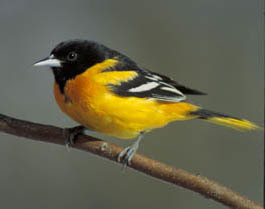 5/23 - Newcomb, HRM 302: There were two “firsts” for me this week. Yesterday a Baltimore oriole came to my hummingbird feeder. He pulled the ant guard off of the feeder and attempted to drink from it. I put two cut oranges on the ground near the feeder and moments later he was pulling at the oranges. Today, I saw a red-bellied woodpecker on a wooden flag pole. It was a brief look, and then he was gone. Looking back at 80 years of observations, it appears to be one of the first records of the species in this area. [Photo of Baltimore oriole by Dave Brezinski courtesy of U.S. Fish and Wildllife Service.]
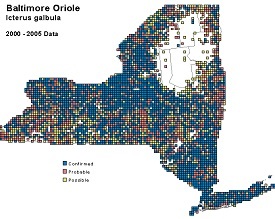 [Surprising as it may seem to Almanac readers in the Hudson Valley, where Baltimore orioles are common, the species is largely missing from the higher elevations of the Adirondacks. The 2000-2005
 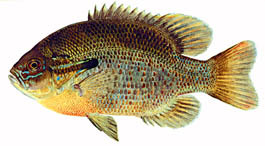 5/25 - Norrie Point, HRM 85: Seventh graders from Wappingers Junior High helped us seine the river in a challenging low tide. The lack of inshore water seemed to signal the fish to move offshore and our catch was meager. A sign-of-the-season persisted however, as we caught many breeding banded killifish as well as a few gorgeous male red-breasted sunfish in their orange breeding colors. Along with white perch and tessellated darters, our entire catch was comprised of native species. The river was 63 degrees F. [Painting of red-breasted sunfish from DEC files.]
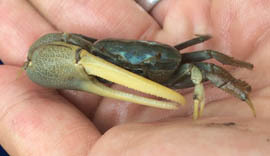 5/26 - Inwood Hill Park, HRM 13.5: I was on the little footbridge by the inlet of Spuyten Duyvil Creek, looking down at some small fish when I saw movement on a tiny patch of bottom. It turned out to be at least three fiddler crabs, the first I had seen here. When I looked at my photo later, I saw two more fiddler crabs and a hermit crab, also a first. [Photo of fiddler crab courtesy of Peter Park.]
|
The New York State Department of Environmental Conservation respects your right to privacy and welcomes your feedback. | Update preferences or unsubscribe. | Learn more about DEC Delivers. |
|
Connect with DEC:   
|
 |
| NOW AVAILABLE: Receive DEC's Twitter feed via email. | |
| Andrew M. Cuomo, Governor * Basil Seggos, Acting Commissioner | |