|
OVERVIEW
It is not often that we have a birthday party for a bald eagle, but in the case of the banded female bald eagle N42 from nest NY62, it was warranted. Her longevity and productivity gives testimony to the amazing recovery of the species in the Hudson River watershed, from our first nestling fledged in 100 years (Greene County 1997) to more than three dozen nests today. Fish aficionados in the greater New York CIty area should check out the schedule for the World Science Festival Great Fish Count coming up on June 4; check out the listing at the end of the natural history observations.
HIGHLIGHT OF THE WEEK
5/21 - Town of Poughkeepsie: Two dozen monitors of bald eagle nest NY62 (“The Soul of NY62”) gathered to celebrate the nest’s female (Mama) who turned 21 years-old this spring. Several times throughout the day she and her mate made flyovers as we ate birthday cake and saluted her with coffee and marshmallow peeps (her current nestling, 55 days old today, was born on Easter Sunday and dubbed “Peep”). This was breeding year 16 for Mama and her mate from three different nests. The first two were in the Town of Wappinger and the current nest is in the Town of Poughkeepsie. Across those 16 years she and her mate will have fledged 16 nestlings.
- Tom McDowell, Bob Rightmyer, Debbie Quick, Tom Lake, T.R. Jackson
[Mama, the female in bald eagle nest NY62, was born in 1995 as one of three nestlings fledged from a nest (NY20-Tusten) on the Delaware River just below Narrowsburg in Sullivan County. She has a blue band (N42) on her left ankle and a silver U.S. Fish & Wildlife band on her right ankle. Her mate of sixteen years is not banded and is thought to be a Canadian bird. Tom Lake.]
NATURAL HISTORY NOTES
5/15 - Troy, HRM 152: I use a regular mix of black oil sunflower seed with a handful of cracked corn to provide variety to the nuthatches, cardinals, and blue jays. Today this offering attracted an indigo bunting, only the second one we’ve had in 38 years. He went right for the sunflower tube feeder. Although we've had two male ruby-throated hummingbirds for a while, today the first female showed up.
- Heidi Klinowski, Hudson-Mohawk Bird Club
5/15 - Esopus Meadows, HRM 87: This evening I took a walk to the water trail pavilion to sit a while with my camera, hoping to catch an osprey or eagle fishing. It rained a bit and then the sun came out with a beautiful rainbow. It stretched a mile end-to-end and it was the first one where I could see the entire rainbow. Both ends touched down in the river and perfectly framed the Mills Mansion. A half-moon appeared right above the top of the rainbow and two cormorants and an eagle flew thru it. I sat there wondering if I was the only person to see it.
- Jim Yates
5/15 - East Fishkill: A month ago we investigated a new bald eagle nest (Wicopee-NY401) 95 feet up in a 115 foot-high white pine. It was small and likely a first-year nest. The adults were hanging around - they had a rousing encounter with a red-tailed hawk - but have not been seen recently. This leads us to believe that an attempt at breeding was unsuccessful (not uncommon for new adults). We will look for them to return late next winter to make another attempt.
- John Basile, Tom Lake
5/16 - Croton River, HRM 34: From sightings at Black Rock Park on the Croton River, situated a little more than a mile from the Hudson River, a haiku:
Loon fishing Black Rock
Orioles on sunny perch
Bald eagle above
- Bradley Shields
5/16 - Manhattan, HRM 1: From the River Project’s killifish traps at their sampling station on the lighthouse tender Lilac at Pier 25 in Hudson River Park, we caught a black sea bass 65 millimeters [mm] long and a grubby (75 mm). Salinity was measured at 6.5 parts-per-thousand [ppt] and the water temperature was 58 degrees Fahrenheit.
- Jacqueline Wu
5/17 - Washington County, HRM 205: We counted 21 species on our bird survey today. Among the notables was an American avocet (also reported by Mona Bearor) walking with long strides through the edges of a pool on New Swamp Road, a willet, three short-billed dowitchers poking their long bills into the shoreline of the shallow pools, and two greater yellowlegs.
- Nancy Kern, Debbie Shaw, Naomi Lloyd, Hudson-Mohawk Bird Club
5/17 - Town of Bethlehem, HRM 141: On Delaware Avenue near the Bethlehem High School, we spotted a sandhill crane fly over, mouth open and probably calling.
- Alan Mapes, Mona Bearoe, Hudson-Mohawk Bird Club
5/18 - Greene County: NY203. The river was very flat on the ebb tide as I paddled over to check on bald eagle nest NY203. One of the adults was in the nest tree and the second one was perched nearby on a limb over the river. The latter had a silver band (U.S. Fish & Wildlife Service) on its right leg and a blue band (NYSDEC) on its left leg. Was this the female? I hung out at a fair distance for 45 minutes and the birds didn't seem to mind. Later, I saw both birds on the rim of the nest leaning in with their heads out of sight. Feeding a nestling?
- Kaare Christian
[Bald eagles were de-listed from the U.S. Fish & Wildlife’s endangered-threatened list in 2007. Prior to 2007, DEC would band as many nestlings as possible each spring. However, discerning sex was problematic: Pete Nye would try to determine sex by morphometric measurements, and in the case of flighted birds, he used a formula based on measurements of the length of the hallux (the “toe” extending to the rear of the eagle’s foot), the length of the culmen (the upper margin of its bill), and the depth of the bill. Basically, the longer the bill and the deeper/wider it is, and the longer the hallux, the more likely it is that the bird is a female. Tom Lake.]
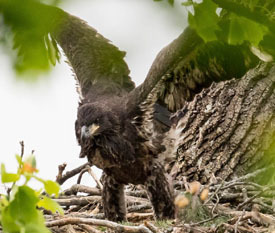 5/18 - Town of Poughkeepsie: The NY62 eagle nestling dubbed “Peep,” 52 days old and now about half the size of the adults, was looking more like an eagle every day. It had begun to flap its wings and hop around. Perched at the edge of the nest looking out to the river, the youngster already had that look of being in charge. In three more weeks we will look for a fledge. [Photo of young eagle flapping its wings in its nest courtesy of John Badura.] 5/18 - Town of Poughkeepsie: The NY62 eagle nestling dubbed “Peep,” 52 days old and now about half the size of the adults, was looking more like an eagle every day. It had begun to flap its wings and hop around. Perched at the edge of the nest looking out to the river, the youngster already had that look of being in charge. In three more weeks we will look for a fledge. [Photo of young eagle flapping its wings in its nest courtesy of John Badura.]
- John Badura
5/18 - Hammond’s Point, HRM 60: With some favorable light from the setting sun, I was able to confirm that there were two nestlings in bald eagle nest NY313. They appear to be crow-size. The setting, adjacent to Denning’s Point bay and the Fishkill Creek delta, is one of the most perfect locations for a nest.
- Bill Way
[Eagle nest NY313 had two fledglings in 2014 as well. However, we were never able to discern if they had any last year (2015). Jesse Jaycox.]
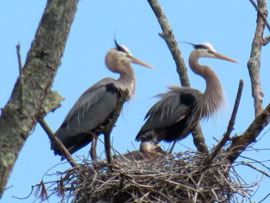 5/18 - Bedford, HRM 35: The nestlings at the great blue heron rockery were becoming more visible as they got bigger. I would estimate that the nestlings are a bit larger than robins and will be growing rapidly. It is not possible to see them all yet, but in some nests I could see two, and at another I could see three nestlings. One nest had both parents present while the others had a single bird looking after the nestlings while the other was out hunting. [Photo of great blue herons in nest courtesy of Jim Steck.] 5/18 - Bedford, HRM 35: The nestlings at the great blue heron rockery were becoming more visible as they got bigger. I would estimate that the nestlings are a bit larger than robins and will be growing rapidly. It is not possible to see them all yet, but in some nests I could see two, and at another I could see three nestlings. One nest had both parents present while the others had a single bird looking after the nestlings while the other was out hunting. [Photo of great blue herons in nest courtesy of Jim Steck.]
- Jim Steck
5/18 - Manhattan, HRM 1: From the River Project’s killifish traps at their sampling station on the lighthouse tender Lilac at Pier 25 in Hudson River Park, we caught two “pregnant” male seahorses (70, 95 millimeters). In our crab pot was another seahorse, this one a female (175 mm). Salinity was measured at 13.0 ppt and the water temperature was 57 degrees F.
- Jacqueline Wu
5/19 - Warrensburg, HRM 207: A weasel came around the corner of my garage early this morning, holding a mouse in its mouth. It was the size of a small red squirrel with a long grayish sleek body and white fur on its chest. It carried its meal under Warrensburg Road to a spring-fed creek that flows into the Hudson River.
- Pete Lochmann
[Pete’s visitor was likely a short-tailed weasel (Mustela erminea). Jesse Jaycox.]
5/19 - Kowawese, HRM 59: A soft breeze coming up through the Hudson Highlands at first light had a modest chop breaking on the beach. The water felt as warm as the air (58 degrees F) as our seine slid smoothly through the shallows. While the catch - tessellated darters, white perch, spottail shiners, and small eels - was quite ordinary, the pink and blue sunrise over the fire tower on South Mountain Beacon was extraordinarily gorgeous.
- Tom Lake, A. Danforth
5/19 - Crugers, HRM 39: While riding past Ogilvie’s Pond this afternoon, I noticed a short, stocky bird sitting near the spillway. With its pale grey and white body, it looked somewhat like a small penguin! Closer observation revealed the long white plumes on the head of a beautiful black-crowned night heron. I returned to the pond later in the day hoping for another glimpse, and was instead treated to the sight of the resident great blue heron.
- Dianne Picciano
5/19 - Croton Point, HRM 34: I listened to four male bobolinks at dawn as I watched their colors flashing; they were busily enforcing their territories. And oh, that wonderful, ethereal, bubbling song! Out on Croton Bay I spotted a couple of male common mergansers. They are common in winter but this is the latest in the season I have seen them here.
- Christopher Letts
5/20 - Cohoes, HRM 158: I counted four short-billed dowitchers on the Cohoes Flats today, as well as two brant and eight semipalmated plovers.
- Larry Alden, Hudson-Mohawk Bird Club
[On May 19 last year, Frank Mitchell counted an Albany County record of 60 short-billed dowitchers at Stanton Pond. Tom Lake.]
5/20 - Delmar, HRM 143: This evening on the Delmar by-pass road (Route 32), I spotted seven geese in flight, two of which were snow geese.
- Barb Beebe, Hudson-Mohawk Bird Club
5/20 - Poughkeepsie, HRM 75.5: More than 175 researchers, teachers and students gathered at the Mid-Hudson Children's Museum in Poughkeepsie to celebrate the end of the 2016 glass eel season in the Hudson River estuary. The net of our nine-year-long sampling program now totaled more than 400,000 glass eels captured, documented, and released. From a modest beginning of 2,388 glass eels in 2008, the numbers had increased to 104,942 glass eels from ten sites in 2016. While the glass eel numbers were undeniably increasing, so were the efforts, skill, and dedication of our student scientists.
- Chris Bowser
5/20 - Town of Poughkeepsie: An eagle carrying a river herring flew in from the north like an arrow, directly into bald eagle nest NY62. By behavior alone, we could be quite certain that this was the female of the mated pair. If it had been the male, he likely would have lingered along the way, perhaps sampling the meal. Mama (N42) had come from the direction of the Casperkill at Clinton Point, where alewives were spawning.
- Tom Lake, Dana Layton
5/20 - Piermont, HRM 25: A low tide brought a nice assortment of creatures into the net for students from the Manhattan Center for Math and Science. Among them was an American eel (210 mm), a palm-sized hogchoker, an immature winter flounder, several male mummichogs in breeding colors with bright yellow abdomens, six northern pipefish, an immature striped bass, and a tiny naked goby. Salinity was 6.0 ppt and the water temperature was 60 degrees F.
- Margie Turrin
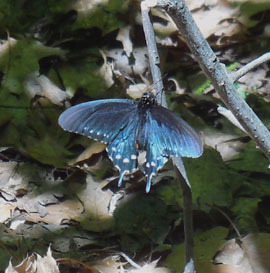 5/20 – Inwood Hill Park, HRM 13.5: In the Clove, where Dutchman’s breeches had been abundant, even their foliage was gone, as were lesser celandine flowers, but jewelweed foliage was knee high. Up on the ridge the “true” celandine was blooming and wild geranium was scattered through the woods. A horse-chestnut in bloom made a bright spot off in the trees. Garlic mustard flowers, though pretty, were too plentiful - they’re invasive and everywhere. The tiny blue flowers of Veronica, the white flowers of cleavers, and the slightly larger chickweed flowers were lovely. Kenilworth ivy was now blooming with little bi-symmetrical flowers. The species name, Cymbalaria muralis, translates as “a plant that grows on walls,” and so it does. False Solomon’s seal was fully leafed and budding. A pipevine swallowtail landed in a sunny spot on the path; after a moment another flew near and they took off together, circling each other. Less than a minute later a mourning cloak landed on the same sunny patch and, to my surprise, the same thing happened. That seemed to be a prime pickup spot! [Photo of pipevine swallowtail courtesy of Thomas Shoesmith.] 5/20 – Inwood Hill Park, HRM 13.5: In the Clove, where Dutchman’s breeches had been abundant, even their foliage was gone, as were lesser celandine flowers, but jewelweed foliage was knee high. Up on the ridge the “true” celandine was blooming and wild geranium was scattered through the woods. A horse-chestnut in bloom made a bright spot off in the trees. Garlic mustard flowers, though pretty, were too plentiful - they’re invasive and everywhere. The tiny blue flowers of Veronica, the white flowers of cleavers, and the slightly larger chickweed flowers were lovely. Kenilworth ivy was now blooming with little bi-symmetrical flowers. The species name, Cymbalaria muralis, translates as “a plant that grows on walls,” and so it does. False Solomon’s seal was fully leafed and budding. A pipevine swallowtail landed in a sunny spot on the path; after a moment another flew near and they took off together, circling each other. Less than a minute later a mourning cloak landed on the same sunny patch and, to my surprise, the same thing happened. That seemed to be a prime pickup spot! [Photo of pipevine swallowtail courtesy of Thomas Shoesmith.]
- Thomas Shoesmith
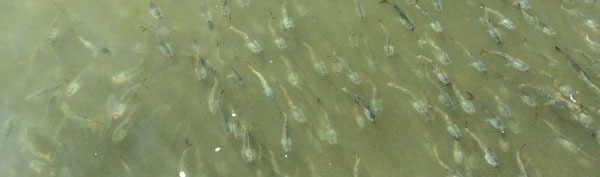
5/20 - Manhattan, HRM 2-1: The striped bass were running! In the last few days, we have seen schools of adult Atlantic menhaden passing by Piers 25 and 40. Today, a huge, tightly packed school off Pier 25 attracted striped bass. Chasing the menhaden, the bass repeatedly broke the surface and then immediately turned back into the water. We counted as many as seven of these explosions every minute while the menhaden were there. [See banner photo of school of Atlantic menhaden, courtesy of Jacqueline Wu.]
- Jacqueline Wu
5/21 - Cohoes, HRM 158: Yesterday’s short-billed dowitchers appeared to have left, but in their place was a snowy egret splashing around in the shallows near Peebles Island, its yellow feet visible. An American pipit was hanging out with two dozen least sandpipers, two semipalmated plovers, and one spotted sandpiper.
- Susan Beaudoin, Hudson-Mohawk Bird Club
5/21 - Town of Poughkeepsie, HRM 70-69: One of the signs of the waning spring season is the appearance of dame’s rocket (Hesperis matronalis) in the uplands and along the river and its tributaries. This naturalized wildflower, native to Eurasia and brought to North America in the 17th century, comes in white, pink, violet, and purple. Carried by spring breezes, its wonderfully sweet fragrance fills the air from mid-May through early June.
- Tom Lake, T.R. Jackson
5/21 - Yonkers, HRM 18: A group of enthusiastic World Science Festival Academy science students descended on the Sarah Lawrence Center for Urban Research at Beczak in preparation for the WSF Great Fish Count on June 4. The group spent the afternoon exploring fish diversity and the river offered a nice array: American eels, northern pipefish, five immature Atlantic tomcod, many immature blue crabs, and an assortment of mummichogs, striped bass, Atlantic silverside, and comb jellies. The salinity was 7.0 ppt.
- Vicky Garufi, Steve Stanne, Alyson Tockstein, Margie Turrin
SPRING 2016 NATURAL HISTORY PROGRAMS
Saturday, June 4: World Science Festival Great Fish Count
Educators from DEC’s Hudson River Estuary Program and Region 2 will join partners from the Lamont-Doherty Earth Observatory and other environmental education groups at multiple sites to show visitors a sample of the variety of slippery, wriggly, and fascinating creatures usually hidden below the surface of estuarine waters around New York City. These programs are free. Visit the World Science Festival’s Great Fish Count website for more information.
Manhattan
• Lower East Side Ecology Center: angling 2:00 - 4:00 PM at the East River Park Fire Boat House
• The River Project: fish and crab traps 12:00 - 2:00 PM at Steamship Lilac, Hudson River Park Pier 25 at West St & North Moore St
• Hudson River Park Trust: angling 1:00 - 4:00 PM on Pier 84 at 12th Ave & 44th St
• Fort Washington Park: seining 2:00 - 4:00 PM just south of Little Red Lighthouse
• Inwood Hill Park: seining 10:30 AM - 12:30 PM in Washington Heights at West 218 St & Indian Rd
• Randall’s Island Park: seining 2:00 - 4:00 PM on the Harlem River just north of 103rd St pedestrian bridge
Brooklyn
• Brooklyn Bridge Park: seining 2:30 - 3:30 PM at 99 Plymouth St; beach under Manhattan Bridge
• Valentino Pier: seining 1:30 - 3:30 PM at end of Coffey St, Red Hook
• Kaiser Park: seining 10:00 AM - 12:00 PM near Bayview & 33rd St, Coney Island
Queens
• Frank Charles Park: seining 2:00 - 4:00 PM near 98th St & 165th Ave, Howard Beach
• Gantry State Park: angling 10:00 AM - 12:00 PM on the East River, at 49th St & Center Blvd, Long Island City
Staten Island
• Lemon Creek Park: seining 1:00 - 3:00 PM at Seguine Point, Prince’s Bay
Bronx
• Concrete Plant Park: seining 2 - 4:00 PM off Bruckner Blvd at west end of Bronx River Bridge
Yonkers
• Sarah Lawrence Center for the Urban River at Beczak: seining 2:00 - 4:00 PM at 35 Alexander St, 1 block from Yonkers Metro North Station (Hudson Line)
New Jersey
• Englewood Boat Basin: seining 2:00 - 4:00 PM in Palisades Interstate Park, Englewood
HUDSON RIVER MILES
The Hudson is measured north from Hudson River Mile 0 at the Battery at the southern tip of Manhattan. The George Washington Bridge is at HRM 12, the Tappan Zee 28, Bear Mountain 47, Beacon-Newburgh 62, Mid-Hudson 75, Kingston-Rhinecliff 95, Rip Van Winkle 114, and the Federal Dam at Troy, the head of tidewater, at 153. The tidal section of the Hudson constitutes a bit less than half the total distance – 315 miles – from Lake Tear of the Clouds to the Battery. Entries from points east and west in the watershed reference the corresponding river mile on the mainstem.
TO CONTRIBUTE YOUR OBSERVATIONS OR TO SUBSCRIBE
The Hudson River Almanac is compiled and edited by Tom Lake and emailed weekly by DEC's Hudson River Estuary Program. Share your observations by e-mailing them to trlake7@aol.com.
To subscribe to the Almanac (or to unsubscribe), go to DEC's Email Lists page, enter your email address, and click on "Submit." Fill in and submit the requested information on the “New Subscriber” page. This will take you to “Quick Subscriptions”. Scroll down; under the heading "Natural Areas and Wildlife" is the section "Lakes and Rivers" with a listing for the Hudson River Almanac. Click on the check box to subscribe. While there, you may wish to subscribe to RiverNet, which covers projects, events and actions related to the Hudson and its watershed, or to other DEC newsletters and information feeds.
The current year's issues are available at http://www.dec.ny.gov/lands/25611.html . To view older issues, visit the New York State Library's Hudson River Almanac Archive. If it asks you to login, click on "Guest." You may then need to reopen this page and click on the Almanac Archive link again to access the Almanac collection in the library's files.
Discover New York State Conservationist - the award-winning, advertisement-free magazine focusing on New York State's great outdoors and natural resources. Conservationist features stunning photography, informative articles and around-the-state coverage. Visit the Conservationist webpage for more information.
USEFUL LINKS
National Oceanic and Atmospheric Administration online tide and tidal current predictions are invaluable when planning Hudson River field trips.
For real-time information on Hudson River tides, weather and water conditions from twelve monitoring stations, visit the Hudson River Environmental Conditions Observing System website.
Information about the Hudson River Estuary Program is available on DEC's website at http://www.dec.ny.gov/lands/4920.html .
Smartphone app available for New York outdoor enthusiasts!
DEC, in partnership with ParksByNature Network®, is proud to announce the launch of the New York Fishing, Hunting & Wildlife App for iPhone and Android. This FREE, cutting-edge mobile app gives both novice and seasoned outdoorsmen and women essential information in the palm of their hands. Powered by Pocket Ranger® technology, this official app for DEC will provide up-to-date information on fishing, hunting and wildlife watching and serve as an interactive outdoor app using today's leading mobile devices. Using the app's advanced GPS features, users will be able identify and locate New York's many hunting, fishing and wildlife watching sites. They will also gain immediate access to species profiles, rules and regulations, and important permits and licensing details.
NY Open for Hunting and Fishing Initiative
Governor Cuomo's NY Open for Fishing and Hunting Initiative is an effort to improve recreational opportunities for sportsmen and women and to boost tourism activities throughout the state. This initiative includes streamlining fishing and hunting licenses, reducing license fees, improving access for fishing and increasing hunting opportunities in New York State.
In support of this initiative, this year's budget includes $6 million in NY Works funding to support creating 50 new land and water access projects to connect hunters, anglers, bird watchers and others who enjoy the outdoors to more than 380,000 acres of existing state and easement lands that have gone largely untapped until now. These 50 new access projects include building new boat launches, installing new hunting blinds and building new trails and parking areas. In addition, the 2014-15 budget includes $4 million to repair the state's fish hatcheries; and renews and allows expanded use of crossbows for hunting in New York State.
This year's budget also reduces short-term fishing licenses fees; increases the number of authorized statewide free fishing days to eight from two; authorizes DEC to offer 10 days of promotional prices for hunting, fishing and trapping licenses; and authorizes free Adventure Plates for new lifetime license holders, discounted Adventure Plates for existing lifetime license holders and regular fee Adventure Plates for annual license holders.
Copies of past issues of the Hudson River Almanac, Volumes II-VIII, are available for purchase from the publisher, Purple Mountain Press, (800) 325-2665, or email purple@catskill.net
|