
Hudson River Almanac 5/8/16 - 5/14/16
The New York State Department of Environmental Conservation sent this bulletin on 05/20/2016 05:54 PM EDT |
| DEC Delivers - Information to keep you connected and informed from the NYS Department of Environmental Conservation |
| Share or view as a web page || Update preferences or unsubscribe |
|
|
OVERVIEW This was the week when brant – small geese – began their spring migration to breeding grounds to the far north. Many birds, from eagles to wood ducks to great blue herons, were tending to their broods.
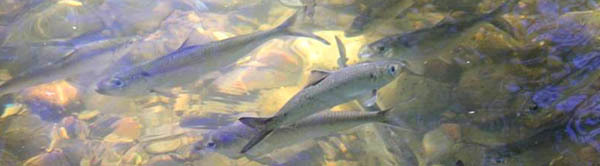
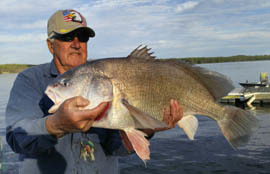
5/10 - Coxsackie, HRM 124: Fishing for striped bass using a river herring rig with heavy monofilament line (14 pound test), I hooked, fought, and landed a huge freshwater drum. I did not weigh it before releasing it but it measured 33 inches long [estimated weight 15 pounds]. [Photo of freshwater drum courtesy of Jerry Bender.] NATURAL HISTORY NOTES 5/8 - Poughkeepsie, HRM 75.5: The students, teachers, and parents of Wappingers Middle School gathered for some Mother’s Day superlatives! First, the Fall Kill was STACKED with migrating river herring, bank-to-bank, thousands of beautiful silvery fish making their way under the footbridge and up to the falls where several anglers were jigging them out, presumably for striped bass bait. It was also one of the highest tides we had seen at the eel fyke this season; we were barely able to reach the net at all. When we did open it up, we found a relatively small number of glass eels, a small tessellated darter, but thousands of tiny herring eggs, both inside the net in big clumps and outside the net, coating it like cake sprinkles. I had never before seen the combination of so much water, so many herring, and so many fish eggs. [See banner photo above of river herring, courtesy of Chris Bowser.] 5/8 - New Hamburg, HRM 67.5: After a week of rain (3.5 inches), the river was a curious shade of green and brown. We welcomed the first sun in many days from a high pressure system that also brought a strong west wind. We were at the river looking to pot some eels for an upcoming education program for fifth graders (show, tell, release). We baited our 90-year-old eel pot with a half-dozen alewives, eased it into the river, and hoped for the best. 5/9 - North River, HRM 263: At 3:45 AM snow was falling heavily outside my camp, elevation 1,587 feet. The air temperature was 34 degrees Fahrenheit (tonight’s forecast issued a freeze advisory). No ruby-throated hummingbirds yet and I can sense why. However, I heard a black bear calling; I believe they do vocalize by calling to other bears, although I may be in the minority with that idea. 5/9 - Greene County, HRM 112: I was sitting on the sunny stoop outside my kitchen door in West Kill this morning when the first hummingbird of the season buzzed me. It was a male with a brilliant red throat. Maybe it was my red bathrobe that drew him over, but I suspect it was one that knew I usually keep a feeder there. He kept buzzing me until I went inside and filled up a feeder and put it out for him. 5/9 - Crugers, HRM 39: We had not seen the resident great blue heron at Ogilvie’s Pond since late January. But as we approached in late afternoon we spotted the heron standing on the concrete wall on the side of the pond, a large orange fish dangling from its beak. Almost immediately the fish disappeared down its long neck. After its meal, it took a drink, shook out its feathers, and flew to a flat-topped tree on the opposite side of the pond. 5/9 - Bedford, HRM 35: I stopped by the great blue heron rookery today. At least 22 of the 25 nests were occupied, and five appeared to have feeding activity going on although fledglings could not be seen. A red-tailed hawk circled ominously over the rookery and a heron flew off of a nest and chased him away with much squawking and clacking.
5/10 - North River, HRM 263: The overnight air temperature fell to 29.8 degrees F and there was frost on my car. Much to my chagrin, our first ruby-throated hummingbird arrived this morning at 6:15. Poor little guy. Good thing their feeder was up and ready. 5/10 - Clermont, HRM 103.5: Our garden club had a good walk at the Clermont Historic Site this morning: scarlet tanager, lots of Baltimore orioles, and many warblers. The biggest surprise was seeing a Cooper’s hawk, a red-tailed hawk, and a Baltimore oriole all together in the same tree. The oriole had the good sense to leave. 5/10 - Norrie Point, HRM 85: A class of seventh graders from Wappingers Junior High helped us sample the river to see what fish were home today. On the tenth haul of our seine, our last one of the day, we finally moved beyond tessellated darters! As we opened the bag, glistening in the sunlight at the back of the net was a beautiful yearling smallmouth bass (110 mm). The students noticed something else squirming in the wet folds of the net. It was an eel, an eel of the size we call “shoe-string.” The water was 56 degrees F. [“Shoe-string” eel is a colloquial name often used by anglers to describe an 8-12 inch-long American eel. This is a highly effective size to live-line for striped bass. The DEC slot-size regulation for American eel as bait, downstream from the Federal Dam at Troy to the Battery at the southern tip of Manhattan Island, is 9-14-inches. Tom Lake.] 5/10 - Bedford, HRM 35: There were some soft vocalizations coming from the great blue heron rookery today. About one third of the nests had a heron standing and the rest had a heron settled down inside. At one of the nests an adult raised itself up several times and I could see two nestlings moving. The adults were not as deep in the nest now and were more visible. That would be a good indicator that they were giving room for nestlings. 5/10 - Croton Point, HRM 34: We did some seining at “Mother’s Lap” today with fifth graders from Friends Seminary School in Manhattan. The catch included spottail shiner, white perch, striped bass, and Atlantic menhaden (75-100 mm). Over the course of half a dozen hauls of the net, our largest single catch of menhaden was 25 fish. Salinity was 1.8 ppt. [Mother’s Lap" is a colloquial name for a small, sheltered cove on the north end of Croton Point. When commercial fishing was in its heyday in the mid-twentieth century, fishermen knew they could find refuge from wind and tide in this little bay as their nets worked offshore. In that regard, it reminded them of the calm and solace of sitting in “mother’s lap.” Tom Lake.] 5/10 - Manhattan, HRM 4: From our killifish traps at the River Project’s sampling station at Pier 40 in Hudson River Park, we caught one female northern pipefish about 150 mm long. 5/11 - Albany County, HRM 143: At least 600 brant flew over my house today, heading north along the Helderberg escarpment. 5/11 - Columbia County, HRM128: Paddling north in midday along the east bank of the Hudson a mile or so north of Stuyvesant, we saw a bald eagle in a tree in the distance. Coming closer, we saw that there were three other eagles on a higher branch. We inadvertently spooked three more that had been on the mud flats hidden in back of a seawall. Those three flew upriver and landed in trees. Paddling farther upriver, we could see that the three mud flat birds had joined others, increasing the count well beyond the seven we saw at first. Counting was difficult because some birds were flying from one tree to another. Six flew off toward the far shore but remained in sight. The “shore birds” stayed put for a few minutes allowing us to count eight in the trees, two of which were definitely adults. Overall, fourteen eagles, a mix of adults, sub-adults, and immatures in just about five minutes. 5/11 - Greene County, HRM127: We paddled past a pontoon boat where the anglers were celebrating a huge striped bass catch. Held with its head at about waist-high, the tail just touched the deck – “39 and a quarter inches” the fisherman claimed. “He's [she’s] going back in.” [With many rod-and-reel caught fish, especially one this large and with the river warming, it is highly advisable to gently rock the fish back-and-forth in the water, allowing the water to pour across its gills and help revitalize (aerate) it. This sometimes takes several minutes but it increases the chances that the fish will survive. Tom Lake.] 5/11 - New Hamburg, HRM 67.5: If you are patient and observe, the river often rewards you with a glimpse into the comings and goings of the natural world. I was leaving on the 5:33 AM Metro North commuter train to Grand Central. As I looked to the river, among the geese and cormorants in the bay, I saw a white-tailed deer head about 200 feet from the eastern shore. It is amazing how strongly they swim. [There are records of all sorts of animals making the swim across the river, including white-tailed deer, squirrels, woodchucks, and black bears. The reasons seem varied and include having been chased (deer) to seeking new territory (bears). John Mylod adds, “Squirrels in transit can ride a wake with skill and always keep their tails high and dry.” My most memorable encounter was a middle-of-the-night drift for shad, listening to loons vocalizing on the calm river, and seeing a black shape move silently past. It was spooky for a few seconds until I figured out it was a white-tailed deer. Tom Lake, Amanda Higgs, Chris Bowser.] 5/11 - Kowawese, HRM 59: The day was warm, the sky was blue, and the tide was perfect on the beach. All of that made the modest catch of our seine secondary. To the teachers, the spottail shiners, golden shiners, tessellated darters, and banded killifish, seemed ordinary. But through the eyes of the 105 fifth-graders from Lakeview Elementary in Mahopac, many of whom had never been to the river before, they were magic. Following a half-dozen hauls of the net, and the subsequent investigation of 50 fish by the students, we topped off the day with an eel race. [The eel race is held on a beach, preferably with a gentle slope to the water. Five-gallon buckets, a quarter-full of water, are lined up a short distance apart, parallel to and about ten feet from the water’s edge. An American eel (trained “racing eel”) is placed in each. A group of eager elementary school students are assigned to each entry. Competing groups can be boys/girls, teachers/students, blue eyes/brown eyes, earth signs/sun signs, or any other meaningful assemblage. The eels are given honorary names like Eelie, Slimy, Snakey, or Fred, which makes cheering much easier. At the chosen moment the buckets are slowly tipped over. The length of the race is a product of factors such as distance to travel, gradient of the beach, how well we watered the “race track,” wind velocity, barometric pressure, enthusiasm of the cheering fans, and the individual eel’s competitive nature. With luck, and about ten seconds, there is a winner. Today’s eels were named “Bull” and “Dog” (Lakeview mascot is the Bulldog). Both eels had a slow start, unsure which way to the river. Eventually, however, amidst the loud cheers of his fans, “Bull” slithered first into the swash. Tom Lake.] 5/11 - Rockland Country, HRM 29: We were getting off Rockland Lake after an early morning row when we surprised a female wood duck ushering her ten ducklings along the shoreline. The noise they made as they hurried away into the near shore vegetation was substantial; we were not sure if it was mom yelling at the kids, or the other way around. 5/11 - Manhattan, HRM 1: The daily catch from our killifish traps at the River Project’s sampling station on the lighthouse tender Lilac at Hudson River Park’s Pier 25 included another grubby (90 mm), a black sea bass (75 mm), and two more lined seahorses (65-70 mm). 5/12- Albany County, HRM 143: A flock of at least 300 brant, heading north, flew over the Black Creek Marsh Wildlife Management Area late this evening. 5/12 - Coeymans, HRM 133.5: Several huge flocks of brant – far more than a thousand – flew past this afternoon, headed north. 5/12 - Ulster County, HRM 91.5: For an hour this evening I watched a huge migration of brant, five flocks following one another, easily thousands, heading up the Hudson. [Waterman Dery Bennett used to mark the seasons by noting how brant left Sandy Hook, NJ, around Memorial Day after spending the winter, and headed north. In his words, “They would shove off for the Canadian Arctic where they breed, fledge young, and then return around Columbus Day.” Tom Lake.] 5/12 - Town of Poughkeepsie: Dad brought a white perch to eagle nest N62 today for the nestling, now 46 days old. He carefully helped the nestling tear the fish and feed, saving only the tail for himself.
5/13 - Catskill, HRM 113: The small colony of cliff swallows at Catskill Point was still active. There were three nests under construction on the east side of the historic warehouse building. From the number of birds swirling around, there will likely be a few more nests under construction pretty soon. 5/13 - Ossining, HRM 33: We seined the lower reach of Sing Sing Brook today in concert with a water quality study by Hudson Valley Arts and Sciences. At the mouth of the brook we collared a large school of Atlantic silversides (81-111 mm. A couple hundred feet upstream we caught a pre-juvenile striped mullet (young-of-the-year; 22 mm), mummichogs (44 mm) and yearling blue crabs (35 mm female; 27 mm male). The water was 57 degrees F and the salinity was 2.2 ppt. [Sixty-five years ago, legendary riverman Henry Gourdine of Ossining used to set fyke nets at the mouth of the Sing Sing Kill (Henry called it the “Kill Brook”) for rainbow smelt. In early spring, these anadromous fish would ascend the estuary’s to spawn. However, by the end of the 20th century, smelt had become uncommon and today they appear, by many accounts, to be extirpated in the estuary.John Waldman, professor of biology at Queens College, comments that their range is retreating northward: “They are essentially gone from Connecticut streams and are in decline in Massachusetts.” Tom Lake.] 5/13 - Manhattan, HRM 1: From the River Project’s killifish traps at their sampling station on the lighthouse tender Lilac at Pier 25, we caught three lined seahorses, a record number for us. One of them was 110 mm long! 5/14 - Saratoga County, HRM 177-165: We spent the morning birding areas of Saratoga County walking the Zim Smith trail in the Town of Halfmoon. Twice we heard a black-billed cuckoo calling fairly close to the trailhead, but they were deep in the woods and we never saw them. Other notables included three green herons, Wilson's warbler, and northern waterthrush. Later, at the Saratoga National Historical Park, we found a pair of orchard orioles that has been present at that location (Stop 6 on the tour) for at least three consecutive years. 5/14 - Saratoga County, HRM 157: As I finished crossing Whipple Bridge at the Vischer Ferry Preserve this morning, I heard a least bittern calling in the marsh to one side and two American bitterns galumphing on the other. 5/14 - Tivoli, HRM 101.5: A weasel made a nest in our walls and this week Mom moved the babies out. For a while we did not know what was in the walls; the babies made a high squealing sound very much like Alvin and the Chipmunks. And then we saw the female with beautiful brown fur. She took the babies, one at a time, putting them in our shed before they all moved into the woods. We had never had a weasel here before but then we also did not have a single mouse in the house since January. Now we know why. [With modest details, determining the species of weasel (mustelid) for this one was a challenge. The least weasel is nearly unknown from the Hudson River Valley, so our best guess is that it was either a short-tailed or a long-tailed weasel, with a slight lean toward the former. Our thanks to Jesse Jaycox for his expertise. Tom Lake.] 5/14 - Brooklyn, New York City: Hundreds of people gathered for “It’s My Estuary Day” at Kaiser Park on Coney Island Creek. Organized by Lane Rosen, these included students and teachers, as well as non-profit groups like City Parks Foundation, New York State Marine Education Association, and the Billion Oyster Project. Many of the students were from Coastal Classrooms led by Luis Gonzales. Our seining caught Atlantic silversides (13), one striped bass (75 mm), a nickel-sized winter flounder, a couple of hermit crabs, about 30 sand shrimp (Crangon sp.), at least 50 mud dog whelks, and a couple dozen comb jellies. The salinity was measured at 24 ppt, about 70 percent of seawater. SPRING 2016 NATURAL HISTORY PROGRAMS Saturday, May 21: 11:00 AM - 2:00 PM Saturday, May 21, 2016: 3:00 - 4:30 PM Saturday, June 4: World Science Festival Great Fish Count HUDSON RIVER MILES The Hudson is measured north from Hudson River Mile 0 at the Battery at the southern tip of Manhattan. The George Washington Bridge is at HRM 12, the Tappan Zee 28, Bear Mountain 47, Beacon-Newburgh 62, Mid-Hudson 75, Kingston-Rhinecliff 95, Rip Van Winkle 114, and the Federal Dam at Troy, the head of tidewater, at 153. The tidal section of the Hudson constitutes a bit less than half the total distance – 315 miles – from Lake Tear of the Clouds to the Battery. Entries from points east and west in the watershed reference the corresponding river mile on the mainstem. TO CONTRIBUTE YOUR OBSERVATIONS OR TO SUBSCRIBE Smartphone app available for New York outdoor enthusiasts! Copies of past issues of the Hudson River Almanac, Volumes II-VIII, are available for purchase from the publisher, Purple Mountain Press, (800) 325-2665, or email purple@catskill.net |
 HIGHLIGHT OF THE WEEK
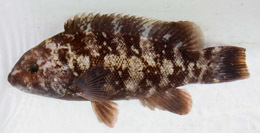 5/9 - Manhattan, HRM 4: From our killifish traps at the River Project’s sampling station at Hudson River Park’s Pier 40, we caught a naked goby 40 millimeters [mm] long; in our crab pots we caught one tautog [blackfish] 240 mm long. We checked water quality parameters as well: water temperature was 56 degrees F; salinity was 15.0 parts-per-thousand [ppt]; turbidity was measured at 50 centimeters (distance one could see beneath the surface); and dissolved oxygen was 6.2 parts-per-million. [Photo of tautog courtesy of Steve Stanne.]
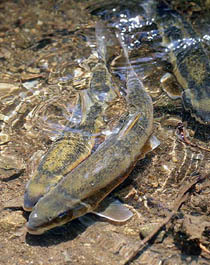 5/12 - Rockland County, HRM 45.5: We were at Timp Brook in Doodletown to bird, but noticed a lot of splashing in a pool at the base of the waterfall. These were spawning white suckers, the males nudging up against the females to release their eggs so the males could cover them with their milt. [Photo of spawning white suckers courtesy of Deborah Tracy-Kral.]
|
The New York State Department of Environmental Conservation respects your right to privacy and welcomes your feedback. | Update preferences or unsubscribe. | Learn more about DEC Delivers. |
|
Connect with DEC:   
|
 |
| NOW AVAILABLE: Receive DEC's Twitter feed via email. | |
| Andrew M. Cuomo, Governor * Basil Seggos, Acting Commissioner | |