
Hudson River Almanac 5/1/16 - 5/7/16
The New York State Department of Environmental Conservation sent this bulletin on 05/13/2016 01:30 PM EDT |
| DEC Delivers - Information to keep you connected and informed from the NYS Department of Environmental Conservation |
| Share or view as a web page || Update preferences or unsubscribe |
|
|
|
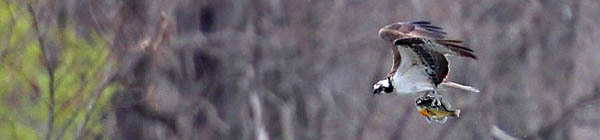
This was a week of seahorses at one end of the estuary, terns throughout the watershed, and ruby-throated hummingbirds arriving in gardens everywhere. HIGHLIGHT OF THE WEEK 5/2 - Hudson River, HRM 158-92. There was a great showing of Caspian terns along the river today: 13 at Kingston Point (Ulster County), one at New Baltimore (Greene), two at Coeymans Landing (Albany), one at Cohoes Flats (Albany/Saratoga), and one at Collins Lake (Saratoga). There were also two black terns at Coeymans Landing and one at Crescent (Mohawk River). In keeping with the “tern theme,” there were common terns at Cohoes Flats as well. It will be interesting to see if this tern presence lingers into tomorrow, or if these migrants move on. [Caspian terns do pass through annually, but I believe they have lately increased dramatically in numbers. The Great Lakes breeding population seems to have been expanding its breeding range eastward, causing an increase in numbers using the Hudson River corridor as their pathway home. Time and more monitoring will tell. Richard Guthrie] NATURAL HISTORY NOTES 5/1 - Peebles Island, HRM 158: It rained off and on during the morning but the birding was good. The highlights of the day were the 20 Bonaparte’s gulls and two Caspian terns seen on Cohoes Flats from the cliff on the Peebles Island Trail. 5/1 - Coxsackie, HRM 123: I spotted a common loon in breeding plumage drifting and preening south of the Coxsackie Boat Launch. It made a foggy, rainy day a whole lot brighter. 5/1 - Northeast Dutchess County, HRM 96: What's better than watching an osprey hunt? Watching two ospreys. One of a pair of osprey fishing a private pond flew past carrying an adult male bluegill in breeding colors. [See banner image of osprey with bluegill, courtesy of Deborah Tracy-Kral.] 5/1 - Quassaick Creek, HRM 60: We were looking at a small, unnamed outflow from Crystal Lake. The outflow was clearly nutrient enriched as there was algal growth and quite a bit of sediment. But there was also an incredible number of snails of a kind I had never seen before. I took some photos hoping to get them identified. [These were Chinese mystery snails (one of two species of Cipangopaludina). They are native to Asia from Indochina to northern China and have been widely released in North America by aquarists and water gardeners. They can become extremely abundant (200 snails per square meter). Dave Strayer, Freshwater Ecologist, Cary Institute of Ecosystem Studies.] 5/2 - Cohoes, HRM 158: The Mohawk River was running fast and muddy over the falls at Cohoes down into the Cohoes Flats. Among the 16 bird species I identified were Caspian terns (six sitting in a group on a rocky sandbar) as well as a dozen common terns flying over, dipping down to touch the water, presumably catching and eating something. 5/2 - Coeymans Landing, RM 133.5: Nearing mid-morning, I spotted a common tern perched on a submerged jetty at the Coeymans Landing boat launch. Two Caspian terns were there as well. A while later we also spotted two black terns over the river.
5/2 - Manhattan, HRM 1: We caught a spotted hake 130 millimeters [mm] long today from our killifish traps at the River Project’s sampling station on the lighthouse tender Lilac at Pier 25 in Hudson River Park. In our crab pot we caught a lined seahorse 60 mm long. The river’s salinity was 14.0 parts-per-thousand [ppt] and the water temperature was 54 degrees Fahrenheit. [At this latitude on the east coast of North America, seawater salinity averages 32-36 ppt. Throughout the year, the Hudson estuary’s salinity is diluted depending upon the volume of freshwater flow from the watershed as well as the vagaries of wind, tide and current. Tom Lake.] 5/3 - Mohawk River, HRM 157: I came upon a lone male surf scoter today on the Mohawk River just west of Amsterdam. [Surf scoters are marine ducks that breed in the Arctic and in our area winter along the Atlantic coast. While they are commonly seen as spring and fall migrants in the lower estuary and northern New Jersey, they are seen only occasionally along inland Hudson River tidewater and the Mohawk River. Surf scoters are sea ducks, with white bills and a white patch on the back of their heads. When seen through binoculars, in the dim light of dawn, bobbing between swells a few hundred yards away, they look like “double-faced” ducks. Tom Lake.] 5/3 - Kingston, HRM 92: I stopped by Kingston Point this evening this evening and immediately spotted 11 of the previously reported 13 Caspian terns. There were also 10 common terns of which eight were in mid-river, flying northward in a loose group with two Bonaparte’s gulls. It was a nice way to end the day.
[Leucism is an abnormal plumage condition caused by a genetic mutation that prevents pigment, particularly melanin, from being properly deposited on a bird’s feathers. As a result, the birds do not have the normal, classic plumage colors listed in field guides, and instead have several color changes, including: white patches where the bird should not have any; paler overall plumage that looks faint, diluted or bleached; and overall white plumage with little or no color discernable. Leucism affects only the bird’s feathers, and typically only those with melanin pigment - usually dark feathers. Birding.about.com] 5/3 - Highland, HRM 75: The Mid-Hudson Bridge is home to newly hatched peregrine falcons for the 20th consecutive breeding season. Two new hatchlings are being nurtured by both parents. Visit DEC’s Peregrine Falcon Webcam page for information about the peregrines and their history of nesting on the bridge as well as a link to still images of the nest, updated every 15 minutes. YouTube clips show the parent falcons tending the hatchlings and feeding the youngsters. 5/4 - Rhinebeck, HRM 90: This morning there was a spotted sandpiper - minus spots at this time of the year - at the edge of the pond beyond my deck. It gave itself away by bobbing its tail. 5/4 - Norrie Point, HRM 85: Seining with a group of Marist College students at the Norrie Point Environmental Center, we brought up the usual cast of characters: tessellated darters, spottail shiners, banded killifish, and one unusual fish, an Atlantic menhaden (Brevoortia tyrannus). We will occasionally catch them here, but this one was 115 mm long, not a size we'd expect to see in early May.
5/4 - Norrie Point, HRM 85: For ten minutes at midday, I counted four Forster's terns overhead at the Norrie Point Environmental Center. 5/4 - Bedford, HRM 35: We have had rainy days and cool weather at the great blue heron rookery. At ten of the nests a heron was settled down keeping the nestlings warm; four nests had a heron standing while another nest had both herons at the nest together. When they were not preening their feathers, they were rearranging the twigs in their nest or looking around for the arrival of their mate so they could leave to hunt for food. 5/4 - Manhattan, HRM 4-2: In the past week, Hudson River Park Trust staff caught a total of five lined seahorses from the Hudson River. The seahorses were found hanging onto the eel mops attached below our floating docks at Piers 40 and 84. Seahorses are weak swimmers due to their vertical orientation and small dorsal fin. For support against river currents, they use their curled tails to grasp onto a substrate. 5/4 - Manhattan, HRM 1: We caught a tautog (blackfish) in our killifish trap at The River Project’s sampling station on the lighthouse tender Lilac at Pier 25 in Hudson River Park. In our crab pot we caught another lined seahorse (95 mm). The river’s salinity measured 15.0 ppt, dissolved oxygen was 5.8 parts-per-million, and the water temperature was 52 degrees F. 5/5 - Town of Poughkeepsie, HRM 69: For the 105 Lakeview Elementary fifth-graders from Mahopac, it was like taking a journey back in time. We visited prehistoric sites in Bowdoin Park including rockshelters where Indians stopped by periodically at least 7,000 years ago. Along the way we found shards of fire-cracked rock, evidence of ancient hearths. Excavations in the park by Donna and Jack Vargo (1983-1984) discovered a series of sturgeon butchering and smoking huts along the river dating to about 4,000 years ago. For at least one day, we were all able to strip away the modern landscape and sense the serenity of long ago. [Fire-cracked rocks are artifacts of hearths, campfires, and human food-processing that often predate the advent of pottery in the Northeast about 2,000 years ago. They are usually quartzite or sandstone cobbles that, when fire-heated and used to boil water, will crack, spall and fracture in a way that is diagnostic. Given the number of campfires that must have been used in the Hudson Valley across a dozen millennia, it is easy to see why “FCR” is commonly found strewn along the flood plains and shoreline. Tom Lake.] 5/5 - Town of Fishkill, HRM 63: A male and female goldfinch went from dandelion to dandelion in my front yard this evening, bobbing on the fluffy seed-heads as they picked off the seed under the “fluff.” I could not think of a better reason to leave dandelions in your lawn! 5/5 - Pollepel Island, HRM 58: Navigation tower 48 off Pollepel Island (Bannerman's Island) had been taken over by a pair of osprey. They constructed a nest atop the tower; one of the pair was in the nest today while the other perched on the superstructure. While it is a likely spot for an osprey nest, this is the first year I've seen it being used. This tower has been a favorite roosting site for cormorants but this year there was nary a cormorant to be seen. 5/5 - Storm King Mountain, HRM 57: The peregrine falcon nesting ledge (eyrie) appears to be active again this year with fresh white wash on the cliff face and an attending adult roosting nearby. This will be the 12th year that I've personally seen this nest ledge in use. 5/5 - Bedford, HRM 35: On a cool, overcast, and windy day I stopped by the great blue heron rookery. I saw no feeding activity on any of the nests; all of the birds were hunkered down and brooding with no coming-and-going activity. 5/5 - Manhattan, HRM 2: From our killifish traps at the River Project’s sampling station on Hudson River Park’s Pier 40, we caught our second striped bass of the spring, a yearling (95 mm). 5/6 - Saratoga County, HRM 82: On my survey of Saratoga Lake, I counted 25 species of birds. Among them were red-breasted merganser (one drake and seven hens), common loon (nine), and Bonaparte's gull (40, all over, swooping and diving). Then there were the terns: a Caspian tern, two black terns, and two common terns. 5/6 - Norrie Point, HRM 85: Future scientists and educators working on the estuary learn quickly that the sun is not always shining and the tide is not always perfect. A class of juniors and seniors from Pine Bush High School helped us sample the river today in a driving rain and a quickly rising flood tide (new moon). By the program’s end, we were fairly drenched and could barely get out of the river as the tide capped off on the rip-rap. The banded killifish we caught were nice, but the lesson may have been delivered by the wind, rain, and tide. The river was 55 degrees F. 5/6 - Manhattan: The following entries were from participants in the 2016 Jane’s Walk, a series of neighborhood walking tours named after the legendary urban activist and writer Jane Jacobs. Since its inception in Toronto in 2007, Jane's Walks have been held annually in over 180 cities across the world during the first weekend of May to coincide with her birthday. They are led by volunteers and are free. The Municipal Art Society is the proud local organizer of Jane’s Walk in New York City, which has grown from 23 walks into the largest Jane’s Walk festival in the world - 211 walks in 2015. During this year’s sixth annual Jane’s Walk in New York City, some of the participants were students in an ecology class taught by Elisa Caref and Nina Zain of The River Project. - We were on Jane's Walk in mid-afternoon, led by Elisa Caref and Nina Zain, walking down Manhattan’s Pier 32. We spotted a “seagull” and a cormorant that had opened its wings, most likely getting them to dry. - We were at Manhattan’s Pier 40 in mid-afternoon, just beginning the adventure of Jane's Walk. We saw purple alliums, located right at the beginning of the walkway, just starting to bloom.
- For me the highlight of today’s Jane's Walk, was seeing how much the greenery and flora had changed since winter. As our tour group was walking southbound from Manhattan’s Pier 40 to Pier 25, I noticed how all the trees were so lush and green. I took a picture of the flowering oak trees in the vicinity of Pier 34 and thought it would be interesting to compare that to a picture I took on February 5 while walking along the same route. During the winter, those same trees had been covered in a light dusting of snow and robins could be seen in the branches. 5/7 - Eastern Dutchess County, HRM 62: While hiking with friends at the Michael Ciaiola Conservation Area we encountered more than 30 red efts on the trails. The interesting thing about the eastern (red-spotted) newt is that they begin their life cycle as an aquatic larva or tadpole with gills. They then transform into their land cycle as a red eft for two to five years before finally transforming into a sexually mature newt with gills to return to the water to breed. 5/7 - Croton River, HRM 34: I counted five Caspian terns on the sand at the confluence of the Croton River and Croton Bay. These were probably in migration but maybe they will stay a while. 5/7 - Manhattan, HRM 1: From our killifish traps at the River Project’s sampling station on the lighthouse tender Lilac at Pier 25, we caught a naked goby (45 mm) as well as three lined seahorses (105, 85, and 55 mm). The seahorses were all “caught” because they were hanging onto the ropes. SPRING 2016 NATURAL HISTORY PROGRAMS Friday, May 20, 4:00 PM Saturday, May 21: 11:00 AM - 2:00 PM Saturday, May 21, 2016: 3:00 - 4:30 PM HUDSON RIVER MILES The Hudson is measured north from Hudson River Mile 0 at the Battery at the southern tip of Manhattan. The George Washington Bridge is at HRM 12, the Tappan Zee 28, Bear Mountain 47, Beacon-Newburgh 62, Mid-Hudson 75, Kingston-Rhinecliff 95, Rip Van Winkle 114, and the Federal Dam at Troy, the head of tidewater, at 153. The tidal section of the Hudson constitutes a bit less than half the total distance – 315 miles – from Lake Tear of the Clouds to the Battery. Entries from points east and west in the watershed reference the corresponding river mile on the mainstem. TO CONTRIBUTE YOUR OBSERVATIONS OR TO SUBSCRIBE Smartphone app available for New York outdoor enthusiasts! Copies of past issues of the Hudson River Almanac, Volumes II-VIII, are available for purchase from the publisher, Purple Mountain Press, (800) 325-2665, or email purple@catskill.net |
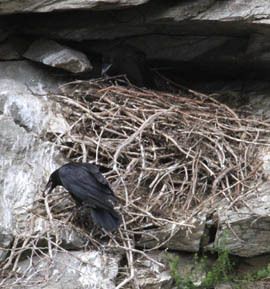 5/2 - Rensselaer County, HRM 145: I found a common raven nest [eyrie] on the face of a rock cut along a much-traveled highway. Another raven appeared to be building a second nest nearby. Since I often travel past them, I am looking forward to watching their progress. [Photo of raven at nest courtesy of Nancy Kern.]
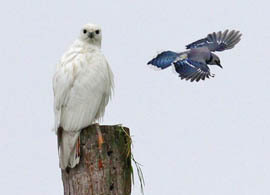 5/3 - Town of Unionvale, HRM 84: Our leucistic red-tailed hawk that we have named “Lucy” was spotted today in Clinton Corners. She was ignoring a blue jay that had chosen to harass her. I've been photographing this Stanfordville-Clinton Corners leucistic red-tailed hawk for at least five years. “Lucy” has moved her territory, over the years, a bit south-west to the area around Hunn's Lake-Shultzville Road. [Photo of blue jay harassing leucistic red-tailed hawk courtesy of Deborah Tracy-Kral.]
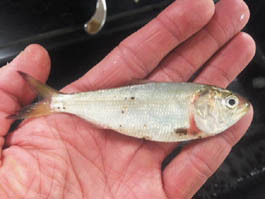 [Atlantic menhaden are a species of herring that spawns in salt to brackish water. Adults, also known regionally as bunker, mossbunker or pogies, and their young-of-the-year, colloquially called peanut bunker or penny bunker, are found by the millions in the estuary in summer, providing forage for striped bass, bluefish, osprey, harriers, eagles and seals. It is not uncommon to find young-of -the-year menhaden as far upriver as Columbia County (river mile 125) in summer. However, consensus of opinion was that this particular menhaden was a yearling holdover from ocean waters adjacent to New York Harbor. Tom Lake. Photo of young Atlantic menhaden courtesy of Chris Bowser.]
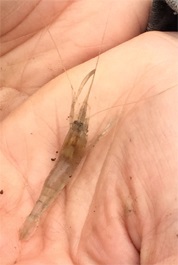 - During our Jane's Walk from Manhattan’s Pier 40 to 25, we came upon many mourning doves standing proud and still as we marched past. We were invited to check the fish traps at Pier 25 and found many “grass shrimp” (Palaemonetes sp.). We were surprised at how jumpy they were! [Photo of Palaemonetes shrimp courtesy of the RIver Project.]
|
The New York State Department of Environmental Conservation respects your right to privacy and welcomes your feedback. | Update preferences or unsubscribe. | Learn more about DEC Delivers. |
|
Connect with DEC:   
|
 |
| NOW AVAILABLE: Receive DEC's Twitter feed via email. | |
| Andrew M. Cuomo, Governor * Basil Seggos, Acting Commissioner | |