|
OVERVIEW
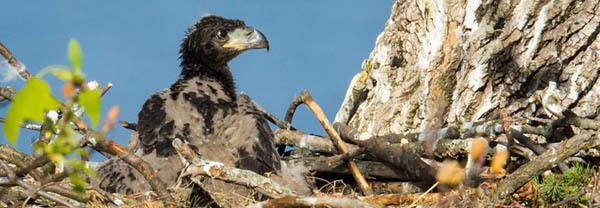
This was a week for seahorses in the lower estuary, a fish we do not often think about in a river where millions of shad, herring, striped bass, and sturgeon dominate. Bald eagle nestlings continued to grow, feeding well on river herring. [Banner photo of bald eagle nestling courtesy of John Badura.]
HIGHLIGHT OF THE WEEK
4/24 - Croton Bay, HRM 34: It was my first time on the river this year and it was thrilling. The moon was sinking toward Hi Tor, its light muted by the heavy mist, and the river was glassy and calm. We baited our lines with herring and settled back. Dennis told the story of being out here last night in the calm of late evening when fire whistles and sirens started up from on shore. That set off a loon that had been drifting off Croton Point. The loon made all sorts of wails, tremolos and other strange noises. Then the coyotes started howling, and as long as the sirens lasted the coyotes howled. The coyote chorus included some squeaky notes and puppy-like yapping, good indications that the Croton Point pack had some new additions. Meanwhile, we were fast into a nice striped bass, 36 inches long, that we carefully unhooked and returned to the river.
- Christopher Letts, Dennis Cooney
NATURAL HISTORY NOTES
4/24 - Mohawk River, HRM 157: I watched a Caspian tern fly downstream along the Mohawk as two Bonaparte's gulls flew upstream at the Shaker Creek Bridge along the Mohawk-Hudson Bike Trail.
- Jeremy Collison, Hudson-Mohawk Bird Club
4/24 - Town of Poughkeepsie: The nestling in eagle nest NY62, dubbed “Peeps” (born on Easter), was four weeks old today and eating well. Over the last week it has had white suckers and river herring, and today Mom brought in a fat alewife.
- John Badura, Kathleen Courtney, Mark Courtney, Bob Rightmyer
4/24 - Beacon, HRM 61: Pete and Toshi Seeger Park, a former landfill along the river, was ringed with anglers. All were after carp, many were successful, and most were eager to show cell phone photos of fish that had been returned to the river. The largest we saw was 25 pounds. Mixed in with the big carp was a steady catch of brown bullheads.
- Tom Lake, T.R. Jackson
4/24 - Beacon 60.5: The carp were also biting a short distance south of Seeger Park; I managed two, the largest of which was 9 pounds, 4 ounces. I also caught and released three brown bullheads, all about eight inches long. Meanwhile, out on the river there was a flotilla of fishing boats all trolling for striped bass.
- Bill Greene
[Common carp (Cyprinus carpio) are nonnative, having been introduced to North America from Europe in the Hudson River at Newburgh in 1831. They are the largest member of our largest family (34) of fishes – the minnows (Cyprinidae). Carp are often hybridized and domesticated as an ornamental variety called koi. Tom Lake.]
4/24 - Town of Wappinger, HRM 67: Flowering dogwood was in full bloom, acting as a colorful segue to the last of the shadbush in the forest. Almanac records indicate that dogwood has bloomed in the Mid-Hudson Valley as early as March 26 (2012) and as late as April 27 (2011). A cursory check showed that the new oak leaves were now “the size of a squirrel’s ear."
- Tom Lake
[In the centuries prior to the arrival of European in the Hudson Valley, the cultivating of maize, or corn, was important for native Americans. There is much lore regarding the planting of corn; oral (ethnographic) tradition among many Midwest and Northeast tribes suggests planting of the corn when the new oak leaves are the size of a squirrel's ear. But what is the size of a squirrel’s ear? One spring I decided to find the answer. I spent the month of April driving around the Hudson Valley, measuring the ears of road-killed gray squirrels. I counted 116. The average “ear size” was 20.6 millimeters, or 0.82 inches long. This might apply to different oaks in different areas, but for the Hudson Valley, it was probably the white oak (Quercus alba). In most years the prime date arrives in early May and is probably related to soil temperature, rainfall, and perhaps some other factors. Tom Lake.]
4/25 - Stony Creek, HRM 225: The Hudson River at Stony Creek, although still flowing well, was about three feet below where it was last month. I tossed some bread in my seine and attracted a crayfish. I also came upon spotted salamanders looking forward to warmer temperatures.
- Pete Loch
4/25 - Saratoga County, HRM 182: Saratoga Lake was calm; most of scaup had left for breeding areas to the north. Among the 35 species I counted were red-necked grebes (12) and common loons (7). Three white-winged scoters were way out in the lake off of Riley Cove.
- Ron Harrower, Hudson-Mohawk Bird Club
4/25 - Milan, HRM 90: The brown bat that seems to annually take up residence in my front light fixture was back. This was probably the fifth year he has showed up.
- Marty Otter
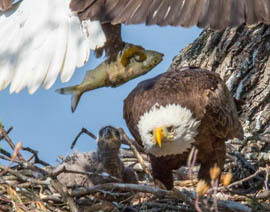 4/25 - Town of Poughkeepsie: It is a treat watching what form “dinner” will take each day for the nestling in eagle nest NY62. Mom brought a river herring to the nest in midday. Since both species of river herring, alewives and blueback herring, are in the river right now and they look very similar, it was impossible to tell. To the nestling is did not matter; both taste the same. [Photo of herring being brought to eagle next courtesy of John Badura.] 4/25 - Town of Poughkeepsie: It is a treat watching what form “dinner” will take each day for the nestling in eagle nest NY62. Mom brought a river herring to the nest in midday. Since both species of river herring, alewives and blueback herring, are in the river right now and they look very similar, it was impossible to tell. To the nestling is did not matter; both taste the same. [Photo of herring being brought to eagle next courtesy of John Badura.]
- John Badura
4/25 - Wicopee, Town of East Fishkill: A new bald eagle nest! This has become an almost common scenario: We get a phone call of “eagles and a possible nest”; we respond and find a new one. This one was 95 feet up in a 115 foot-high white pine. Judging by its small size (circumference) it was likely a first-year nest. The adults have been around but seem to be displaying another trait of “new adults”: They do not seem quite sure of what to do. New nesters frequently take a year to get their instincts in order.
- Tom Lake. John Basile
[In 1997, the Hudson Valley had its first successfully hatched nestling in 100 years. Today, in less than two decades, as the result of improved air, land, and water quality, we have more than 30 nests, many breeding successfully, along the river and its tributaries. Tom Lake.]
4/25 - Manhattan, HRM 1: We pulled our pots and traps at the River Project’s sampling station on the lighthouse tender Lilac at Pier 25 in Hudson River Park and found six seahorses ranging in size from 55 to 70 millimeters. Most were caught because they were hanging onto the traps or the ropes; only two of the six were caught inside a killifish trap. We also caught a spotted hake (145 mm) in a killifish trap, one of eight “cods” (Gadidae) found in the estuary.
- Jacqueline Wu
[With most fishes we give their size as “length.” However, with seahorses, length is actually their height, since they swim upright in the water like tiny galloping ponies. Tom Lake.]
4/26 - Saratoga County, HRM 170: Rain was just tapering off when I pulled up on the north side of Round Lake where I happened upon the “loon parade!” Ten common loons and one red-throated loon, merging from two groups, paddled past. Even more striking were the more than 2,500 mixed swallows (a conservative estimate) flying over the entire lake. I was able to pick out five species: rough-winged, tree, barn, cliff, and bank swallows.
- Ron Harrower, Hudson-Mohawk Bird Club
4/26 - Rhinebeck, HRM 90: For the first time this year there were swallows, about two dozen, mainly rough-winged but also barn swallows and at least one adult tree swallow, swooping over the pond beyond my deck. It is difficult to be precise in counting because they fly so fast. Compared to other birds, they're manic.
- Phyllis Marsteller
4/26 - Bedford, HRM 35: I brought my spotting scope to the great blue heron rookery today. With the naked eye I counted 25 nests. Through the spotting scope I found that many of the nests were pretty much occupied with a nesting bird; I could only find one that was “empty” and even that one had a heron return to it as I watched. This is a very busy rookery with birds coming and going, relieving each other on the nests.
- Rick Stafford
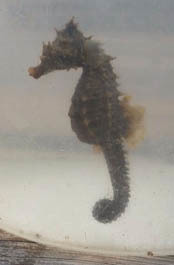 4/26 - Brooklyn, New York City: In prepping for a school program, Brooklyn Bridge Park Conservancy educators pulled up one of our oyster monitoring cages from the East River and spotted an unexpected visitor: a young lined seahorse. Surprisingly the cage was bare of any other reef associates: no mud crabs, shrimp, or even sea squirts. Students and staff were equally amazed. [Photo of lined seahorse courtesy of Christina Tobitsch.] 4/26 - Brooklyn, New York City: In prepping for a school program, Brooklyn Bridge Park Conservancy educators pulled up one of our oyster monitoring cages from the East River and spotted an unexpected visitor: a young lined seahorse. Surprisingly the cage was bare of any other reef associates: no mud crabs, shrimp, or even sea squirts. Students and staff were equally amazed. [Photo of lined seahorse courtesy of Christina Tobitsch.]
- Christina Tobitsch
4/27 - Greene County, HRM 112.2: During a survey of the RamsHorn-Livingston Sanctuary, I counted 51 species of birds. Highlights included osprey (2), northern harrier (1), sharp-shinned hawk (1), and double-crested cormorants (149). The latter were in multiple strings of between 30-50 birds each, flying north. There were also ten bald eagles, four adults and six immatures.
- Larry Federman
4/27 - Ulster County, HRM 85: The adults in bald eagle nest NY92 were leaving the nest quite often now. With the nestling being about two weeks old, the adults must feel comfortable with it. However, I still have not managed to be there when a fish was delivered. This morning Mom was on the nest when Dad came in. He may have had a fish but I missed his arrival. They both soon left and three osprey circled together above the nest tree while they were gone.
- Jim Yates
4/27 - Norrie Point, HRM 85: Ninth-grade students from Poughkeepsie High School helped us to sample the south cove on the ebb tide at Norrie Point. Successive hauls of our seine provided a good lesson in tides: By the time we were finished in late morning, the students were hauling across shallow water and through heavy sediments. Our net captured the expected resident fishes, including spottail shiners, tessellated darters, and banded killifish. While we seined, we were being watched by an osprey and two bald eagles, all fish fanciers. The water temperature was 54 degrees Fahrenheit.
- Giancarlo Coppola, Tom Lake
4/27 - Beacon, 60.5: There were no carp today, but two channel catfish helped make the fishing worthwhile. Both were released; the larger of the two was 7 pounds, 10 ounces and nearly 26 inches long.
- Bill Greene
4/27 - Stony Point, HRM 40: A week ago in the marsh below the historic Revolutionary War battlefield, I noticed a lone mute swan floating idly in the water. A few yards away, in the cattails, I saw its mate. Today I saw both swans preening themselves, sitting on a large pile of reeds and sticks in the same spot among the cattails. It looks like the female approved of her mate’s choice of a nesting site.
- Sophia Hsieh
4/27 - Bedford, HRM 35: It appeared that hatching had occurred at the great blue heron rookery. Of the 15 occupied nests I counted, nine were still incubating and six nests had a heron standing on the edge of the nest either looking into the nest or preening. Herons spend a lot of time preening their specialized breast feathers. These coarse-looking feathers grow continually and fray at the ends, making a powder. They spread this powder to other feathers to remove fish slime and other debris to keep their feathers clean. The young nestlings at this point are huddled together at the bottom of the nest and are not visible. They grow rapidly and soon will be seen.
- Jim Steck
4/27 - Manhattan, HRM 1: We pulled our killifish traps at the River Project’s sampling station on Pier 40 and caught found our first striped bass of the season, a yearling 135 millimeters [mm] long.
- Matt Tutunjian, Jacqueline Wu
4/28 - Minerva, HRM 284: Spring is happening more slowly than I was expecting, but our ponded area in the back forty is showing signs of the season. This evening we heard our American bittern for the first time this year, with a backdrop of spring peepers and red-winged blackbirds. In the woods, a phoebe and a Swainson's thrush were singing and a woodcock peented and twittered his way around the area.
- Mike Corey
4/28 - Fort Miller, HRM 192.5: We checked the area of the osprey nest at Lock 6 in late afternoon and spotted one adult on the nest and another bringing nesting material - not sticks, but smaller vegetation, probably interior construction.
- Scott Stoner, Denise Stoner, Hudson-Mohawk Bird Club
4/28 - Ulster County, HRM 86: Viewing from the east side of the river, I found both adult bald eagles at home at West Park's nest NY142. One eagle departed southward but was soon accosted by a northbound osprey. A brief aerial dogfight ensued until both disappeared behind Esopus Island. Minutes later, the osprey appeared again over the mouth of Black Creek, hovered on the morning's north breeze, and then dive-bombed into the river with a splash. As it emerged it carried a fish in its talons.
- Dave Lindemann
4/28 - Norrie Point, HRM 85: On Day 2 of their ninth-grade visit, Poughkeepsie High School students found a little gentler ebb tide to sample today. As it was yesterday, the resident fishes were there for us to capture, discuss their life history, and release (spottail shiners and tessellated darters). Today’s sample, however, had some important additions: American eels. The two elvers we caught represented two distinct year-classes: a likely 3-year-old and a 5-year-old. Without serious laboratory work, aging small eels can be problematic.
- Giancarlo Coppola, Tom Lake
4/28 - Town of Poughkeepsie: The nestling in bald eagle nest NY62 was 32 days old today and appeared to be the size of a chicken. NY62 is frequently featured in the Almanac due to the excellent monitoring it receives and, as such, it is illustrative of most of the other successful eagle nests in the Hudson Valley.
- Tom Lake
4/28 - Manhattan, HRM 1: We pulled our pots and traps at the River Project’s sampling station on the lighthouse tender Lilac at Pier 25 and found three more seahorses (50 mm - 75 mm). With these three, we had officially bested our previous record by one (2012) of 13 seahorses by the end of April. The killifish trap also had a grubby (70 mm) and the crab pot had our first large oyster toadfish of the season (265 mm).
- Jacqueline Wu
4/29 - Town of Fishkill, HRM 63: My cat and I were finishing some gardening this evening when I spotted an immature barred owl sitting in a locust tree. Two minutes later an adult landed three feet away from the bird and they perched there just looking at us. I moved to the back yard and, sure enough, the two birds moved to a silver maple still eyeballing us. Thinking the cat might be the object of their attention, I took him inside and the two owls flew off. Fifteen minutes later I heard them hooting from the Stony Kill Farm fields.
- Andra Sramek
4/29 - Quassaick Creek, HRM 60: The Quassaick Creek Watershed Alliance, demonstrating their five years of glass eel monitoring experience, quickly and efficiently cleared the fyke net. We counted 81 glass eels and four elvers, a modest number by this year’s standard, but a welcome number nevertheless. As the net was being worked we watched at least a half-dozen alewives in mid-stream heading up the creek to their spawning reach. The water temperature was 56 degrees F.
- Laura Kohlmann, Ted Kohlmann, Tom Lake, T.R. Jackson
4/29 - Manhattan, HRM 1: We pulled our pots and traps at the River Project’s sampling station on Pier 40, as well as at the lighthouse tender Lilac at Pier 25, and found three more lined seahorses. Our crab pot had two (65 mm, 75 mm), the largest a female, and our killifish trap had one (110 mm), also a female, and our largest seahorse of the season.
- Jacqueline Wu
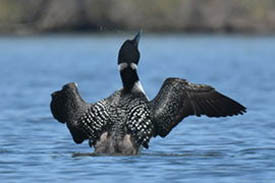 4/30 - Saratoga County, HRM 176: Like bald eagles and bobcats, this was something we never tire of seeing: As I paddled along in the river I came upon a common loon in breeding plumage, dousing, shaking, and putting on a show. [Photo of common loon courtesy of Michael Kalin.] 4/30 - Saratoga County, HRM 176: Like bald eagles and bobcats, this was something we never tire of seeing: As I paddled along in the river I came upon a common loon in breeding plumage, dousing, shaking, and putting on a show. [Photo of common loon courtesy of Michael Kalin.]
- Michael Kalin
[The common loon, like the bald eagle, raven, black bear, moose, river otter, coyote, and bobcat, is an iconic image in the sense that it reminds us of less complex times, when demand on space in the watershed was less contentious. Tom Lake.]
4/30 - Town of Poughkeepsie: We watched the nest for three hours today hoping for some interaction between Mom, Dad, the nestling, or some other wildlife. Unless you are extremely fortunate, bald eagle nest monitoring takes incredible patience. This was Day 34 for the nestling and Mom sat, perched on a branch of the tulip tree less than ten feet from the nest, for three hours staring stoically out to the river. On this day her patience was greater than ours.
- Tom Lake, T.R. Jackson
4/30 - Hopewell Junction, HRM 67: The first eastern bluebird chicks (first brood of the year) were now active and Dad, being proactive, was providing protection as well as sharing the feeding responsibilities.
- Tom McDowell
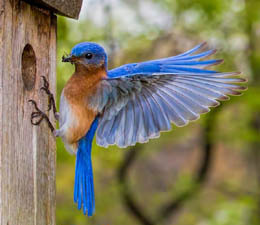 [ I got started with bluebirds 30 years ago when my children volunteered me to help the Sprout Creek Farm transform into an educational center. My job was to build and install bluebird houses. It was a huge success and incredibly rewarding so we continued installing boxes at our home. Bluebirds need a little room so I limit our property to five boxes. I have been able to fledge an average of 19 bluebirds annually for almost three decades and enjoy the insect control they provide. Two years ago, tree swallows joined in and so I built “duplex nest boxes” (back-to-back nest boxes). They now breed together: bluebirds on one side, swallows on the other. Tom McDowell. Photo of male bluebird at next box courtesy of Tom McDowell.] [ I got started with bluebirds 30 years ago when my children volunteered me to help the Sprout Creek Farm transform into an educational center. My job was to build and install bluebird houses. It was a huge success and incredibly rewarding so we continued installing boxes at our home. Bluebirds need a little room so I limit our property to five boxes. I have been able to fledge an average of 19 bluebirds annually for almost three decades and enjoy the insect control they provide. Two years ago, tree swallows joined in and so I built “duplex nest boxes” (back-to-back nest boxes). They now breed together: bluebirds on one side, swallows on the other. Tom McDowell. Photo of male bluebird at next box courtesy of Tom McDowell.]
SPRING 2016 NATURAL HISTORY PROGRAMS
2016 WAVE Training Sessions Open For Registration
DEC’s Water Assessments by Volunteer Evaluators (WAVE) project is recruiting participants to conduct water quality assessments in streams and rivers of the Lower Hudson River basin this summer. WAVE data augment the work of the DEC Stream Biomonitoring Unit, which samples streams and rivers across the state to create an inventory of stream water quality. Citizen monitors will assist in identifying healthy stream sites and flagging sites that potentially have water quality concerns. These data are included in federal and state water quality reports and help to target professional assessments and local restoration or conservation efforts to where they are most needed.
Citizen monitors visit stream sites once per year, anytime between July and September, and collect macroinvertebrates - insects and other small organisms - from the rocks and rubble on the stream bottom. If six or more of the "Most Wanted" organisms are found, the stream segment is unimpaired and fully supports aquatic life. If mostly "Least Wanted" organisms are found, then the stream segment is flagged for possible investigation by professionals.
Citizen monitors can participate in the WAVE project in one of three ways:
- Serve as local coordinators who coach and coordinate their own team of WAVE participants. Local coordinators must attend a full day training to participate.
- Sample independently. Independent samplers must also attend a full day training to participate.
- Join a local team lead by a WAVE local coordinator. No training is required for this option.
WAVE training sessions are scheduled for late April and May at the following Hudson Valley locations:
- Monday, May 9, 9 AM-4 PM, Delmar (Albany County)
- Friday, May 13, 9 AM-4 PM, Montebello (Rockland County)
To register for a training session or for more information, email DEC’s WAVE Coordinator Alene Onion.
Wednesday, May 18, 2016: 3:00 - 4:30 PM
The Good, the Bad, and the Ugly: Conserving Migratory Fish in the Hudson River Estuary, Henry A. Wallace Education and Visitors Center, Franklin D. Roosevelt National Historic Site, Hyde Park [Dutchess County]. Chris Bowser, estuary educator for DEC’s Hudson River Estuary Program and the Hudson River National Estuarine Research Reserve, will describe migratory fish like sturgeon, shad, and eels that journey between freshwater and saltwater and historically have been culturally and economically valuable. Some are now struggling for survival, but there is hope and good news as well! The program is free, but online registration is required: For more information contact Susanne Norris at 845-229-6873.
Saturday, May 21: 11:00 AM - 2:00 PM
Family Fishing Day at the Norrie Point Environmental Center. All ages welcome; free use of rods, reels and bait. Free; wheelchair accessible. For information: 845-889-4745 x109.
HUDSON RIVER MILES
The Hudson is measured north from Hudson River Mile 0 at the Battery at the southern tip of Manhattan. The George Washington Bridge is at HRM 12, the Tappan Zee 28, Bear Mountain 47, Beacon-Newburgh 62, Mid-Hudson 75, Kingston-Rhinecliff 95, Rip Van Winkle 114, and the Federal Dam at Troy, the head of tidewater, at 153. The tidal section of the Hudson constitutes a bit less than half the total distance – 315 miles – from Lake Tear of the Clouds to the Battery. Entries from points east and west in the watershed reference the corresponding river mile on the mainstem.
TO CONTRIBUTE YOUR OBSERVATIONS OR TO SUBSCRIBE
The Hudson River Almanac is compiled and edited by Tom Lake and emailed weekly by DEC's Hudson River Estuary Program. Share your observations by e-mailing them to trlake7@aol.com.
To subscribe to the Almanac (or to unsubscribe), go to DEC's Email Lists page, enter your email address, and click on "Submit." Fill in and submit the requested information on the “New Subscriber” page. This will take you to “Quick Subscriptions”. Scroll down; under the heading "Natural Areas and Wildlife" is the section "Lakes and Rivers" with a listing for the Hudson River Almanac. Click on the check box to subscribe. While there, you may wish to subscribe to RiverNet, which covers projects, events and actions related to the Hudson and its watershed, or to other DEC newsletters and information feeds.
The current year's issues are available at http://www.dec.ny.gov/lands/25611.html . To view older issues, visit the New York State Library's Hudson River Almanac Archive. If it asks you to login, click on "Guest." You may then need to reopen this page and click on the Almanac Archive link again to access the Almanac collection in the library's files.
Discover New York State Conservationist - the award-winning, advertisement-free magazine focusing on New York State's great outdoors and natural resources. Conservationist features stunning photography, informative articles and around-the-state coverage. For a free, no-obligation issue go to http://www.dec.ny.gov/pubs/conservationist.html
USEFUL LINKS
National Oceanic and Atmospheric Administration online tide and tidal current predictions are invaluable when planning Hudson River field trips.
For real-time information on Hudson River tides, weather and water conditions from twelve monitoring stations, visit the Hudson River Environmental Conditions Observing System website.
Information about the Hudson River Estuary Program is available on DEC's website at http://www.dec.ny.gov/lands/4920.html .
Smartphone app available for New York outdoor enthusiasts!
DEC, in partnership with ParksByNature Network®, is proud to announce the launch of the New York Fishing, Hunting & Wildlife App for iPhone and Android. This FREE, cutting-edge mobile app gives both novice and seasoned outdoorsmen and women essential information in the palm of their hands. Powered by Pocket Ranger® technology, this official app for DEC will provide up-to-date information on fishing, hunting and wildlife watching and serve as an interactive outdoor app using today's leading mobile devices. Using the app's advanced GPS features, users will be able identify and locate New York's many hunting, fishing and wildlife watching sites. They will also gain immediate access to species profiles, rules and regulations, and important permits and licensing details.
NY Open for Hunting and Fishing Initiative
Governor Cuomo's NY Open for Fishing and Hunting Initiative is an effort to improve recreational opportunities for sportsmen and women and to boost tourism activities throughout the state. This initiative includes streamlining fishing and hunting licenses, reducing license fees, improving access for fishing and increasing hunting opportunities in New York State.
In support of this initiative, this year's budget includes $6 million in NY Works funding to support creating 50 new land and water access projects to connect hunters, anglers, bird watchers and others who enjoy the outdoors to more than 380,000 acres of existing state and easement lands that have gone largely untapped until now. These 50 new access projects include building new boat launches, installing new hunting blinds and building new trails and parking areas. In addition, the 2014-15 budget includes $4 million to repair the state's fish hatcheries; and renews and allows expanded use of crossbows for hunting in New York State.
This year's budget also reduces short-term fishing licenses fees; increases the number of authorized statewide free fishing days to eight from two; authorizes DEC to offer 10 days of promotional prices for hunting, fishing and trapping licenses; and authorizes free Adventure Plates for new lifetime license holders, discounted Adventure Plates for existing lifetime license holders and regular fee Adventure Plates for annual license holders.
Copies of past issues of the Hudson River Almanac, Volumes II-VIII, are available for purchase from the publisher, Purple Mountain Press, (800) 325-2665, or email purple@catskill.net
|