
Hudson River Almanac 4/17/16 - 4/23/16
The New York State Department of Environmental Conservation sent this bulletin on 04/29/2016 04:19 PM EDT |
| DEC Delivers - Information to keep you connected and informed from the NYS Department of Environmental Conservation |
| Share or view as a web page || Update preferences or unsubscribe |
|
|
|
OVERVIEW The pace of spring’s advance picked up this week, with first-of-season reports of various butterflies, flowers, and migratory birds. Views of bald eagle nestlings being fed Hudson River fishes were, in many instances, quickly becoming obscured by the greening of the woods. HIGHLIGHT OF THE WEEK 4/23 - Fort Miller, HRM 192.5: There was a new osprey nest on the crosspieces of a power line pole along West River Road near Lock 6 of the Hudson-Champlain Canal. National Grid personal arrived the other day, put up a platform on a pole 100 feet away, and moved the nest. The osprey, without missing a beat, went right back to the old nest at the new location. NATURAL HISTORY NOTES 4/17 - Minerva, HRM 284: Coltsfoot, brilliant yellow and lovely despite its alien, naturalized persuasion, was out and blooming behind our house today. And, sadly, the last snow and ice melted away yesterday. 4/17 - Albany County, HRM 144: There's a bald eagle nest easily viewed from Henry Hudson Park in Glenmont. The nest is high in a tree across the river on the south side of an inlet. The viewing will become less visible, however, when the leaves come out on the cottonwoods. Anglers along the shore fishing for striped bass all know about it and will gladly point it out. 4/17 - Germantown, HRM 108: Birds in the yard were jumping almost round-the-clock. Today I had four sparrows: white-throated, song, chipping, and white-crowned that I look for every year. Two immature bald eagles flew so low over my yard in late afternoon that I didn't need binoculars. As they banked off southwest, they were joined by a third and a smaller raptor, a Cooper’s hawk, I think, that targeted one for “hawk harassment.” That behavior continued until they disappeared. 4/17 - Town of Saugerties, HRM 102: Two new butterfly species for the year were flying in my meadow this afternoon, a smallish male black swallowtail and two meadow fritillaries. My previous early record for black swallowtail was also April 17 when I encountered three in 2012. The meadow fritillaries represent a new early record by seven days, eclipsing April 24, 2012.
4/17 - Town of Poughkeepsie: As we peered into eagle nest NY62 from a distance, we could see Dad apparently trying to shield his nestling from the hot sun. While we watched, he also fed the nestling twice. The first feeding was leftover squirrel and fish. The second feeding was fresh fish, an alewife that Mom flew in with. Dad wanted to feed so Mom didn't stay long and flew off toward the river. 4/17 - Brooklyn, New York City: As I drove east from the National Park Service’s Canarsie Pier in Brooklyn, I watched a large flock of brant, approximately 500 birds, fly in to roost for the night on Jamaica Bay. 4/18 - Esopus Meadows, HRM 87: A common loon in breeding colors flew up the river this evening at full speed. Two horned grebes swam past, and offshore I estimated that there were a few hundred double-crested cormorants. 4/18 - Ulster County, HRM 85: The adult birds were still around bald eagle nest NY92. I was still waiting to see a fish delivery signifying a hatch. However, these past two days were the first time I have seen both adults in the nest at same time in more than a week. I watched Mom head-bobbing so hopefully that is a good sign that something was happening or about to happen. Dad was perched 100 yards away where he ate a black crappie he had caught in Sturgeon Pool. 4/18 - Gardiner, HRM 73: A black bear trashed bird feeders behind at least three cottages at Woodland Pond last night as well as our feeders in Gardiner. Yes, I know, some humans never learn. The bear did not return tonight - no action but no food either.
4/18 - Manhattan, HRM 1: From our killifish traps at the River Project’s sampling station on the lighthouse tender Lilac at Hudson River Park’s Pier 25 we caught an immature tautog 40 millimeters [mm] long. [Tautog (Tautoga onitis) are a rather common, bottom-dwelling fish of New York Harbor. Their colloquial name, blackfish, refers to the adults as they attain a deep, coal black color. Among their favorite foods are mussels and other shellfish that they find in abundance in near-shore rocky areas. In the spirit of “you are what you eat,” blackfish, perhaps owing to their shellfish diet, are one of the most sought-after food fishes in the New York Bight. Tom Lake.] 4/19 - Minerva, HRM 284: The first spring peepers of the season were out in the back forty behind the house in Minerva. They were still a bit hesitant but seemed to be working up to something nice over the next few days. The first quacks of our local wood frogs were heard in their favorite vernal pool in that same area. 4/19 - Ulster County, HRM 85: Early this morning I watched Mom in bald eagle nest NY92 as she moved around. Several hours later in midday, she was still in the nest and appeared to be feeding at least one nestling. Between these moments, I spotted an osprey as it circled overhead and made a quick dive for a fish in Sturgeon Pool. Then, just as suddenly, the osprey aborted the dive. The adult male eagle from NY92 was making a beeline for the osprey, talons extended. He swooped past and made the catch himself. He then flew to a tree and ate the entire fish in a matter of minutes.
4/19 - Town of Fishkill, HRM 62: My fourth trip across two months to keep watch over NY377 (a bald eagle nest at Brockway) was finally a success. On previous visits I had discovered indications of occupation such as fresh white-wash on the surrounding foliage, new wood added to the nest, and adult two eagles soar over the river. But I never found a bird in the nest until this morning. Although I was several hundred yards away and looking through ever-greening branches, the bright white head was difficult to miss, glowing in the first light of sunrise. The eagle was sitting in what appeared to be a typical incubation posture. 4/19 - Fishkill, HRM 61: For a few weeks now, a pair of eastern bluebirds had been active in patrolling and nest-building at a nest box in my backyard. Today, however, while the female was perched on a limb of a black walnut tree, the male bluebird brought her a tasty choice larva (species unknown). After the feeding, the male moved a short distance away. There was something in the air, I'd say. 4/19 - Bedford, HRM 35: Incubation continued at the great blue heron rookery. They were all settled down on their eggs with the exception of one nest where a bird was looking around as if searching for its mate to return. Could it mean that hatching has started? During the time I was there no herons flew in to exchange nesting duties. 4/20 - Greene County: I visited bald eagle nest NY203 today and, as I arrived paddling offshore, an adult was sitting deep in the nest. I watched for a few minutes and then paddled off. Looking back from a distance, I saw an adult fly away from the nest but I couldn't tell if it had been a turnover or a brief visit from the other adult. What is certain so far is that there is a pair tending the nest. Last year it was May 8 when I first saw one of the adults sitting low in the nest, presumably on eggs. So we're a few weeks ahead of that. 4/20 - Saw Kill, HRM 98.5: The Saw Kill had finally awakened. I saw at least 300 alewife that had migrated upstream from the river to the base of the waterfall. There was a lot of chasing going on and I saw about 20 spawning incidents. I also saw two white suckers, both large and in their striped spawning colors. On the way back down stream, I encountered my first tiger swallowtail of the season. It was still chilly and the butterfly had not gotten up to speed. I could have easily caught it with my hands. 4/20 - Staatsburg, HRM 86: I spotted and confirmed a second nestling at bald eagle nest NY143 today. The nestling was being fed while its huge, older sibling pranced around on the other side of the nest displaying its new dark plumage. I was impressed and amazed by the difference in size between the two; their hatch dates must have been more than the usual couple of days apart. 4/20 - Stanfordville, HRM 84: I was on my way back from viewing a local bald eagle nest when I happened upon a beautiful sight: A white-tailed deer stood looking at me in a golden grassy field, back-lit by a gorgeous near-full moon. I was hoping for a kestrel or a northern harrier to streak across the face of the moon, but the deer nevertheless made a nice accent. [See banner photo by Deborah Tracy-Kral.] 4/20 - Manhattan, HRM 1: The highlight from our crab pots at the River Project’s sampling station on the lighthouse tender Lilac was a female northern pipefish (80 mm). Mud dog whelks (Nassarius obsoletus) a benthic gastropod scavenger, were everywhere and we even found a species of tube-dwelling anemone (Ceriantheopsis austroafricanus). In our killifish traps we caught a small blue crab (26 mm), a rock gunnel (110 mm), and a male lined seahorse (65 mm). [The lined seahorse (Hippocampus erectus) and the northern pipefish (Syngnathus fuscus) belong to the pipefish family of fishes (Syngnathidae). These small to palm-sized fish swim in an upright position - the seahorse looks much like the knight piece in chess. Male sea horses and pipefish are notable for their brood pouch in which they carry fertilized eggs deposited by the females. In one of the rare instances in the animal kingdom, it is the males that give live birth. Tom Lake.] 4/20 - Coney Island to Howard Beach, New York City: Evaluating waterfront sites for use in education programs, we pulled a 30-foot seine at several parks today. Highlights were hauls at Gerritsen Creek in Marine Park and at Frank Charles Park in Howard Beach. At the former, dozens of tiny silver fish about 30 mm long squeezed through the meshes to escape as the net came ashore, while scores of somewhat larger fish splashed inside its folds. The catch included the expected – mummichogs and Atlantic silversides – and two surprises: a lovely three-inch-long three-spine stickleback and the little silver fish that turned out to be juvenile mullet. Striped or white mullet? We were not sure, though we put some in our cooler to bring back alive. Our haul at Howard Beach included more mummichogs and the largest striped killifish and Atlantic silversides we had ever seen, a few six inches in length. The striped killies also went in the cooler, and in the time it took to travel back upriver and prepare aquaria for them, they evidently got hungry and found baby mullet on the menu. [While there are many records of white mullet (Mugil curema) in the Hudson River Almanac from the New York Bight - Jamaica Bay to Sandy Hook - there are far more reports of striped mullet (M. cephalus) in the estuary. From 2000 to 2015, reports ranged from Englewood, NJ, to Little Stony Point (river miles 14-55), from June to October, in sizes from 100 to 300 mm, and in salinities ranging from 3.0 to 10.0 parts-per-thousand. Many of these “finger mullet” were captured in beach seines and cast nets and were described at the time as being the “surprise catch of the day” While there are no records of white mullet upriver in the estuary, this does not imply that they are not around. Tom Lake.] 4/21 - Fort Miller, HRM 192.5: The bald eagle pair that had built a nest on East River Road seems to have failed at their first try. Judging by the time frame, there should be nestlings in view by now had they been successful. However, neither adult has been seen on the nest for a couple of weeks. Today both adults were sitting side-by-side on a branch of the nest tree. Those of us who have been monitoring them think they are young birds; the female still has some brown streaks on her head and in her tail feathers. This was probably their first attempt at nesting. 4/21 - Hyde Park, HRM 82: We finished this warm winter with 14 inches of snow - about one-third of my backyard winter average of 44 inches. It was also the second lowest total in the 40 years I've been tracking. The range goes from a high of 97.5 (1996) to 6.0 (1989). 4/22 - Albany, HRM 145: I came upon a pair of black-crowned night herons perched in a tree on the Albany waterfront just south of the U.S.S. Slater. This was exactly two years and a day after my last Albany County sighting of black-crowned night herons. Even on the highly developed Albany waterfront, surprising sights like this remind me how much birds and other wildlife use the Hudson as a migratory corridor. 4/22 - Ulster County, HRM 98-97: This morning, between Turkey Point and Ulster Landing Park, I saw a lot of activity in the calm, glassy water. I got close enough to see that river herring were being herded up against the shoreline by larger fish, probably striped bass. This continued for a while on the ebbing tide. 4/22 - Hyde Park, HRM 82: I put out two hummingbird feeders yesterday and this afternoon a male ruby-throated hummingbird arrived, my first of the season. I think this is the earliest I have seen one in many years.
4/22 - New Paltz, HRM 78: During my walk through the Mohonk foothills I was enjoying the profusion of trout lily or adder’s tongue between Lenape Lane and its drainage ditches. A short distance beyond the paths of lilies I spied a small snake at the road’s edge. From a distance I was thinking DeKay’s snake because of the brown color, but with closer inspection the dorsal surface was more orange with distinct banding along the side. The body was also far too chunky for a DeKay’s snake and the head a very dark brown, revealing this small snake to be a northern water snake (Nerodia sipedon), the first water snake I had seen this year. 4/23 - Millbrook, HRM 82: In the local woods, the crowns of the maples led the canopy out of winter. In early April, the blossoms of red maples formed patches of magenta in the gray canopy, and last weekend the blossoms of sugar maples formed larger patches of pale chartreuse. Underneath, the rue anemones and early meadow rues were blooming by the ephemeral forest ponds. Fig buttercups and the fertile fronds of sensitive ferns dotted the swampy areas and seeps under the shale slopes. Flowering sweet vernal grass lined the paths through the fields for those who like to chew its stems. 4/23 - Millbrook, HRM 82: A loose kettle of ten broad-winged hawks were quartering a stiff westerly breeze. Like the motion of a wheel, they rotated in place while the kettle slowly drifted north. 4/23 - Town of Poughkeepsie: Late this afternoon Mom brought a pumpkinseed sunfish to bald eagle nest NY62. After settling in, she tore the fish in pieces and fed the nestling.
4/23 - Manhattan, HRM 1: We pulled our pots and traps on the ebb tide after an extra high tide (full moon) at the River Project’s sampling station on the lighthouse tender Lilac. In our killifish traps we caught another lined seahorse (85 mm) and a black sea bass (65 mm). In our crab pots we caught another seahorse (75 mm) and two tautog (18 mm, 28 mm). Apart from the usual mud crabs, grass shrimp, mud dog whelks, and ispods, we also caught a hermit crab! SPRING 2016 NATURAL HISTORY PROGRAMS 2016 WAVE Training Sessions Open For Registration
WAVE training sessions are scheduled for late April and May at the following Hudson Valley locations:
To register for a training session or for more information, email DEC’s WAVE Coordinator Alene Onion. HUDSON RIVER MILES The Hudson is measured north from Hudson River Mile 0 at the Battery at the southern tip of Manhattan. The George Washington Bridge is at HRM 12, the Tappan Zee 28, Bear Mountain 47, Beacon-Newburgh 62, Mid-Hudson 75, Kingston-Rhinecliff 95, Rip Van Winkle 114, and the Federal Dam at Troy, the head of tidewater, at 153. The tidal section of the Hudson constitutes a bit less than half the total distance – 315 miles – from Lake Tear of the Clouds to the Battery. Entries from points east and west in the watershed reference the corresponding river mile on the mainstem. TO CONTRIBUTE YOUR OBSERVATIONS OR TO SUBSCRIBE Smartphone app available for New York outdoor enthusiasts! Copies of past issues of the Hudson River Almanac, Volumes II-VIII, are available for purchase from the publisher, Purple Mountain Press, (800) 325-2665, or email purple@catskill.net |

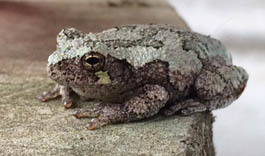 4/17 - Ulster County, HRM 84: Working on scraping and priming an old garage gives hours of time to enjoy backyard natural history. On this day in Rosendale, the warm sun and balmy 80 degrees Fahrenheit temperature made it feel like summer. Gray treefrogs (Hyla versicolor) were calling from the mature trees in my yard. Since moving to my home, I’ve been happy these little amphibians are around and surprised to learn they seem to call at all times of day. I live on a dry sand plain and expect the frogs will be moving toward water for breeding soon. [Photo of gray tree frog courtesy of Laura Heady.]
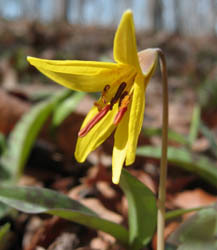 4/18 - Westchester County, HRM 51: It was a beautiful day for a hike in Somers and I came across a nice patch of trout lilies. The yellow flower of a trout lily is another sure sign of spring. [Photo of trout lily courtesy of Jim Steck.]
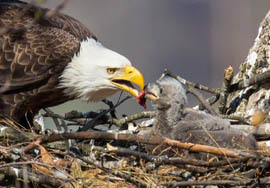 4/19 - Town of Poughkeepsie: Early this morning, Mom brought a white sucker to bald eagle nest NY62 and then left. Dad was on nest watch and when the fish, still alive, began flopping around, it seemed to give him a start. He then fed the nestling, dubbed “Peeps,” who was now 24 days old. [Photo of parent eagle feeding young eaglet courtesy of John Badura.]
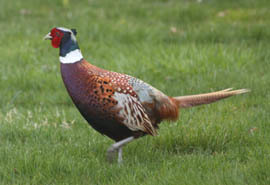 4/22 - Clinton Corners, HRM 82: Spring had finally arrived and today we saw an uncommon bird in our yard - a ring-necked pheasant. It was such a pleasure seeing this beautiful bird; we had not seen one in many years. [Photo of ring-necked pheasant courtesy of Bob and Kathleen Tucker.]
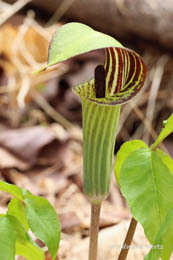 4/23 - Westchester County, HRM 36: The changes of spring were advancing at a very rapid pace at the Brinton Brook Sanctuary. These changes were apparent in the many diversities of nature including numerous firsts-of-the-season: I saw my first northern parula (warbler), my first Jack-in-the-Pulpit, my first clouded sulphur and tiger swallowtail butterflies, and my first dragonflies. Amazingly, the dragonflies were attached male-female green darners laying eggs. [Photo of Jack-in-the-pulpit courtesy of Edward Mertz.]
|
The New York State Department of Environmental Conservation respects your right to privacy and welcomes your feedback. | Update preferences or unsubscribe. | Learn more about DEC Delivers. |
|
Connect with DEC:   
|
 |
| NOW AVAILABLE: Receive DEC's Twitter feed via email. | |
| Andrew M. Cuomo, Governor * Basil Seggos, Acting Commissioner | |