
Hudson River Almanac 4/10/16 - 4/16/16
The New York State Department of Environmental Conservation sent this bulletin on 04/22/2016 04:04 PM EDT |
| DEC Delivers - Information to keep you connected and informed from the NYS Department of Environmental Conservation |
| Share or view as a web page || Update preferences or unsubscribe |
|
|
|
OVERVIEW One of the foundations of estuarine ecology is the connection of the land to the water; another is the connection between fresh water and ocean woven by migratory fish. This week we followed pulses of glass eels and river herring to the head of tide and watched bald eagles and osprey capture fish for both themselves and their nestlings. Shorebirds, wading birds, and butterflies also made an appearance. HIGHLIGHT OF THE WEEK 4/11 - Riverhead, Long Island: We finished the necropsy on the adult male bottlenose dolphin recovered on April 5 at Conference Park on Staten Island. The total length of the dolphin was 270 centimeters (8.85 feet) making it likely that, due to size, it was an offshore bottlenose. There were no teeth to assess the age of the animal and fish bones were present within the stomach and the intestinal tract. The most significant findings were intestinal adhesions which will have to be looked into further to determine their significance. [While dolphins, particularly bottlenose dolphins (Tursiops truncatus) are not common, they are also not entirely rare in the estuary. One or two are reported almost every year. The last report of an offshore bottlenose dolphin (a variety or morphotype) occurred in June 2012, in the Hudson River off Harlem. Their presence is a mystery since, as their name suggests, they are more often found offshore. NATURAL HISTORY NOTES
4/10 - Ulster County, HRM 85: By my calculations, this was Day 35 of incubation at bald eagle nest NY92 with no sign of a hatching. I watched Mom on the nest for a couple of hours this morning and tonight at sundown, Dad was on the nest and Mom flew in to relieve him. [Estimating hatch dates (average 32-35 days) is tricky. It frequently ends up being an exercise of going back 32-35 days following a hatch to find the real beginning of incubation. Not all incubations end in a hatch. According to Pete Nye, approximately 30 percent of nesting pairs are unsuccessful. Tom Lake.] 4/10 - Millbrook, HRM 82: The signs of spring were slowly emerging. The shadbush had yet to bloom but the red flowers of the maples had come and gone. Yesterday, the aspens were full of catkins like giant pussy willows in the morning sun. Little brown bats had returned to my equipment shed, perhaps a bit early; I found one dead on my doorstep yesterday morning after a night of sub-freezing temperatures. 4/10 - Hunter’s Brook, HRM 67.5: At low tide the water tumbling down the fall line and running into Wappinger Creek was a chilly 43 degrees Fahrenheit (the river was 48). We were installing a fyke net for glass eels. After a hiatus of eight years, we were once again sampling here to see if the impressive increase of these tiny fish elsewhere in the watershed had reached into Hunter’s Brook. We came upon a dead white sucker, an 18-inch female. Her abdomen was torn open and vacant; larger eels had consumed her eggs. [The fall line is a geologic term, usually applied to tidewater and is associated with sea level. It is the point at which the rise in elevation of the land at a natural falls or rapids precludes the reach of the tide. The precise point can vary day to day, tide to tide, depending on river flow, moon phase, and strength of tide. Fall lines often occur where resistant bedrock meets outcrops of less-resistant rock. Tom Lake.] 4/11 - New Paltz, HRM 78: Taking an early afternoon walk through the Mohonk foothills, I passed by the Lenape marsh and happened upon a pair of wood ducks cruising along the deeper shore. Mist-covered rosettes of mullein lined either side of my route. Nearing the end of my walk I was treated to seven vultures in a single tree: six turkey vultures and a single black vulture perched a bit apart. My last sighting was of a male kestrel sitting on a telephone wire adjacent to its nest box. Although he was 200 feet away, I was still able to discern the silhouette of a meadow vole clutched in one of his talons. 4/11- Hunter’s Brook, HRM 67.5: John Jay students were eager to see if our glass eel fyke had captured anything overnight. While there are days each spring when the catch is zero, the students reveled in the 16 glass eels and one elver that spilled out into their bucket. They considered the intriguing idea that these tiny eels were “returning to a place they had never been.” Do they receive a genetic imprinting for this brook through their parents? Why else would they choose this tiny tributary-of-a-tributary, nearly 80 miles from the sea, rather than hundreds of others in the river? It is just another piece of the mystery of the American eel. [Actually, scientists believe that American eels do not search out “home” streams. Adult eels from the entire East Coast do return to spawning grounds in the Sargasso Sea, where it is thought that mixing of parents and their genes makes it very unlikely that that their offspring would deliberately seek out a particular stream. Their choice to enter the Hudson, Wappingers Creek, and Hunter’s Brook is independent of parentage. That said, much of their life history is cloaked in mystery. Steve Stanne.] 4/11 - Manhattan, HRM 1: From our killifish traps at the River Project’s sampling station on the lighthouse tender Lilac at Hudson River Park’s Pier 25, we caught three black sea bass 90, 70, and 65 millimeters [mm] long and another rock gunnel (130 mm). Our crab pots had two northern pipefish clinging to the wire (140 and 135 mm). Our highlight, however, was at our Pier 40 location, where we caught a lined seahorse (60 mm). 4/12 Croton River, HRM 34: I watched a flock of white birds flying in formation land on the low tide sandbar just east of the railroad bridge over the Croton River. They were seven snowy egrets. Now, that will touch up your day! 4/12 - Bedford, HRM 35: Incubation continued at the great blue heron rookery. Some of the nests were not very deep, making the herons easily visible, while others were very deep, with only a part of the bird showing. With the incubation period being 27 days, we are getting close to hatchings. At one nest there was a heron with its head down and after a few minutes it settled down. I believe it was turning the eggs, which is necessary for the embryo to develop properly. 4/12 - Manhattan, HRM 3: Bagworm moths (Thyridopteryx ephemeraeformis), an invasive species, cause damage and defoliation when they feed on red cedar trees. For years they have been building cases that house their eggs along the estuary in Hudson River Park. In order to reduce their impact, park staff inspect trees and removes the cases every spring. After three years of removing bagworm moth cases in the park, there are significantly fewer of them, highlighting the power of invasive removal! 4/12 - Manhattan, HRM 1: Our catches today, from an eel pot at the River Project’s sampling station on Pier 40 in Hudson River Park, included two wrasses (Labridae): a 90 mm juvenile blackfish (tautog) and a 60 mm cunner (bergall). Both of these species have specialized teeth that allow them to feed on shellfish, particularly mussels. 4/13 - Albany County, HRM 150-148: While kayaking today, we were delighted to watch a very active common loon swimming and diving. [When hunting, loons will “troll with their eyes,” a classic behavior so beautifully described by John McPhee in The Survival of the Bark Canoe. They swim along, eyes submerged just below the surface of the water, surveying for their next meal. With the abundance of herring in the river right now, the view must have been quite appealing. Tom Lake.] 4/13 - Hannacroix Creek, HRM 132.5: Beneath a waxing moon, we counted 50 glass eels and 14 elvers at our glass eel fyke net this evening. The creek temperature was 44 degrees F. We came upon a dragonfly nymph, a hellgramite, and a number of amphipods and beetles sharing the net with the glass eels. [Elver is the next life stage after glass eel. These are, for the most part, last year’s glass eels that have lingered in the tributary and matured to the point where they look like miniature adults, in both physical characteristics and darker pigmentation. Elvers are at least two years old and range up to five years old, with sizes ranging from 100-200 mm total length. Tom Lake.] 4/13 - Town of Fishkill, HRM 63: Two Cooper's hawks, one right after the other, snatched up two mourning doves that were eating birdseed in my backyard. BAM! And literally three seconds later, BAM! Again. Other doves, sparrows, red-winged blackbirds, blue jays, brown-headed cowbirds all flew to cover. I had never seen a double strike like that before.
4/13- Hunter’s Brook, HRM 67.5: Students from Poughkeepsie Day School, joining us today to check our glass eel fyke net, were amazed with the mass of tiny eels in the bag of the net. They counted and counted, finally announcing a total of 106 glass eels. Water temperature in the brook was 52 degrees F. [In a brief search upstream to the fall line we found several large (five pound) quartzite “quarry stones.” Prehistoric artisans found these tidal streams with their multitude of water-worn chert pebbles and cobbles to be excellent sources of raw material for their stone tools (this was the Stone Age). The quarry stones, with distal and proximal fractures, were used to reduce larger pebbles and cobbles to smaller pieces from which knives, scraper, spear points, and even arrowheads could be fashioned. Tom Lake.] 4/13 - Croton River: This spot rarely disappoints. On the low tide sandbar just inside Croton Bay were two large pale plovers, killdeer-sized but chunkier: Black-bellied plovers. Before I could set up a spotting scope, a mob of gulls swept in and the plovers were gone. I had never seen them here before. 4/13 - Manhattan, HRM 1: From our killifish traps at the River Project’s sampling station on the lighthouse tender Lilac at Pier 25 in Hudson River Park, we caught white perch (200 millimeters) and pipefish (15 mm). In killifish traps at our Pier 40 location, we caught rock gunnel (100 mm) and another seahorse (60 mm). 4/14 - Stockport Flats, HRM 121-120: While I spotted five double-crested cormorants and four bald eagles on my trip, the highlight was a golden eagle. The bird flew around for five minutes and was also seen by two other experienced birders. The eagle had a golden sheen over the top of its head with the rest of bird being dark brown with a black terminal band on its tail. 4/14 - Ulster County, HRM 85: As I was watching bald eagle nest NY92, Mom soared up in a thermal, circled high above, and was joined by a red-tailed hawk. The hawk made a few stoops at her and, on one close approach, Mom reached out and grabbed the hawk by one of its talons. She then proceeded to drag it around for a few seconds before they tumbled toward the ground and released just below the tree line. 4/14 - Hunter’s Brook, HRM 67.5: Students from Poughkeepsie Day School joined us again today to check our glass eel fyke net. The students were delighted as they counted out 51 glass eels and three elvers. The brook was 53 degrees F. 4/14- Hunter’s Brook, HRM 67.5: We debated whether a night tide would be worth the effort. When we arrived at 1:00 AM, the woods on either side of the brook were oddly silent. The tide was still ebbing and the water was also flat and quiet. Our goal was to catch some of the fishes that favor the night tides, such as herring, suckers, and catfish. We did well, catching three channel catfish (23-24 inches long), white perch, white suckers and, most importantly, five alewives, four males and a female. All of the fish went back except for four white perch, a few alewives and a male white sucker (kept on ice) to show the Wappinger Junior High students later in the day. [The female alewife was 304 mm long; the four males were 268, 270, 272, and 275 mm. Tom Lake.]
4/15 - Kowawese, HRM 59: This park on the Hudson River at the head of Cornwall Bay has an outstanding low-gradient passive-use beach. On nice days in warm weather, finding space to haul a seine often means squeezing between anglers, kayaks, and canoes. Today there were a dozen or more anglers hoping for striped bass, and three kayaks, as we carefully set our 85-footer in a 70-foot-long slot. As it turned out, we caught the only fish on the beach during the two hours we were there. And while the anglers showed little interest in our catch of small fish - yellow perch, white perch, spottail shiners, tessellated darters, channel catfish, and small sunfish - the fish’s presence told us much about the strength of numbers and diversity of species in the river off this beach. The river was 54 degrees F. 4/15 - Ossining, HRM 33: Last year I spotted a pair of gorgeous gray foxes off Croton Dam Road. Early this morning I spotted another pair, or perhaps the same pair, in the same location. I am thinking that there must be a den, downslope, nearby. 4/15 - Manhattan, HRM 1: From a crab pot at the River Project’s sampling station on Pier 40 in Hudson River Park, we caught an adult winter flounder (200 mm).
4/16 - Tivoli South Bay, HRM 98.5: We caught 87 glass eels, five elvers, five fourspine sticklebacks, and 13 banded killifish at the outflow of the Sawkill. The water temperature was 55 degrees F. 4/16 - Town of Poughkeepsie: As I watched eagle nest NY62, Dad flew in with a large, green American eel. He landed, quite delicately, in the nest and shared his prize with Mom and the nestling. 4/16 - Brooklyn, New York City: I spotted an unexpected osprey nest in industrial Brooklyn today. The nest is on a very tall light tower above a parking lot at the South Brooklyn Marine Terminal in the Sunset Park neighborhood where it overlooks Gowanus Bay off the Upper Bay of New York Harbor. Two birds were visible, with one gathering nesting material. Ironically, nesting platforms recently set up at nearby Bush Terminal Park and farther away at Brooklyn Bridge Park, have not had any takers. SPRING 2016 NATURAL HISTORY PROGRAMS
WAVE training sessions are scheduled for late April and May at the following Hudson Valley locations:
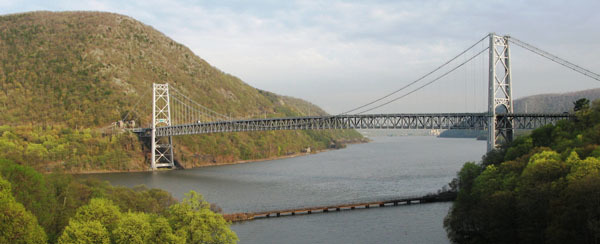
To register for a training session or for more information, email DEC’s WAVE Coordinator Alene Onion. HUDSON RIVER MILES The Hudson is measured north from Hudson River Mile 0 at the Battery at the southern tip of Manhattan. The George Washington Bridge is at HRM 12, the Tappan Zee 28, Bear Mountain 47, Beacon-Newburgh 62, Mid-Hudson 75, Kingston-Rhinecliff 95, Rip Van Winkle 114, and the Federal Dam at Troy, the head of tidewater, at 153. The tidal section of the Hudson constitutes a bit less than half the total distance – 315 miles – from Lake Tear of the Clouds to the Battery. Entries from points east and west in the watershed reference the corresponding river mile on the mainstem. TO CONTRIBUTE YOUR OBSERVATIONS OR TO SUBSCRIBE Smartphone app available for New York outdoor enthusiasts! Copies of past issues of the Hudson River Almanac, Volumes II-VIII, are available for purchase from the publisher, Purple Mountain Press, (800) 325-2665, or email purple@catskill.net |
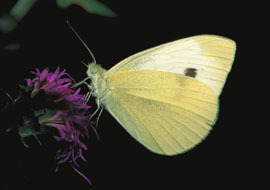 4/10 - Columbia County, HRM 119: We saw our first butterfly of the season this afternoon on the Harlem Valley Rail Trail in Hillsdale. Sadly, it was a European cabbage butterfly (Pieris rapae). As we were watching, a black-capped chickadee appeared and, using its maneuverability, tried to catch the butterfly. We didn't know who to root for: the first butterfly, although an alien species, or the cute little chickadee. The butterfly out-flew the bird, however, and they went their separate ways. [Photo of European cabbage white butterfy by Thomas G. Barnes, courtesy U.S. Fish and Wildlife Service.]
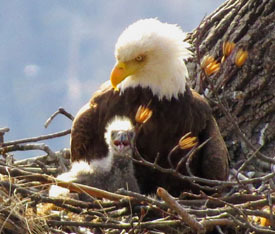 4/13 - Town of Poughkeepsie: When we arrived in mid-afternoon to check on bald eagle nest NY62, Mama was perched high in the nest, her white head glowing like a light bulb in the bright sunshine. After a while, she took off and flew toward the river, flying quite low over the heads of nearly a hundred people. Unfortunately, as is often the case, no one looked up and she passed unnoticed. [Photo of bald eagle and nestling courtesy of Mark Courtney.]
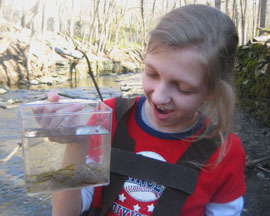 4/15 - Hunter’s Brook, HRM 67.5: The Wappinger Falls Junior High students had a double treat today as they helped us check our fyke net. This was our biggest glass eel catch of the week (175) and possibly the largest number of glass eels ever taken in a single set in this small brook (a research fyke net was used in Hunter’s Brook 2003-2008).
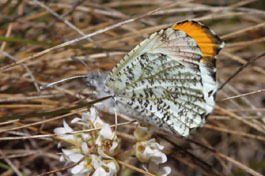 4/16 - Town of Saugerties, HRM 102: Early season butterflies were increasing in number with warming temperatures. Today's walk on a utility cut produced three male and five female falcate orangetips (Anthocharis midea), two eastern pine elfins, five spring azures, and one each of eastern comma and mourning cloak. I also noticed the first signs of post-hibernation Baltimore checkerspot activity, with several dozen small caterpillars feeding on new growth English plantain in my meadow. [Photo of falcate orangetip butterfly courtesy of Steve Chorvas.]
|
The New York State Department of Environmental Conservation respects your right to privacy and welcomes your feedback. | Update preferences or unsubscribe. | Learn more about DEC Delivers. |
|
Connect with DEC:   
|
 |
| NOW AVAILABLE: Receive DEC's Twitter feed via email. | |
| Andrew M. Cuomo, Governor * Basil Seggos, Acting Commissioner | |