
Hudson River Almanac 3/28/16 - 4/2/16
The New York State Department of Environmental Conservation sent this bulletin on 04/08/2016 05:01 PM EDT |
| DEC Delivers - Information to keep you connected and informed from the NYS Department of Environmental Conservation |
| Share or view as a web page || Update preferences or unsubscribe |
|
|
|
OVERVIEW This week saw Hudson River Valley bald eagle nestlings being fed, great blue herons and osprey preparing for their nesting season, and near-record numbers of glass eels (juvenile American eels) pulsing into the tributaries. HIGHLIGHT OF THE WEEK 3/28 - Croton-on-Hudson, HRM 34: It was a welcome sight: the “cell tower” osprey pair had returned. We watched as they busily carried nesting supplies to the top of the cell tower in the Croton-Harmon Railroad Station parking lot. One stout stick was surely more than four feet long. These were highly motivated birds! [This will be this pair’s fourth season at this nest. They fledged three young in 2013, two in 2014, and two more last summer that left the nest in mid-July. Tom Lake.] NATURAL HISTORY NOTES 3/28 - Saratoga County, HRM 166: Our osprey had returned to Ballston Lake. I watched today as one of them appeared to be trying to steal a meal from a gull, but did not succeed. Two great blue herons flew over as a tightly matched pair, and the night sounds of the spring peepers were almost loud enough to drown out the honking of the Canada geese. 3/28 - Town of Stuyvesant, HRM 127: On a survey this afternoon I counted 43 bird species including a single snow goose in with two Canada geese out in a cornfield. I came upon three ring-necked pheasants, each in a different field. Feeding in a shallow pool of water in a muddy cornfield was a Wilson's snipe. Perched in a tree overlooking the cornfield was a merlin. [The ring-necked pheasant (Phasianus colchicus) is native to Asia but has been extensively introduced in North America and raised and released as a game bird. Seasonal holdovers from hunt club introductions find it difficult to survive in the presence of robust coyote and fox populations in the Hudson Valley. Overall, New York’s pheasant population has declined nearly 90% since 1970. Most biologists believe it is because of a lack of fallow grasslands for nesting and brood-rearing. Visit DEC’s ring-necked pheasant webpage for more information. Tom Lake.] 3/28 - Columbia County: I was very pleased to receive an email today from Denmark regarding the nine yellow-collared Canada geese I reported that were part of a flock of more than 400 in the Town of Schodack (see 2/27 - Schodack, HRM 139). “I write to thank you for reporting the neck-collared Canada geese to the Bird Banding Lab. This is an extraordinary set of observations and we are very grateful. These Canada geese were all banded in west Greenland; it is unusual to have reports of so many individuals together away from Greenland. All of the birds you reported were caught in the summer of 2014 in Isunngua, a region of inland west Greenland close to ice cap, on two lakes in relative close proximity to each other. Note that all of the geese you reported were full grown, older than first-summer geese when banded. Most of these geese were seen in Nova Scotia this fall before coming your way.” Tony Fox, Bioscience, Aarhus University.
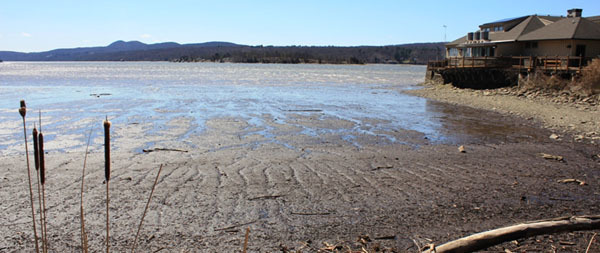
3/29 - Rhinebeck, HRM 90: Driving past an open field on Route 308, I spotted a large bird feeding on roadkill. Then we spotted the white head. “That’s an eagle!” We pulled over. The eagle grabbed what appeared to be part of a white-tailed deer carcass and attempted to fly off, but had to land. As we waited, the eagle began to feed again, nervously looking around, amazingly close to the road. [One of the tenets of eagle watching is to stay in your vehicle. Eagles appear to have no qualms about being watched as long as you do not step outside in an attempt to get closer. Tom Lake.] 3/29 - New Hamburg, HRM 67.5: After two days of strong west-northwest winds, we had an extraordinary blowout tide. The flood tide never seemed to rise as the ebb continued to fall. At its lowest, exposed mud flats were all that remained of the Wappinger Creek delta. The too-many-to-count tiny tide pools held stranded river life, and two great blue herons and many gulls were having a buffet. [see banner photo of blowout tide at Norrie Point, courtesy of Chris Bowser.] 3/29 - Furnace Woods, HRM 38.5: No matter how bountiful our garden becomes, wild food – foraged food – is important in this home, and never more so than at this time of year. A huge salad of dandelion crowns, dressed with sliced “Easter Eggs” and wild onions, was the main course tonight, satisfying in every way (without, of course, the American shad roe that for so many years made up the rest of this vernal feast). 3/30 - Albany, HRM 146: For a couple of weeks now, we’ve been hearing spring peepers and wood frogs in the vernal pools and permanent ponds. But tonight the gray tree frogs joined in to serenade us (a bit early this year?). It’s encouraging to hear them since the pools are small due to a lack of snowmelt. 3/30 - Albany, HRM 145: Driving on Everett Road near the old First Prize Factory this morning, we had a raven fly in and land on the First Prize sign. It was joined by a second raven. Would a bird that nests on cliffs like the concrete ruins of a factory? [In New York City, they've been seen nesting not only on old warehouses, but also water and cellular towers. Zach Schwartz-Weinstein.] 3/30 - Town of Poughkeepsie: In mid-morning at eagle nest NY62, it was Day 4 for at least one nestling. Dad was in the nest feeding the nestling, but the bowl of the nest was deep and the nestling was well hidden. Mom arrived in mid-day with a squirrel (which she “de-furred”) and then flew to a nearby perch. In mid-afternoon, Dad flew out of the nest, vocalizing to Mom, but she would not budge. So he returned to the nest, doing double duty. 3/30 - Quassaick Creek, HRM 60: The unbelievable occurred today: Our research fyke contained not a single glass eel from an overnight set. The huge numbers we have been seeing dissolved away. We speculated over a dozen possible causes, among them moon tide, water temperature, and blowout tide. But not one seemed entirely plausible. This was likely the vagaries of fish migration; it is not like a faucet turned on, but more like a sprinkler with pulses, with inherent gaps in the flow. 3/30 - Bedford, HRM 35: The great blue heron rookery was off to a very good start. It appeared that there were now 15 occupied nests, with eight nests having a heron incubating. Last year I counted 12 occupied nests. Before egg laying begins, the usual pattern is for one heron to guard the nest from intruders while the mate is off hunting. I believe that some of the unoccupied nests in past years have now been built up and are large enough and strong enough to support the weight of the adults and their brood. 3/30 - New York Harbor, Upper Bay: I spotted a single dolphin off the west side of Governors Island today. It was heading south toward the Statue of Liberty. It was black, surfaced twice, and seemed too big to be a harbor porpoise. The dorsal fin looked more like a dolphin, but I am not an expert. I never got a good look at its snout. [We have a report of a deceased dolphin (I believe a bottlenose) dead at Conference Park, Staten Island, NY. The carcass looks to be in an advance state of decomposition, so while this would not be Doug Vogel’s dolphin, its presence suggests there may be another one in the Upper Bay. In additions to seals, dolphins and porpoises are well known to enter the estuary in spring following the incredible spawning runs of American shad and river herring. Kim Durham, The Riverhead Foundation.] 3/31 - Hannacroix Creek, HRM 132.5: Eels have been trickling into our fyke net since we installed it ten days ago. We have only caught a few glass eels and a few elvers, but there's been plenty of excitement. Four days ago we spied a mudpuppy in the rocks beneath the net. Today Ro Woodard, a fellow volunteer, told me that they had an immature mudpuppy in the net along with three elvers and one glass eel. 3/31 - Town of Poughkeepsie: This was eagle nestling Day 5 at NY62. We arrived at the nest in mid-morning as a change-over was in progress: Dad left, Mom took over. We were able to watch two very short feedings while there and managed to see the top of one little white fluffy head. We are still not sure if there is more than one. [Again this year, against all protocols of sound wildlife management, the many admirers of the NY62 bald eagles have named the first nestling hatched on Easter Sunday “Peep.” Tom Lake.] 3/31 - Beacon 60.5: Another nice carp – 24 inches long; six pounds - was caught and released today. Additionally I landed four brown bullheads in quick succession once the tide turned to flood. 3/31 - Quassaick Creek, HRM 60: How fortunes can turn! After the empty fyke net of yesterday, today’s catch was difficult to lift. As we peered into the throat of the net, we were stunned to see a writhing mass of glass eels - we had a fyke-full! It took us three hours to count the 6,004 glass eels and six elvers. The water temperature was 53 degrees Fahrenheit, about ten degrees warmer than last year at this time. Today’s conditions mirrored yesterday’s, but the gap in the run had closed. [This was the second highest number for a single lift ever recorded for this program. The highest number, 8,067 glass eels, was recorded on April 20, 2013 in Hannacroix Creek (river mile 132.5). Chris Bowser.]
4/1 - West Hurley, HRM 93: As I traveled from my home in Selkirk to West Hurley, the transformation was amazing (river mile 135-93), as everything in West Hurley was in bloom: trees, flowers, and bushes. 4/1 - Highland, HRM 75: We were on the Highland Trail in early morning, from the Walkway over the Hudson to the underpass for Route 9W, when we came upon a standoff: A feral black-and-white cat and a turkey vulture were each eying a dead opossum. Each time the vulture flapped its large wings, the cat backed off and finally walked away. On our way back along the trail another turkey vulture had joined the first and together they had made good progress on disposing of the carcass. 4/1 - Mid-Hudson Valley: It was difficult to reconcile that azaleas were in bloom on April 1, and the woods were filled with shadbush. The air temperature of 78 degrees F helped offset the unusually early calendar date. We noted a later bloom last year, on April 26: “The clean white blossoms of shadbush were beginning to bloom, perhaps a little late this year.” This plant was named, in part, because its flowers generally appeared at the time American shad were beginning their spawning run up estuaries in the Mid-Atlantic and Northeast. However, seasons have shifted over the last century (climate change), and its timing has become more aligned with the full throttle of the run. [For thousands of years, people have measured springtime by the appearance of flowers, a process called phenology, the study of nature through the appearance of seasonal phenomena. The word comes from the Greek word “phaino,” meaning “to appear,” or the Latin “phenomenon,” meaning “appearance, happening, display, or event.” Those who worked on the river came to associate certain blooms with events unseen, such as the shadbush and the arrival from the sea of American shad and river herring. Presently, the progression moves north in an orderly manner from magnolia to forsythia to shadbush to dogwood, with lilac being the final signal that spring is ready for summer. Tom Lake.] 4/1 - Hunter’s Brook, HRM 67.5: It was just past twilight and the colors in the landscape were turning to gray. The last notes of “teacher, teacher, teacher” were coming from the woods. We were returning glass eel we had caught to the brook so they could continue their journey upland where they might spend the next decade or even longer. As we finished we saw a faint movement along the creek below us. It was a coyote, not more than 50 feet away at the edge of the woods. It had been there all the while, blending in, assessing what we up to and if we were a threat. I guess we passed, for the coyote turned and walked very slowly away. [“Teacher, teacher, teacher,” is the song of the ovenbird, a sparrow-sized warbler. Tom Lake.] 4/1 - Furnace Woods, HRM 38.5: Black flies began to bite today. Ugh! But it was 72 degrees F, shirt sleeves weather. Robins and cardinals were caroling merrily and the radishes, peas, and arugula were poking up. 4/1 - Croton-on-Hudson, HRM 34: I watched as a common loon patrolled an offshore sandbar in Croton Bay. The pair of osprey were again today industriously carrying nesting material to the cell tower in the Metro North parking lot. 4/1 - Ossining, HRM 33: I accompanied Pace University’s Environmental Sciences Field Studies class, led by Professor Mike Rubbo, to assess the vernal pools at Teatown Reservation. We explored two different vernal pools, taking counts of salamander eggs and wood frog eggs. In the first vernal pool we found 16 rafts of salamander eggs and 38 rafts of wood frog eggs, including uncountable numbers of tiny tadpoles. We found many spring peepers and wood frogs; we even saw what we think was a very large green frog. We also found a red backed salamander, two red-spotted newts, two garter snakes, and two spotted turtles! It was a great day in waders! 4/2 - Newcomb, HRM 302: The wood frog egg masses in a vernal pool and the sighting of a common loon on the open water of a local lake this morning told me it was finally spring. In the past week we have seen American robins, red-winged blackbirds, common grackles, snow geese, Canada geese, song sparrows, hooded mergansers and common mergansers, but nothing says spring like the call of the wood frog. 4/2 - Dutchess County, HRM 98.5: We worked our research eel fyke on the Saw Kill between rain showers and caught 105 glass eels, five elvers, 25 sticklebacks, and five banded killifish.
SPRING 2016 NATURAL HISTORY PROGRAMS Striped Bass Cooperative Angler Program Volunteer Opportunity: Eel Monitoring Saturday, April 9: 1:00 p.m. HUDSON RIVER MILES The Hudson is measured north from Hudson River Mile 0 at the Battery at the southern tip of Manhattan. The George Washington Bridge is at HRM 12, the Tappan Zee 28, Bear Mountain 47, Beacon-Newburgh 62, Mid-Hudson 75, Kingston-Rhinecliff 95, Rip Van Winkle 114, and the Federal Dam at Troy, the head of tidewater, at 153. The tidal section of the Hudson constitutes a bit less than half the total distance – 315 miles – from Lake Tear of the Clouds to the Battery. Entries from points east and west in the watershed reference the corresponding river mile on the mainstem. TO CONTRIBUTE YOUR OBSERVATIONS OR TO SUBSCRIBE Smartphone app available for New York outdoor enthusiasts! Copies of past issues of the Hudson River Almanac, Volumes II-VIII, are available for purchase from the publisher, Purple Mountain Press, (800) 325-2665, or email purple@catskill.net |
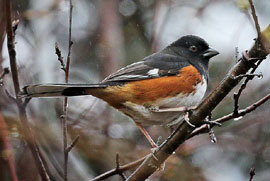 3/28 - Norrie Point, HRM 85: “Drink your tea," the song of the eastern towhee, was in the air. They had arrived. I heard and saw a male towhee this afternoon at Norrie Point. [Photo of male eastern towhee courtesy of Deborah Tracy-Kral.]
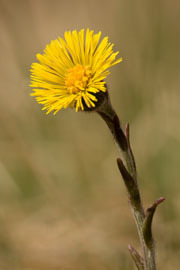 4/1 - Town of Stuyvesant, HRM 120: The skunk cabbage was prolific along the half-mile of Lewis Swyer Preserve boardwalk at a freshwater tidal swamp of Mill Creek. Amidst the thousands of these odd and odiferous plants with their hooded, maroon-colored bracts (called spathes), bright green leaves, and hidden yellow flowers stood one lone coltsfoot. Most likely, within 48 hours, the score will be evened up as the coltsfoot’s perennial root system produces more flowers from its extensive underground network. [Photo of coltsfoot by Richard Bartz under
 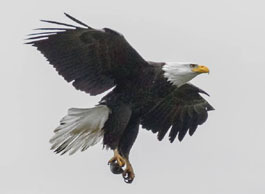 4/2 - Town of Poughkeepsie: We watched Dad return to bald eagle nest NY372 with a musk turtle. NY372 is a new nest (second season) near the Hudson River. [Photo of adult bald eagle with turtle in talons courtesy of Bob Rightmyer.]
|
The New York State Department of Environmental Conservation respects your right to privacy and welcomes your feedback. | Update preferences or unsubscribe. | Learn more about DEC Delivers. |
|
Connect with DEC:   
|
 |
| Andrew M. Cuomo, Governor * Basil Seggos, Acting Commissioner | |