
Hudson River Almanac 3/21/16 - 3/27/16
The New York State Department of Environmental Conservation sent this bulletin on 04/01/2016 03:56 PM EDT |
| DEC Delivers - Information to keep you connected and informed from the NYS Department of Environmental Conservation |
| Share or view as a web page || Update preferences or unsubscribe |
|
|
|
OVERVIEW The season for nestlings has arrived and we must give extra thought to our wildlife viewing and photography habits. Many birds, such as bald eagles, will abandon their nests if they feel threatened. Our trying to get closer for a better look is often the primary threat. An eagle’s instinct tells them that if they sacrifice themselves for this year’s nestlings, their lineage will die. If they leave, they will have the opportunity to reproduce next year. Wildlife is ambivalent: They do not love you, they do not hate you. But they will fear you if you enter their comfort zone. Getting closer should rely more on our optics than our legs. HIGHLIGHT OF THE WEEK 3/27 - Poughkeepsie, HRM 75.5: While a squadron of white suckers jockeyed for position just upstream of the Water Street bridge, the Fall Kill eel fyke net yielded a wonderful wriggling catch of 423 glass eels, seven elvers, and one small banded killifish. One of my favorite parts of eel monitoring on the Fall Kill is the regular parade of weekend visitors and the inevitable question “What are those things?” when they see the hundreds of squiggly threads swarming in our buckets and bags. Glass eels are a natural gateway for people to learn about creeks, estuaries, and the ocean. A Little Killifish Haiku NATURAL HISTORY NOTES
[Yes, these were zebra mussels. We are used to seeing smallish zebra mussels in the Hudson, but they do get quite a bit larger - I've seen zebra mussels close to two-inches-long in a creek in central New York. My guess would be that they found hospitable conditions in the creek mouth, and have somehow avoided predators. Dave Strayer, Cary Institute of Ecosystem Studies.] 3/21 - Town of Poughkeepsie: We waited for four hours this afternoon in the wind and cold for a change-over at eagle nest NY62. And was it ever worth it, a spectacular show. Mom had been in the nest incubating and Dad was perched in “his tree” a bit north of the nest. Mom began calling (her shift was up) to Dad to come relieve her, but he wasn't being cooperative. She finally flew to him and, after a brief chat, he flew toward the nest tree. He ended up landing on the “front perch” and then into the nest. 3/21 - Furnace Woods, HRM 38.5: A late-winter storm had frosted the landscape with a skim of sleet and snow. The crocus, daffodils, and snowdrops flashed their fresh colors from beneath caps of white. 3/21 – Brinton Brook Sanctuary, HRM 36: Signs of spring were everywhere: Air temperatures were warming, flowers were starting to bloom, tree buds were fattening, bird populations were moving, and butterflies were emerging. I saw my first mourning cloak today as well as my first spring azure. 3/22 - Town of Bethlehem, HRM 141: I watched a bald eagle attack a crow today at the Moh-He-Con-Nuck Nature Preserve. The crow was harassing an immature eagle in flight and that led to them both landing in a tall white pine. The crow began screaming in distress and then an adult eagle joined the fray. After that the crow's cries faded away pretty quickly. I don't think the crow survived though I couldn't be sure. [Crow/eagle interactions usually do not reach a “combat” stage. Crows are more agile and generally far too clever for an eagle to engage.] [Moh-He-Con-Nuck is a derivation of the Algonquian word “Mahicanituk” (since Native Americans had an oral tradition, our spelling of words they spoke is phonetically approximate). In their aboriginal language, surviving as Indian folklore, this was generally translated as “the river that flows both ways.” This phenomenon is caused by the hydrology and physics of water depth and current velocity. Current is a horizontal measurement of water movement; tide is a vertical measurement. Often the river will cease to rise or fall (tide), but the Hudson's waters will continue to flow upriver or down at some speed (current). Tom Lake.] 3/22 - Ulster County, HRM 85: When I arrived in early morning to monitor bald eagle nest NY92, Mama was in the nest incubating and an immature eagle was perched not far away. In mid-morning, two adult eagles soared overhead. One circled back above the nest for a few minutes, calling loudly, and then made a steep dive straight at the nest with talons extended. This was Dad and he was going after the interloper. After chasing off the immature, Dad arrived at the nest and swapped incubation duty with Mama. 3/22 - Town of Poughkeepsie: I arrived at eagle nest NY62 in early morning in anticipation of catching the morning change-over for incubation duty. Mama was in the nest diligently rotating the egg(s) every 45 minutes. In midday, when the nest was in full sunlight, she ventured out to find Dad. She returned seven minutes later by herself. Dad has a history of occasionally shirking his duty. [When incubating, eagles will turn or rotate their eggs periodically in an effort to distribute the adult’s body heat. Tom Lake.]
3/22 - Sleepy Hollow, HRM 28: I saw a river otter in a local pond again today. It swam along the pond shore looking like a miniature Loch Ness Monster, then disappeared into the bank. This is my third sighting since 2008. I don’t know if it’s the same otter or a different one each time. 3/22 - Manhattan, HRM 1: This week we caught some interesting fishes at the River Project’s sampling station on the lighthouse tender Lilac at Pier 25 in Hudson River Park. Among them were two northern pipefish (130 and 195 millimeters [mm]), another grubby (85 mm), another rock gunnel (115 mm), and a juvenile oyster toadfish – this last species in one of our cages in which we overwinter our oysters. [Oyster toadfish, known colloquially as “oyster crackers,” are common along the Atlantic Coast and in New York Harbor. They set up shop on the bottom of the river and, with strong, sharp teeth, they crush and feed on shellfish such as crabs, oysters, and other bivalves. While they are most often found in salt or brackish water, they can tolerate low salinity and even freshwater for a short time. Tom Lake.] 3/23 - Greene County, HRM 109.5: At least two great cormorants were on the “IB” channel marker today. With a spotting scope, I could see the white patches on two of the five birds that all looked about the same overall size. Double-crested cormorants were also on the marker.
3/23 - Beacon, HRM 60.5: My first common carp of the season was caught and released today. The fish weighed nine pounds, ten ounces, and was 28 inches long. There was also lots of bait-stealing going on, probably from golden shiners, brown bullheads, small channel catfish, and white perch. 3/23 - Quassaick Creek, HRM 60: We caught an incredible number - more than 3,000 – of glass eels in our research fyke net today. 3/23 - Kowawese, HRM 59: The full moon had the tide racing from flood to ebb back to flood. We hauled our seine in the shallows (46 degrees F) more for practice than in any real anticipation of a great catch. Therefore we were not disappointed when the net held only the locals: spottail shiners, tessellated darters, yearling channel catfish, and various sunfishes. A dozen anglers on the beach were no more successful than us, but their stories of “the one that got away” and “that huge fish caught last week” kept us entertained. 3/24 - Northern Dutchess County: It is an amazing experience to watch a bald eagle sail across the sky, kite for a few minutes, and then let the wind drift it back across the sky, back and forth, back and forth. I watched this for almost an hour today until the bird soared high and left the area. They and other raptors are spectacular birds - as Peter Dunne calls them, “The Wind Masters!” 3/24 - Albany County, HRM 145: The Thursday Birders who were scared off by the changing weather forecast missed a pleasant morning at Black Creek Marsh Wildlife Management Area. Spring migrants were slowly trickling in. Wood ducks were the most numerous waterfowl with more than 30; green-winged teal numbered in the dozens. Four killdeer postured and mated on the rails. It was also an active raptor day with one each of red-tailed hawk, northern harrier, sharp-shinned and Cooper's hawks, and American kestrel. However, the best bird of the day was a Virginia rail calling loudly “kidik-kidik-ing.”
3/25 - Bedford, HRM 35: As noted by others, the great blue herons are back at the Bedford rookery. I rode by there today and most of the two dozen nests were already occupied. 3/26 - Schenectady County, HRM 159: Downy, hairy, and red-bellied woodpeckers visit my suet feeder almost every day in Glenville, and did again today. A pileated was out in the woods and I just had a northern flicker at the suet feeder. It was a “five woodpecker day.” It still amazes me to have red-bellied woodpeckers around all the time. From when we moved here in 1985 until fall 1993, I never saw one. Then they were rare but notable visitors for several years. Now they are always seen or heard whenever I am out. 3/26 - Greene County, HRM 128: I cleaned out nine of ten bluebird nest boxes at the Coxsackie Creek Grasslands Preserve at the New Baltimore/Coxsackie line. Most of the nest boxes had mice taking up residence. Some of them needed an additional touch-up and tightening, especially the door hinges and pole fasteners. There were three bluebirds waiting nearby at three of the box sites as if to lay claim as soon as the premises were ready for occupancy. A pair of kestrels was also investigating the nest box supplied for them as well. Ah - Spring! 3/26 - Coxsackie, HRM 124: I spotted a common loon as well as four buffleheads at midday at the Coxsackie Boat Launch. Meanwhile, I counted 30 ring-necked ducks and a lot of common mergansers at Coxsackie Reservoir. 3/26 - Ulster County, HRM 85: I visited bald eagle nest NY92 in mid-morning, finding Mama on the nest incubating. Within a few minutes two immature eagles appeared and flew low and close with one landing on a limb above the nest, prompting screams from Mama. I was thinking that the male was not close enough to hear, but then I spotted him flying in like a rocket with full, steady, fast wingbeats. The chase was on! I was amazed at just how far away Dad was, yet he still heard the calls. After chasing off the immature he perched in a tree nearby and kept watch. 3/26 - Town of Poughkeepsie: Once again in violation of protocol, Dad brought a fish back to the nest and both adults helped themselves. These eagles are either supremely confident in their nest being “raccoon proof,” or they are simply tired of waiting. The gorgeous orange flowers of the tulip tree in the canopy were beginning to open. 3/27 - Saratoga County, HRM 169: There was a pair of ospreys calling constantly on a nest at Ballston Creek Preserve today. 3/27 - Selkirk, HRM 135: I spotted a golden eagle gliding and flying north over our neighborhood late this afternoon. 3/27 - Germantown, HRM 108: On a somewhat gloomy Easter morning, I went for my usual eagle check at the Anchorage (Lasher Park) and found only a bunch of cormorants on the green channel marker. As I was about to pack it in, I looked at the water and saw a trail of disturbance. My first thought was muskrat. My second thought was seal. Finally I made it out to be a river otter! It also seems that I have a great horned owl around my property. I found a headless red-winged blackbird on the front lawn and a goodly pile of bunny fluff under the bird feeders. I hope that was not the Easter Bunny. 3/27 - Town of Poughkeepsie: After several change-overs at eagle nest NY62, and another fish brought in by Mama in midday, it appeared that we had an Easter Hatch! Dad was in the nest looking down and he moved as if there was a tiny eaglet under him. He then began feeding some of the fish to the unseen hatchling. This is year sixteen for this pair, eleven of which have produced nestlings. [Hindsight is often 20:20. Our original estimate for the start of incubation at NY62 was February 17. However, with a hatch on March 27, we reinterpreted the activity during the third week of February and have fine-tuned our estimate to February 24, making Easter Day 33. This fits well within the average of 32-35 days. Tom Lake] 3/27 - Town of Wappinger, HRM 67: As another reminder of seasons lost, forsythia and magnolia were in full bloom. This used to be the time of the spring when fishers would be mending their nets in the sunshine, oilskins coated with fish scales, and delicious anticipation building for the next drift for American shad on the river. [All commercial fishing for American shad ceased on the Hudson River in 2010. The closure was made necessary by the drastic decline in shad populations primarily due to decades of poorly regulated over-harvesting in coastal waters. Tom Lake.] SPRING 2016 NATURAL HISTORY PROGRAMS Striped Bass Cooperative Angler Program Volunteer Opportunity: Eel Monitoring Saturday, April 9: 1:00 p.m. HUDSON RIVER MILES The Hudson is measured north from Hudson River Mile 0 at the Battery at the southern tip of Manhattan. The George Washington Bridge is at HRM 12, the Tappan Zee 28, Bear Mountain 47, Beacon-Newburgh 62, Mid-Hudson 75, Kingston-Rhinecliff 95, Rip Van Winkle 114, and the Federal Dam at Troy, the head of tidewater, at 153. The tidal section of the Hudson constitutes a bit less than half the total distance – 315 miles – from Lake Tear of the Clouds to the Battery. Entries from points east and west in the watershed reference the corresponding river mile on the mainstem. TO CONTRIBUTE YOUR OBSERVATIONS OR TO SUBSCRIBE Smartphone app available for New York outdoor enthusiasts! Copies of past issues of the Hudson River Almanac, Volumes II-VIII, are available for purchase from the publisher, Purple Mountain Press, (800) 325-2665, or email purple@catskill.net |

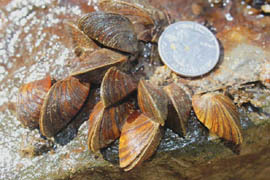 3/21 - Hannacroix Creek, HRM 132.5: We installed our glass eel research fyke net today with a band of hearty, happy volunteers in chilly 40 degree Fahrenheit water. I noticed quite a few large mussels on several rocks, all of a fairly uniform size that looked very much like zebra mussels. However, they were much larger than any zebra mussel I had ever seen. We’ve been setting nets in this creek each spring since 2010, and this is the first time any of us had seen these. Could the tidal mouth of the Hannacroix be an odd refugia of older and larger zebra mussels? [Photo of zebra mussels in Hannacroix Creek courtesy of Chris Bowser.]
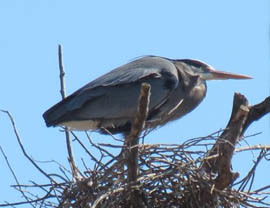 3/22 - Bedford, HRM 35: The great blue heron rookery appeared to now have ten occupied nests. The heron in one nest had only its back and bill showing, which could mean that this early nester had started laying eggs. Heron eggs are usually laid at two-day intervals with a total of three to five eggs per nest. Two nests had a pair of herons while the rest of them had a single bird standing guard. On two occasions, a heron flew to a nest with its mate taking off. [Photo of great blue heron at nest courtesy of Jim Steck.]
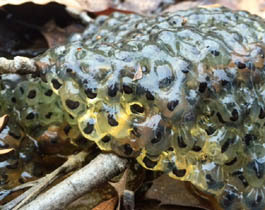 3/23 - Ulster County, HRM 90: In most of the Hudson Valley, it seems the amphibian breeding season was underway on March 10, when wood frogs, spotted salamanders, and Jefferson-blue spotted salamander hybrids were observed on their migrations to woodland pools. Since that rainy night, there’s been little precipitation and no snow to melt, so these pools may be a little dryer than is typical for the season. The amphibians rely on adequate inundation for eggs to hatch and young to develop before the pools dry up, usually in summer. I’ve been visiting a particularly shallow woodland pool in Rosendale; today it had dried up considerably, leaving spotted salamander and wood frog egg masses out of the water. They appeared to still be viable, although a little dry and sticky on the outside, and we returned them to the now small pool. The unusual dry winter reminds us of how vulnerable woodland pool breeding habitat may be to climate change, and how important it is to proactively conserve these critical habitats. [Photo of wood frog egg mass courtesy of Laura Heady.]
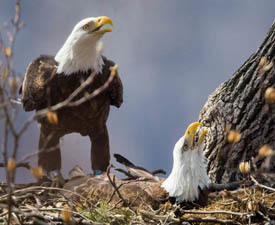 3/24 - Town of Poughkeepsie: For once our timing was perfect at eagle nest NY62 as we were there to see the 2:00 PM change-over. In what turned out to be a false alarm, we saw Dad bring a fish to the nest where the two adults ate it. Ordinarily, the first food delivery means another mouth to feed, and for a while we were sure there had been a hatch. Eventually we recognized that the incubation was still ongoing and that Dad had simply violated “the law of the nest” [no food in the nest until eaglets must be fed]. [Photo of incubation changeover at bald eagle nest courtesy of John Badura.]
|
The New York State Department of Environmental Conservation respects your right to privacy and welcomes your feedback. | Update preferences or unsubscribe. | Learn more about DEC Delivers. |
|
Connect with DEC:   
|
 |
| Andrew M. Cuomo, Governor * Basil Seggos, Acting Commissioner | |