|
OVERVIEW
Black vultures seemed to be a hot topic this week, from both entries and personal conversations. Their rather recent range expansion north from the Mid-Atlantic States has some ecologists thinking climate change.
HIGHLIGHT OF THE WEEK
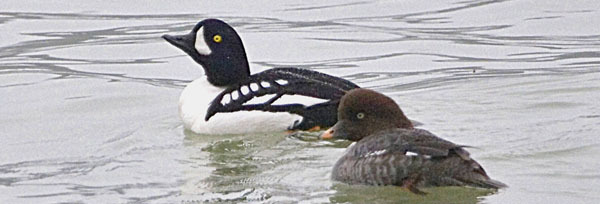
3/6 - Glasco, HRM 100: In early afternoon, Deb Ferguson and Frank Murphy came upon a drake Barrow's goldeneye on the Hudson River. The bird was associated with a good-sized flock of common goldeneye and both greater and lesser scaup.
- Mark DeDea
[A Barrow's goldeneye is always a good find in Ulster County waters but this individual marks the third consecutive March with a county sighting. Traditionally, our reach of the Hudson peaks in waterfowl numbers and diversity over the next two weeks. Maybe we'll have another rarity to report. Mark DeDea.]
[While on the subject of waterfowl, we note that the last issue’s description of eclipse plumage in reference to the common loon mentioned in a 2/29 entry gave an overly broad definition of the term. According to Erik Kiviat of Hudsonia, eclipse is not normally used to describe the typical winter plumage (technically called basic plumage) of loons and many other species. Rather, eclipse plumage is used in reference to ducks and a few other species that molt into their dull basic plumage only briefly in summer before quickly molting again into breeding plumage. Steve Stanne.]
NATURAL HISTORY NOTES
3/1 - Valatie, HRM 129: In a field of a large farm on Running Creek Road, I counted 80 Canada geese. Mixed in was a single snow goose.
- Nancy Kern
[This phenomenon is not common, but is seen several times each fall and late winter during migration. The usual explanation is that the snow goose somehow loses contact with its parent flock, senses a family kinship (Anatidae), and joins their loosely-related relatives. Tom Lake]
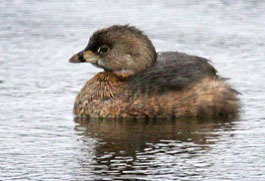 3/1 - Eastern Dutchess County, HRM 96: I was counting the ring-necked ducks on Twin Island Lake in Pine Plains when I was surprised to see a wee pied-billed grebe, my first sighting of the season! [Photo of pied-billed grebe courtesy of Deborah Tracy-Kral.] 3/1 - Eastern Dutchess County, HRM 96: I was counting the ring-necked ducks on Twin Island Lake in Pine Plains when I was surprised to see a wee pied-billed grebe, my first sighting of the season! [Photo of pied-billed grebe courtesy of Deborah Tracy-Kral.]
- Deborah Tracy-Kral
3/1 - Rhinebeck, HRM 90: The image of a banded adult bald eagle (R68) was captured on a trail camera near Silver Lake. She stayed around for a few days before leaving.
- Jay Meyer
[Bald eagle R68 is a nine-year-old female; she was banded on May 15, 2007 at Neversink Reservoir in Sullivan County. She was four weeks old when she was banded and was one of two nestlings. The other was also a female. Malcolm Grant.]
3/1 - Pleasantville, HRM 32: We were walking down Main Street when we heard a deep, croaking call that didn't sound like the abundant local American and fish crows. We stopped and looked up as the bird flew over. Large size? Check. Big beak? Check. Wedge-shaped tail? Check. Yes, it was a common raven, the first we've ever seen here.
- Joe Wallace, Sharon AvRutick
3/2 - Saugerties Lighthouse, HRM 102: The local bald eagle pair appear to be on eggs (incubating) in their nest (NY205) across the river from the lighthouse.
- Patrick Landewe
3/2 - Kingston Point, HRM 92: This was an extremely cold and windy morning (air temperature mid-20s), too cold for black vultures to be in the air. As I pulled up to the Kingston Point beach, I spotted two black vultures on the roadside. I passed within ten feet of them and had to admit that they were, despite their culinary preferences, very handsome birds. Out on the river I had the opportunity to see a double-crested cormorant briefly fly backwards in the high wind.
 - Tom Lake - Tom Lake
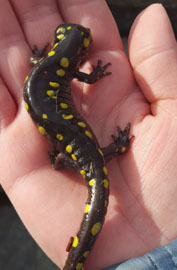
3/2 - Staatsburg, HRM 86: In a first unmistakable sign of spring, I came upon a gorgeous spotted salamander on our walkway. [Photo of spotted salamander courtesy of Wendi Huff.]
- Wendi Huff
3/2 - Hyde Park, HRM 80: Not even a half-hour after sunrise this morning, I spotted a fisher on the north end of the Culinary Institute of America campus. As far as we can tell, this was the first time anyone had seen or reported a fisher here. Once it saw me, the fisher made a quick exit into the woods.
- Robin Watzka
[Fishers are one of our largest weasels (our river otters are similar-sized) reaching over 40 inches in length. While they reside in the Catskills and Adirondacks, they are not common in the Mid-Hudson Valley. While the name of this fur bearer suggests an aquatic habitat and diet, they actually much prefer dense forests and porcupines. One of the colloquial names for the fisher is “fisher-cat.” Ellen Rathbone.]
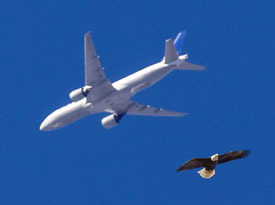 3/2 - Town of Poughkeepsie: One of the adults from bald eagle nest NY62 (I think it was Dad), was captured in a photo as it soared overhead. The eagle was in the foreground with a Jet Blue commercial airliner in the background approaching to land at Stewart Airport in Newburgh. [Photo of bald eagle and jet airliner courtesy of Bob Rightmyer.] 3/2 - Town of Poughkeepsie: One of the adults from bald eagle nest NY62 (I think it was Dad), was captured in a photo as it soared overhead. The eagle was in the foreground with a Jet Blue commercial airliner in the background approaching to land at Stewart Airport in Newburgh. [Photo of bald eagle and jet airliner courtesy of Bob Rightmyer.]
- Bob Rightmyer
3/2- Orange County, HRM 50: I watched a pair of sandhill cranes soar over the New York State Thruway at Woodbury this morning.
- Stephen M. Seymour
[Sandhill cranes (Grus canadensis) have an impressive six to eight foot wingspan. Not long ago their breeding range extended from the Great Lakes west into the Pacific Northwest and Alaska, but recently the breeding population has expanded into the Northeast, from New Jersey to Maine. Tom Lake.]
3/3 - Adirondack Park, HRM 302-265: Our Thursday birders group set out in search of “real winter” and found a taste of it in the Adirondacks. Air temperatures were in the single digits to low teens with a light but biting breeze. There was remarkably little snow on the ground. Feeders in Newcomb turned up many pine siskins, American goldfinches (now coming into color), several radiant purple finches, and a single female evening grosbeak. In Indian Lake, we found one Bohemian waxwing in a flock of cedar waxwings as well as a “swarm” of pine siskins.
- Naomi Lloyd
3/3 - Coxsackie, HRM 124: Yesterday, and again today, I found two different color-marked ring-billed gulls at the Coxsackie boat launch. Yesterday's alpha code was: black letters on a yellow band (“AFL”). Today's alpha/numeric code was: yellow on blue (“K78"). There was yet another banded gull today (standard aluminum leg band), but it flew off before I could get the code. I sent the observation information to the USGS Bird Banding Laboratory and Canadian Wildlife Service. The lab will contact the researcher to get the banding date and location. When I hear back from the lab, I'll forward the information.
- Richard Guthrie
[On October 31, 2015, Rich Guthrie spotted a color-marked ring-billed gull along the Hudson River at the Coxsackie boat launch. The gull had been marked on June 30, 2011 at Ile Des Laueier, NR Varennes, Quebec, Canada. It was hatched in 2008, possibly earlier. Tom Lake.]
3/3 - Catskill, HRM 113: I had a brief look at an adult golden eagle soaring over the New York State Thruway this morning. The eagle displayed a light dihedral, small head, no white feathers mixed in, and a warmer brown color than an immature bald eagle
- Alan Mapes
[Dihedral refers to a bird’s wings being held in an upward angle, forming a shallow V when viewed head on. How a soaring bird holds its wings can be useful in identification. Unlike Alan’s golden eagle, bald eagles typically soar with their wings held straight out. Turkey vultures soar with a pronounced dihedral. Ospreys soar with their wings crooked. Steve Stanne.]
3/3 - Town of Unionvale, HRM 82: Just when I was thinking that most of the eagles had already migrated north (only two seen in Dover Plains this morning) a mighty kettle of eight appeared over the Clove Cemetery with accompanying ravens and red-tailed hawks.
- Deborah Tracy-Kral
3/4 - South Glens Falls, HRM 207: On the Betar Byway two very cooperative pileated woodpeckers did some courting only five feet above the ground, oblivious to some delighted hikers. On the river were three pairs of common mergansers, and white-throated sparrows hopped in trees lining the path.
- Eric Krantz
3/4 - Germantown, HRM 108: Wild turkey flocks have been big and active with lots of displaying. I’ve seen groups of 30-50 birds.
- Mimi Brauch
3/4 - Columbia County, HRM 106: In mid-morning with a cold north wind blowing, a small raft of common goldeneyes had found refuge in the lee of Cheviot Point. Mixed in was a single redhead duck, the first I had seen in several years.
- Tom Lake
[Like the closely related canvasback (Aythya valisineria), redhead duck (A. americana) populations have been adversely affected by ecological damage to the seasonal ponds and wetlands of the upper Midwest prairie pothole region where they breed. Tom Lake.]
3/4 - Millbrook, HRM 82: We had to stop to count them: Eleven black vultures were still in their night roost nearing midday. The air temperature was barely above freezing, the windchill was far colder, and apparently there were insufficient thermals to help them rise off their perches.
- Tom Lake, T.R. Jackson
[More than other birds, black vultures and turkey vultures rely on soaring flight and therefore on updrafts of warm air (thermals) that assist them in gaining height. Soaring flight allows vultures to search large areas in energy-efficient manner, perhaps an advantage given that the distribution of their food – carrion – can be spatially unpredictable. Tom Lake.]
3/4 - Town of Poughkeepsie: This was Day 17 of incubation, halfway home if we have our dates right. Quite a few bald eagles passed over today, adults and immatures, surprisingly headed south. One adult was quite distinctive, with a series of wing feathers missing. Mom (banded N42) returned to the nest in early afternoon with a meal for Dad who left in the switch-over and flew to a nearby tree to snack.
- Deborah Tracy-Kral, Bob Rightmyer, T.R. Jackson, Tom Lake
3/4 - Town of Fishkill, HRM 63: A single coyote was howling up a storm from Stony Kill Farm tonight.
- Andra Sramek
3/4 - Westchester County, HRM 44: It was closing in on midnight in North Salem. A great horned owl was calling from the top of an extremely tall conifer across the road. Owl calls are some of my favorite wildlife sounds, especially wonderful in the still quiet of night.
- Chris Mars
[Through time, not everyone has shared Chris Mars’ sentiments. Literature is rife with tales of “precognition in owls,” attributing an ability to foreshadow doom. Today, we tend to consider these urban legends, but not so long ago owls calling in the dark of night invoked real terror. As a small child in Beacon in the 1950s, I vividly remember owls frequently hooting from the top of a tall Norway spruce across the street. One night, our neighbors could take it no more. The local fire company was called, their ladder truck responded, and I watched like everyone else as a fire fighter ascended the ladder, ironically, as I recall, smoking a White Owl cigar. He carried not a fire hose, but a double-barreled shotgun. Once up top he fired in the air and the owl went quiet. We never saw it fly away. But after that sortie, our nights became much quieter. Tom Lake.]
3/4 - Rockland County, HRM 31: As with Chris Mars’ experience (see above), nearing midnight I heard a great horned owl calling outside my house in Suffern. I felt surprised and excited.
- Linda Pistolesi
3/5 - Dutchess-Ulster counties, HRM 87-85: All three bald eagle nests that I monitor within this short but broad reach of the Hudson Valley (NY142, NY143, and NY261) appear to be in Day 16 or 17 of incubation.
- Dave Lindemann
3/5 - Town of Fishkill, HRM 63: For the second night in a row, a single coyote was howling from the same direction at Stony Kill Farm. Can I assume it was the same coyote?
- Andra Sramek
[There are so many coyotes in the Town of Fishkill that it is problematic to suppose it was the same one. Tom Lake.]
3/5 - Westchester County, HRM 38.5: We put our glass eel fyke in Furnace Brook three days ago. Two days ago we caught our first glass eel of the season. Today we caught two more.
- Chris Bowser
[DEC's American eel migration study is looking for volunteers to check our fyke nets this spring. See the recruiting announcement below, and check out the eel project video on DEC's YouTube channel. Steve Stanne.]
3/6 - Minerva, HRM 284: I tapped my five sugar maple trees today and collected about a gallon and a half of sap. Then everything froze and the drips stopped.
- Mike Corey
3/6 - Saratoga County, HRM 182: I drove around Saratoga Lake today and found it to be three-quarters frozen over. But the waterfowl still seem to be finding it. I estimated 2,800 Canada geese, 120 common mergansers, three hooded mergansers, 35 common goldeneye, and two buffleheads. There were also nine bald eagles, seven of which were immatures. Between those two extremes - waterfowl and eagles - was a loudly singing Carolina wren.
- Ron Harrower
3/6 - Green Island, HRM 154: I have been watching a pair of bald eagles just above the Federal Dam from the north end of Green Island. There are two nests at the site (NY101), a large one and a somewhat smaller one. I have spotted one of the eagles standing in, and apparently renovating, the smaller of the two nests. Today, the eagle was sitting in the smaller nest, perhaps incubating.
- Howard Stoner
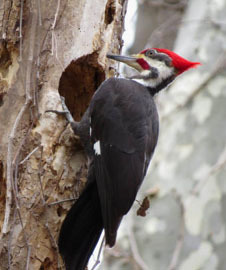 3/6 - Selkirk, HRM 135: I was checking the maple tree sap buckets in the back fields this afternoon when I saw two pileated woodpeckers on a “woodpecker tree” (standing deadfall) by a stone wall fence. They saw me and flew away but then quickly flew back to the tree. I tried to see if it was a female and male but whenever I moved they flew off again with their unmistakable call. The sugar maple sap has been flowing with no end in sight! The garlic in the garden is starting to sprout, as is the onion grass. [Photo of pileated woodpecker by Michelle Smith, courtesy U.S. Fish and Wildlife Service.] 3/6 - Selkirk, HRM 135: I was checking the maple tree sap buckets in the back fields this afternoon when I saw two pileated woodpeckers on a “woodpecker tree” (standing deadfall) by a stone wall fence. They saw me and flew away but then quickly flew back to the tree. I tried to see if it was a female and male but whenever I moved they flew off again with their unmistakable call. The sugar maple sap has been flowing with no end in sight! The garlic in the garden is starting to sprout, as is the onion grass. [Photo of pileated woodpecker by Michelle Smith, courtesy U.S. Fish and Wildlife Service.]
- Roberta Jeracka
3/6 - Eastern Dutchess County, HRM 85: The tundra swans that we found here a week ago were still here. Where we had counted two a week ago, there were now six.
- Carena Pooth, Herb Thompson
[Tundra swans (Cygnus columbianus) are often called “America’s native swan.” Their common name refers to their summer nesting range north of Hudson Bay in the Arctic tundra. They can usually be heard calling long before they are seen, which leads to another frequently used colloquial name, “whistling swan.” David Sibley remarks that distant flocks sound like “baying hounds.” Tundra swans are occasional visitors to the Hudson Valley during spring and fall migrations. Tom Lake.]
3/6 - Millbrook, HRM 82: In late afternoon, I counted five American wigeons, three hooded mergansers, three ring-necked ducks, two wood ducks, a male pintail, and a male green-winged teal at the beaver pond at Shaw Swamp.
- John Askildsen
3/6 - Galeville, HRM 74: It was a beautiful day at the Shawangunks Grasslands National Wildlife Refuge and the grasslands did not disappoint. There were a couple of harriers in sight in late afternoon and the first short-eared owl popped just after 5:00 PM. There was still plenty of light to enjoy its beautiful patterns. Overall, we saw about half-dozen harriers and a similar number of owls. It was interesting to see an owl take flight when a harrier approached its perch. An hour later several woodcock were calling. One was fairly close and then, “poof,” there it was about 15 feet away. We also enjoyed a few eastern meadowlarks. This is the third month in a row that we’ve seen them here. I wonder how often they're here all winter.
- Peter Relson & Carol Anderson
3/6 - Town of Fishkill, HRM 63: In early evening, a barred owl landed in a silver maple tree in my back yard while I stacked fire wood. It hooted four times and then flew off, literally, into the sunset. What a wonderful and comforting sight.
- Andra Sramek
WINTER/SPRING 2016 NATURAL HISTORY PROGRAMS
Striped Bass Cooperative Angler Program
Do you fish for striped bass in the Hudson River? You can share your fishing trip information and help biologists understand and manage our striped bass fishery.
Here’s how it works. Fill out a logbook (provided by us) whenever you fish in the Hudson River. Record general location, time, gear used, what you caught (or if you didn’t catch anything) and return the logbook when you are done fishing for the season. You’ll receive an annual newsletter summarizing the information in addition to the latest news regarding regulations and the river.
Whether you practice catch-and-release or take home a keeper, you can be part of the Cooperative Angler Program. Join today by emailing Jessica Best or calling 845-256-3009.
Volunteer Opportunity: Eel Monitoring
Volunteers are needed to help monitor juvenile glass eels as they enter freshwater habitats from the ocean. The American eel (Anguilla rostrata) is in decline over much of its range, and baseline studies are needed for conservation. The young eels are counted, weighed, and released upstream, often above barriers to their migration. Volunteers can assist at sample streams from New York City to Greene County. This requires mostly outdoor field work from late March through May, with very flexible schedules. Volunteers are able to explore local wildlife in the great outdoors while working collaboratively within a team. If you are interested, call or email Sarah Mount at 845-889-4745 x106 or Grace Ballou at 845-889-4745 x108. Please indicate what town and county you live in, and detail some of your interests or experience. Check out DEC’s American Eel Research website for more information.
Wednesday, March 16: 7:00 p.m.
Lives and Legends of Hudson River Fishes, presented by Tom Lake, NYSDEC Hudson River Estuary Program consulting naturalist. Presented by Capital District Flyfishers at VFW Post 8692, 140 VFW Drive, Colonie [Albany County]. For more information, email Brad Sargent.
Saturday, April 9: 1:00 p.m.
Fish Stories from the Hudson, with Tom Lake, John Mylod, and Christopher Letts. Based on nearly a century of collective commercial fishing experience on the Hudson River, these rivermen will share stories and tales, most of which are true. Fort Montgomery State Historic Site, Route 9W, Fort Montgomery [Orange County]. For more information, email Peter Cutul.
HUDSON RIVER MILES
The Hudson is measured north from Hudson River Mile 0 at the Battery at the southern tip of Manhattan. The George Washington Bridge is at HRM 12, the Tappan Zee 28, Bear Mountain 47, Beacon-Newburgh 62, Mid-Hudson 75, Kingston-Rhinecliff 95, Rip Van Winkle 114, and the Federal Dam at Troy, the head of tidewater, at 153. The tidal section of the Hudson constitutes a bit less than half the total distance – 315 miles – from Lake Tear of the Clouds to the Battery. Entries from points east and west in the watershed reference the corresponding river mile on the mainstem.
TO CONTRIBUTE YOUR OBSERVATIONS OR TO SUBSCRIBE
The Hudson River Almanac is compiled and edited by Tom Lake and emailed weekly by DEC's Hudson River Estuary Program. Share your observations by e-mailing them to trlake7@aol.com.
To subscribe to the Almanac (or to unsubscribe), go to DEC's Email Lists page, enter your email address, and click on "Submit." Fill in and submit the requested information on the “New Subscriber” page. This will take you to “Quick Subscriptions”. Scroll down; under the heading "Natural Areas and Wildlife" is the section "Lakes and Rivers" with a listing for the Hudson River Almanac. Click on the check box to subscribe. While there, you may wish to subscribe to RiverNet, which covers projects, events and actions related to the Hudson and its watershed, or to other DEC newsletters and information feeds.
The current year's issues are available at http://www.dec.ny.gov/lands/25611.html . To view older issues, visit the New York State Library's Hudson River Almanac Archive. If it asks you to login, click on "Guest." You may then need to reopen this page and click on the Almanac Archive link again to access the Almanac collection in the library's files.
Discover New York State Conservationist - the award-winning, advertisement-free magazine focusing on New York State's great outdoors and natural resources. Conservationist features stunning photography, informative articles and around-the-state coverage. For a free, no-obligation issue go to http://www.dec.ny.gov/pubs/conservationist.html
USEFUL LINKS
National Oceanic and Atmospheric Administration online tide and tidal current are invaluable when planning Hudson River field trips.
For real-time information on Hudson River tides, weather and water conditions from eight monitoring stations, visit the Hudson River Environmental Conditions Observing System website.
Visit the U.S. Geological Survey’s Hudson River Salt Front website for historical information on the salt front’s movements in the estuary.
Information about the Hudson River Estuary Program is available on DEC's website at http://www.dec.ny.gov/lands/4920.html .
Smartphone app available for New York outdoor enthusiasts!
DEC, in partnership with ParksByNature Network®, is proud to announce the launch of the New York Fishing, Hunting & Wildlife App for iPhone and Android. This FREE, cutting-edge mobile app gives both novice and seasoned outdoorsmen and women essential information in the palm of their hands. Powered by Pocket Ranger® technology, this official app for DEC will provide up-to-date information on fishing, hunting and wildlife watching and serve as an interactive outdoor app using today's leading mobile devices. Using the app's advanced GPS features, users will be able identify and locate New York's many hunting, fishing and wildlife watching sites. They will also gain immediate access to species profiles, rules and regulations, and important permits and licensing details.
NY Open for Hunting and Fishing Initiative
Governor Cuomo's NY Open for Fishing and Hunting Initiative is an effort to improve recreational opportunities for sportsmen and women and to boost tourism activities throughout the state. This initiative includes streamlining fishing and hunting licenses, reducing license fees, improving access for fishing and increasing hunting opportunities in New York State.
In support of this initiative, this year's budget includes $6 million in NY Works funding to support creating 50 new land and water access projects to connect hunters, anglers, bird watchers and others who enjoy the outdoors to more than 380,000 acres of existing state and easement lands that have gone largely untapped until now. These 50 new access projects include building new boat launches, installing new hunting blinds and building new trails and parking areas. In addition, the 2014-15 budget includes $4 million to repair the state's fish hatcheries; and renews and allows expanded use of crossbows for hunting in New York State.
This year's budget also reduces short-term fishing licenses fees; increases the number of authorized statewide free fishing days to eight from two; authorizes DEC to offer 10 days of promotional prices for hunting, fishing and trapping licenses; and authorizes free Adventure Plates for new lifetime license holders, discounted Adventure Plates for existing lifetime license holders and regular fee Adventure Plates for annual license holders.
Copies of past issues of the Hudson River Almanac, Volumes II-VIII, are available for purchase from the publisher, Purple Mountain Press, (800) 325-2665, or email purple@catskill.net
|