
Hudson River Almanac 10/24/15 - 10/31/15
The New York State Department of Environmental Conservation sent this bulletin on 11/06/2015 04:23 PM EST |
| DEC Delivers - Information to keep you connected and informed from the NYS Department of Environmental Conservation |
| Share or view as a web page || Update preferences or unsubscribe |
|
|
|
OVERVIEW Our gray seal in the river, well into its third month above tidewater between Saratoga and Rensselaer Counties, continued its cryptic ways. Waterfowl joined songbirds, raptors, and river herring, as fall migration heated up. HIGHLIGHT OF THE WEEK
[The striped nudibranch (Cratena pilata) is a member of Nudibranchia, a group of soft-bodied, marine gastropod mollusks that shed their shells after their larval stage. Nudibranchs, colloquially called sea slugs, are carnivorous, benthic animals found crawling over the bottom substrate. Gosner (1971) Guide to the Identification of Marine and Estuarine Invertebrates: Cape Hatteras to the Bay of Fundy.] NATURAL HISTORY NOTES Note: In last week’s Hudson River Almanac entry for October 20 at the Schoharie Creek we listed the incorrect species name for longnose dace. It should have been Rhinichthys cataractae. 10/24 - Columbia County, HRM 129: While visiting the DEC boat launch and fishing access site at Queechy Lake, I spotted a great blue heron under the trees at the edge of the parking area. As I stayed well back to see what it was doing, my colleague realized that it was hunting a chipmunk. After a few minutes of edging closer to the rocks, where the chipmunk was on the move, the heron darted in and grabbed it by the tail. Success! It then moved away from us to eat its meal. 10/24 - Esopus Island, HRM 85: I took my daughter and son (ages seven and nine) fishing to Esopus Island for my daughter Sophie’s seventh birthday. We ended up fishing off the far southeastern tip of the island where there was a good rip off the rocky point, about mid-way down the ebb tide. The best part of the afternoon was when my daughter hooked a 28-inch channel catfish. She was fishing with a lightweight outfit so it took our combined efforts and about five minutes to bring it in. She was so proud! 10/24 - Bedford, HRM 35: An active morning at the Chestnut Ridge Hawkwatch gave us an adult northern goshawk heading west. Later in the day, we saw a juvenile goshawk to the east that dove down into the trees. We have seen red-shouldered hawk numbers (29) increasing in the last week (66 for the season). Non-raptor observations included 24 Canada geese. 10/25 - New Hamburg, HRM 67.5: We were accustomed to seeing mute swans in Wappinger Creek where they seem to prefer calmer waters. So we were surprised today to see eight swans - three adults and five cygnets, plumage still tinged with brown - slowly cruising around our Rabbit Island home facing the big water of the river. 10/25 - Crugers, HRM 39: Since we had not seen the local great blue heron in quite a while, we were delighted to spot him standing quietly near the shoreline of Ogilvie’s Pond. As we watched, a dark shadow swept over the pond as another great blue heron flew in, causing a disturbance. Heron number one took off and flew circles over the pond with heron number two, the intruder, in pursuit. After a while, for reasons that were unclear, the intruder heron flew off, allowing the local bird to settle down again and resume its peaceful stance in its original spot. 10/25 - Bedford, HRM 35: There was minimal movement today at the Chestnut Ridge Hawkwatch with the highlight being an immature goshawk seen hovering to the east before diving at full speed into the trees.
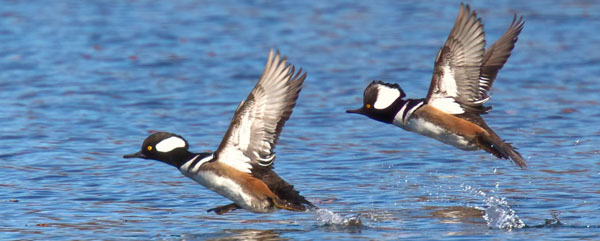
[The male northern harrier, or marsh hawk, pale with black wing tips, is a light-colored raptor that birders refer to as the “Grey Ghost.” Tom Lake.] 10/26 - Newcomb to Minerva, HRM 302-284: I went birding in the Newcomb-Minerva area from late morning to early afternoon, checking feeders in Newcomb, several places along Route 28N, the Boreas River, the Roosevelt Truck Trail, and a section of the new snowmobile trail where it crosses Route 28N. Among the birds found were ruffed grouse (snowmobile trail), two male black-backed woodpeckers (one at the Boreas River; the other along the snowmobile trail), a northern shrike (Newcomb), seven boreal chickadees (along the Roosevelt Truck Trail and the snowmobile trail), red crossbill (heard near the Roosevelt Truck Trail parking area), pine siskin (they continue to be everywhere), and a male evening grosbeak eating crab apples in Newcomb 10/26 - Albany County, HRM 135: There was a pair of surf scoters near the middle of the north portion of Basic Creek Reservoir in Westerlo. I also found four pectoral sandpipers, several greater yellowlegs, a common loon, and a variety of ducks, including more than one hundred hooded mergansers. [Surf scoters are marine birds that breed in the Arctic and winter along the Atlantic coast. While they are commonly seen as spring and fall migrants in the lower estuary and northern New Jersey, they are seen only occasionally along inland Hudson River tidewater. Surf scoters are sea ducks, with white bills and a white patch on the back of their heads. When seen through binoculars, in the dim light of dawn, bobbing between swells a few hundred yards away, they look like “double-faced” ducks. Tom Lake.] 10/26 - Bedford, HRM 35: It was a surprisingly slow day at the Chestnut Ridge Hawkwatch. There were very few accipiter sightings with only four sharp-shinned hawks (1,416 for the season) and three Cooper’s hawks (255 for the season). Non-raptor observations included one hundred brant and two common loons. 10/27 - Dutchess County, HRM 82: As I was driving today, I had yet another bobcat sighting as one quickly crossed the road in front of me heading toward a wetland. It moved so quickly that I was unable to photograph it. How is it that I have been looking for bobcats for twenty years with no luck yet within ten days I have seen three different adults and two kittens? Just amazing! 10/27 - Hyde Park, HRM 82: My first two “snowbirds," otherwise known as dark-eyed juncos, arrived today. They soon busied themselves selecting choice bits from my feeders. 10/27 - Stanfordville, HRM 87: My neighbor, Joe Schwartz, and I enjoyed good views of a beautiful male northern harrier coursing over his hayfields in the late afternoon sun. Joe showed me how his roadside stream was nearly dry; the beavers had returned to the wetlands above his fields. 10/28 - Saratoga County, HRM 164: This was Day 96 for the gray seal residing in the Hudson River above tidewater. We have not had a single sign of him in quite a while. However, there is far less traffic on the river right now, so less of a chance for a sighting. 10/28 - Newburgh, HRM 61: From time to time I read of black squirrel sightings in the Hudson River Almanac. How about a black woodchuck? There is one living on the hillside visible from the second-story window of my classroom on the SUNY Orange-Newburgh campus. There are numerous holes and I often see several woodchucks feeding in the sunshine throughout the day. But only one is black. [The woodchuck, or groundhog (Marmota monax) is the largest member of the squirrel family (Sciuridae). Black (melanistic), partially black, or more commonly, blackish-brown color phases, are not uncommon. SUNY ESF Adirondack Ecological Center.] 10/28 - Bedford, HRM 35: Quite unexpectedly, a golden eagle was spotted in the drizzle this morning at the Chestnut Ridge Hawkwatch. Otherwise, five turkey vultures was the high count (2,090 for the season) on a very slow day. Non-raptor observations included two common ravens. 10/29 - Glenmont, HRM 143: A rain and wind squall line came through around noon but I did not think much of it. However, when I walked outside in early afternoon, I found the trees around my yard full of vultures. I counted fifteen turkey vultures (several more flying) and at least six black vultures. There may have been more in the trees farther away, out of sight - a vulture fallout! It was quite a sight to see them all with their wings extended drying off, before they all took off heading to the southeast. [Fallouts are caused by severe weather during peak migration periods as birds run into storms or strong headwinds and are forced down to wait things out. Steve Stanne.] 10/29 - Coxsackie, HRM 124: Four snow buntings showed up at the Coxsackie Grasslands today, right where they have been at about this time each of the past four years - a faithful four.
10/29 - Bedford, HRM 35: After a front moved through, there was minimal activity at the Chestnut Ridge Hawkwatch. Five turkey vultures and three sharp-shinned hawks comprised the entire day. Non-raptor observations included a red crossbill that was heard and then seen flying south. The bird was alone and identified first by the flight call, and then by the bird’s reddish appearance 10/30 - Kowawese, HRM 59: We can follow the seasons from this Orange County beach by marking the sunrise each day. In the wake of a pink and blue sky this morning, the sun rose just north of Breakneck Ridge in the Hudson Highlands. By the winter solstice, the sun will be nearly over Mount Taurus to the south. We were here to see who was home in the river today. The bag of our seine was dominated by young-of-the-year, heading-to-the-sea fishes such as American shad (85-89 mm), blueback herring (61-74 mm), and striped bass (68-80 mm). Among the residents were gorgeous smallmouth bass (73-75 mm). The river was 55 degrees Fahrenheit (goose bumps), and after recent heavy rains (1.45 inches), the salinity was down to 1.0 parts-per-thousand. 10/30 - Bedford, HRM 35: There was not as much activity as was anticipated for today at the Chestnut Ridge Hawkwatch. In early afternoon a sharp–shinned hawk was spotted as it flew into the woods just south of the hawk watch. Upon closer inspection, we saw that the bird had snatched a tufted titmouse and ate it on a downed tree. Non-raptor observations, after the red crossbill yesterday, included a white-winged crossbill flying north. The bird was first heard and then spotted with an overall reddish color and white in the wings. 10/31 - Saratoga Lake, HRM 184: A birding check of Saratoga Lake began with three common loons, one of which I heard call near Riley Cove just after sunrise. That was beautiful. Among the other waterfowl were 150 Canada geese, six lesser scaup, eight ruddy ducks, and 31 bufflehead, some of which were near shore at Silver Beach and another raft south of Snake Hill.
10/31 - Denning’s Point, HRM 60: No carp today; the season was winding down. I did catch and release three channel catfish, the largest of which was 4 pounds 9 ounces, and 24 inches long. The other two were a bit smaller. 10/31 - Bedford, HRM 35: Trick or Treat at the Chestnut Ridge Hawkwatch? We were treated to a nice day of movement. The morning brought a good number of red-shouldered hawks (22), red-tailed hawks (12), and one late broad-winged hawk. Non-raptor observations included 29 Canada geese. HUDSON RIVER MILES The Hudson is measured north from Hudson River Mile 0 at the Battery at the southern tip of Manhattan. The George Washington Bridge is at HRM 12, the Tappan Zee 28, Bear Mountain 47, Beacon-Newburgh 62, Mid-Hudson 75, Kingston-Rhinecliff 95, Rip Van Winkle 114, and the Federal Dam at Troy, the head of tidewater, at 153. The tidal section of the Hudson constitutes a bit less than half the total distance – 315 miles – from Lake Tear of the Clouds to the Battery. Entries from points east and west in the watershed reference the corresponding river mile on the mainstem. TO CONTRIBUTE YOUR OBSERVATIONS OR TO SUBSCRIBE The Hudson River Almanac is compiled and edited by Tom Lake and emailed weekly by DEC's Hudson River Estuary Program. Share your observations by e-mailing them to trlake7@aol.com. To subscribe to the Almanac (or to unsubscribe), go to DEC's Email Lists page, enter your email address, and click on "Submit." Fill in and submit the requested information on the “New Subscriber” page. This will take you to “Quick Subscriptions”. Scroll down; under the heading "Natural Areas and Wildlife" is the section "Lakes and Rivers" with a listing for the Hudson River Almanac. Click on the check box to subscribe. While there, you may wish to subscribe to RiverNet, which covers projects, events and actions related to the Hudson and its watershed, or to other DEC newsletters and information feeds. The current year's issues are available at http://www.dec.ny.gov/lands/25611.html . To view older issues, visit the New York State Library's Hudson River Almanac Archive. If it asks you to login, click on "Guest." You may then need to reopen this page and click on the Almanac Archive link again to access the Almanac collection in the library's files. Discover New York State Conservationist - the award-winning, advertisement-free magazine focusing on New York State's great outdoors and natural resources. Conservationist features stunning photography, informative articles and around-the-state coverage. For a free, no-obligation issue go to http://www.dec.ny.gov/pubs/conservationist.html USEFUL LINKS National Oceanic and Atmospheric Administration online tide and tidal current predictions are invaluable when planning Hudson River field trips. For real-time information on Hudson River tides, weather and water conditions from eight monitoring stations, visit the Hudson River Environmental Conditions Observing System website. Visit the U.S. Geological Survey’s Hudson River Salt Front website for historical information on the salt front’s movements in the estuary. Information about the Hudson River Estuary Program is available on DEC's website at http://www.dec.ny.gov/lands/4920.html . Smartphone App Available for New York Outdoor Enthusiasts! NY Open for Hunting and Fishing Initiative Copies of past issues of the Hudson River Almanac, Volumes II-VIII, are available for purchase from the publisher, Purple Mountain Press, (800) 325-2665 FREE, or email purple@catskill.net .
|
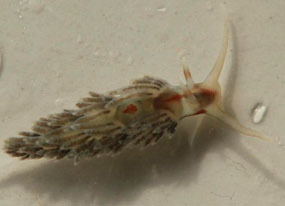 10/30 - Manhattan, HRM 1: Our star catch this week at The River Project’s Pier 40 sampling site was a striped nudibranch! It was timely that we had been catching lots of ctenophores (comb jellies) since they became food for the nudibranch. We also caught an 80 millimeter [mm] blackfish (tautog) and almost caught a northern pipefish, but it escaped off the trap. [Photo of striped nudibranch courtesy of the River Project.]
 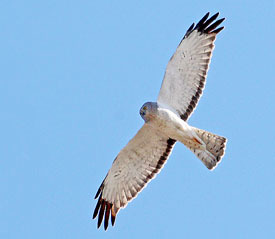 10/25 - Croton Point, HRM 35-34: I found four species of warblers today, three of them expected: palm and yellow-rumped warbler, and common yellowthroat. The one unexpected was a young Nashville warbler, with a full eye ring, that gave me great looks. Among the raptors, was a male northern harrier, a “Grey Ghost” - just a beautiful bird - as well as two adult bald eagles, a late-season osprey with a very large fish, and a kestrel on the landfill. [Photo of male northern harrier courtesy of Deborah Tracy-Kral.]
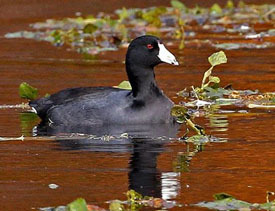 10/29 - Wappinger Lake, HRM 67: The American coots (10) that I saw yesterday were still there today, fairly close to shore at the Spring Street Park on Wappinger Lake. [Photo of American coot courtesy of Deborah Tracy-Kral.]
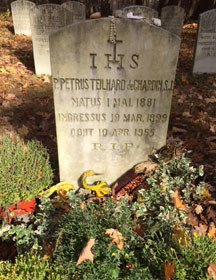 10/31 - Hyde Park, HRM 80: All Hallows Eve. For many fans of the season, Halloween is a time to dress up in scary fashion and go in search of tricks-or-treats. I have my own tradition: I visit the grave of Pierre Teilhard de Chardin, a Jesuit theologian, paleontologist, and renowned naturalist who died in 1955 and was buried on the grounds of the Culinary Institute of America. The graveyard was glowing in the bright sunlight today, the Japanese red maples radiating brilliantly in red and orange. The Norway spruce and oaks cast long shadows. Amidst a hundred or more identical gravestones, de Chardin’s is easy to find. There is always a collection of items - tokens of natural history - left by those paying homage. Teilhard de Chardin spent much of his life searching for common ground between religious dogma and natural history, reconciling his faith with modern science. That made him a truly unique individual in his time. Our offering today was a native freshwater mussel (Elliptio complanata), a threatened species in the watershed. [Photo of gravesite courtesy of Tom Lake.]
|
The New York State Department of Environmental Conservation respects your right to privacy and welcomes your feedback. | Update preferences or unsubscribe. | Learn more about DEC Delivers. |
|
Connect with DEC:   
|
 |