
Hudson River Almanac 5/17/15 - 5/23/15
The New York State Department of Environmental Conservation sent this bulletin on 05/29/2015 04:18 PM EDTNews update from the New York State Department of Environmental Conservation

 You are subscribed to receive updates from DEC. Links to receive help or to change your preferences are provided below. Having trouble viewing this email? View it as a Web page.
May 17 - 23, 2015
Compiled by Tom Lake, Hudson River Estuary Program Naturalist
OVERVIEW
Bird migration peaks in May, and this week it brought shorebirds not commonly seen in the Hudson Valley. May also sees a large number of big yellow buses rolling down to the river with students eager to explore its diversity of life; we feature many reports of their discoveries in this issue.
HIGHLIGHT OF THE WEEK
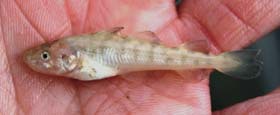 5/21 - Poughkeepsie, HRM 76: The Hudson River sloop Clearwater hosted a late afternoon sail for glass eel project volunteers from Poughkeepsie High School and Arlington High School. It was great to describe their otter trawl net as “like our eel fyke net, just deep underwater!” When the net came up, among the fish were 20 young-of-the-year Atlantic tomcod, each 50 millimeters [mm] long. Tomcod spawn in late fall through late winter, under the ice, as far north as Poughkeepsie, thus earning them the nickname “frost fish.” This was a great opportunity to talk about migrations, life cycles, and even climate change. Our river is at the southern end of their range, and as oceans and estuaries warm up, tomcod will have to adapt or become extirpated from the Hudson. [Photo of young of the year Atlantic tomcod courtesy of Chris Bowser.]
- Chris Bowser, Maura Niemesto, Annika Savio
NATURAL HISTORY NOTES
5/17 - Norrie Point, HRM 85: Following nearly two inches of rain across the last three days, the river was mocha-colored and sport fishing was very slow. Thirty anglers caught thirty fish at our DEC public program, and there were long periods of quiet. One striped bass was caught, a yearling (135 mm), as well as golden shiners and white perch. The “big fish” of the day was an eleven-inch rudd caught by four-year-old Tommy Jackson. The water temperature was 64 degrees Fahrenheit.
- Ryan Coulter, Kacie Giuliano, Tom Lake
5/17 - Hyde Park, HRM 82: Stone Church Fishing Club off Crum Elbow Road has a three-acre pond in an old gravel pit that has largemouth bass, bluegills, yellow perch, golden shiners, and brown bullhead, and that is stocked annually with trout. Every year someone catches an American eel. There is a feeder stream with several waterfalls and a swamp that eels must get past to reach the pond. Recently someone caught an eel that was about three feet long.
- Jeff Lucas
5/18 - Saugerties to New Baltimore, HRM 102-132: Hundreds of brant were moving up the Hudson River Valley past Saugerties, Coxsackie, and New Baltimore over several evenings this week.
- Richard Guthrie
5/18 - Norrie Point, HRM 85: Our catch today was modest but consisted entirely of native fishes. Fifth and eighth-grade students from Woodstock Day School helped us haul the seine and we caught eight species: American eel, redbreast sunfish, golden shiners, white perch, yellow perch, spottail shiners, an eleven-inch alewife, and breeding banded killifish. The water temperature was 65 degrees F.
- Giancarlo Coppola, Tom Lake
[There may not be a prettier fish in the river than a courting male banded killifish with iridescent blue, lavender and silver highlights in their bands. A favorite name for the male is “blue-banded mudminnow,” a colloquialism coined by riverman Everett Nack. The females, a drab brownish-green, are a good example of sexual dimorphism. Tom Lake.]
5/18 - Croton-on-Hudson, HRM 35: One of the adult osprey from the cell phone tower near the Croton-Harmon train station came to the nest with a large stick – new “furniture” – for the nest. After gently landing and poking about for a bit, the bird took off, flew in a lazy circle, and then landed on one of the cell tower antennas. I could see the other adult moving about in the nest and then settling back down.
- Hugh L. McLean
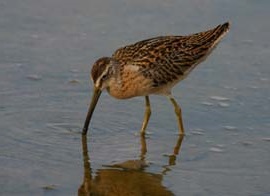 5/19 - Town of Coeymans, HRM 133: I had the good fortune to see 60 short-billed dowitchers (carefully counted by threes) at the south end of Stanton Pond. The bad news is that I couldn't shake a long-billed dowitcher out of the group. The good news is that I didn't mistake them for least sandpipers! Unfortunately, these shorebirds moved on, as long distance migrants do. [Photo of short-billed dowitcher courtesy of Mike Pogue.]
- Frank Mitchell, Hudson-Mohawk Bird Club
[This is truly an exceptional record! A count of 60 short-billed dowitchers blows away the previous Albany County high by about 59. For a species that is not annually seen in our area, this is very surprising. Larry Alden added that it's quite likely that we will not have a repeat sighting like this in these parts in our lifetime. Will Raup.]
5/19 - New Baltimore, HRM 131.5: A flock of about 50 brant flew by New Baltimore, winging north up the Hudson River. They seem to be a bit behind schedule this year, but here they come.
- Richard Guthrie
5/19 - North Germantown to Kingston Point, HRM 109-92: While tracking striped bass and shortnose sturgeon movements today, we identified several neat birds. To start, we saw seven white-winged scoters on the Upper Green Flat, just south of Cheviot. Not far from them was a lone drake hooded merganser. Near Imbocht Bay, we saw a canvasback up close. Last but not least, near the mouth of Rondout Creek, was a flock of about thirty brant heading north.
- Joe Lydon, Dan Jahn
5/19 - Norrie Point, HRM 85: A cold overnight rain lowered the river a degree to 64 degrees F. Kinry Road Elementary students helped us seine the shallows to see “who was home” today. Our big fish was an eleven-inch river herring – a male alewife. Much of our catch was spottail shiners, and being a rather delicate species, a few of them went belly-up on us. This gave us the opportunity to assure the students that nothing goes to waste in the estuary: although unseen, there are hungry turtles, crabs, eels, and water snakes out there that need to eat as well.
- Giancarlo Coppola, Tom Lake, T.R. Jackson
5/19 - Town of Poughkeepsie: We spent some time watching eagle nest NY62 today. We couldn't believe how big “Destiny,” the single nestling, has gotten in just the last week – at least half the size of Mom and Dad.
- Debbie Quick, Bob Rightmyer
5/19 - Beacon, HRM 61: Another day of patience at Long Dock as bait-stealers had their way with me. I still managed to hook, land, and release two carp, the largest of which was fourteen pounds. Mixed in was a beautiful nineteen-inch channel catfish.
- Bill Greene
5/19 - Orange County, HRM 44: There was a report of more than 50 short-billed dowitchers near Goshen in mid-afternoon.
- Will Raup
5/19 - Croton-on-Hudson, HRM 35: We discovered a large headless fish on the ground under the cell phone tower this afternoon. It was difficult to tell the species of fish, but it was pretty certain that it had come from the osprey nest atop the tower.
- Hugh L. McLean
5/20 - Fort Edward, HRM 202: Gordon Ellmers photographed a dozen short-billed dowitchers this morning and the images revealed that these were the Atlantic subspecies of the bird - Limnodromus griseus griseus (Sibley 2000: 191). This was potentially a first record for Washington County.
- Will Raup, Hudson-Mohawk Bird Club
[According to Birds of North America Online, two subspecies of this shorebird are common on the New York/New Jersey shore in mid to late May. One concentrates between Delaware Bay and Long Island before flying to breeding grounds in northern Quebec; the second comes only as far north as New Jersey, before taking off for Alberta and Saskatchewan. For both, flights from coast to breeding grounds appear to be nonstop; inland records along the way are relatively few. The spate of dowitcher reports included here may have resulted from passage of a cold front on 5/19, accompanied by a wind shift from a southerly tailwind to a northerly (and gusty) headwind, leading the birds to land. Steve Stanne.]
5/20 - Annandale, HRM 98.5: I visited the Saw Kill today. It had actually rained and the stream was a little high and turbid. That made counting alewives next to impossible, but they were still in the stream from the head of tide up to the waterfall and I could see them swirling on occasion. There was an influx of smallmouth bass into the stream as well. I caught four, two of which exceeded two pounds.
- Bob Schmidt
5/20 - Norrie Point, HRM 85: A blustery cold north wind was blowing and the accumulated effects of several days had created a blowout tide. The river temperature dropped another degree to 63 degrees F. The Kinry Road Elementary students kept their backs to the wind, stayed warm, and helped us seine the diminishing shallows. Highlights include a big alewife (eleven inches long) and a tiny brown bullhead (70 mm). The thirty-inch-long resident northern water snake made an appearance, causing a few squeals, but its attention was focused on any small fish that did not survive our net.
- Giancarlo Coppola, Tom Lake
[The northern water snake (see banner photo) is a common reptile and, as the name suggests, frequents water bodies like the Hudson. They prey on fish and small mammals and swallow their prey whole. It is not uncommon for them to take considerable time swallowing large prey. They are native, non-venomous, and can grow to lengths in excess of four feet. Tom Lake.]
5/20 - Town of Poughkeepsie: I was thinking today that Destiny, the lone eaglet in NY62, should be self-feeding at Day 53, so I decided to check. I saw an eagle in the nest feeding and I thought it was one of the adults until it popped its head up. It was Destiny!
- Kathleen Courtney
5/20 - Quassaick Creek, HRM 60: On one of our final days of eel sampling this spring, our Mount Saint Mary’s team counted 600 glass eels captured overnight in our research fyke net.
- Rebecca Houser
5/20 - Kowawese, HRM 59: The educators from the Hudson Highlands Nature Museum had three fifth-grade classes from Sheafe Road Elementary on the beach today to sample the inshore shallows with our 30-foot seine. For most of these students, this was like an exciting trip to the “ocean.” The overwhelming majority of the catch (99%) was spottail shiners, a native species. The odd catch, although another common species, was a white perch.
- Carl Heitmuller, Adam Harlec, Megan Hoffman, Pam Golben
[The spottail shiner (Notropis hudsonius) was first described and named for the Hudson River by a former governor of New York State, De Witt Clinton, in 1824. Tom Lake.]
5/20 - Crugers, HRM 39: What a thrill to have our first ruby-throated hummingbird visitor this spring! It was a beautiful female that just arrived this morning although our feeder has been up for more than a week.
- Dorothy Ferguson, Bob Ferguson
5/20 - Croton Bay, HRM 34: As our 7:15 AM Metro-North commuter train left the station heading to Manhattan, I saw an adult bald eagle standing on an sandbar exposed by the low tide in Croton Bay.
- Hugh L. McLean
5/21 - Greene County: I visited the vicinity of eagle nest NY203 in my kayak today at almost low tide, which was not ideal. But I could see, despite looking through a maze of cottonwood leaves, an adult sitting on the nest.
- Kaare Christian
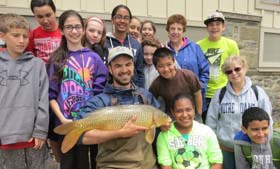 5/21 - Norrie Point, HRM 85: The sixth-graders from Kinry Road Elementary had a great day learning about the river under a sky dotted with eagles and osprey. As we always do, we invited them to help us sample the river as a means of discovering its diversity of life. Our seine collected the usual spottail shiners, tessellated darters, and white perch, but it also held a few surprises: a gorgeous eight-inch-long smallmouth bass, a quarter-sized hogchoker, and a small blue crab (38 mm across). While catching the blue crab was unusual, the fact that it was a female was a real surprise. However, the highlight came courtesy of an angler, Sam Williams, who caught a huge, sixteen pound common carp (32") that had the students speechless in delight. [Photo of students and common carp courtesy of Tom Lake.]
- Giancarlo Coppola, Tom Lake
5/22 - Ulster Park, HRM 87: On a pleasant and balmy day, tiger swallowtails and spicebush swallowtails darted past me while sulfurs and black swallowtails wandered across the fields. There were small flocks of cedar waxwings that were starting, once more, to nest in the near-by maples. And as I walked through the woods, I greatly enjoyed finding tiny red efts on the path.
- Kent Warner
5/22 - Kowawese, HRM 59: In the shadow of Storm King Mountain, educators from the Hudson Highlands Nature Museum and a class of fifth graders from Garrison School sampled the river off the beach at Kowawese. Despite the very low tide, we caught 41 fish. While spottail shiners (with some very gravid females) were again most numerous (85%), we did catch a few less common fishes: a quarter-size hogchoker, a small American eel (“elver”), and a yearling striped bass (70 mm). The shallows were a warm 69 degrees F.
- Lisa Mechaley, Pam Golben, Katie Cohan, Robin Waters
5/22 - Cornwall on Hudson, HRM 56: This morning I encountered a flock of wild turkeys crossing The Boulevard onto the property of the Hudson Highlands Nature Museum. Four of them stayed on one side and I decided to give the four my best turkey call, an unintelligible series of gobbles, and to my surprise the four responded in unison.
- Robert Anderson
5/22 - Manhattan, HRM 1: The River Project’s highlight catches this week at Hudson River Park’s Piers 25 and 40 were three grubbies (Myoxocephalus aenaeus), our first of the season. The grubby is a sculpin, a bottom-dwelling fish that shares a niche with toadfish, cunner, tautog, and others. All three were about 70 mm long. We also caught two more oyster toadfish (90 mm and 260 mm), a northern pipefish (130 mm), a juvenile striped bass, and a cunner.
- Jessica Bonamusa
[Cunners (Tautogolabrus adspersus) are a member of the wrasse family, Labridae, closely related to the tautog or blackfish. They are commonly found in the lower estuary in many habitats, but prefer rocky areas where they feed on small shellfish and mollusks. Anglers know them, colloquially, as “bergalls,” and in New England they are called “chogies.” Tom Lake.]
5/23 - Columbia, HRM 126: I was in Chatham visiting family when I saw some Canada geese and wondered what all that “fluff” was, moving around on the ground. They were the first goslings I've seen this year.
- Roberta Jeracka
5/23 - Brewster, HRM 52: From the fresh soil outside one of the entrances, the disembodied rabbit tail, and the starling's head, I had known since the last sighting on April 24 that red foxes were still under our shed. But I had not seen them until this morning at 5:00 a.m. when I looked out at my garden. One fox kit was outside the garden looking in and two others were inside. They were dull red-blonde now and about eighteen inches long not including their tails. One of them bolted out of the garden pursued by the others. After a few high speed round trips around the garden, the three of them bounded off behind a line of evergreen trees. What a wonderful sight. [See March 22 for the first sighting.]
- Bruce Iacono, Maureen Iacono
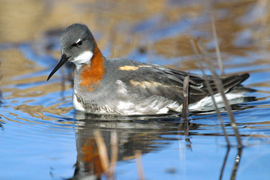 5/23 - Piermont Pier, HRM 25: I drove to the end of the Piermont Pier this morning and on the way back, on the south side of the pier, I saw a small shorebird in the water with some mallards. It was a red- necked phalarope, my first. [Photo of female red-necked phalarope courtesy of U.S. Fish and Wildlife Service.]
- Linda Pistolesi
[The red-necked phalarope is a small sandpiper with unusual traits for a shorebird. One is that it spends nine months of the year on the open ocean, where it swims at the surface and spins in tight circles to swirl its planktonic food within reach. Given their pelagic habit, sightings of phalaropes inland in the Hudson Valley are uncommon. Steve Stanne.]
NOTES TO ALMANAC READERS
If you see a dead sturgeon floating or on the shore of the Hudson River, please notify DEC by calling 845-256-3071 (Kathy Hattala) AND 845-256-3073 (Amanda Higgs). DEC’s Atlantic sturgeon webpage lists the details needed about your find, as well as information about research on this iconic species.
The diamondback terrapin (Malaclemys terrapin) is a native species that can trace its presence in our area back to the post-glacial Pleistocene epoch more than 10,000 years ago. Its present distribution is along the coastal strip and associated brackish marshes from Cape Cod to southeastern Texas (Dobie and Jackson, 1979). However, our resident populations are threatened and we need more data on their locations, numbers, and habitats. If you see any diamondback terrapins, please report the where and when and other particulars to biorlb@hofstra.edu. Terrapins might be seen basking on shorelines or on projections, floating at the surface, or swimming. Whatever and wherever, we’d like to know. Thanks. Russell Burke, Hofstra University, Department of Biology.
We are gathering information of the presence of larger American eels (post-elver stages) in Hudson River tributaries in an effort to better understand and protect their habitat. Please e-mail us (trlake7@aol.com) if you encounter (see, catch, watch eagles or ospreys take) adult eels. Thank you. Tom Lake.
SPRING 2015 NATURAL HISTORY PROGRAMS
Saturday, May 30
World Science Festival’s Great New York Fish Count - Educators from the New York State Department of Environmental Conservation, the Lamont-Doherty Earth Observatory of Columbia University’s Earth Institute, and several New York metro area agencies and environmental education groups will be helping out with this free event at fourteen sites from Yonkers and Englewood, NJ, to Jamaica Bay and Staten Island. Visit the World Science Festival website for details on the fish count and many other exciting events taking place during the festival.
Sunday, June 14: 10:00 a.m - 1:00 p.m.
Family Fishing Day at the Norrie Point Environmental Center. All ages welcome; free use of rods, reels and bait. Free; wheelchair accessible. For information: 845-889-4745 x109.
RECENT PUBLICATIONS FROM THE HUDSON RIVER ESTUARY PROGRAM
New! Natural Resources Guidebook for Hudson River Communities
To help watershed municipalities build a strong foundation of natural resource information for planning and decision-making, the Estuary Program and Cornell University recently published Creating a Natural Resources Inventory: A Guide for Communities in the Hudson River Estuary Watershed. Natural Resources Inventories (NRI) compile data on natural (and cultural) resources and provide a starting point for open space planning, watershed characterizations, zoning amendments, environmental reviews, and raising awareness of a community's natural assets. A valuable reference for anyone involved in land-use and watershed planning, the guidebook suggests an approach for developing an NRI, recommends components to inventory and explains their importance, and provides sources of data and assistance. Hudson Valley case studies and strategies for incorporating NRIs into local planning are also included. Visit www.dec.ny.gov/lands/100925.html for more information and a digital version of the guidebook.
The State of the Hudson 2015
How is the Hudson doing? That is the number one question on people's minds when conversation turns to the river. To answer it, the Hudson River Estuary Program has produced The State of the Hudson 2015. In layperson's language, this illustrated report concisely describes progress and identifies ongoing problems. It looks at water quality, habitat, biodiversity, and fish and wildlife in the estuary and its watershed as well as climate change challenges and stewardship initiatives. Visit http://www.dec.ny.gov/lands/51492.html for more information and to download a copy.
HUDSON RIVER MILES
The Hudson is measured north from Hudson River Mile 0 at the Battery at the southern tip of Manhattan. The George Washington Bridge is at HRM 12, the Tappan Zee 28, Bear Mountain 47, Beacon-Newburgh 62, Mid-Hudson 75, Kingston-Rhinecliff 95, Rip Van Winkle 114, and the Federal Dam at Troy, the head of tidewater, at 153. The tidal section of the Hudson constitutes a bit less than half the total distance – 315 miles – from Lake Tear of the Clouds to the Battery. Entries from points east and west in the watershed reference the corresponding river mile on the mainstem.
TO CONTRIBUTE YOUR OBSERVATIONS OR TO SUBSCRIBE
The Hudson River Almanac is compiled and edited by Tom Lake and emailed weekly by DEC's Hudson River Estuary Program. Share your observations by e-mailing them to trlake7@aol.com.
To subscribe to the Almanac (or to unsubscribe), go to DEC's Email Lists page, enter your email address, and click on "Submit." Fill in and submit the requested information on the “New Subscriber” page. This will take you to “Quick Subscriptions”. Scroll down; under the heading "Natural Areas and Wildlife" is the section "Lakes and Rivers" with a listing for the Hudson River Almanac. Click on the check box to subscribe. While there, you may wish to subscribe to RiverNet, which covers projects, events and actions related to the Hudson and its watershed, or to other DEC newsletters and information feeds.
The current year's issues are available at http://www.dec.ny.gov/lands/25611.html . To view older issues, visit the New York State Library's Hudson River Almanac Archive. If it asks you to login, click on "Guest." You may then need to reopen this page and click on the Almanac Archive link again to directly access the Almanac collection in the library's files.
Discover New York State Conservationist - the award-winning, advertisement-free magazine focusing on New York State's great outdoors and natural resources. Conservationist features stunning photography, informative articles and around-the-state coverage. For a free, no-obligation issue go to http://www.dec.ny.gov/pubs/conservationist.html
USEFUL LINKS
National Oceanic and Atmospheric Administration online tide and tidal current predictions are invaluable when planning Hudson River field trips.
For real-time information on Hudson River tides, weather and water conditions from eight monitoring stations, visit the Hudson River Environmental Conditions Observing System website.
Information on the movements of the salt front in the Hudson estuary is presented by the U.S. Geological Survey: http://ny.water.usgs.gov/projects/dialer_plots/saltfront.html .
Information about the Hudson River Estuary Program is available on DEC's website at http://www.dec.ny.gov/lands/4920.html .
Smartphone app available for New York outdoor enthusiasts!
DEC, in partnership with ParksByNature Network®, is proud to announce the launch of the New York Fishing, Hunting & Wildlife App for iPhone and Android. This FREE, cutting-edge mobile app gives both novice and seasoned outdoorsmen and women essential information in the palm of their hands. Powered by Pocket Ranger® technology, this official app for DEC will provide up-to-date information on fishing, hunting and wildlife watching and serve as an interactive outdoor app using today's leading mobile devices. Using the app's advanced GPS features, users will be able identify and locate New York's many hunting, fishing and wildlife watching sites. They will also gain immediate access to species profiles, rules and regulations, and important permits and licensing details.
NY Open for Hunting and Fishing Initiative
Governor Cuomo's NY Open for Fishing and Hunting Initiative is an effort to improve recreational opportunities for sportsmen and women and to boost tourism activities throughout the state. This initiative includes streamlining fishing and hunting licenses, reducing license fees, improving access for fishing and increasing hunting opportunities in New York State.
In support of this initiative, this year's budget includes $6 million in NY Works funding to support creating 50 new land and water access projects to connect hunters, anglers, bird watchers and others who enjoy the outdoors to more than 380,000 acres of existing state and easement lands that have gone largely untapped until now. These 50 new access projects include building new boat launches, installing new hunting blinds and building new trails and parking areas. In addition, the 2014-15 budget includes $4 million to repair the state's fish hatcheries; and renews and allows expanded use of crossbows for hunting in New York State.
This year's budget also reduces short-term fishing licenses fees; increases the number of authorized statewide free fishing days to eight from two; authorizes DEC to offer 10 days of promotional prices for hunting, fishing and trapping licenses; and authorizes free Adventure Plates for new lifetime license holders, discounted Adventure Plates for existing lifetime license holders and regular fee Adventure Plates for annual license holders.
Copies of past issues of the Hudson River Almanac, Volumes II-VIII, are available for purchase from the publisher, Purple Mountain Press, (800) 325-2665, or email purple@catskill.net
Update your subscriptions, modify your password or email address, or stop subscriptions at any time on your Subscriber Preferences Page. Please visit subscriberhelp.govdelivery.com if you have questions or problems with the subscription service.
This service is provided to you by New York State Department of Environmental Conservation. We respect your right to privacy and welcome your feedback.
Connect with DEC on Facebook and Twitter
