|

by Steven Koczak, PhD, Research Specialist
Coffee is celebrated the world over. The International Coffee Organization (ICO) considers October 1 of every year to be International Coffee Day, which ICO calls “a celebration of the coffee sector’s diversity, quality and passion.” In observance of International Coffee Day, we revisit the topic of coffee and the New York State labor market, which was last considered here in June 2017.
Coffee grows as cherries, often called “berries,” which produce seeds, often called “beans.” In turn, these beans are roasted, ground, and brewed to produce coffee, with variations, sometimes minute and sometimes extreme.
Coffee has been a globally traded commodity for at least 1000 years. Coffee shrubbery can only grow in hot, moist climates with soil that allows water to pass through steadily with limited pooling. The first mass scale coffee plantations, meeting growing demand primarily in the west, were in Asia and were worked by enslaved people. Europeans brought coffee to the Western hemisphere, where most of it is grown inside the tropical “Bean Belt” between the Tropic of Cancer (23.5° north latitude) and the Tropic of Capricorn (23.5° south latitude).
Brazil rapidly emerged as a major center of raw coffee production. It continues to be so to this day, but over the last century it’s found itself with a diminishing share of a consistently expanding global trade. The international coffee trade is measured by bags of raw coffee beans, weighing 120-135 pounds each. In 1910, Brazil produced over 85% of global supply; 45% in the 1970s; and 35% dated to “2025/2026” according to the most recent U.S. government statistics.
In terms of overall consumption, the U.S. rules the world, but not by a lot. We consume roughly 1.4 million tons of coffee annually, while Brazil is second at 1.1 million tons. Switching to per capita consumption (measured in kilograms), however, the U.S. simply doesn’t register. Hong Kong rules the world by far at 43.23 kilograms per capita, more than 10 times our nation’s 4.17.
According to the National Coffee Association of the U.S.A., coffee is a $343 billion business annually in the U.S. Around 66% of American adults drink coffee daily and they consume around 3 cups per day. According to the U.S. Census Bureau, the adult population of the U.S. as of July 1, 2025, was just under 270 million, resulting in 178 million coffee drinkers and 535 million cups consumed per day.
Coffee in New York — The Past
During the colonial and early independence eras, New York City’s coffee houses were popular meeting places for the rich and powerful. Coffee was seen as fueling coldly intense deliberations — considered important to building empires of cash and commerce. Most sources seem to name King’s Arms, established in 1696, as New York City’s first coffee house, and Café Reggio, established in 1927, as its longest running one.
A futures exchange called the New York Coffee Exchange officially opened for business in March 1882. Related commodities — sugar and cocoa — were added in subsequent years. The idea of the exchange was to smooth out both the price and the supply of coffee — the demand for coffee is relatively static, but the supply and price can vary widely. Accounts differ regarding how well it worked. The exchange existed well over 100 years and eventually merged with the Intercontinental Exchange in 2007.
Additionally, Baseball Hall of Famer Joe DiMaggio, famously of the New York Yankees, became the spokesman for the Mr. Coffee brand of coffee makers in the 1970s. Many more people saw him in these commercials than ever saw him play baseball in person, and he earned significantly more money annually from coffee than from sports.
Coffee in New York — The Present
Opinions differ regarding how important New York is to the coffee culture of the world, or how important coffee culture is to New York. The iconic fictional coffeehouse from the popular sitcom Friends, Central Perk, helped to shape 1990s television coffee culture. And in an example of life imitating art, Central Perk has since expanded into a real-life coffee brand with a permanent store location in Times Square.
How many coffee shops are there in New York? Estimates vary considerably by source and definition. The U.S. Census Bureau counted New York State’s adult population at 16 million as of July 1, 2026. We can then infer around 13 million coffee drinkers, consuming 39 million cups of coffee daily and over 14 billion cups annually.
Most coffee-related businesses in our state, excluding convenience stores, appear to fall into the following three industries.
-
Snack and Nonalcoholic Beverage Bars (NAICS 722515)
-
Full-Service Restaurants (NAICS 722511)
-
Limited-Service Restaurants (NAICS 722513)
Coffee is everywhere. For example, many full-service restaurants call themselves “coffee shops” or “cafés” and even McDonald’s has a “McCafé” product line. Accordingly, trying to develop a reliable method to calculate how much employment in these sectors was directly related to coffee seemed as pointless as it was unlikely to succeed.
New York’s economy maintains a limited presence of Coffee and Tea Manufacturing (NAICS 31192) establishments. According to QCEW data, in 2025, there were 95 establishments classified this way, which employed around 858 New Yorkers. Most of these (321 workers, 36 establishments) were within New York City. Most of these establishments appear to be primarily cafés or retail locations that roast their own beans or otherwise engage in just enough of the manufacturing process to warrant the classification.
Some on the Internet like to angrily proclaim that “you can’t find just a cup of coffee” anymore, then take their ire out on coffee shop counter employees, often known as baristas.
Baristas fall within the “Fast Food and Counter Workers” occupation group (SOC 35-3023). Unsurprisingly, the vast majority of Fast Food and Counter workers (over 77%) in New York State are employed in the various restaurant industries (NAICS 7225), per staffing patterns data. Around 15% are employed in Special Food Services (NAICS 7223) and Food and Beverage Stores (NAICS 4451 and 4452).
Over 4% of the Fast Food and Counter Workers in the country are employed within New York State, ranking us #4 in the nation. As of May 2025, their average wage was around $37,000, which was about 15% above the national average of $32,000.
Data from Lightcast, a labor market analytics firm, indicate there were 6,647 unique job postings, from 788 distinct companies, for some variation on “barista” within New York in 2025. The vast majority were from the New York-Newark-Jersey City metro area, with the Buffalo-Cheektowaga and Albany-Schenectady-Troy metro areas playing a distant second and third, respectively.
The median posted salary for barista jobs, around $37,800 annually in August 2026, was in line with the state average for the state’s Fast Food and Counter Workers generally. Most of the barista postings (around 53%) required no experience to one year of experience. Most of the rest (around 42% of all postings) didn’t specify one way or another.
The company responsible for the greatest number of postings was Starbuck’s. A distant second was Compass Group, which operates cafeterias and snack bars in college campuses, hospitals, workplaces, and the like, under a variety of brand names. Dunkin’ Donuts’ counter employees don’t seem to be called “baristas” as often.
Just as pizza has, over the years, made room for a growing variety of American culinary staples, coffee has made room for a variety of other types of coffee. Business is still brewing at your local coffee shop, whatever form that takes, and yes, you can still order just a cup of coffee, if you like.
|
|
“Long Island’s skilled trades represent an important and often overlooked component of the regional workforce.”
by Shital Patel, Labor Market Analyst, Long Island region
The rapid rise of artificial intelligence (AI) has prompted new conversations about which jobs are least likely to be replaced, and the skilled trades have increasingly become part of that conversation. Most of the skilled trades require hands-on work in physical settings, making them less susceptible to the types of automation currently associated with generative AI.
Sizing Up the Skilled Trades
Labor market data analytics firm Lightcast defines the "skilled trades" as 135 hands-on, in-person occupations that do not require a four-year college degree. However, they do require specialized preparation through certificates, associate degrees, apprenticeships, or other on-the-job training and experience.
These occupations account for approximately 120,300 jobs on Long Island and support many others. Skilled trade workers construct and maintain buildings and infrastructure, install and repair equipment, operate and maintain transportation systems, manufacture products, and provide technical services to businesses and households. On Long Island, some of the largest skilled trade occupations include:
-
Maintenance and repair workers (general)
-
Automotive service technicians and mechanics
Strong Earnings — No Expensive Degree
Occupations in the skilled trades often pay quite well. On Long Island, for example, the median wage of skilled trades occupations is 50% higher than the median wage of all occupations that don’t require a bachelor’s degree — $67,280 versus $44,850. The median wage for specific occupations can vary considerably, with some skilled trades offering substantially higher earnings than others and requiring extensive training or specialized certifications.
Workers can enter many of these occupations through an apprenticeship or other specialized training and gain experience while developing their skills. Further, career advancement doesn’t necessarily mean becoming a manager or supervisor. Lightcast estimates that roughly one in three skilled trades workers’ next occupations are managerial or executive. The skilled trades can also provide a foundation for more specialized technical work or, for some workers, eventually starting a business of their own.
An Aging Workforce Creates New Opportunities
Over the next decade, the large-scale retirement of Baby Boomers — people born between 1946 and 1964 — is expected to open substantial job opportunities across the skilled trades. On Long Island, 29.6% of skilled-trade workers are aged 55 or older.
Moreover, the New York State Department of Labor projects nearly 12,000 openings for skilled trade workers on Long Island annually between 2022 and 2032. About 4,800 of these annual openings are associated with labor force exits (such as retirements), and another 6,500 stem from occupational transfers — around 96% of all projected openings.
Fortunately for the future of the skilled trades, recent survey data suggest that members of Generation Z are more open to work in the skilled trades than previous generations have been. One survey by Resume Templates found that 60% of Gen Zers plan to pursue jobs in the skilled trades. Some factors cited for their interest include:
-
Blue-collar and trade positions are viewed as much safer from AI than traditional desk and office jobs.
-
The high cost of higher education makes vocational paths and apprenticeships more financially attractive.
-
The skilled trades often pay more than other jobs that do not require a four-year college degree.
Preparing for a Changing Economy
The demand for skilled workers is also being shaped by changes in the macroeconomy. Investments in infrastructure, advanced manufacturing, clean energy, technology, and other industries require workers who can build, install, operate, and maintain increasingly sophisticated systems.
At the same time, advances in AI are changing the nature of work across many occupations. Lightcast found that more than 70% of skilled trade occupations nationally have relatively low AI exposure, reflecting the importance of physical work and hands-on problem-solving in these careers. Technology is more likely to change the skills workers need than to eliminate the work entirely. Tradespeople may need to combine digital skills, equipment diagnostics, automation, and other emerging technologies with the skills traditionally used in the trades.
Building the Next Generation of Skilled Workers
Workforce leaders on Long Island are already taking steps to build the next generation of skilled workers through a mix of apprenticeships, career and technical education, and workforce development programs. Programs such as Opportunities Long Island provide people from underserved communities with connections to hands-on, pre-apprenticeship training and union construction careers. In addition, the region’s BOCES and community colleges offer career-focused technical training in areas ranging from construction and automotive technology to advanced manufacturing.
New York State’s registered apprenticeship system also provides a direct pathway into many skilled trades. On Long Island, there are nearly 80 registered apprenticeship programs in the skilled trades. These efforts are helping connect Long Islanders to roles that employers need to fill, but with thousands of projected openings and an aging workforce, expanding access to these pathways and reaching more young people will remain important.
Long Island’s skilled trades represent an important and often overlooked component of the regional workforce. As employers contend with an aging workforce and changing macroeconomy, the skilled trades can provide career pathways for workers who don’t pursue a four-year degree. The higher wages found in the skilled trades' could be used to reposition the trades as a competitive, non-degree career pathway for regional high school graduates and career-changers, particularly as student debt concerns push more families towards alternatives to a four-year degree.
|
|
 In August 2026, New York State’s seasonally adjusted private sector job count decreased over the month by 23,400, or 0.3%, to 8,413,900. In addition, the state’s seasonally adjusted unemployment rate fell from 4.4% to 4.3% in August 2026, while New York’s seasonally adjusted labor force participation rate held steady at 61.3%.
Over the past year, the private sector job count in the Capital Region increased by 200, or less than 0.1%, to 449,700 in August 2026. Employment gains occurred in the following sectors:
- education and health services (+2,600)
- professional and business services (+700)
-
manufacturing (+400)
The greatest over-the-year job losses were in the following sectors:
- trade, transportation and utilities (-1,500)
- financial activities (-1,100)
-
information (-400)
The number of private sector jobs in the Syracuse metro area decreased over the past year by 2,300, or 0.9%, to 259,900 in August 2026. Job gains occurred in the following sectors:
- education and health services (+300)
- leisure and hospitality (+300)
-
other services (+300)
The largest job losses were in the following sectors:
- trade, transportation and utilities (-1,400)
- professional and business services (-1,200)
- financial activities (-200)
-
manufacturing (-200)
From August 2025 to August 2026, the number of private sector jobs in the Rochester metro area decreased by 4,900, or 1.1%, to 439,200. Employment gains were largest in the following sectors:
- leisure and hospitality (+400)
-
natural resources, mining and construction (+300)
Over-the-year job losses were largest in the following sectors:
- education and health services (-1,700)
- professional and business services (-1,400)
- financial activities (-1,200)
- manufacturing (-900)
-
information (-400)
Over the past year, the number of private sector jobs in the Hudson Valley grew by 14,000, or 1.7%, to 859,900 in August 2026. Employment gains occurred in these sectors:
- education and health services (+6,500)
- leisure and hospitality (+2,100)
- trade, transportation and utilities (+1,500)
- other services (+1,300)
- professional and business services (+1,200)
- financial activities (+800)
- manufacturing (+500)
-
natural resources, mining and construction (+500)
Job losses were focused in the following sector:
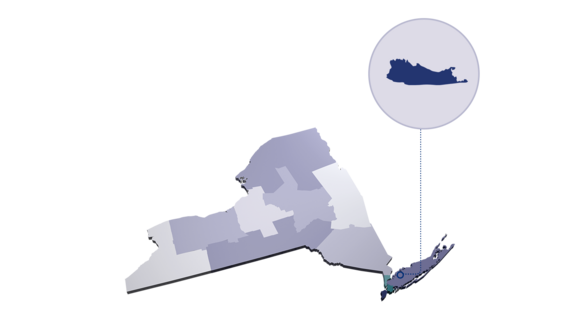
From August 2025 to August 2026, private sector jobs on Long Island decreased by 800, or 0.1%, to 1,194,100. The following sectors experienced job gains:
- education and health services (+10,300)
- other services (+1,200)
-
professional and business services (+600)
Over-the-year employment losses were greatest in the following sectors:
- leisure and hospitality (-5,900)
- financial activities (-2,800)
- natural resources, mining and construction (-1,400)
- trade, transportation and utilities (-1,300)
-
manufacturing (-900)
For the 12-month period ending August 2026, the number of private sector jobs in the Mohawk Valley region increased by 500, or 0.3%, to 143,500. Over-the-year employment gains were focused in the following sector:
-
education and health services (+900)
Job losses were largest in the following sectors:
- professional and business services (-300)
-
manufacturing (-200)
New York City’s private sector job count increased over the past year by 27,600, or 0.7%, to 4,171,000 in August 2026. Job gains occurred in the following sectors:
- education and health services (+34,200)
- other services (+3,500)
- professional and business services (+3,300)
- financial activities (+1,800)
-
natural resources, mining and construction (+1,500)
Employment losses were largest in the following sectors:
- leisure and hospitality (-10,800)
- information (-3,800)
-
manufacturing (-1,700)
The number of private sector jobs in the North Country region decreased over the past year by 400, or 0.4%, to 111,600 in August 2026. Employment gains were greatest in the following sectors:
- education and health services (+400)
-
other services (+200)
Job losses were largest in the following sectors:
- trade, transportation and utilities (-900)
-
information (-200)
For the 12-month period ending August 2026, the private sector employment count in the Southern Tier region decreased by 2,000, or 1.0%, to 207,700. The largest gain occurred in the following sector:
-
education and health services (+200)
Job losses were greatest in the following sectors:
- professional and business services (-700)
- leisure and hospitality (-600)
- trade, transportation, and utilities (-500)
-
manufacturing (-300)
Over the past 12 months, the number of private sector jobs in the Buffalo-Cheektowaga metro area increased by 600, or 0.1%, to 470,900 in August 2026. The largest over-the-year job gains occurred in the following sectors:
- education and health services (+500)
- leisure and hospitality (+500)
- other services (+500)
-
professional and business services (+300)
Employment losses were greatest in the following sectors:
- financial activities (-500)
- manufacturing (-400)
-
information (-300)
|
|
|
Click the button below to become a subscriber to Employment in New York State
Deputy Director / Editor
Kevin Jack
Associate Editors
|
Kevin Phelps
|
|
Steven Koczak
|
Editorial Advisor
Samantha Murray
|
|
|
|
|