|
 by Kevin Jack, Deputy Director
“Every generation imagines itself to be more intelligent than the one that went before it, and wiser than the one that comes after it."
George Orwell
Americans like to research and discuss our nation’s generations. Journalist Tom Brokaw popularized such self-inspection and introspection with his 1998 book The Greatest Generation and its 1999 sequel The Greatest Generation Speaks. His books focused on the generation that came of age during the Great Depression and World War II. Brokaw argued that this generation — whose members were born roughly between 1910 and the 1920s — was exceptional. He cited its heroism and resilience in fighting the war and its contributions to creating a strong American economy after the war.
Studying today’s generations gives us deeper insights into the workforce. Each cohort has its own distinct characteristics, values and attitudes toward work, based on shared life experiences. It also helps us to better understand how different age groups share common values, behaviors and perspectives shaped by our technology and culture.
Dr. Jean Twenge, a Professor of Psychology at San Diego State University, notes that “Technology seems to be at the root of many generational differences,” which show up in how we prefer to communicate. She observed:
- Baby Boomers often want to meet in person
- Gen Xers like to use email
- Millennials prefer to text
- Gen Zers want to use TikTok
Dr. Twenge acknowledges that, though these generalizations are exaggerated and somewhat stereotypical, they contain some truth.
This article reviews the generations active in the workforce. We also explore some of the generational variations in workplace motivators and the events that have impacted each generation.
Generations and Their Workplace Motivators
Here’s a look at the five generations working in the U.S. today and their birth years:
-
Gen Z (1997-2012): This is the youngest group in the workforce today. It is also the first generation to have grown up in an entirely “post-digital” era. Factors shaping Gen Z’s outlook include their early access to technology, the Great Recession of 2007-09 and the COVID-19 pandemic. They are motivated by diversity, individuality and creativity.
-
Millennials (1981-1996): Also known as Gen Y. Defining events for this group include the rise of the Internet and the growing impact of global terrorism, such as the 2001 World Trade Center attack. In the workplace, they are motivated by responsibility, the quality of their manager and unique work experiences.
-
Gen X (1965-1980): Due to a sharp drop in fertility rates in the late 1960s and 1970s, this group is much smaller than the older Baby Boomers or younger Millennials. The experience of being a “baby bust” cohort has powerfully shaped Gen X’s outlook. A 30-country poll by Ipsos found that 31% of Gen Xers say they are "not very happy" or "not happy at all," the most of any generation. The Economist reports that, based on Google searches, “the world is less than half as interested in Gen X as it is in Millennials, Gen Zers or Baby Boomers.” Defining events for Gen X include the AIDS epidemic, the fall of the Berlin Wall and the dot.com boom and bust. Gen Xers are interested in work-life balance and diversity.
-
Baby Boomers (1946-1964): The oldest Boomers turn 80 in 2026, while the youngest ones turned 60 in 2024. As a result, many are retired or are about to leave the labor force. Events shaping this group include various civil rights movements, the Vietnam War and the various political assassinations that rocked the 1960s. For many Boomers, work was a greater priority than personal life, and as a result, they are known for being team-oriented, competitive and highly dedicated to work.
-
Traditionalists (1925-1945): This category combines two older groups: the Silent Generation (1928-1945) and the Greatest Generation (before 1928). We lump these together due to the sparse number of employed people in each group. The youngest Traditionalists turned 80 in 2025. Defining moments for this cohort include the Great Depression, World War II and the Korean War. This group is known for being straightforward, loyal and dependable. A guiding principle for Traditionalists is conformity over individuality.
Most people are likely familiar with most of the generations discussed above, but did you know that 2024 also marks the last year of Gen Alpha? The children of Millennial parents and often the younger siblings of Gen Zers, Gen Alpha’s oldest members were born starting in 2013. Gen Alphas are the first group born entirely within the 21st century. They have adopted technologies like smartphones and social media at an even faster pace than members of Gen Z.
Defining experiences for Gen Alphas include the COVID-19 pandemic (and its aftermath) and the widespread availability of advanced technology, such as AI and smartphones. These factors have profoundly impacted their education, social development and daily lives. While members of this cohort are too young for inclusion in this analysis, it is important to note that the oldest Gen Alphas will begin to enter the workforce at the end of this decade.
According to Australian analyst and demographer Mark McCrindle, the next birth cohort, which is called Gen Beta, includes people born between 2025-2039. They will be the children of younger Millennials and older Gen Zers. McCrindle estimates that Gen Betas will make up 16% of the global population by 2035, with many expected to live well into the 22nd century.
Generations Working in NYS Today
More than 9.23 million New Yorkers were at work in 2024. We use employment estimates tabulated from Current Population Survey (CPS) public-use microdata files to take a “generational snapshot” of New York State’s workforce. The CPS is a monthly household survey conducted jointly by the U.S. Census Bureau and the U.S. Bureau of Labor Statistics. It is a primary source of information on the labor force and other demographic characteristics of the U.S. population.
The table below presents the generational composition of New York’s workforce in 2024, the latest full year for which we have CPS data. Per CPS procedures, we only present data for people at least 16 years of age, as this is the minimum age to count as part of the workforce for statistical purposes. In addition, the CPS takes extra steps to protect the confidentiality of respondents starting at age 80.
Millennials, with more than 3.3 million members, are by far the largest generation, with a 35.8% share of working New Yorkers. Gen X follows with 2.87 million members. This group accounted for 31.1% of working New Yorkers.
In 2024, Gen Z had 1.56 million workers, with a 16.9% share of the state’s workforce. Since the youngest Gen Zers are still too young to count in the workforce, we won’t feel their full impact on the state’s labor market until the end of the 2020s.
There are still more than 1.43 million Baby Boomers working in New York in 2024. Although more than 2.6 million Boomers have exited New York’s workforce since the turn of the 21st century, they were still the largest segment of the state’s workforce as recently as the early 2010s. As of 2024, Baby Boomers ranked #4 and represented more than one in seven (15.5%) working New Yorkers.
Summing Up
Looking at differences in workforce data by generation helps us to better understand the broader labor market. While a unique set of factors influenced each generation, they all continue to contribute to, and make a difference in, New York State’s workforce.
New York State Workforce, by Generation (Age 16+), 2024
|
Generation Name (birth years)
|
Employed
(in 1000s)
|
% Share of Total NYS Employed, 2024
|
|
Gen Z (1997-2012)
|
1,563.6
|
16.9%
|
|
Millennials (1981-1996)
|
3,301.4
|
35.8%
|
|
Gen X (1965-1980)
|
2,868.8
|
31.1%
|
|
Baby Boomers (1946-1964)
|
1,431.3
|
15.5%
|
|
Traditionalists (1925-1945)
|
66.7
|
0.7%
|
|
Total, NYS Workforce
|
9,231.8
|
100.0%
|
Source: CPS
|
|
“The Construction sector remains one of the most dependable sources of jobs, wages and economic vitality in the North Country region.”
by Konstantin Sikhaou, Labor Market Analyst, North Country region
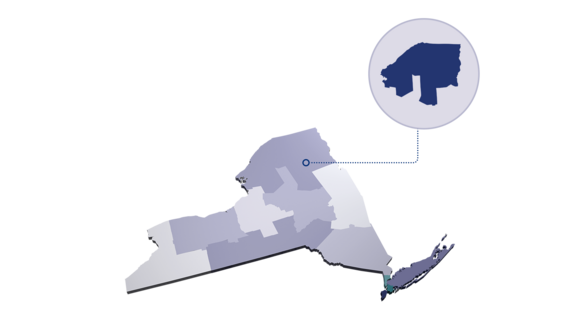
The Construction sector, which plays a central role in the North Country’s regional economy, includes three subsectors:
- Construction of Buildings (NAICS 236)
- Heavy and Civil Engineering (NAICS 237)
- Specialty Trade Contractors (NAICS 238)
Together, these subsectors help keep the region’s infrastructure strong, support a steady mix of residential and commercial work, and help to grow New York State’s burgeoning clean-energy industry. With roughly 6,150 jobs in 2024, Construction accounted for 5.8% of all private sector employment in the North Country, making it one of the region’s five largest sectors. This article looks at the important contributions the sector makes to the North Country’s regional economy.
Post-Pandemic Growth
Since the pandemic, Construction employment growth in the North Country has shifted from stabilization mode to steady, broad-based expansion. Data from the Quarterly Census of Employment and Wages show that sector employment grew by more than 600, or almost 12%, between 2020 and 2024.
This employment gain underscores the point that not only has the sector recovered from pandemic disruptions, but it has built a foundation for further growth. While sector employment has increased moderately, sector wages ($72,900) have remained well above the region’s private sector average wage ($53,660). Moreover, investment in infrastructure, housing, and renewable energy projects has helped local firms to retain skilled labor and strengthen the region’s construction base.
Also of note is that all three construction subsectors in the region added jobs between 2020 and 2024:
- Specialty Trade Contractors, the region’s largest Construction subsector, grew 12.7%, from 2,840 to 3,200 jobs, with an average wage of $65,730
- The Construction of Buildings subsector grew 13.1%, from 1,830 to 2,070 jobs, with an average wage of $62,840
- Heavy and Civil Engineering Construction, the subsector with the highest average wage ($122,560), grew 5.9%, from 830 to 880 jobs, thanks to a steady flow of infrastructure improvements, energy development, and public facility projects
Key Sector Drivers
Several factors are contributing to the current positive outlook for the North Country’s Construction sector. First, public infrastructure investments continue to be a steady driver by providing predictable workloads across roads, bridges and water systems. A recent example is a $15 million package to upgrade six bridges in Lewis County, showing the scale of capital now reaching rural areas.
A second factor is growing defense and aviation work. Fort Drum in Jefferson County has secured $18.5 million in federal funds for new barracks and a hangar addition, while the AIR NY aviation capital program recently awarded more than $4.1 million for airport improvements.
Finally, clean energy construction is expanding rapidly in the region. Quebec-based Boralex’s two advanced utility-scale solar sites — the 250 megawatt (MW) Fort Covington Solar Plant in Franklin County and the 200 MW Two Rivers Solar Farm in St. Lawrence County — are providing nearly 240 jobs during the construction phase and creating new opportunities for local contractors and skilled trades. These and similar projects are helping to diversify work for firms across the North Country and strengthen the region’s role in New York’s clean-energy transition.
Sector Outlook
The long-term outlook for the North Country’s Construction sector remains positive. Long-term industry employment projections from the New York State Department of Labor show all three subsectors — Specialty Trade Contractors (+24.4%), Construction of Buildings (+17.6%) and Heavy and Civil Engineering Construction (+15.7%) — are expected to grow between 2020 and 2030.
Similarly, key occupations within the Construction sector are also projected to expand between 2022 and 2032. These key occupations and their projected rate of growth over this period include:
- HVAC Mechanics and Installers (+11.4%)
- Operating Engineers and Other Construction Equipment Operators (+9.1%)
- Supervisors of Construction and Extraction Workers (+6.8%)
- Electricians (+4.6%)
- Construction Laborers (+4.4%)
Concluding Thoughts
State and federal government investments in transportation infrastructure, housing upgrades and renewable-energy projects are expected to further strengthen the Construction sector’s long-term demand for workers in the skilled trades. With an average sector wage well above the regional private sector average, Construction continues to serve as one of the most important and rewarding employment paths in the North Country. Not only do positions in the Construction sector offer durable, middle-income careers, they also help to boost the region’s broader economic resilience. As a result, the Construction sector remains one of the most dependable sources of jobs, wages and economic vitality in the North Country region.
|
|
 by Kevin Phelps, Principal Economist
From the Adirondack peaks to the New York City skyline, and from Long Island’s vineyards to Niagara Falls, the natural beauty and wonder of New York State has long attracted visitors from around the world. Their spending on dining, lodging, transportation, and entertainment supports the livelihoods of workers in the tourism industry. Moreover, it also drives economic growth and bolsters public services. As a result, a vibrant tourism sector is essential to the overall health of the state’s economy.
2024 Tourism by the Numbers
A recent report from analytics firm Tourism Economics prepared for Empire State Development found that a record-high 315.4 million visitors — defined as people who stayed overnight or traveled more than 50 miles to their destination — traveled to New York in 2024. These visitors contributed $94 billion in direct spending to the state’s economy.
After accounting for ripple effects, such as supplier purchases and the spending of tourism-generated wages, the total economic impact of tourism reached $145.2 billion. Consequently, tourism generated more than $11.4 billion in state and local taxes. Without this revenue, each household in New York State would need to pay an additional $1,490 in taxes to maintain the same level of government services.
The Rebound Continues
The COVID-19 pandemic had a profound negative impact on travel to New York State. Between 2019 and 2020, the number of visitors declined by 25.7% to 198.3 million, while visitor spending fell by 53.9% to $33.9 billion. Since then, the tourism sector has rebounded, with visitor volume and spending increasing at annual rates of 15.6% and 40.5%, respectively, through 2023.
The 2024 tourism figures build upon this strong rebound; however, the rate of growth has slowed from the double-digit yearly growth seen from 2020 to 2023. The number of visitors was up 3.0% from 2023 as the demand for travel returned to its pre-pandemic trend. Growth was driven by increases in both domestic (+2.9%) and international travelers (+7.9%).
Visitor spending grew by 6.7% from 2023’s level. Tourism Economics attributes the slower growth rate to “easing demand coupled with inflation across key spending categories.” The increase in spending was driven more by international visitors (+17.5%) than by domestic visitors (+4.1%). However, despite the sizeable increase in spending by international travelers, this group’s spending in 2024 was still 3.7% below its pre-pandemic level set in 2019, suggesting there is still room for further recovery.
Where the Money Goes: Lodging Leads the Way
From 2023 to 2024, visitor spending increased across all major categories. Lodging (+8.2%) was a standout, with travelers spending $31 billion, accounting for one-third of all visitor spending. This growth was driven by a combination of higher demand and a 6.0% rise in average daily room rates. Spending for other major categories included:
-
Food and beverage: up 7.9% to $24.4 billion
-
Retail and service stations: up 4.5% to $15.9 billion
-
Transportation: up 4.6% to $13.4 billion
-
Recreation and entertainment: up 5.5% to $9.4 billion
Fueling New York’s Job Market
In 2024, tourism continued to be a major employer in New York State, supporting hundreds of thousands of jobs. Within the food and beverage industry alone, tourism spending supported more than 240,000 jobs. The second largest industry was lodging, with nearly 100,000 tourism-supported jobs.
These jobs are not just confined to the state’s urban centers either. Tourism-supported employment increased over the year in each of New York State’s 10 labor market regions, from the largely rural North Country to New York City. In total, Tourism Economics estimates that tourism spending supported more than 740,000 jobs across the state in 2024.
Strategic Investments in Tourism
According to the U.S. Department of Commerce, New York was the most-visited state by overseas air travelers in 2024, accounting for more than a quarter of all such visits to the U.S. While New York’s natural wonders and world-renowned destinations are key contributors, another important factor is our world-class infrastructure and amenities. New York has made significant investments in its airports, transportation hubs, trails, welcome centers and other tourism-related facilities. As a result, the state has become more accessible and appealing to both visitors and residents.
Summing Up
With more than 315 million visitors, nearly $100 billion in visitor spending and over $145 billion in total economic impact, the 2024 data highlight the importance of tourism to the Empire State’s economy. As tourism continues to rebound and expand following the disruption of the COVID-19 pandemic, strategic investments in infrastructure, amenities and marketing efforts will all remain critical to the sector’s long-term success.
|
|
|
Click the button below to become a subscriber to Employment in New York State

|
|
|
|
|