|
Autumn 2026 Newsletter
|
Santa Fe County Awarded $706,054 for Solar Power and Battery Backup at Senior Centers

Santa Fe County has been awarded $706,054 through the NMFA Local Solar Access Fund to bring solar power and battery storage to three senior centers. The Bennie J. Chavez Senior Center (Chimayó), the Ken & Patty Adam Senior Center (Eldorado), and the Edgewood Senior Center will each receive tailored solar and battery systems designed to reliably provide power during normal operations while also sustaining critical functions during power outages or emergencies. “By adding solar and batteries to these senior centers, we will improve everyday resilience, reduce electricity costs, and enable them to serve as resilience hubs for the surrounding communities,” says PJ Montano, Facilities and Projects Division Director.
The new systems will provide reliable power to these senior centers on a daily basis, and batteries will help each site make the most of the solar energy it generates. When outages do happen, the same systems will keep heating, cooling, lighting, refrigerated medication storage, and device charging available. “Senior centers are already places our residents count on for a range of services,” says Brian Snyder, Public Works Department Director. “Solar and batteries will help these facilities run smoothly and efficiently day in and day out, while also giving us backup power we can count on when it’s needed.”
These senior centers will provide comfortable, climate-controlled spaces for community members, support local emergency response activities, and increase on-site solar energy generation for County operations. “We’re always looking for ways to support our community while increasing resilience,” says Jonathan Butler, Community Development Director. “We’re grateful to receive this award and look forward to bringing reliable, renewable energy to our senior centers.”
|
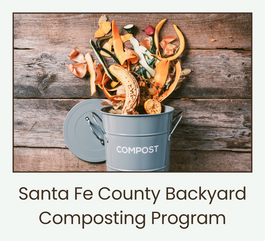
The Santa Fe County Backyard Composting Program provides free compost system installations and training to residents who live in unincorporated areas of Santa Fe County. County residents can apply now to receive compost systems in spring 2027.
Roughly one-third of household waste is organic matter (like food and yard trimmings), and the Backyard Composting Program diverts this material from the landfill by transforming it into a beneficial soil amendment. Composting reduces greenhouse gas emissions, saves time and money by minimizing trips to transfer stations, and creates a soil amendment that helps plants flourish.
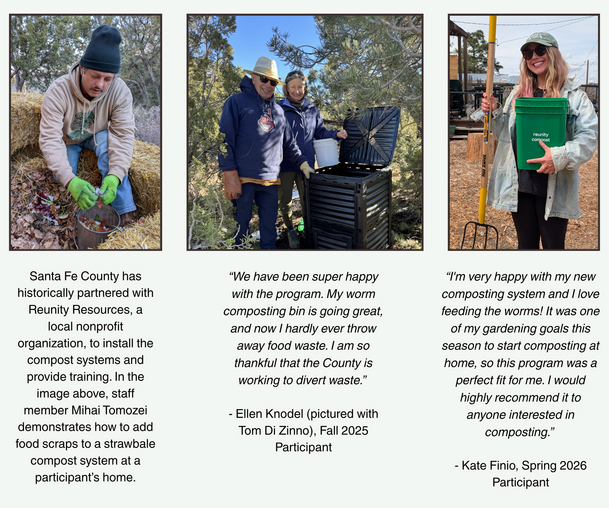
Participants can choose between a black plastic composting system and a strawbale composting system, and Santa Fe County has partnered with Reunity Resources since 2018 to install the compost systems and provide personalized guidance and technical support. “We love working with Santa Fe County to help make composting accessible to our community,” says Reunity Resources Program Director Juliana Ciano. “Composting is a tangible, daily act of hope and positive transformation, and this program can help you do it right in your backyard!”
The New Mexico Recycling Coalition awarded the Santa Fe Backyard Composting Program “Diversion Project of the Year” in 2025, and you can learn more about the program's positive impact in this press release.
|
Michael J. W. Carr, Environmental Compliance Officer

On September 8th, Santa Fe County Public Works announced its plan to roll out a revitalized Domestic Well Use Metering Program to the Board of County Commissioners (BCC). The program will require all new developments utilizing domestic groundwater wells to participate in annual reporting of their flow meter readings. This effort is accompanied by broader conversations about water resource management and concerns about groundwater availability across New Mexico. These anxieties aren’t new, but part of a changing climate that local communities have been grappling with for decades. These hotter, drier realities will require a better understanding of our water usage, which groundwater metering can provide.
In 2002, the County initiated the original Domestic Well Use Metering Program in response to severe droughts and groundwater overuse – issues still affecting our community. However, limited staff resources and well-owner engagement restricted the implementation of an effective program, and reimplementing the program has been a County priority and strategic goal since 2019. With considerable efforts being allocated towards water resource management, the County plans to roll out this revised well metering effort that prioritizes community engagement and ease of reporting for well owners in early 2027.
This modernized iteration of the program will include a new online reporting feature to keep reporting well meter readings as easy as possible. The program also includes a revamped webpage and educational materials to help owners participate in the program and care for their wells. Visit the updated Meter Reading Website for additional details.
County staff plan to present to the BCC as the supporting web application is developed. This will be accompanied by an extensive public outreach campaign, including open house events throughout the county before and following the formal implementation of the program. The September 8th BCC presentation can be viewed on the County YouTube Channel. Updates will be shared through County press releases available on the News and Articles webpage.
|
Volunteers Help Keep Open Space Windmills in Good Repair
Monica Harmon, Open Space Resource Management Specialist
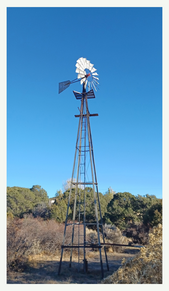
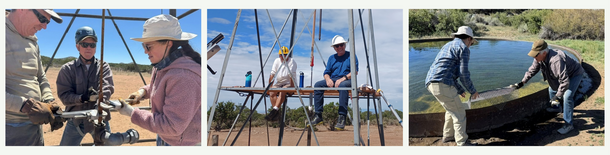
After closing on Bobcat Crossing Ranch Open Space in late 2025, the open space program inventory of windmills doubled. The new property has two windmills on site. These water sources dotted across our dry landscape provide oases for wildlife who roam sometimes vast distances between mountain ranges in Santa Fe County.
Drawn almost by instinct, retired engineer and Eldorado resident Joe A. reached out to county staff. “After retiring from the oilfield, I thought I was done working on wells. Then I noticed windmills in Santa Fe County that were in dilapidated condition and needed attention,” he said. With the help of a few interested and enthusiastic problem solvers, Joe and volunteers work to maintain windmills on open space properties. Volunteer Jack H. finds motivation in enhancing habitat: “My passion for rehabbing these old agricultural windmills is based in my love of wildlife. Providing drinkers in this desert landscape helps to promote a more viable natural environment for all types of wildlife, from big game to upland birds and predatory species, each of which contributes to a healthy ecosystem.”
These volunteers are helping us in our goal of maintaining a healthy ecosystem, which contributes to a healthy community. Volunteer Drew G. shares this sentiment, “The main reason is to give wildlife sanctuary to live since their habitat is dwindling everywhere else and I just enjoy working with everyone.” Thank you, windmill volunteers!
|
 |
Planning Staff Update: Advancing Community Resilience at La Bajada Ranch and Agua Fria
Joseph Scala, Community Planner
The job of Santa Fe County planning staff is essentially to work alongside local communities to help shape and implement shared long-term visions. While these ongoing efforts often center on everyday, fundamental concerns; such as water availability, emergency access, wildfire risk, and maintaining a rural character, the community planning process at times also brings forward visionary projects focused on sustainable agriculture, cultural preservation, and intergenerational support. At the heart of this work is a commitment to ensuring our ecological, economic, and cultural landscapes endure.
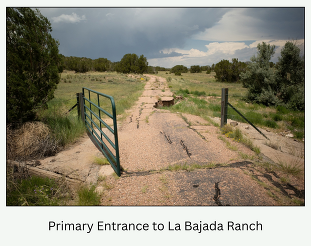
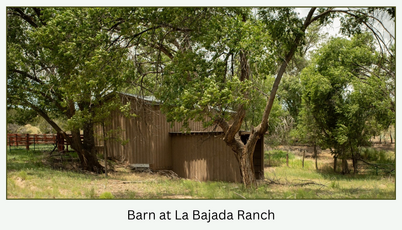
To understand the promise of La Bajada Ranch, we look to its rich history at the confluence of geography and human experience. Situated adjacent to Lower La Cienega, the property spans roughly 470 acres of historic ranch. For thousands of years, the site has been shaped by Indigenous stewardship, generations of Nuevo Mexicano land use, and a deep, enduring relationship to the landscape.
In November 2009, Santa Fe County acquired the ranch property as a strategic investment to prevent development and ensure its permanent preservation. Following the acquisition, the County conducted extensive studies evaluating its agricultural suitability, a winery incubator, and an agri-hub business plan, aligning with the 2025 La Cienega/La Cieneguilla Community Plan. Because the property has remained largely undeveloped since its purchase, planning staff are now working closely with community members to establish a dedicated working group to guide a comprehensive master planning process for the site.
Sustainability serves as the foundational lens for the future of La Bajada Ranch. Environmental and cultural sustainability are planned through commitments to protect sensitive archaeological resources while expanding regional trail systems that respect the natural terrain. The working group will discuss economic and social sustainability by exploring the potential for a regional food hub dedicated to crop aggregation and distribution, which supports local farm viability and food security, alongside vital public safety infrastructure like a local fire station. When the working group discusses these and other potential land uses, staff will encourage the integration of Green Stormwater Infrastructure, such as contoured earthworks, rain gardens, and micro-catchments, to capture runoff and recharge local groundwater.
In Agua Fria, planning efforts are similarly grounded in sustainability through cultural continuity and community vision. In April 2025, Mainstreet New Mexico completed a feasibility study for a proposed history, arts, and culture center designed to celebrate the heritage of Agua Fria. Staff are currently working with ARC consultants on a study to assess the programmatic, operational, and engineering feasibility of the facility. The center will highlight Agua Fria's long-standing history of agriculture and the arts while serving as an intergenerational community hub featuring a community farm, integrated GSI practices, and vital social services that bridge past traditions with modern needs.
To bring these agricultural and ecological visions to life, the County is exploring collaborative frameworks with regional leaders in regenerative agriculture and land stewardship, like Reunity Resources, the Quivira Coalition, and the Coalition to Enhance Working Lands. By partnering with these groups, La Bajada Ranch, the Agua Fria center, and potentially expanded County open space properties could serve as demonstration sites for soil health improvement, carbon sequestration, and low-input, low intensity, dryland farming. Establishing structured agricultural leases with local producers and land stewards will help these partnerships turn public lands into active incubators for ecological education, local food production, and community-scaled land healing.
These initiatives reflect Santa Fe County's ongoing dedication to balancing ecological stewardship, economic resilience, and the preservation of our cultural landscapes. Stay tuned for more updates as these projects develop!
|
 |
Support Birds During Migration Season
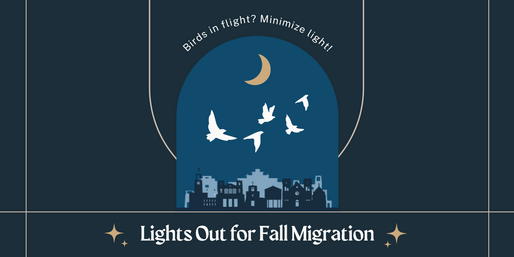
Each fall, birds like the Wilson's Warbler, Western Tanager, and Lark Sparrow migrate through New Mexico as part of their seasonal journey. September and October are the peak migration period, and you can view BirdCast’s real-time estimates and predictions for Santa Fe County. Much of this travel occurs under the cover of darkness, and bright lights at night can disorient these birds and lead to collisions. The good news is that some small changes can make a big difference. Minimizing non-essential light between 11 p.m. and 6 a.m. can help keep these birds safe during their fall migration while also potentially lowering your energy bill.
Here are some specific actions you can take:
- Turn off non-essential outdoor lights at night, especially upward-facing lights.
- Add downward shields on exterior lights to minimize upward glare.
- Install motion sensors and automatic controls where possible.
- Minimize decorative lighting around buildings.
- Turn off interior lights in empty rooms at night, especially on upper floors.
- Close blinds and curtains to reduce light from windows.
You can learn more about the Audubon Lights Out program.
If you're interested in everyday strategies for supporting birds, consider implementing window-collision prevention methods such as screens or decals. Window collisions are one of the leading direct human causes of bird mortality, mainly because birds can’t see glass in the same way people do. Creating barriers or visual clues can help birds recognize that there is a solid object, whether this is through external screens, special glass, or patterns on reflective glass surfaces. Quantity and spacing do matter, and multiple markings that are two to four inches apart are recommended. You can learn more about reducing window collisions from this Audubon article, which includes links to various resources like this brochure, "Making Your Home Safe for Birds."
 |

The leaves are turning, the temperatures are dipping, and Halloween is right around the corner. Pumpkin carving and the golden glow of jack-o'-lanterns on crisp autumn evenings are a delightful part of the season for young and old. But here's the scary truth - roughly 1.3 billion pumpkins end up in U.S. landfills every year! Would you like your Halloween pumpkins to avoid this grim fate? Here are some ideas to consider:
Eat Them: No, not the actual jack-o'-lantern pumpkin. While there are many delicious pumpkins available for cooking, a carving pumpkin will probably be bland, stringy, and watery. Additionally, a carved pumpkin left on your front porch for weeks will not be safe to eat because of bacterial contamination and spoilage. However, when you carve your jack-o'-lantern, the seeds you scoop out can be cleaned, roasted, and enjoyed as a delicious snack. Another approach to pumpkin decor is to specifically select edible pumpkins, display them uncarved, and then enjoy them later in the season in pies, breads, soups, and more. You can also simply cut and roast them as a simple and delicious side dish.
|
Compost Them: Old pumpkins can be turned into compost, which builds soil health and supports plant growth while reducing greenhouse gas emissions. Just remember to remove extra decorations or avoid them altogether. While paint, glitter, and hairspray can look vibrant and fun on a pumpkin, they are non-organic materials that don't break down in a compost pile. Chopping up your pumpkin can also speed up the decomposition process. If you don't have a backyard compost pile, you still have lots of great options for composting your pumpkins in Santa Fe, such as bringing them to a community composting site like Reunity Resources Farm or signing up for a compost collection program. You can learn more about composting options on the Santa Fe County Sustainability webpage.
Feed Them to Animals: Mold-free and untreated pumpkins can be a fun treat for local animals. Whether you split them and fill them with birdseed for local birds, leave them out for deer and squirrels, or give them to a local farmer for their animals, your old pumpkin can be a food source instead of landfill fodder. Just remember, you may want to think twice about leaving old pumpkins out in your yard if there are bears in your area.
Whatever option you choose, your pumpkins will be making a positive impact while avoiding a dark fate in the landfill.
|
Highlighted Autumn Events
|
Saturday, October 24
8:30 - 10:00 a.m.
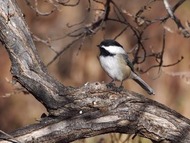
Join the free guided bird walk led each Saturday by experienced volunteers. This program is one of the best ways to get to know local birds, and there may be some special avian guests because of seasonal migration. All levels are welcome, and no RSVP is necessary. The guides are happy to introduce novices to the basics of birding, and more experienced birders will enjoy seeing wildlife in their natural habitat.
Learn More Here

Friday, November 6 -
Sunday, November 8
The Recycle Santa Fe Art Festival is the largest and longest-running recycled art market in the United States, showcasing original works made from a minimum of 75% reused materials by over 90 artists. The multi-day event includes a juried art show, family make-and-take activities, and a high-energy Trash Fashion Show on Friday night.
Registration is required for the Fashion Show, and admission information can be found here. The Art Festival on Saturday and Sunday is free to attend.
Learn More Here

Tuesday, December 15
5:30 - 7:00 p.m.
Learn about Bureau of Land Management conservation case studies here in New Mexico from award-winning author Dr. Andrew Gulliford, who will discuss his newly-released book Lonesome Landscapes: Stories from National Conservation Lands.
This free event will be held in the Main Library Community Room. Registration is required and will close at noon on December 15.
Learn More Here
|
|
|
Saturday, October 24
7:00 - 9:00 p.m.
See the Santa Fe Botanical Garden in a new light during this special, spooky event. Enjoy hot cider and light refreshments in the eerie glow of flickering campfires, and take a tour to hear spine-tingling tales in the darkest corners of the grounds.
Advanced registration is required for this event, and admission information can be found here.
Register Here
Thursday, November 12
6:00 - 7:00 p.m.
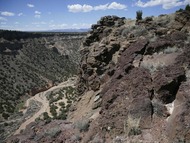
This installment of the River Talks series explores the geology of the Santa Fe River Basin and how groundwater moves in our landscape. Daniel Koning, Senior Research Scientist for the New Mexico Bureau of Geology and Mineral Resources, will be the featured guest speaker.
River Talks is a free, ongoing community conversation series presented by the City of Santa Fe and the Santa Fe Watershed Association, with seasonal talks held throughout 2026 at Iconik Red.
Learn More Here

December 17-31
(closed 24-25)
4:30-7:30 p.m.
This December, the Santa Fe Botanical Garden opens its gates after dark for La Luz de las Noches, a winter tradition where thousands of twinkling lights, glowing farolitos, and the warm flicker of real wood fire pits transform the Garden into an inspirational gathering place for the whole community. Stroll the beautifully illuminated pathways, and enjoy live music, warm drinks, and plenty of holiday cheer. Admission is required for adult and youth guests, but children 5 and under enter free.
Register Here
|
|

Thursday, November 5
9:00 - 11:00 a.m.
Mike Kintgen, Curator of Alpine Collections at Denver Botanic Gardens, will share his insights on the conservation of alpine plants in an era of accelerating climate change. As snowpack shrinks and alpine summers shorten, high-altitude plant communities face growing pressure, and botanical gardens play critical role in conservation. Advanced registration is recommended for this Botanical Garden event, and admission information can be found here.
Register Here

Wednesday, November 18
5:30 - 7:00 p.m.
Read about and discuss the wonders of the natural world with like-minded people. Each monthly session revolves around a new title from a curated list of recent publications. The November selection is The Light Between Apple Trees: Rediscovering the Wild Through a Beloved American Fruit by Priyanka Kumar. This meditative and illuminating book explores the rich and complex history of wild apple trees while weaving together science, memory, and our relationship with the natural world.
Learn More Here

Thursday, December 24
5:00 - 9:00 p.m.
The Farolito Walk on Canyon Road provides an evening of holiday magic for the thousands who stroll the iconic road on Christmas Eve. Known for world class galleries, Canyon Road transforms itself into a work of art during this unique annual celebration. Many businesses are closed on Christmas Eve, but some remain open for last minute shoppers and offer a place to warm up. Be sure to dress warmly, and bring the whole family to this festive holiday event.
Learn More Here
|
|
|
|
|
|
|
Sharing
Share this issue with others! 
Sustainability Questions?
We are your local advisors on all things sustainability in Santa Fe County.
Feel free to reach out if you have any questions.
Jacqueline Beam, jybeam@santafecountynm.gov
Elizabeth Houghton, ehoughton@santafecountynm.gov
Click to visit the Sustainability webpage
|
|