Smart Buildings and Smart Vehicles
Will Donahoo, Sustainability Specialist
This June, Santa Fe County completed two long-running initiatives aimed at reducing emissions and energy costs and modernizing operations within the County.
Presented to the Board of County Commissioners on June 9, the Balanced Resource Acquisition and Information Network, or BRAIN, is an energy management system that collects and aggregates information from monthly utility bills, smart systems such as EV charging stations, and energy monitors installed at high-use County facilities. Encompassing nearly 100 County-owned facilities, from administration buildings to senior centers, the BRAIN allows County staff to quickly understand how much energy each facility uses every month and determine whether County assets are performing as anticipated. Previously, answering a simple question like how much electricity senior centers used in 2025 would have required spending many hours tracking down account numbers, visiting utility websites, and downloading data. Now, using the BRAIN, the same process can be completed with the click of a button. Within the next year, efforts will be made to expand the system by integrating new technologies, such as smart water meters that analyze facility water usage in real time and 3D building walkthroughs.
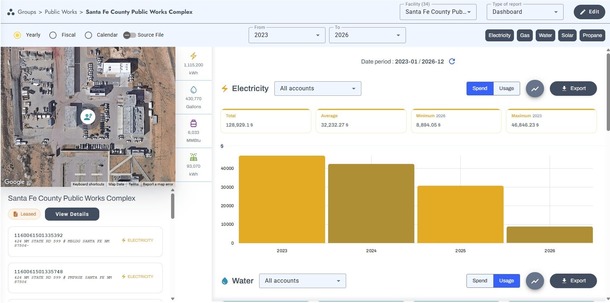 |
Online Dashboard for the Santa Fe County BRAIN
At the following Board of County Commissioners meeting, on June 30, Sustainability staff and consultant ERG, presented the findings of the Santa Fe County Vehicle Replacement and Charging Infrastructure and Equipment Electrification Plans. Throughout 2025 and 2026, ERG worked with County staff to evaluate fleet operations, vehicle utilization, and charging infrastructure needs to develop a comprehensive strategy to inform the County’s transition to zero-emission vehicles and equipment.
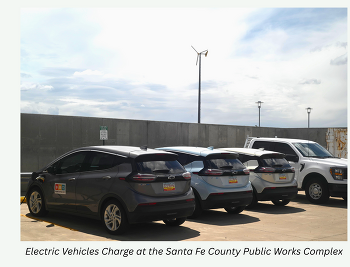
As a result of these efforts, ERG identified which County vehicles are best suited for replacement with EV alternatives, modeled the total vehicle and infrastructure costs associated with electrifying the County fleet, developed site-specific infrastructure strategies, and provided detailed policy recommendations. The plans found that over 250 County vehicles are currently well-suited for replacement with EV alternatives. In the coming years, County staff will use this plan to guide vehicle replacement decisions, prioritize investments in charging infrastructure, and refine electrification policies and procedures.
|
Groundwater, Drought and Climate Change:
Sustainability’s Growing Enigma
Jacqueline Beam, Sustainability Manager
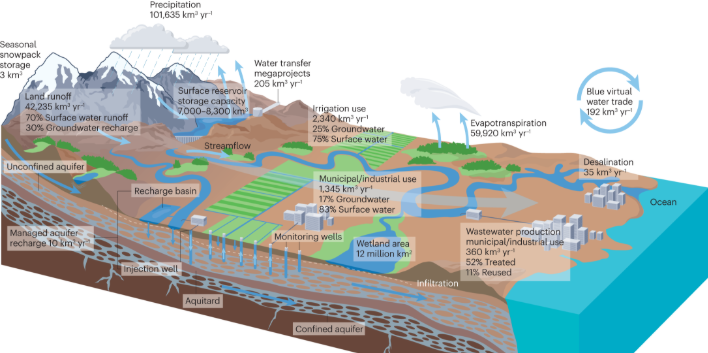
Water is heavy on everyone’s mind it would seem and with reason. We are facing the lowest amount of precipitation ever recorded in the snowpack for ’25-26. Rivers, and wells are drying up throughout New Mexico. As human beings it is common for the thread of hope to hold us fixed to our usual routines and habits, especially when the source is hidden from sight. Over 50% of the State of New Mexico depend upon groundwater for drinking and irrigation—a source that is increasingly disappearing and sadly, unregulated at a level of need required to ensure future availability. We rely upon that water to keep coming out of the tap and in many areas throughout Santa Fe County, if one is fortunate enough to be connected to a utility line, it will. Yet, for those who are reliant upon underground water, the recent 360 Groundwater Report states the irrefutable data as a fact: water tables are dropping all around and far outpacing recharge capabilities in the State of New Mexico.
Yet, as a colleague recently stated, it isn’t helpful to spout gloom and doom. Agreed! We need practical and effective solutions to manage this crisis upon us. Shifts in planning toward resiliency, and application of sustainable best practices, long-term, is much more effective than the head-in-the-sand approach and provides the hopeful light on the horizon we all seek.
The Next Generation Water Summit 2026; Increasing Demand, Declining Realities, covered many of these same issues and concerns. Held this past month, the event had the largest participation since its inception ten years ago. This year, as a result of the County’s sponsorship and focus on traditional communities and rural concerns, a plethora of innovation and technological applications were presented for reshaping the aquifer mining aspect of rural and fringe rural neighborhood realities. Presentations are still available online for local residents. Black and grey water systems, green stormwater infrastructure, waste water infrastructure financing, wastewater treatment options—these applications are solutions for immediately reducing the pumping of aquifers. However, for the average home or business owner, and depending upon scale, they require research, substantial funding, and more importantly, a drastic policy shift towards water recycling practices in planning, codes, and enforcement.
This is a paradigm that Santa Fe County is actively working through considering most of County residents are dependent upon domestic wells and/or mutual domestic water providers that depend upon subsurface water sources. Recycling water is the solution. The Southwest challenges are complicated and complex in that the strained watershed basin and surrounding landscapes are going through aridification. These challenges are further intensified by climate change and population growth with the majority of the population relying upon a shared source below ground that is disappearing.
To make the most sustainable decisions and take action, more information is needed and a light is on the horizon as the County works on Sustainable Land Development Code updates and the State continues its aquifer mapping throughout the State. Santa Fe County is on the list for this project coming soon through Airborne Electromagnetic Surveying (AES and/or AEM for mapping). AES/AEM technology provides a look deep below the surface to analyze the health of aquifers to include structural makeup, capacity, and water quality using electromagnetic waves. Santa Fe County staff, along with the City of Santa Fe and New Mexico Bureau of Geology & Mineral Resources met during the Next Generation Water Summit to plan for an area of fly overs in the County as a result of this statewide initiative. If completed as intended, the below-ground viewing through this technology will provide our community with a great deal more in data and understanding in the coming months. In the meantime, conservation and low-tech measures such as gray water reuse, Green Stormwater Infrastructure (GSI) are available to everyone at a fairly low cost and can stretch well usage timelines and slow the pumping.
Every drop counts in the sustainability bucket and every drop is a recycling/reuse opportunity.
Free Tire Recycling Month a Success
More Free Solid Waste Days on the Horizon
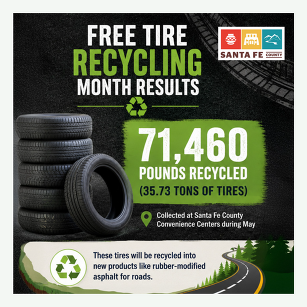
Illegally dumped tires pollute the environment and pose a serious fire hazard, and proper recycling turns them into valuable new products such as rubber-modified asphalt. With funding support from the NMED RAID grant, Santa Fe County expanded free tire recycling at its convenience centers from three weekends, to the entire month of May and also reduced barriers to participation by allowing residents to present a valid ID and proof of address in lieu of a solid waste permit. There was an unprecedented level of participation, and Santa Fe County residents recycled 71,460 pounds (35.73 tons) of scrap tires at no cost during the month of May. This is equivalent to the weight of 20 Chevy Impalas!
|
While free tire recycling won't be offered at County convenience centers again until next spring, there are some other upcoming opportunities to dispose of green waste and residential trash at no cost. More details are outlined below.
🌿 Free Green Waste Disposal Days 🌿
Green waste that is brought to County collection centers is processed into mulch and compost. This is much safer and cleaner than open burning, and Santa Fe County is offering 12 free green waste disposal days this year.
-
When: The second Friday and Saturday in July and August, as well as the first Friday and Saturday of September
- July 10 and 11
- August 7 and 8
- September 4 and 5
-
Where: Stanley, Jacona, and Eldorado Collection Centers
-
Eligibility: County residents with a valid solid waste permit who are dropping off green waste
-
Additional Details: "Green waste" includes yard waste, lawn clippings, leaves, and tree trimmings (under 18" diameter). It does NOT include weeds, cholla cactus, sod, root balls, stumps, lumber, treated wood, dirt, rocks, or construction materials.
🗑️ Free Trash Disposal Days 🗑️
Santa Fe County is hosting a free trash day that coincides with Keep Santa Fe Beautiful's Toss No Mas litter cleanup event. This gives residents a convenient way to responsibly dispose of household waste while joining a broader effort to reduce litter across Santa Fe County.
-
When: Saturday, September 19
-
Where: All Seven County Collection Centers
-
Eligibility: County residents with a valid solid waste permit who are dropping off residential solid waste
Santa Fe County's Open Space and Trails Division Welcomes
New Volunteer Coordinator
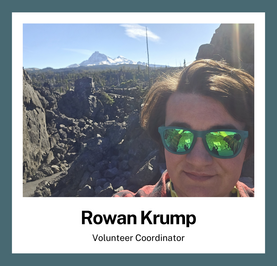
We're excited to have Rowan Krump join the Santa Fe County Open Space and Trails division as the new Volunteer Coordinator! Rowan has undergraduate degrees in Outdoor Education (Black Hills State University) and Environmental Systems Science (University of Wyoming), and he has worked for the Forest Service and Bureau of Land Management as a wildfire dispatcher, fire lookout, forestry technician, soil technician, and soil scientist. He also worked in interpretive roles at Vore Buffalo Jump, Kam Wah Chung State Heritage Site, and Big Four Ice Caves, and as a field guide for college outdoor and wilderness therapy programs.
Originally from Bend, OR, he has lived and worked in Colorado, Wisconsin, Wyoming, South Dakota, Washington, and New Mexico before joining Santa Fe County. In his spare time, he enjoys backpacking, reading, hiking, camping, cooking, and birding with his husband. We appreciate Rowan's rich experience, warm sense of humor, and genuine care, and we look forward to having him connect Santa Fe County residents' passion for the natural world with exciting projects in our open spaces.
|
City Nature Challenge 2026 Results
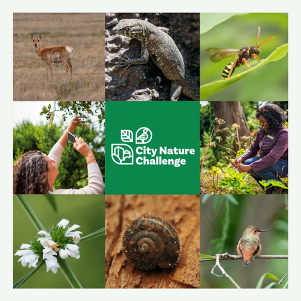
The City Nature Challenge is an international effort to find and document plants and wildlife in cities across the globe. It’s a bioblitz-style competition to see which cities can make the most observations, find the most species, and engage the most people. Participants photographed wild plants and animals from April 24–27 using iNaturalist, then identified observations through May 13.
The 2026 Santa Fe City Nature Challenge was a great success, with 358 participants making 2,085 observations of 614 species. In fact, we placed 256 out of 670 participating cities worldwide! Across the globe, a total of 102,945 participants made 3,310,131 observations of 73,765 species, and you can learn more about this year's results on the City Nature Challenge website and the iNaturalist project page. If you're interested in reading about how this annual event contributes to biodiversity knowledge and informs local government practices, check out this BioScience journal article.
This is the Santa Fe Area's third year of participating in the City Nature Challenge, and we deeply appreciate all the work that Michael Carr (Environmental Compliance Officer for Santa Fe County) has done to support its success. Whether leading iNaturalist workshops, tabling at events, or serving as a key observer and identifier for the event itself, he has provided key leadership through the years.
|
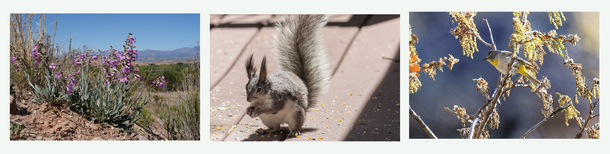 2026 Santa Fe City Nature Challenge observations featured above:
- Penstemon augustifolius (Broadbeard beardtongue); LINK; Alec Mckeand CC-BY-NC
- Sciurus aberti (Abert’s Squirrel); LINK; Craig Martin CC0
- Leiothylypis virginiae (Virginia’s Warbler); LINK; rwalkernm CC-BY-NC
Notes from the Field: Don’t Please Badger Me!
Rose Masters, Open Space Interpretive Ranger for Santa Fe County Open Space, Trails, and Parks
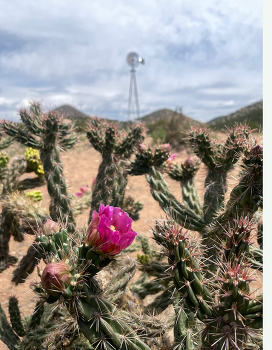
Greetings, nature lovers! Welcome to Santa Fe County’s newest open space, Bobcat Crossing Ranch, which was acquired in October 2025. Since December, Open Space & Trails staff, with the support of Master Naturalist volunteers, have been conducting wildlife monitoring to learn which creatures call this beautiful place home or pass through on their journeys from the southernmost Rocky Mountains to the Galisteo Basin and beyond.
A big reason this open space is so valuable is that it protects an important wildlife corridor from development, which would interrupt these migration patterns. What we’ve learned so far is that Bobcat Crossing Ranch is home to a diverse array of wildlife, from black bears and mule deer to pinyon jays, and perhaps most surprisingly, even tiger salamanders. The property also lives up to its name with a healthy population of bobcats!
|
But for this newsletter, I thought it would be fun to highlight a new family that makes its home at Bobcat Crossing. In early June, I noticed a large hole had been dug deep into the middle of a newly dried-up pond adjacent to a malfunctioning windmill. I placed a wildlife camera facing the hole and waited a couple of weeks to see if it was regularly inhabited. When I checked the photos, I was quite pleased to find that a mother American badger (Taxidea taxus) and her two juveniles live here and have been expanding their den by flinging soil from it every few nights.
These young badgers were born elsewhere, likely at the end of March or the beginning of April, and then moved to this new den where they have access to new foraging opportunities. Generally, adult badgers without young will stay in dens only for a few days before moving on. This family unit, which has been in this den for at least a few weeks, requires more stability while the young badgers mature enough to set out on their own, usually at about 3 months of age. We should expect these two juveniles to be fully independent between now and August.
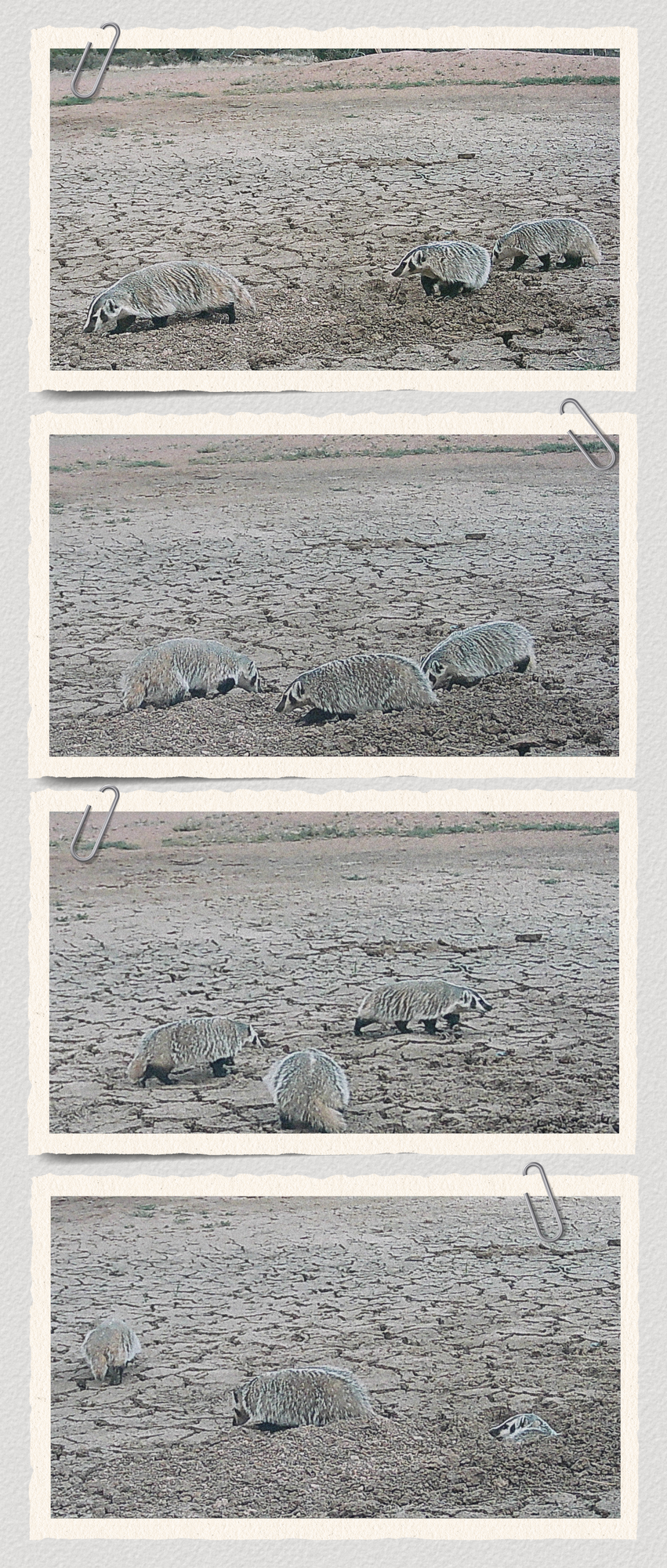 Though in English we may use or hear the phrase “Stop badgering me!”, suggesting that a badger is frequently in our space pestering us, in reality, badgers are pretty hard to spot and tend to keep to themselves, so I was pretty excited to see these photos. (Woodrats, a favorite badger snack, may have been the ones to come up with the phrase, as they are really in trouble if they are getting “badgered”!)
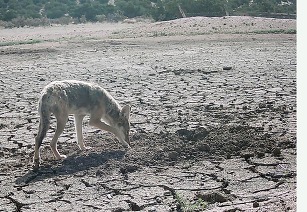
Besides woodrats, badgers hunt and eat a large variety of small mammals, from kangaroo rats to deer mice to prairie dogs, digging into dens for their dinner. Badgers will also eat cottontails and jackrabbits, some reptiles and amphibians, ground-nesting birds, and occasionally larger mammals like small skunks or baby coyotes. Adult coyotes, which have also been known to eat young badgers, will sometimes co-hunt with badgers, working together to trap and catch prey.
|
Habitat loss, especially the conversion of grasslands to agricultural use or other development, is one of the primary reasons badger populations have declined. In fact, most badger deaths result from human activity, including vehicle strikes, fur trapping, and conflicts with farmers and ranchers. Yet supporting healthy badger habitat, such as grasslands, helps humans, including farmers struggling with too many rodents. Badgers are our strong allies in maintaining a balanced rodent population, which is something I’m sure anyone who has found that a woodrat has moved into their car’s engine can appreciate!
Interested in spotting badger dens while hiking? Look for ~10” diameter holes in embankments or other areas near grasslands or good rodent habitat, with fresh soil recently dug out. Please don’t get too close – all wild animals need space to thrive.
Using Ollas to Increase Plant Biodiversity in Arid Lands:
A Perspective from Santa Fe County Open Space
Monica Harmon, Open Space Resource Management Specialist
As humans have lived in arid landscapes throughout our time on Earth, we have used our ingenuity to adapt to them. One creative approach involves using ollas, which are clay vessels buried near plants to provide passive irrigation. Just as one might bury a drip hose throughout their garden, in the appropriate space, one might bury a refillable clay vessel to help a plant get established or keep it watered while you are away.
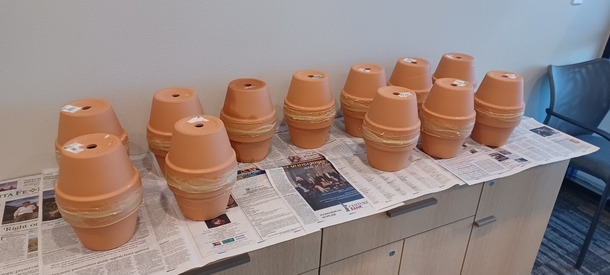
Our native plant species know how to endure these dry times, but when extremely dry conditions persist, new plants have a tough time getting started. With the help of master naturalist volunteers and youth crews, the county open space team has planted 22 native grass and wildflower species alongside ollas on our newest open space property, Bobcat Crossing Ranch. Instead of purchasing premade ollas, which are nicely shaped but a bit more expensive, county staff opted to make their own with clay pots from the store. Instead of using a potentially toxic glue, we sealed the bottom hole and the sides together with melted, all-natural beeswax. Some of the completed, homemade ollas are pictured below.
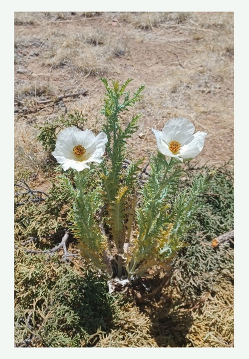
So far, all plants in the field have survived… though some of our animal neighbors have been quite hungry and thirsty lately, and they helped themselves to these new treats. This could be fixed by adding a cage around plants that you would like to survive to maturity. However, some plants are adapted to such herbivory. The grasses are grazed, which is a natural disturbance that keeps them healthy, while a prickly poppy (Argemone polyanthemos) that was planted in the field was just too prickly to eat. And not only that, she decided to bloom!
|
If ollas sound like a good option to you, consider utilizing this technology to enhance your garden or yard with native wildflowers and grasses. A healthy, biodiverse ecosystem benefits us all.
|