New Jersey Launches Civilian Cyber Resilience Corps to Strengthen Statewide Cyber Defense
The New Jersey Office of Homeland Security and Preparedness (NJOHSP) and the New Jersey Cybersecurity and Communications Integration Cell (NJCCIC) today announced the launch of the New Jersey Civilian Cyber Resilience Corps (Cyber Corps), a statewide volunteer cybersecurity initiative designed to enhance New Jersey's ability to prevent, withstand, and recover from cyberattacks.
The Cyber Corps, established under the oversight of the NJCCIC and authorized by the New Jersey Domestic Security Preparedness Task Force (DSPTF), will mobilize experienced cybersecurity and IT professionals to support government entities, critical infrastructure providers, and community organizations across the state. Corps members will provide surge capacity and specialized expertise in incident response, vulnerability assessment, target hardening, cybersecurity training, and resilience-building efforts.
"As cyber threats continue to escalate in frequency and sophistication, New Jersey must continue to expand its defensive capabilities," said NJOHSP Director Laurie Doran. "The Cyber Corps unlocks a new way for cybersecurity professionals to contribute directly to the security and resilience of the communities they live in."
Read the full press release.
|
NJOHSP, Multi-Agency Partners Provide Training on Combating Online Threats
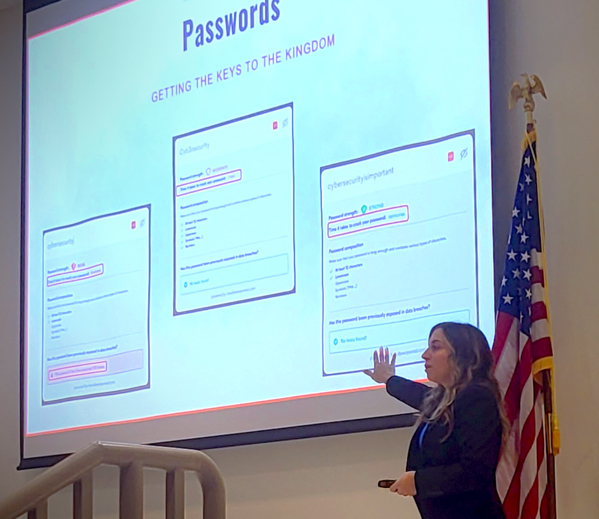 NJCCIC's Cyber Threat Outreach and Partnerships Bureau Chief Krista Valenzuela discusses the importance of password protection in fortifying cybersecurity frameworks and safeguarding sensitive information.
NJOHSP, in collaboration with the NJCCIC, the New Jersey State Police (NJSP), the Cybersecurity and Infrastructure Security Agency (CISA), and the Public Service Enterprise Group (PSE&G), held an in-person and virtual Cyber Safety Training program on November 24.
The high-impact session brought together subject matter experts from the NJCCIC, CISA, and the New Jersey Internet Crimes Against Children (ICAC) Task Force to address the growing landscape of online threats. While the session highlighted risks facing children and families, including exploitation, sextortion, cyberbullying, and exposure to harmful content, the broader focus was on practical cybersecurity awareness and resilience across New Jersey communities.
Attendees received expert guidance on digital safety tools, privacy controls, monitoring strategies, and proactive steps to mitigate risk in today's connected environment. The seminar represented a coordinated effort among law enforcement and private-sector partners to strengthen cybersecurity awareness and community preparedness across the state.
The NJ Shield Hometown Security Initiative training was held for NJOHSP staff, NJ Shield and Global Shield members, and PSE&G staff.
NJOHSP Interns Complete Fall Internship with Capstone Presentations
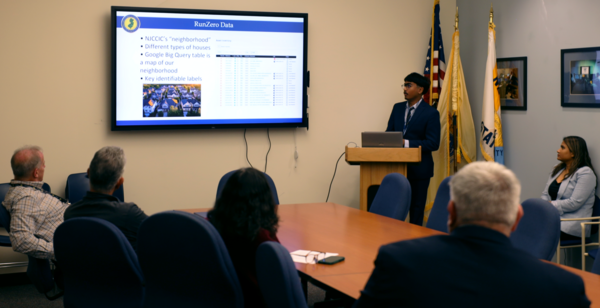 NJOHSP's 2025 fall interns recently presented their capstone projects to NJOHSP leadership, which included presentations regarding intelligence and risk remediation services as well as how to better leverage the capacities of the NJOHSP's Grants Tracking System and improve the closeout process through automation.
The capstone projects enable interns to apply their academic knowledge to practical challenges, acquire valuable field experience, and make significant contributions to NJOHSP's mission of bolstering New Jersey's security and preparedness.
Their dedication during the eight-week internship was truly admirable. We are grateful for their contributions and wish them great success in their future endeavors.
Visit NJOHSP's careers web page for more information on the internship program.
House Passes PILLAR Act; NJCCIC Director Lauds Cyber Grant Program's Impact on NJ
 The U.S. House of Representatives recently passed the Protecting Information by Local Leaders for Agency Resilience (PILLAR) Act to revive and extend the State and Local Cybersecurity Grant Program (SLCGP) through 2033, as reported in GovTech.com.
The legislation aims to enhance cybersecurity measures at state and local levels across the country, seeks to stabilize cost shares, and incentivize the implementation of multifactor authentication while ensuring long-term accountability. It also includes provisions for addressing artificial intelligence and encourages outreach to smaller, rural communities.
Over the past four years, the SLCGP supported cybersecurity initiatives in various governments, with notable contributions in states such as New Jersey. NJCCIC Director Michael Geraghty emphasized the program's importance at the Aspen Cyber Summit, highlighting its role in adopting a comprehensive statewide approach to cybersecurity.
"The State and Local Cybersecurity Grant Program was great," said Director Geraghty. "It wasn't enough money for everything that we wanted to do; but one of the ways we attacked - rather than just giving money to municipalities, counties and others - was to do a whole-of-state approach."
Director Geraghty explained that the money in part went to statewide volume licensing for endpoint detection and response and managed detection and response tools. The funds were also used to lower costs and expand access to local agencies.
The program now supports 153 New Jersey municipalities and has helped block more than 200 ransomware attacks. Director Geraghty said the goal was to deliver tools, technologies and services quickly to local governments, schools and utilities within weeks of receiving the first grant.
The new bill does not specify a dollar amount for future grantmaking, instead noting that grants are "subject to the availability of appropriations." CISA oversees the program.
The PILLAR Act now heads to the Senate Committee on Homeland Security and Governmental Affairs, which will determine whether the reauthorization advances this session.
NJOHSP's Engelhardt to Share Insights on Securing Large-Scale Events

Register now for the upcoming webinar, "High Stakes, Shared Responsibility: Leading Safely Through Major Events," featuring panelist NJOHSP Deputy Director Daniel Engelhardt who will share invaluable insights into the strategies that are redefining large-scale event management. As the complexity of large-scale events continues to rise, the need for innovative and effective public safety strategies becomes increasingly critical.
The program will be held Wednesday, December 17, at 1 p.m., and will include other leading experts who will offer attendees an in-depth exploration of the complex challenges involved in organizing major events like parades, concerts, and championship games.
Participants will gain insights into how public safety and government leaders use real-time data integration to boost preparedness and improve inter-agency coordination, focusing on crowd management, traffic flow, medical response, and public trust.
|
|