|
January 8, 2024

|
|

The New Jersey Office of Homeland Security and Preparedness will introduce suspicious activity reporting training to hundreds of security personnel at the East Coast’s largest port starting Jan. 8. NJOHSP’s Intelligence Management Bureau will be on site at the Port of New York and New Jersey’s Maher terminals in Elizabeth, kicking off the first of 10 training sessions and wrapping up the program by Jan. 22. By the close of those sessions, more than 250 Port Authority guards will be well versed on federal suspicious activity reporting guidelines to include observed behavior, incident reporting and signs of terrorism. Training will provide Port Authority staff the necessary tools and information to prevent terrorists, criminal organizations and nation-state actors from impacting port operations. As a gateway to one of the largest consumer markets in North America, the Port of New York and New Jersey could make an attractive target for those bad actors seeking to disrupt commerce and supply chains. While NJOHSP has conducted SAR training for law enforcement agencies, the private sector, critical infrastructure personnel and members of its Interfaith Advisory Council in the past, the agency consistently looks for opportunities to expand the program to stakeholders.
|
Additional Resources
NJ SARS | Signs of Suspicious Activity
|
|
 NJCCIC Reporting Increase in Cryptocurrency Scams

The New Jersey Cybersecurity and Communications Integration Cell has observed increased reports of cryptocurrency scams over the past few weeks, consistent with open-source reporting. The scams begin with a sophisticated phishing attack and use cryptocurrency stealers to transfer cryptocurrency from victims’ wallets without their consent. Cybercriminals lure users by offering free tokens in fake airdrop or phishing campaigns that are promoted on social media or via email. Scammers then direct them to a fraudulent website to claim these tokens. These websites mimic genuine token distribution platforms and request to connect to a victim's crypto wallet. Targets are then enticed to engage with a malicious smart contract, inadvertently granting the cybercriminal access to their funds and enabling token theft without further user interaction. Social engineering tactics in recent campaigns include fake job interviews via LinkedIn, romance scams and other quick cryptocurrency return promotions. The NJCCIC recommends users exercise caution when interacting with social media posts, direct messages, texts or emails and refrain from responding to or clicking links delivered in communications from unknown or unverified senders. If theft of funds has occurred, victims should immediately report the activity to the FBI’s IC3, as well as their local FBI field office, local law enforcement, the NJCCIC and the FTC. Visit the NJCCIC website for additional information.
|
Additional Resources
Incident Reporting | NJCCIC Membership
|
|
 Police Rescue Chinese Exchange Student in Utah Mountains Following 'Cyber Kidnapping'
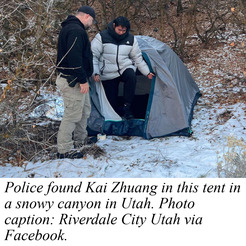
Police found a missing Chinese exchange student alive and cold in a tent in the snowy mountains of Utah Dec. 31 in a phenomenon authorities are calling a "cyber kidnapping." Police rescued Kai Zhuang, 17, three days after high school officials reported him missing. Zhuang’s parents in China contacted the school upon receiving a ransom photo of their son and had sent $80,000 to bank accounts in China “due to continuous threats from the kidnappers,” according to the Riverdale Police Department. The teen’s host family was not aware he was missing. Authorities found Zhuang at a makeshift campsite near Brigham City, Utah, where cyber kidnappers directed him to isolate himself by convincing him they would harm his family. He had a heat blanket, sleeping bag, limited food and water and several phones that police believe the criminals contacted to carry out the cyber kidnapping. Unlike traditional abductions, virtual kidnappers do not actually abduct an individual. Instead, through deception and threats, they order victims to isolate themselves, monitor them through FaceTime or Skype, then use fear tactics. Using photos and voice recordings of the victim, perpetrators will convince the missing individual's family that the kidnappers are with their loved one causing them harm. The cyber kidnappers then proceed to coerce the families to pay a quick ransom before the scheme falls apart. While the FBI has been aware of cyber kidnapping for 20 years – it was once limited to Mexico and the Southwest border – it has since evolved with criminals recently targeting foreign exchange students, particularly those from China.
|
|
|
Contact Information
For more information, please contact communications@njohsp.gov.
The NJOHSP Weekly Bulletin is a weekly publication of the New Jersey Office of Homeland Security and Preparedness and is intended to provide our constituents with finished intelligence and resiliency publications and announcements.
Report Suspicious Activity: Call 1-866-4-SAFE-NJ or email tips@njohsp.gov.
|
|
|
|