|
September 5, 2023

|
|
NJOHSP, NJDOT and NJ Turnpike Authority Launch ‘See Something, Say Something’ Messaging Campaign
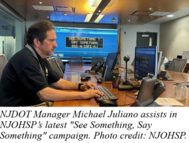
The New Jersey Office of Homeland Security and Preparedness, in partnership with the New Jersey Department of Transportation and the New Jersey Turnpike Authority, announced Aug. 30 the launch of a “See Something, Say Something” public safety campaign, which employs variable message signs to remind drivers along New Jersey’s major interstates to remain vigilant and report suspicious activity related to terrorism or other criminal activity. The campaign runs from Sept. 1 through Feb. 17, 2024, and includes nearly 200 variable message signs. These signs promote NJOHSP’s suspicious activity reporting number seven days per week, during the morning and afternoon rush hours and across the New Jersey Turnpike and interstate highways, including I-78, I-195 and I-280, as well as Route 440. “The goal of the campaign over the next few months is to remind residents and visitors, who may be traversing New Jersey’s highways for vacation, holiday shopping and other festivities, of the importance of being aware of their surroundings and of reporting suspicious activity,” said NJOHSP Director Laurie Doran. “The public is one of our first and best lines of defense in the fight against terrorism. Our ‘See Something, Say Something’ initiative bolsters the State’s security efforts and plays a key role in helping to identify threats and prevent attacks.” “See Something, Say Something” messages will also be displayed on 511nj.org in the “Severity Alert” section and as a widget in the “Safety Message” section.
|
Additional Resources
Press Release | Suspicious Activity Reporting
|
|
NJOHSP Opens State Nonprofit Security and Reproductive Health Security Grant Programs

The New Jersey Office of Homeland Security and Preparedness has opened the application period for the New Jersey Nonprofit Security Grant Program and the State’s Reproductive Health Security Grant Program for the 2024 fiscal year grant cycle.
NJ NSGP
The open enrollment period for the NJ NSGP is Sept.1 through Oct. 31, 2023. The grant opportunity provides eligible New Jersey nonprofit organizations at the highest risk for a terrorist attack with funding for target-hardening equipment and security personnel. To date, NJOHSP has awarded approximately $11.8 million to successful grant recipients through the program.
RHSGP
The open enrollment period for the State’s RHSGP is Sept.1 through Sept. 30, 2023. The grant provides awards up to $100,000 to eligible New Jersey-licensed reproductive healthcare facilities that can demonstrate a high security risk. This initiative is geared toward those facilities that may be targeted by violence, property damage, vandalism, harassment or similar illegal activities. NJOHSP awarded security funding to 28 eligible healthcare providers and facilities in June during the last cycle.
Application Requirements
NJOHSP reminds applicants to ensure their group’s Vulnerability Risk Assessment is up to date and to read all instructions carefully as these are competitive grant programs. All awards are subject to the availability of funding.
|
Additional Resources
NJOHSP Grants
|
|
 Cyber Criminals Heavily Targeting Education Sector as School Year Begins

As the new academic year begins, the New Jersey Cybersecurity and Communications Integration Cell warns that cybercriminals are poised to launch various cyberattacks and scams targeting the education sector. Ransomware attacks against school districts have increased over the last few weeks with incidents at Cleveland City Schools in Tennessee, Prince George’s County Public Schools in Maryland and the University of Michigan. Several scams targeting college students are circulating, including those involving scholarship, grant, employment and student loan forgiveness scams. The Better Business Bureau recently identified a phishing email scam claiming to be from a school’s financial department. The message instructed the recipient to click on a malicious link and log in with their student username and password. Victims unknowingly sent their login credentials to cybercriminals and downloaded malware in the background. The NJCCIC recommends that users refrain from initiating contact in response to unexpected messages and to flag these messages as “spam” or “phishing” via their email client. These actions will enable the system to identify and block similar fraudulent emails. The NJCCIC also advises education-sector administrators to perform scheduled backups regularly, store an updated copy offline, keep systems patched and updated, enable strong endpoint security and implement a defense-in-depth strategy. Visit the NJCCIC’s website for more information.
|
Additional Resources
Cybersecurity Best Practices | Ransomware: The Current Threat Landscape
Incident Reporting | NJCCIC Membership
|
|
 FBI-Led Global Operation Takes Down Notorious Qakbot Malware Platform

On Aug. 25, the FBI and international law enforcement agencies reportedly dismantled the Qakbot malware platform, one of the most infamous cybercrime tools used by criminals to infect computers, launch ransomware attacks and steal sensitive data. The Department of Justice referred to the operation as the “largest U.S.-led financial and technical disruption of a botnet infrastructure leveraged by cybercriminals to commit ransomware, financial fraud and other cyber-enabled criminal activity.” The FBI reported that it had received authorization for and successfully wiped malicious programs from more than 700,000 computers around the world, with upwards of 200,000 based in the U.S. In a coordinated effort, the agencies removed the malware without potential victims’ knowledge. The FBI and its international partners also seized nearly $9 million in illicit cryptocurrency profits as hackers used the malware to extort millions of dollars from victims, including $58 million in ransom paid by victims between October 2012 and April 2023. Qakbot emerged in 2008 as a tool to steal banking credentials but evolved over time to become a powerful weapon for cybercriminals. Hackers used it and other malware to launch ransomware attacks on U.S. critical sectors, including hospitals, schools, police departments and local governments. Law enforcement agencies from France, Germany, the Netherlands, the United Kingdom, Romania and Latvia took part in the operation code-named “Duck Hunt.”
|
|
|
Contact Information
For more information, please contact communications@njohsp.gov.
The NJOHSP Weekly Bulletin is a weekly publication of the New Jersey Office of Homeland Security and Preparedness and is intended to provide our constituents with finished intelligence and resiliency publications and announcements.
Report Suspicious Activity: Call 1-866-4-SAFE-NJ or email tips@njohsp.gov.
|
|
|
|
|