|
July 3, 2023

|
|
NJOHSP’s New Emergency Action Plan Template, Guide Available
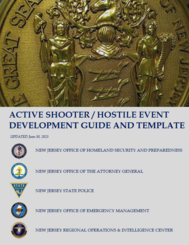
The New Jersey Office of Homeland Security and Preparedness recently posted to its website a streamlined template to assist certain faith-based facilities with submitting an Emergency Operations Plan to law enforcement agencies in accordance with new State legislation. Gov. Phil Murphy signed the legislation Nov. 14, 2022, to assist houses of worship that can seat 500 or more persons with mitigating risks and preparing for potential mass casualty and active shooter incidents. Under the new law, S721/A1061, which went into effect June 1, 2023, houses of worship have until June 1, 2024, to comply with the legislation. To assist with this effort, NJOHSP, in collaboration with the New Jersey Office of Emergency Management, New Jersey Office of the Attorney General and the Regional Intelligence and Operations Center, recently developed an Active Shooter and Hostile Event Emergency Action Plan template that applicable houses of worship can utilize. “NJOHSP staff and its law enforcement partners have streamlined the federal emergency operations plan to make it more user friendly for security planners at our state’s religious facilities or even to applicable movie theaters and sporting venues,” said NJOHSP Director Laurie Doran. “The simplified template and its guide will make it easier for facilities to comply with the new law and will improve response efforts in the event of a mass shooting.” Under previous legislation, only sports and entertainment facilities were required to file an emergency operations plan with their respective municipal emergency management coordinator on an annual basis.
The EAP template and an instructional guide are currently available on the NJOHSP website at:
The template asks facility managers to input information regarding facility layouts, emergency contacts, response actions, staging areas and assigned responsibilities. It also contains recommended training courses and resources. Additionally, the Federal Emergency Management Agency Region 2 and NJOHSP are offering an Emergency Operations Planning Workshop in Mercer County July 12 to assist houses of worship personnel with developing and expanding their emergency operations plans. The three-hour training program features an overview of the “FEMA Guide to Developing High Quality Emergency Operations Plans for Houses of Worship” and provides participants the opportunity to share best practices.
The details for the Mercer County EOP workshop are as follows:
- July 12, 2023, 5:30 p.m. to 8:30 p.m.
NJOHSP encourages houses of worship safety, security and emergency planning committee members, including religious leaders, teachers, administrators, security guards, ushers, greeters and other volunteers, regardless of religious denomination, to attend.
|
|
|
NJOHSP, Gloucester County to Host Houses of Worship Security Program Seminar

As part of its ongoing outreach efforts to faith-based organizations, the New Jersey Office of Homeland Security and Preparedness, in conjunction with the Gloucester County Prosecutor’s Office and the U.S. Department of Homeland Security, is offering a Houses of Worship Security Program seminar July 20.
Date: Thursday, July 20, 2023
Time: 5:30 p.m. to 8 p.m. (Registration begins at 5 p.m.)
Location: St. Matthew’s Baptist Church, 245 Glassboro Road, Williamstown, NJ 08094
Register: https://forms.office.com/g/WyEGNvRNvA
Religious leaders and houses of worship safety and security committee members of all faiths in the immediate areas are welcome to attend. Interested parties must register prior to each seminar. For more information, email training@njohsp.gov.
|
Additional Resources
NJOHSP Training Programs | Houses of Worship
|
|
 Payment Phishing Lures Target NJ State Employees

Threat actors are using payment-themed lures in several new phishing campaigns, including multiple attempts to deliver the messages to New Jersey State employees, the New Jersey Cybersecurity and Communications Integration Cell observed. In one campaign, the sender impersonates Intuit QuickBooks in an attempt to harvest account credentials. However, the display name used in the email is “Intuit Quickbooks.Online,” and the sender’s email address is a Gmail account. The message conveys urgency to convince recipients to click on a PDF attachment, stating “Action Required: New Pending Payment.” The PDF directs recipients to a phishing website that uses stolen Intuit branding to appear legitimate. VirusTotal flagged the site as malicious since entering account credentials sends the information to threat actors in the background. The NJCCIC advises users to refrain from opening attachments or clicking links delivered in unexpected emails. If unsure of the legitimacy of a message, contact the sender using a different means of communication. The NJCCIC also advises users to navigate directly to official sites by manually typing the legitimate URL into the browser before entering account credentials. More information regarding this campaign and others is available on the NJCCIC’s website.
|
Additional Resources
Incident Reporting | NJCCIC Membership
|
|
 US Supreme Court Ruling on Violent Threats Impacts Schools
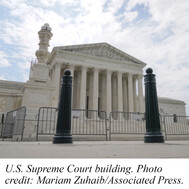
In a decision with implications for threats directed at schools, the U.S. Supreme Court on June 27 made it more difficult for states to prosecute an individual for making violent threats by requiring them to prove intent to harm. In a 7-2 ruling, the court said a state can meet that test under a “recklessness” standard for the defendant’s state of mind. “The state must show that the defendant consciously disregarded a substantial risk that his communications would be viewed as threatening violence,” Justice Elena Kagan wrote for the majority in Counterman v. Colorado. The recklessness standard, she said, “offers enough breathing space for protected speech, without sacrificing too many of the benefits of enforcing laws against true threats.” The case involved a Colorado man convicted under a state stalking law for sending threatening Facebook messages to a singer and songwriter. The defendant’s lawyers argued their client suffered from mental illness and never intended his messages to be threatening. Kagen did not address school threats in her opinion, however, Justice Amy Coney Barrett, who wrote the main dissent, cited several school cases in which courts upheld discipline of students for making true threats. In one case, she noted that a federal appeals court upheld a student’s expulsion in 2002 for an individual who threatened to “molest, rape and murder” his ex-girlfriend. In another, two lower federal courts upheld a student’s suspension for talking about taking a gun to school to “shoot everyone he hates.” Barrett stressed, “the court’s new rule applies to all of these situations” and “that can make all the difference in some cases.”
|
|
|
Contact Information
For more information, please contact communications@njohsp.gov.
The NJOHSP Weekly Bulletin is a weekly publication of the New Jersey Office of Homeland Security and Preparedness and is intended to provide our constituents with finished intelligence and resiliency publications and announcements.
Report Suspicious Activity: Call 1-866-4-SAFE-NJ or email tips@njohsp.gov
|
|
|
|
|



