|
June 12, 2023

|
|
NJOHSP Welcomes 2023 Summer Interns

The New Jersey Office of Homeland Security and Preparedness welcomed 10 college and graduate students to its first paid internship program June 5. During past cycles, students received college-approved credits for completed internships; however, NJOHSP began offering paid internships beginning with its 2023 summer program, which runs from June 5 to July 28. The program, also offered during the spring and fall semesters, helps interns develop and apply their educational training to a real-world setting as they explore various NJOHSP career paths. Internships are available within NJOHSP’s four areas of operation: Counterterrorism, Preparedness, Cybersecurity and Administration. Under the guidance of a supervisor or mentor, interns work on ongoing projects, participate in field excursions, meetings and presentations, have access to online professional training courses and learn firsthand about NJOHSP partnerships with local, State and federal agencies. The program concludes with a capstone presentation in which each intern focuses on one or two main projects and presents their work to NJOHSP staff. The presentation allows interns to develop and hone their public speaking skills, answer audience questions and receive feedback from their mentors and peers.
|
Additional Resources
NJOHSP Internship Program
|
|
 Phishing Emails Bypassing Security Solutions
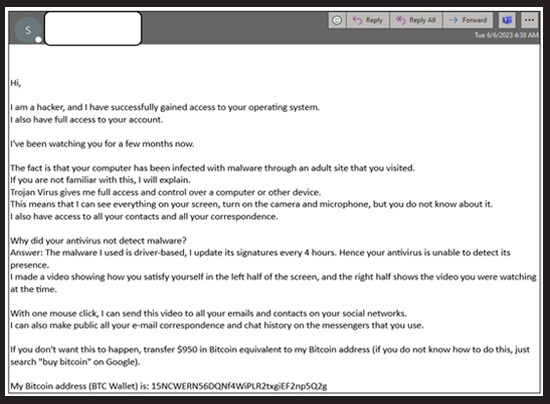
The New Jersey Cybersecurity and Communications Integration Cell identified an increase in phishing attempts targeting New Jersey State employees and public-sector partners. The emails claim that the recipient’s account was hacked and include the subject line, “Your account is hacked. Your data is stolen. Learn how to regain access.” The messages further state the threat actor has obtained access to the user’s system and created compromising videos or images of the target, demanding a cryptocurrency ransom payment to prevent public release of the files. NJCCIC’s email security solution quarantined roughly 91.7 percent of these phishing emails. However, approximately eight percent either bypassed quarantine or users released them to their inbox. The NJCCIC advises organizations to implement filters at the email gateway to identify and block emails that are using known phishing tactics and those emails stemming from suspicious IP addresses. Users should ignore and delete these phishing emails, report the activity to their information technology department and avoid releasing these types of correspondence to their inbox from a quarantined environment. Users should also refrain from responding to unsolicited communications, avoid clicking links or opening attachments from unknown senders and exercise caution with communications from known senders. More information and recommendations can be found on the NJCCIC’s website.
|
Additional Resources
Incident Reporting | NJCCIC Membership
|
|
 UK Terror Watchdog Warns Artificial Intelligence Poses National Security Risk
Britain’s terrorism watchdog warned in early June that artificial intelligence poses a national security risk and called for its creators to abandon their “tech utopian mindset” amid growing fears terror groups will use the technology to groom vulnerable individuals, including children, to launch attacks. Jonathan Hall, Britain’s appointed Independent Reviewer of Terrorism Legislation, said that AI development is primarily focused on the technology’s potential positives while neglecting to consider the ways in which terrorists might use it to carry out attacks. “What worries me is the suggestibility of humans when immersed in this world and the computer is off the hook,” Hall said. “Use of language, in the context of national security, matters because ultimately language persuades people to do things.” The country’s security services are particularly concerned about the ability of AI chatbots to recruit children. MI5, the United Kingdom's domestic counterintelligence and security agency, is partnering with the Alan Turing Institute, the national body for data science and artificial intelligence, to deal with national security challenges posed by AI. The way humans retain “cognitive autonomy” or control over AI and the control built into the technology is concerning, Hall said. He also noted that greater transparency from tech firms developing AI technology and new legislation can help curb AI’s growing threat.
|
|
|
Contact Information
For more information, please contact communications@njohsp.gov.
The NJOHSP Weekly Bulletin is a weekly publication of the New Jersey Office of Homeland Security and Preparedness and is intended to provide our constituents with finished intelligence and resiliency publications and announcements.
Report Suspicious Activity: Call 1-866-4-SAFE-NJ or email tips@njohsp.gov
|
|
|
|