 Eastern Tiger Swallowtail and Echinacea at Deep Cut Gardens, Middletown.
Monmouth County Environmental Newsletter: Summer 2021
|
|
|
|
Having trouble viewing this email? View it as a Web page.
|
|
|
|
Joint Land Use Study III Underway
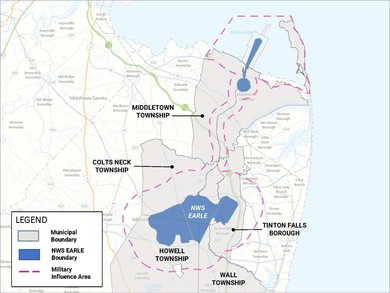 The areas shown above are the focus of the Joint Land Use Study III, Next Steps to Compatibility Study.
As reported in the August/September 2020 newsletter, Monmouth County has taken the lead on two new studies funded by a grant from the Department of Defense’s Office of Local Defense Community Cooperation. The first project is the Next Steps to Compatibility Study. The County and its consultant, Michael Baker International, are working closely with the five municipalities immediately adjacent to Naval Weapons Station Earle (Colts Neck, Howell, Middletown, Tinton Falls and Wall) to evaluate land use patterns and recent changes in use in the vicinity of the base. The study will consider tools and strategies that support the military’s mission and minimize negative impacts to the surrounding communities.
The second study, the Bayshore Coastal Resilience Design Study, will gather additional data on two public sites highlighted in the 2019 Bayshore Coastal Resilience Planning Study. The first site is Whale Creek in Aberdeen adjacent to Veterans Memorial Park and sprayground. The second site is Flat Creek in Union Beach at the Scholer Park Development. Once the data is analyzed, the County, its consultant Princeton Hydro, and a Technical Advisory Committee will identify opportunities for restoration and site improvements and draft site plans and designs.
|
|
Upcoming Environmental & Outdoor Events in Monmouth County:
- Every Wednesday, July 28 - Aug. 25, 5 p.m. Fort Hancock History Tours, Fort Hancock Museum, Building 28
- July 27, 10 a.m. Junior Ranger Spy an Osprey, Fort Hancock Museum, Building 28
- July 30, 12 p.m. NJAFM Local Design Flood Elevation Worksheet Training
- July 30, 6:30-7:45 p.m. Evening Garden Walk Deep Cut Gardens, Middletown.
- Every Monday, Aug. 2 -Aug. 30, 9 a.m. Birding on the Deck, Sandy Hook Observation Deck, Lot M
-
Aug. 10, 1 - 2 p.m. Strategizing for Success: Actions to Help
Your Town Get Sustainable Jersey Certified
- Aug. 10, 7 -8 p.m., Designing and Planting with Native Plants: Creating a Native Habitat
- Aug. 13, 5 p.m. Sandy Hook Bike Tour, Sandy Hook Lighthouse
|
|
|
Join the Battle, Beat the Bug!
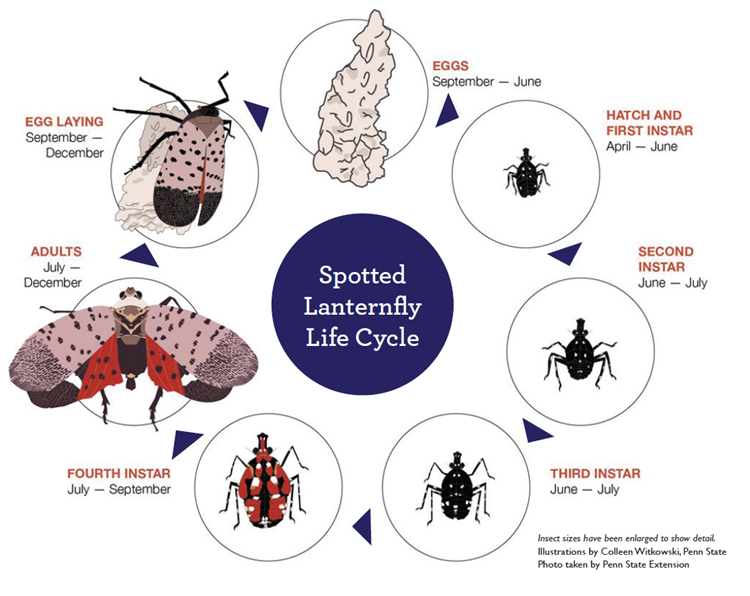 This summer, keep an eye out for the Spotted Lanternfly. The Spotted Lanternfly is a serious invasive pest with a healthy appetite for our plants. Using their piercing-sucking mouthparts, they feed on the sap of over 70 trees and crops. Not only do they damage the structure of plants, but they secrete large quantities of a waste product called honeydew. This sugary substance can coat trees and promote the growth of sooty mold fungus that can lead to the death of the plant, according to Rutgers Agriculture Experiment Station.
Check out NJ Department of Agriculture resources for information on spotted lanternflies and refer to the diagram above for help identifying nymphs, adults, and egg masses. If you see a Spotted Lanternfly, report it here. You are encouraged to kill Spotted Lanternflies and to scrape off egg masses and dispose of them in plastic bags. Learn more about Spotted Lantern flies here. For questions, call 1-866-BAD-BUGZ.
American Forests Launches Tree Equity Score Analyzer
 American Forests, a conservation non-profit, has found that trees are often sparse in socio-economically disadvantaged neighborhoods.
According to American Forests, cities that have an abundance of trees can be 10 degrees cooler in the summer, whereas cities that lack trees can become heat islands, with temperatures 5-7 degrees hotter during the day and 22 degrees hotter at night. This can contribute to heat-related illnesses and fatalities. To help cities assess how well they are delivering equitable tree canopy cover to all residents, American Forests has developed the Tree Equity Score Analyzer (TESA) mapping tool. The tool generates a score by evaluating existing tree canopy cover, climate, demographic and socio-economic data.
|
|
|
|
|
|
NJDEP Climate Change Initiatives
In June, the New Jersey Department of Environmental Protection (NJDEP) released its Draft Climate Change Resilience Strategy. The document offers policy recommendations to address six priorities: building resilient and healthy communities, strengthening the resilience of New Jersey's ecosystems, promoting coordinated governance, investing in information and increased public understanding, promoting climate informed investments and innovative financing, and a statewide Coastal Resilience Plan. NJDEP also released the Resilient NJ: Local Planning for Climate Change Toolkit to guide municipalities developing local climate resilience strategies.
New Bill Addresses Lead Service Lines
The New Jersey Legislature passed Bill A5343/S3398 and is awaiting Governor Murphy's signature. The bill would require public community water systems to inventory service lines and identify and replace lines containing lead. The bill proposes that lead service lines shall be identified within six months, then replaced within ten years and sets other requirements for reporting. Read the bill.
|
|
Plastic Pollution Reduction Act Update
In November 2020, the Plastic Pollution Reduction Act was signed into law by Governor Murphy. While the ban on single use plastic bags, paper bags, and disposable food containers will not go into effect until May 2022, provisions on straws will begin in November 2021. Starting this fall, food service businesses shall only offer plastic straws if specifically requested by customers. Learn more about the Plastic Pollution Reduction Act here.
DEP Recycling Award Applications
The New Jersey Department of Environmental Protection (NJDEP) is accepting applications for its annual Recycling Awards. Applications may be submitted in 10 categories: Institution, Business, Retail Merchant, Government, Leadership, Rising Star, Recycling Industry, Outstanding Educator/Educational Program, Volunteer Citizen and Source Reduction/Resource Management/Sustainability. Nominations are due Friday, July 30. Access the application and view past winners here.
|
|
|
New Preserved Farmland
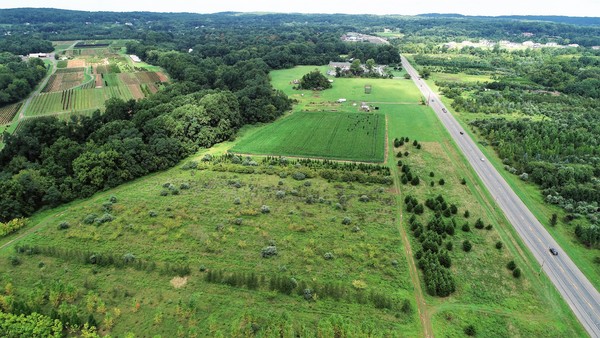 In 2020, Monmouth County acquired this 62-acre farmland easement on the southbound side of State Highway 34, near the County Route 520 intersection. Source: Fred Yahn.
Monmouth County has been busy preserving farmland in 2020 and 2021, including some highly visible properties. In early 2020, Monmouth County obtained an agricultural easement on a 62-acre parcel on Route 34 in Holmdel and Marlboro Townships. The farm has long been of interest to the Farmland Preservation Program because of its proximity to Holmdel Park and an adjacent 79-acre deed-restricted nursery. In partnership with the State and Holmdel Township, the County obtained the easement from HMF Associates, Inc. Soon thereafter, the longtime tenant farmer, AKC Inc., purchased the land.
The Stattel Farm was also added to the preserved farms list in 2021. Marlboro Township purchased the fee rights to the property in 2018. It lies along Routes NJ-79 and CR-520 and is the site of the Marlboro Community Farmers Market. The County and State pooled funds to purchase and record an easement on 43 acres to permanently restrict the area to agricultural use. A smaller piece of the original farm, on the south side of CR-520, has been designated as open space.
Monmouth County and its partners preserved the seven-acre Peplowski farm at the intersection of Stage Coach Road and the Rising Sun Tavern Road in Millstone Township in 2020. The Township was particularly interested in preserving the farm to create an opportunity for a new or expanding farm operation to own its own land. As hoped, the property changed hands in 2021.
In February of 2021, Monmouth County acquired an agricultural easement on the Mosley Farm on Laird Road in Colts Neck Township with financial assistance from the State Agriculture Development Committee and the municipality. The 26-acre livestock and field crop farm is situated across the street from the preserved Crystal Brook Training Center.
Wall Township Elementary School Aquaponics
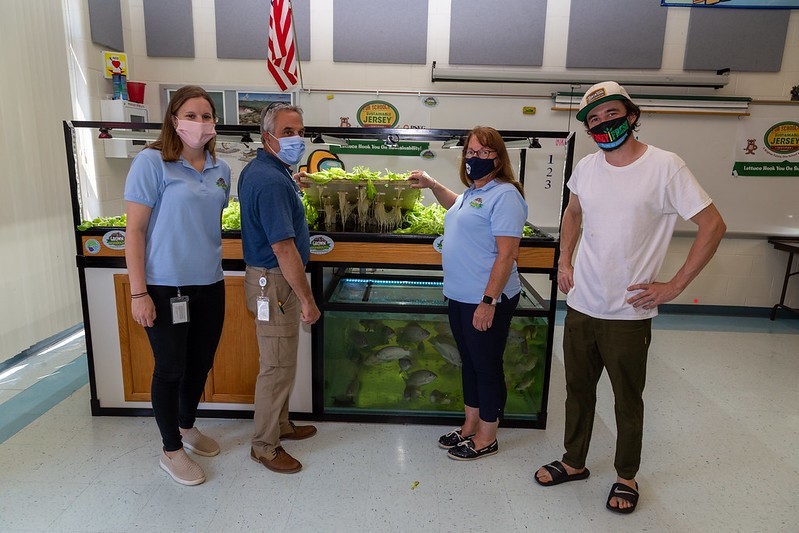 Monmouth County Division of Economic Development staff and owner of Drop the Beet Farms display the custom build aquaponics system at the West Belmar Elementary School. Source: Monmouth County.
In 2020, Wall Township School District was awarded a $10,000 grant from Sustainable Jersey for Schools funded by the Public Service Enterprise Group (PSEG) Foundation. The District purchased a custom-made aquaponics system to use as a hands-on STEAM based learning tool. In an aquaponics system, plants are grown in water on floating trays. Below, living fish provide natural fertilizer with their waste. In turn, the plants filter the water for the fish. The West Belmar Elementary School garden allows students to grow up to 112 plants such as lettuce and herbs. In the spring of 2021, the students celebrated their new project with the Monmouth County Commissioner Director Thomas A. Arnone, staff from the Monmouth County Division of Economic Development, Drop the Beet Farms, the manufacturer of the custom built aquatics system and owner of Joe Leones Italian Specialties and Catering and created salad lunches with the lettuce they grew.
Art meets Nature in Wall Township
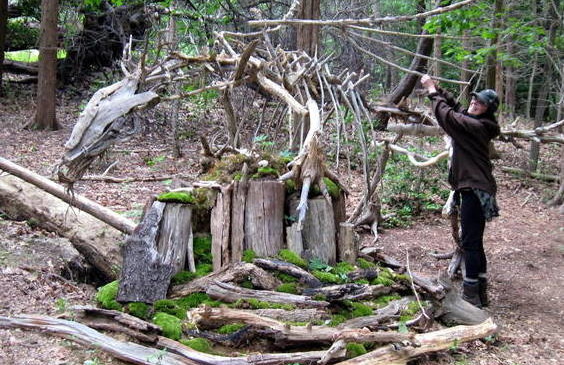
Meet Annabelle the Dragon who resides in the woods at the Wall Township Municipal Self-Guided Nature Trail adjacent to the soccer field and municipal building. Sightseers can view the dragon near the trail exit between stop 10 and stop 11. Artist Robin Ruggiero uses twigs, tree limbs, twine, and some rope for her fantastic creations. While residents may consider these items as brush, Robin sees this as using the environment’s 3Rs: Reduce, Reuse and Recycle. Robin’s first installed prehistoric figures of a T-rex, Pteranodon, Stegosaurus, Triceratops and a butterfly at Allaire State Park. In 2020, Robin received acclamations for her work by The Asbury Park Press/Coast Star News, and CBS News.
After learning about her work, the Wall Township Environmental Advisory Committee (WTEAC) was impressed by her unusual, creative and original talent and invited her to attend a WTEAC meeting. At the end of the meeting, Robin agreed to build a sculpture for the committee. Thus, Annabelle the Dragon descended on the Wall Township Community Self-Guided Nature Trail. On July 17, the WTEAC officially welcomed Annabelle with a special dedication ceremony and presented Robin Ruggiero with a certificate of appreciation.
Now that you have met Annabelle the Dragon, we hope you enjoy the Self-Guided Nature Trail and viewing the dragon in person. Click here to access the Nature Trail brochures. Bring your camera and enjoy.
Contributed by Wilma Morrissey, Monmouth County Environmental Council Chairwoman and Wall Township Environmental Advisory Committee Chairwoman.

Grown in Monmouth Directories
Summer in Monmouth County is a great time to enjoy local garden centers, farmer markets and farm stands, restaurants, pick your own farms, and more! Check out the Grown in Monmouth Directories to learn more about your favorite Grown in Monmouth organizations or browse to find somewhere new!
|
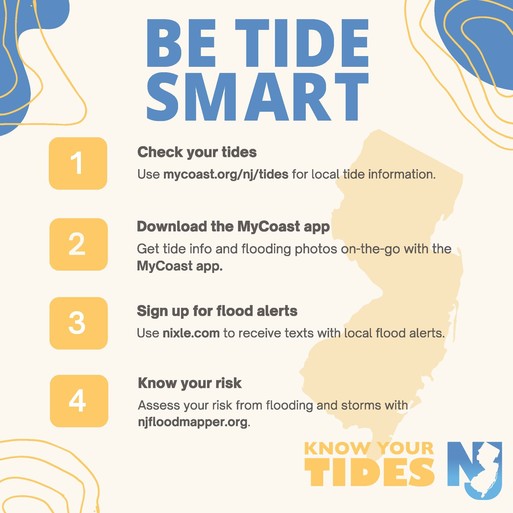
Know Your Tides Using MyCoast New Jersey
High tide in New Jersey comes twice a day, whether you’re on the ocean, a bay, or a tidal river. You can maximize your summer fun and stay safe by visiting the MyCoast Know Your Tides webpage. The MyCoast New Jersey portal is also used to collect and analyze photos of coastal events and places. Photos are linked to data about weather and tides to create reports that help stakeholders like government agencies, business owners and residents to understand coastal change and make informed decisions. Visit MyCoast to browse photos from around the state or upload your own photos!
Support Local Plants and Animals with Certified Wildlife Habitats
Below, the Allenwood Native Garden is now a Certified Wildlife Habitat.
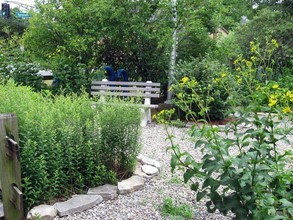
At the April 1 Monmouth County Environmental Council meeting, Kristin Hock, Habitat Outreach Coordinator from New Jersey Audubon presented information on the National Wildlife Federation Certified Wildlife Habitat program and the New Jersey Audubon Gardening for Wildlife program. Ms. Hock explained that providing habitat in urban suburban places is important as it supplies much needed resources for our native bird and pollinator species. Homeowners, businesses and public entities can certify gardens, patios, or even balconies that offer five key elements for healthy wildlife habitats: food, water, cover, and places to raise young, and sustainable practices.
After learning about the program, Wilma Morrissey brought the information back to the Wall Township Environmental Advisory Committee (WTEAC). The WTEAC maintains its Allenwood Native Garden and along with volunteers like Loretta Cooper, a strong advocate that has worked countless hours maintaining the garden. Together the WTEAC and Loretta found that the garden does meet the certification requirements. After completing the application and paying a donation fee they will receive a certificate and sign to display in the garden.
Contributed by Wilma Morrissey, Monmouth County Environmental Council Chairwoman and Wall Township Environmental Advisory Committee Chairwoman.
|
About This Newsletter
The purpose of the newsletter is to inform Monmouth County citizens on the health of their environment and list environmental outreach events in their community. The newsletter is produced by the Monmouth County Division of Planning Section of Environmental & Sustainability Planning in coordination with the Monmouth County Environmental Council. The County of Monmouth and the Board of County Commissioners do not necessarily share the viewpoints of any environmental group mentioned in this newsletter.
If you have questions, comments, or wish to have an event listed in the newsletter, please contact: Amber.Mallm@co.monmouth.nj.us
|
|
|
|