
Monmouth County Environmental Newsletter: Winter 2021
|
|
|
|
Having trouble viewing this email? View it as a Web page.
|
|
|
|
RU Testing Your Soil?
Start your garden with healthy soil this spring. Photo source: Rutgers Cooperative Extension.

Whether you are growing a vegetable garden, perennial flowers or lush green turf, healthy plants start with healthy soil. Plants require specific amounts of nutrients including Nitrogen (N), Phosphorus (P), and Potassium (K), as well as a balanced pH level (6.2 to 6.8 for most plants). Soil fertility testing is the best way to make sure that your plants are getting all the nutrients that they require without adding any excess fertilizer to your soil, which can have negative impacts on the environment. Soil samples are best taken after the harvest in the fall or in the early spring before any fertilizer applications. Soil testing should be repeated at least every 2 to 3 years because fertility conditions can change as plants take up the nutrients that are in the soil. Soil test kits can be obtained from your Rutgers Cooperative Extension County Office or from the Rutgers Soils Laboratory.
To take a soil sample, collect 10 to 15 cores or trowels full of soil by walking in a randomized pattern in your yard or garden. Place all the cores into a bucket and mix them together, being sure to break up any clods. Take approximately 2 cups of soil from the bucket and place it into a plastic bag. Fill out the questionnaire that comes with the soil test kit and mail the sample to the laboratory. After the sample is analyzed, you will receive a soil test report with lime and fertilizer recommendations specific to your garden. For more information on soil testing for home lawns and gardens, click here, or contact the Rutgers Cooperative Extension of Monmouth County office.
|
Contributed by Bill Errickson, Rutgers Cooperative Extension of Monmouth County.
|
|
Upcoming Environmental & Outdoor Events in Monmouth County
Some activities require registration and/or fees:
- Mar. 9, 7 -8 p.m. Cultivating Respect for Insects: An Overview of Ecosystem Services That Insects Provide, webinar
- Mar. 11, 6:30 -7:30 p.m., RU Ready to Garden? Pruning Your Fruit Trees, webinar
- Mar. 12, 10 a.m. -12 p.m. Green Infrastructure Planning and Implementation for Sustainable Jersey Points, webinar
- Mar. 13 10 a.m. -12 p.m., Save Coastal Wildlife & AmeriCorps NATCO Lake Clean Up, Hazlet
- Mar. 26, 10 a.m. -12 p.m. Green Infrastructure Projects for Schools, webinar
- Mar. 27, 12 -2 p.m., Starting a Summer Garden, Historic Longstreet Farm, Holmdel
- Mar. 29, 6:30 -8:00 p.m. Horseshoe Crabs in New Jersey: An Ancient Species in Modern Times, webinar
|
|
|
Sustainable Jersey Offers Community Solar Guidebook
Sustainable Jersey recently issued its Community Solar Guidebook, which offers guidance for municipalities interested in supporting community solar projects. Typically, in order to experience the benefits of solar energy, individuals must install solar panels on their property, then they receive a credit on their utility bill for the electricity generated on the panels. However, residents, business and other organizations may be unable to install solar panels on because they are renters, a roof may be in poor condition or the site may be too shady. But in a community solar project, individuals do not need to install panels on their property. Instead, customers can sign up to participate in a solar installation located off their property but in their utility provider’s service area. The guidebook outlines ways municipalities can start a community solar project and offers case studies from a 2019 Community Solar Energy Pilot Program with the Board of Public Utility’s New Jersey Clean Energy Program.
|
|
|
|
Two Monmouth County Towns Recognized by ANJEC
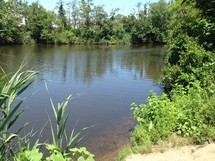
Below: Wreck Pond Nature Preserve was highlighted in an award winning article series written by the Wall Township Environmental Advisory Committee. Source Linda Brennen.
The Association of New Jersey Environmental Commissions (ANJEC) annually celebrates outstanding achievement by local environmental commissions and nonprofit organizations. Two Monmouth County municipalities, Keyport and Wall Township, were among the 10 honorees for 2020.
The Keyport Borough Environmental Commission’s Cedar Street Beach Dune Restoration Project was a volunteer effort assisted by the Jersey Shore Surfrider Association to improve storm resilience and reduce airborne sand that was impacting an adjacent park. The volunteers removed invasive plants, restored a dune and planted native beach grasses over a multi-year period.
A series of “Environmentally Yours” articles, published monthly in Wall Township Living magazine, brought recognition to the Wall Township Environmental Advisory Committee. The intent of the articles is to educate residents about a variety of environmental issues and highlight local resources. Article topics included single use plastic bags, recycling, gardening, and the Township’s Green Business Recognition Program. Resource focused articles highlighted a self-guided nature trail and the Wreck Pond Nature Preserve.
|
Ocean Township's Schools Receive $10,000 for Urban Agriculture Program
Sustainable Jersey provided nine energy grants, funded by the Gardinier Environmental Fund, to four school districts and five municipalities for sustainable energy projects. The Ocean Township School District received $10,000 for their Sustainable Greenhouse that they plan to use for their Environmental Studies and Urban Agriculture Program. The district will use the funds to build a greenhouse to teach modern urban growing techniques in the face of climate change. To make the greenhouse energy-efficient, the District plans to use glazing for efficient sun exposure, geothermal heating, solar energy where possible for supplemental energy, and rain-capture irrigation. For information on this and the other grantees, see the press release.
|
|
|
|
DEP NJPACT Framework
At the Protecting Against Climate Threats (PACT) Stakeholder meeting held on Dec. 22, 2020, NJDEP launched their Watershed-Based approach to Land Resource Planning as a framework for the PACT initiative and for proposed Resilient Environments and Landscapes (REAL) rule amendments. The presentation outlined a restructuring of NJDEP divisions, articulated six guiding principles and discussed potential amendments to the Department’s resource protection rules around eight themes. The themes are: better protection against future inundation and flood damage, protecting critical facilities and infrastructure, increased protection of land and water resources, stormwater, planning for climate change, nature-based solutions, renewable energy and green building design and process improvements. NJDEP is considering amending several Rules including Coastal Zone Management, Flood Hazard, and Freshwater Wetlands. The new regulations are expected to be proposed during the first quarter of 2021 and the State’s climate change strategy is expected to be released on April 22 for Earth Day. The NJ PACT meeting can be viewed on YouTube.
State of the Pinelands Annual Report
With January 2021 marking the 40th anniversary of the Pinelands Comprehensive Management Plan (CMP), the Pinelands Preservation Alliance (PPA) released the 2021 State of the Pinelands report. Although the Pinelands Management Area does not extend into Monmouth County, pineland ecosystems can be found in in the southern tier of the County’s municipalities and even as far north as Tinton Falls. While the 2021 report focuses on the management area, CMP, Pinelands Commission and the work of the PPA, it also provides a spotlight on climate change and offers summaries of federal and state actions during 2020 that have impacts outside of the Pinelands Management Area. These brief summaries cover issues such as public land management during COVID-19, municipal stormwater management, water supply, environmental justice legislation, and the Plastic Reduction Act. Previous State of the Pinelands reports can also be found on the PPA website.
Recent Legislation
On February 4, bill S-2607 was approved as P.L.2021 which requires New Jersey Municipal Master Plans to include a climate change-related hazard vulnerability assessment. It replaces previous the Municipal Land Use Law directive to consider climate change impacts with a requirement to analyze current and future hazards including those related to increased temperatures, drought, flooding, storm events and sea level rise. It also requires a build-out analysis with an assessment of these vulnerabilities; identification of critical infrastructure that might be impacted; the provision of a policy statement; along with strategies and design standards for implementation. The changes would be required for any municipal land use plan element adopted after the effective date of the legislation.
S-1245, a bill that addressed housing of equine-related farm employees in facilities with horses as a "Right to Farm" permissible activity, passed both houses and was approved on January 7 as P.L.2020, c.154.
Several bills related to forest stewardship plans, amending P.L.2009, c.256, have moved out of committee recently: A-4843, which would require forest stewardship plans for forested lands of 25 acres or more acquired for recreation and conservation purposes using Corporate Business Tax or Green Acres funding, and A-4844, which would prevent local governments from enacting an ordinance, rule, or resolution that requires local approval of a forest stewardship plan.
On January 11, 2021 the Senate passed S-3223, which provides that electric vehicle charging infrastructure is inherently beneficial, may require minor site plan approval, and is permitted accessory use and structure. The bill is now under review by the Assembly State and Local Government Committee. S-2605, which was introduced to the Senate in June moved to the Senate Energy and Environment Committee in January, would direct BPU to establish a utility-scale solar energy development program
New Release Schedule
The Monmouth County Environmental Newsletter will now be released on a quarterly basis. Each season you can expect the same newsletter highlighting different topics around the County and the state. To keep everyone up to date on upcoming dates and activities, we will release a brief monthly calendar highlighting local events, comment periods, and deadlines.
About This Newsletter
The purpose of the newsletter is to inform Monmouth County citizens on the health of their environment and list environmental outreach events in their community. The newsletter is produced by the Monmouth County Division of Planning Section of Environmental & Sustainability Planning in coordination with the Monmouth County Environmental Council. The County of Monmouth and the Board of Chosen Freeholders do not necessarily share the viewpoints of any environmental group mentioned in this newsletter.
If you have questions, comments, or wish to have an event listed in the newsletter, please contact: Amber.Mallm@co.monmouth.nj.us
|
|
|
|



