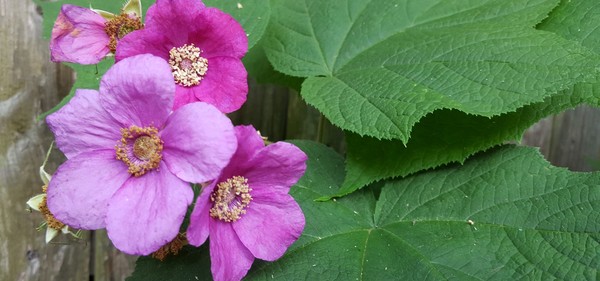
 Purple Flowering Raspberry, Rubus odoratus, is a native shrub that boasts flowers all summer long.
Monmouth County Environmental Newsletter: July 2020
|
|
|
|
Having trouble viewing this email? View it as a Web page.
|
|
|
|
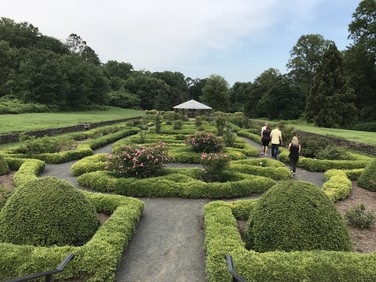 Take time to appreciate nature at parks like Deep Cut Gardens, Middletown.
Enjoy Monmouth County Parks and Programs this Summer
At this time, Monmouth County Parks are open with modifications to protect the health and safety of citizens. Visitors can enjoy trails and recreational areas like basketball courts and golf courses, but some facilities such as playgrounds remain closed until further notice. Before you go, check the Park System website for a complete list of available facilities.
The Park System is also offering activities and programs. View the calendar of events for activities including guided kayak tours, Enviro-Quests, or seining along Bayshore Waterfront Park. Browse the online program guide to register for special programs.
As per State guidance, patrons must practice social distancing, excluding family members or significant others. Monmouth County Park System is requiring face coverings in all restrooms and during any indoor programs. For more information on safely using parks view Monmouth County Park System guidance and CDC guidance.
|
|
Upcoming Environmental & Outdoor Events in Monmouth County:
Some activities may require fees and/or registration:
- July 2, 12 p.m. Continuing Effective Community Engagement in Times of COVID-19, Webinar
- July 3 through Aug. 28 Mondays, Wednesdays and Fridays, 11 a.m. -12 p.m. Seining Along Sandy Hook Bay, Bayshore Waterfront Park
- July 7, 7 p.m. Introduction to Jersey-Friendly Yards, Webinar
- July 11 & 12, 12 -2 p.m. Wheat Harvest and Threshing Demonstration, Historic Long Street Farm, Holmdel
-
July 16, 9 a.m. Casual Birder, Crosswicks Creek Park, Parking lot across from 4 Polhemustown Road, Allentown
- July 16, 7 -8 p.m. Dolphins Facts and Tales, Bayshore Waterfront Park
- July 21, 7 p.m. If You Plant It, They Will Come, Webinar
|
|
|
Study Ranks New Jersey #1 in Addressing Loss of Farmland
The American Farmland Trust (AFT) issued a multi-year study on farmland loss across the nation titled, “Farms Under Threat: The State of the States.” The study ranked New Jersey first in the nation for implementing policies and programs that address loss of farmland.
The report gave special recognition to New Jersey's Farmland Preservation Program (FPP). The FPP has permanently protected over 2,600 farms, for a total of roughly 237,000 acres, or one-third of all farmland in the State. Although NJ was ranked first for protecting farmland, it also ranked third among states with the most threatened agricultural land. In the face of threats, a New Jersey State Agriculture Development Committee (SADC) press release emphasized that N.J. will continue to need a strong FPP.
According to the press release, David Haight, Vice President of Programs at AFT stated, "Farmers, land trusts, public officials at all levels and the people of New Jersey deserve tremendous credit for seeing that farms were being destroyed by poorly planned real estate development and taking action in multiple ways over decades to protect this land and keep farmers on it. But, the job is not done. The State has some of the most expensive farmland in America making it difficult for a new generation of farmers to find land, while more needs to be done to help farmers use regenerative practices on this land and increase resilience to climate change." Haight added, "We look forward to working with the State of New Jersey and our many partners to sustain their position as a national leader and push for innovative approaches for addressing these emerging needs.”
|
|
|
|
Stormwater Management Rule Amendments
Below: A biorention system addresses water quality, quantity, and recharge standards. Source: Blue Grass Landscaping and Maintenance
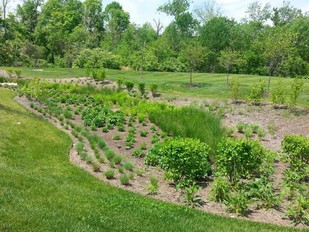
On March 3, 2020 NJDEP adopted amended Stormwater Management rules. One of the most notable aspects of the amendment is the new green infrastructure standard. The rule requires major developments manage stormwater with green infrastructure best management practices (BMP) such as pervious pavement or bioretention systems. However, the rule shows that each BMP performs differently when addressing stormwater runoff quality, quantity, and groundwater recharge. Due to the unique performance of each BMP, a site may require a combination of BMPs. The rule also outlines that BMPs can only treat a certain drainage area, which may require multiple BMPs throughout a development. These requirements are established to mimic natural hydrology and treat stormwater close to the source.
According to NJDEP guidance, municipalities must revise municipal stormwater control ordinances to be consistent with the rule by March 3, 2021. Visit the stormwater management page for resources including the full amended rule, an FAQ page issued by NJDEP, the Stormwater BMP Manual and a model stormwater control ordinance.
The Monmouth County Division of Planning and the County Stormwater Technical Advisory Committee provided the County's municipalities with a packet of information to assist them with updating municipal Stormwater Plans and Ordinances. New Jersey Future also offers a variety of tools and resources to help municipalities and developers understand green infrastructure and implement the new rules. Use the Municipal Toolkit for tips on incorporating green infrastructure into a community, or browse the Developers Guide for case studies and examples of how green infrastructure can be incorporated into a major development.
|
Rutgers Workshop Examined COVID-19 Public Health, Economics and Environment
In a recent webinar, individuals from local institutions discussed how COVID-19 has impacted public health and economics in New Jersey. Panelists brainstormed ideas to improve public health, the economy and address climate change. View biographies of the panelists and access recordings of the sessions here.
A discussion on climate change continued during the Rutgers NJ Climate Change Resource Center Summer Climate Change Academy. Sessions focused on the state of the climate, sea level rise, protecting historical and cultural assets, tools to visualize climate futures and engaging vulnerable populations in resilience planning. All sessions were recorded and can be accessed here.
Recent Legislation Proposes BPU Office of Clean Energy and Equity
On May 2020, Bill S2484 was introduced in the Senate and referred to the Senate Environment and Energy Committee. The Bill would establish an Office of Clean Energy and Equity in the Board of Public Utilities (BPU). The new office would be directed to develop onsite solar or community solar and energy efficient programs to benefit low income households as well as establish energy storage in overburdened communities. The Bill would also direct the new office to integrate workforce development training into clean energy and energy storage programs, conduct education and outreach and establish a grant program for community based diversity-focused nonprofit organizations to develop solar or clean energy workforce training programs.
NJBPU Launches Online Application for Electric Vehicle Incentive Program
New Jersey residents who purchased or leased an electric vehicle since January 17, 2020 can apply online to receive a rebate for up to $5,000. Visit the Charge Up NJ webpage to learn about the program, eligible vehicles, and access the application. The incentive is part of Public Law 362, signed in January, which aims to increase electric vehicles in New Jersey. The law also directs the State to establish a rebate program for residents to earn up to $500 for charging infrastructure, however, this portion of the program is still under development. Check the Drivegreen NJ website for updates as the State continues to implement the law.
Nancy Blackwood Named June Sustainability Hero
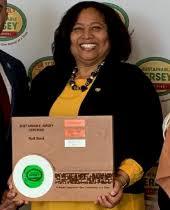
Sustainable Jersey named Nancy Blackwood, Chair of the Red Bank Environmental Commission, the June Sustainability Hero. Since joining the Environmental Commission and Green Team, Nancy has been instrumental in many of Red Bank's efforts. During her time, Nancy gave special focus on improving the safety along Red Bank's roadways. She helped update the municipal Complete Street's program by managing a group of stakeholders and spearheaded Red Bank's award winning 2019 Pedestrian Safety Demonstration Project. Nancy also assisted Red Bank develop its green business recognition program to promote sustainable practices at local business. In 2018, Nancy participated in Red Bank's education initiative to reduce plastic consumption and helped obtain a Sustainable Jersey grant to install water refilling stations at local parks.
|
Sustainable Communities Grant Opportunity
Municipalities registered or certified with Sustainable Jersey may apply to one of two grants by July 16, 2020. Sustainable Jersey outlined these grant opportunities in a webinar on May 19. View the slideshow here.
The first opportunity is titled, Environmental Stewardship. Under this program, municipalities may apply for funds to plan, protect, and improve public places such as parks, natural areas and resources. Sustainable Jersey will award six $5,000 grants and ten $2,000 grants. The second opportunity is a Resiliency grant. Eligible projects should be aimed at preventing and responding to catastrophic events and emergencies. Sustainable Jersey will award two $10,000 grants, and one $5,000 grant. Click here to learn more and access the applications.
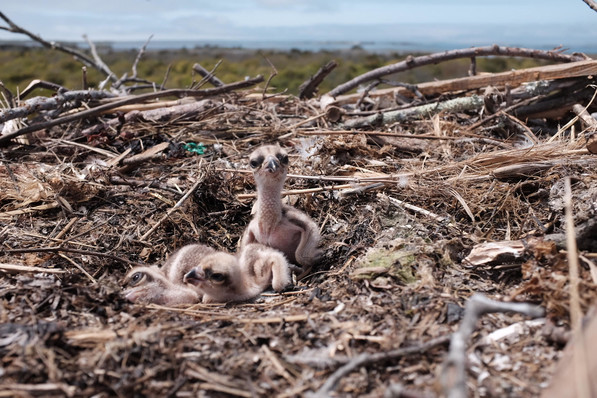 Viewers watching wildlife cameras at nests like this one in Island Beach State Park are helping scientists protect and research osprey. Source: Friends of Island Beach State Park
Wildlife Cameras: A Tool for Citizen Science
Wildlife cameras are proving to be a useful tool for monitoring, education, and conservation. This May, viewers watching the Pete McClain Osprey cam alerted scientists that a chick was trapped in a plastic bag. This allowed Conserve Wildlife Foundation (CFW) biologist, Ben Wurst, to quickly intervene and remove the bag and other plastic from the nest. Watch Ben free the chick here. Later, viewers also reported one of the chicks had an injury, then scientists removed the chick for medical attention.
To gather data and engage with the community, CWF launched an online monitoring form. When citizen scientists watching the Barnegat Light nest see osprey with a fish, they can fill out the form to report data on the species and size of the fish. Scientists will compare data from this nest and others from around the world to understand how prey influences the reproductive success of osprey.
Remembering William Michael "Bill" Simmons

It is with great sympathy that we acknowledge the passing of Bill Simmons. Bill was an avid lover of the environment and nature. He worked for the Monmouth County Health Department for over 30 years where he authored several environmental reports. During his time, he also worked closely with the Monmouth County Planning Board and Environmental Council. An obituary remembering Bill is available here
|
|
|
|
|
|
About This Newsletter
The purpose of the newsletter is to inform Monmouth County citizens on the health of their environment and list environmental outreach events in their community. The newsletter is produced by the Monmouth County Division of Planning Section of Environmental & Sustainability Planning in coordination with the Monmouth County Environmental Council. The County of Monmouth and the Board of Chosen Freeholders do not necessarily share the viewpoints of any environmental group mentioned in this newsletter.
If you have questions, comments, or wish to have an event listed in the newsletter, please contact: Amber.Mallm@co.monmouth.nj.us
|
|
|
|



