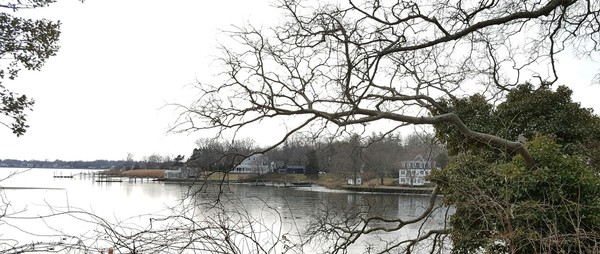
 Claypit Creek, Hartshorne Woods Park
Monmouth County Environmental Newsletter: March 2020
|
|
|
|
Having trouble viewing this email? View it as a Web page.
|
|
|
|
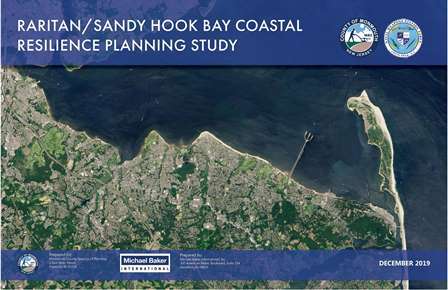 Monmouth County Division of Planning Completes Coastal Resilience Planning Study
The Monmouth County Division of Planning, Naval Weapons Station Earle and a consulting team at Michael Baker International Inc. recently completed the Raritan/Sandy Hook Bay Coastal Resilience Planning Study. The Study is a follow-up to the County's Joint Land Use Study for Naval Weapons Station (NWS) Earle. NWS Earle provides all ordnance for the entire Atlantic fleet. Superstorm Sandy caused an estimated $50 million in damages to NWS Earle and brought to the forefront a need to expand planning for resilience at the base and in the surrounding communities. The Study identified 11 potential sites and projects aimed at improving coastal resilience in the communities and infrastructure surrounding NWS Earle in the face of future threats like coastal storms, tidal flooding and sea-level rise.
The Study outlines potential projects primarily focused on improving natural systems' capacity to handle coastal hazards through nature based solutions like beach replenishment, wetlands restoration, upland maritime forest development and dune stabilization. The Study also identifies some hard structure solutions like stormwater pump stations or offshore wave attenuation devices. Each project concept identifies environmental constraints at each site, potential permitting requirements and potential sources of funding. Municipalities, the County and non-profits may use the Plan to seek funding for further design and implementation. Learn more about the Joint Land Use study and the Coastal Resilience Study here.
|
|
Upcoming Environmental & Outdoor Events in Monmouth County:
Some activities require registration and/or fees:
- March 5, 5 p.m. Monmouth County Environmental Council Meeting, Hall of Records Annex, Freehold
- March 11, 7 -9 p.m. Monmouth County Audubon Society: Family Night: Feathers & Fur Investigating Animal Coverings, Red Bank
-
March 14, 6:30 -7:30 p.m. Monmouth County Audubon Society: Timberdoodle Walk, Big Brook Park, Marlboro
- March 19, 7 -8 p.m. Nature Wildlife Talk: The Life History of Brook Trout, Freneau Woods, Aberdeen
- March 25, 8:30 a.m. -3 p.m. BBP Education and Outreach Retreat: Changing the Conversation on Climate Change
- March 25 12 -1 p.m. Fish Suffering, Climate Change, and the Public Trust Doctrine, Monmouth University
- March 28, 12- 3 p.m. Celebrating Agriculture Day, Historic Longstreet Farm, Holmdel
- April 16, 4 -6 p.m. Climate Governance Roundtable, Monmouth University
|
|
|
SAVE THE DATE: April 29, Roundtable Focuses on Invasive Species
Below: Hydrilla tangled on a boat propeller. This aquatic invasive plant is being managed in Monmouth County and other parts of the region. Learn about what's being done and how individuals can prevent its spread by keeping boats and equipment clean. Source: NJ Water Supply Authority.
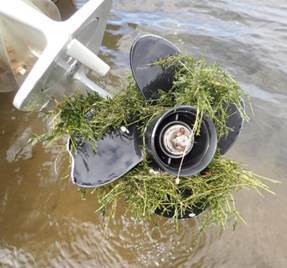
On April 29, the Monmouth County Environmental Council will host a roundtable event to discuss invasive plants and insects. Join the Council to learn about efforts to manage hydrilla, how the County Park System manages invasive terrestrial plants, and tips for homeowners to recognize and treat invasive insects. Guests will also receive a copy of a new Eco-Tips brochure focused on invasive species. The event will take place in the evening on April 29 at the Monmouth County Agriculture Building in Freehold. Stay tuned for more information and a complete agenda. Learn more about the Monmouth County Environmental Council roundtable events, and Eco-Tips brochures.
|
Bill Signed into Law Aims to Increase Electric Vehicles in NJ
On January 17, 2020, Senate Bill S-2252 was signed into law. The Act establishes State goals and incentive programs to increase electric vehicles in New Jersey. According to the Act, it is the State's goal to have at least 300,000 registered light duty electric vehicles by 2025, two-million registered light-duty electric vehicles by 2035 and by 2040, at least 85% of all new sold or leased light-duty vehicles must be electric. The Act also states that at least 25% of State owned non-emergency vehicles should be electric by 2025 and 100% of State owned non-emergency vehicles should be electric by 2035. To support more electric vehicles in the on the road, the Act is setting goals to increase charging stations at travel corridors, community locations, multi-family properties and overnight lodging establishments.
The State will also implement a 10 year program to administer $5,000 rebates for the purchase or lease of new electric vehicles under $50,000. A separate program will also offer up to $500 in incentives for individuals purchasing or installing at-home electric vehicle service equipment such as chargers and accessory devices. The New Jersey Department of Environmental Protection (NJDEP) is directed to educate the public about the availability and benefits of EVs. In consultation with the Board of Public Utilities, NJDEP will issue a report in December 2020 that:
- Examines the current state of the electric vehicle market
- Measures the State's progress towards achieving its goals
- Identifies barriers to achieving goals
- Recommends legislative or regulatory action to address barriers
Read the full signed bill, or visit the NJDEP Air Quality, Energy and Sustainability program "Drive Green" webpage for more information on State electric vehicles.
State Plastic Ban Bill Passed in Senate
On Jan. 13, 2020, the Senate passed Senate Bill S-2776, it was then received in the Assembly. The Bill would limit straws and ban plastic and paper bags as well as Styrofoam.
One year after the effective date, the Bill would limit food service businesses to only provide straws upon request. Stores would be able to continue selling packages of straws and beverages with pre-packaged straws, such as juice boxes. Two years after the effective date, the bill would prohibit stores or restaurants from providing or selling single-use plastic and paper bags, polystyrene foam carryout containers as well as meat trays. One year after the effective date, stores would be required to give free reusable bags to their customers for two months.
There are some temporary exemptions to the prohibition on polystyrene foam. For example, Styrofoam trays holding raw meat or small cups with lids would be exempt for an additional two years from the effective date.
If enacted, local governments would no longer be able to adopt similar regulations. Two years after the effective date, the Bill would replace all county and municipal plastic bag and Styrofoam bans. Similarly, the Bill would replace straw bans one year after the effective date and local governments would no longer be able to adopt their own straw regulations. The bill also directs NJDEP to form a Plastics Advisory Council to study:
- Environmental and public health impacts of single-use plastics and micro-plastics
- Environmentally friendly alternatives to single-use plastics
- Strategies and policies to increase the recyclability of plastics and reduce plastics entering the environment
- Technological feasibility of increasing recycled content of consumer plastics
- Expanding the types of plastics that may be manufactured from recycled material
- Enhancing the development and expansion of markets of post-consumer recycled plastics
The Department of State would be directed to establish a program to help businesses comply and NJDEP would implement a public information and education program and distribute reusable carryout bags. For the first three years after the effective date, the program would be funded with $500,000 appropriated each year from the Clean Communities Fund. The companion Bill A-1978 was introduced in the Assembly on January 14, 2020 and referred tot he Environmental and Solid Waste Committee.
|
|
|
|
|
|
Monmouth Conservation Foundation & Neptune Township Preserve Land for Future Park
Neptune Township recently preserved a 2.5 acre lot along Shark River to transform into a public waterfront park. According to a report from Monmouth Conservation Foundation (MCF), after the land was submerged during Superstorm Sandy, Neptune Township lead the effort to ensure the property would not be developed. The Township purchased the parcel, which is adjacent to the municipal marina, with contributing funds from MCF and the NJ Green Acres Program. The MCF director called public access to the waterfront and sustainability MCF's top priorities when preserving land. Read more here.
|
|
County Receives Funding from Recycling Enhancement Act
Monmouth County will receive $523,118 in grant funding from revenue generated by NJDEP's Recycling Enhancement Act (REA). The REA establishes a source of funding to improve recycling in New Jersey through a $3.00 per ton surcharge on solid waste accepted for disposal or transfer at in-state solid waste facilities. NJDEP allocates a portion of the funds back to municipalities and counties based on their recycling performance to further improve recycling programs. This year, the grant allocations were based on 2017 recycling rates. In 2017, Monmouth County generated 1,928,731 tons of solid waste, of which 1,224,316 tons were recycled, for an overall recycling rate of 63%. Monmouth County had the second highest tonnage of recycled material when compared to the other 20 counties. Read more in the press release.
|
|
|
Teen Arts Festival Celebrates Earth Day
Monmouth Arts, a non-profit organization dedicated to supporting the art community in Monmouth County, is holding its annual Teen Arts Festival on March 19 and 20 at Brookdale Community College. Teens will participate in performances, exhibitions and workshops focused on visual and performing arts. To celebrate the 50th anniversary of Earth Day, this year's program is titled "Recreate" and will feature workshops that promote environmental awareness and protection. Monmouth Arts hopes that students may act as environmental stewards through their work and will leave the program with a desire to influence their communities.
Mosquito Madness: Free Tire Pick-Up in Long Branch
Many mosquito species lay their eggs in containers that collect rain water. Items like bottles, plastic toys or unused tires can hold stagnant water in yards and act as the perfect predator-free habitat for breeding mosquitoes. It is crucial that these items are removed or periodically drained to prevent the over population of mosquitoes that may carry disease.
To reduce the mosquito population, the Monmouth County Mosquito Control Division is offering its "Mosquito Madness" free tire collection program in Long Branch. From March 1 through April 15, upon request, the Division will collect tires straight from residents' yards. Long Branch residents may arrange a pick-up by calling the Division at 732-542-3630, or by emailing name, address, number of tires and location of tires on your property to mosquitoes@co.monmouth.nj.us. Learn more about Mosquito Madness here.
While the program is only being offered in Long Branch, Monmouth County residents can drop-off rim-less tires at the Monmouth County Reclamation center, or check if their municipal recycling facilities will accept tires. To learn more about preventing mosquitoes in your yard, visit the Monmouth County Mosquito Control webpage.
State Endangered Seabeach Amaranth Thrived in 2019
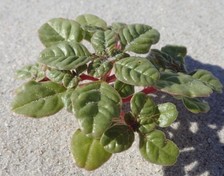
State endangered seabeach amaranth plants increased significantly in 2019 according to an annual plant census performed along New Jersey's coastal beaches south of Sandy Hook. Sea Beach Amaranth is a low growing annual, only growing about 4 inches in diameter, with reddish stems and small spinach like leaves. Its seeds are thought to remain viable for long periods of time and can be dispersed long distances through wind and by water. It grows on undisturbed beaches, from the high tide line to the base of the dune, a similar habitat of beach nesting birds like piping plover.
According to a NJDEP press release, from 1913 to 2000 the plant had not been reported on a New Jersey beach. It was not until 2000, when the plant was identified near Sandy Hook after a beach-fill operation. Since its rediscovery, NJDEP performs annual surveys for the plant. The 2018 survey reported a 91% increase in plants, a total of 1,591 plants were identified. The 2019 report shows an even greater increase. In 2019, biologists counted a total of 7,195 plants, showing a 600% increase when compared to 2018.
|
Monmouth County Division of Planning Welcomes New Director
At the end of 2019, the Monmouth County Division of Planning congratulated Director Edward Sampson upon his retirement. The Division now welcomes the new Director, Joe Barris. Joe previously held the position of the Assistant Director and has worked in the Division of Planning since 2003. Joe is a New Jersey licensed Professional Planner, ACIP certified planner, and Certified Floodplain Manager (CFM).
As a project manager he incorporated arts and culture into Monmouth County's regional studies including the 2016 Monmouth County Master Plan, reinforcing their importance for positive social, economic and cultural outcomes in the community. He was instrumental in assisting local stakeholders create the Upper Freehold Historic Farmland Byway, the third such scenic byway in the State of New Jersey. Based on this work, he and his team have completed creating a network of online cultural and heritage byway tours showcasing the invaluable and irreplaceable community assets found throughout Monmouth County’s 53 municipalities.
In response to Superstorm Sandy, he co-developed and implemented the Monmouth County Community Rating System Municipal Assistance program and is currently assisting the Office of Emergency Management with an update to the county’s Hazard Mitigation Plan. He is a founding member of the Freehold Borough Arts Council, is Chair of Monmouth Arts, the County’s official art’s service and advocacy agency, and has recently joined the Stakeholder Advisory Board for the New Jersey Sea Grant Consortium. He is presently a guest faculty member at NJIT for their Creative Placemaking Certificate Program.
About This Newsletter
The purpose of the newsletter is to inform Monmouth County citizens on the health of their environment and list environmental outreach events in their community. The newsletter is produced by the Monmouth County Division of Planning Section of Environmental & Sustainability Planning in coordination with the Monmouth County Environmental Council. The County of Monmouth and the Board of Chosen Freeholders do not necessarily share the viewpoints of any environmental group mentioned in this newsletter.
If you have questions, comments, or wish to have an event listed in the newsletter, please contact: Amber.Mallm@co.monmouth.nj.us
|
|
|
|



