 Announcement & Updates!
Check out our program line up for August, CLICK HERE.
Virtual Summer Camps Available! Click here to view the schedule
Lichen "Walk" Webinar Thursday, Aug. 27 at 7 p.m.
Lichens are everywhere but often overlooked. Did you know there are 175 different kinds of lichen in Mercer County alone? Join lichenologist Dennis Waters to learn where to find lichens in Mercer County Parks and how to recognize the common ones. You'll also learn about their interesting lifestyles and ecological importance.
Invasive Species Spotlight
By Jillian Stark, Senior Land Steward
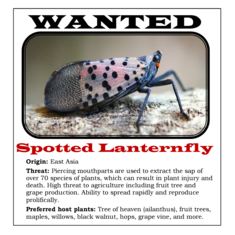
Late summer is approaching and we still need your help to reduce the spread of the invasive spotted lanternfly! You may have been noticing nymphs of this invasive pest all summer long in their different life phases – black with white spots, and later red with black and white spots. Now, they have begun emerging in their adult phase.
If you see them, squish, scrape and report! For more information on these methods, please visit: https://extension.psu.edu/spotted-lanternfly-management-resources.
|
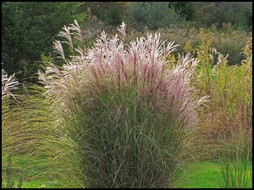
Chinese silvergrass
Also known as maiden grass, this ornamental grass is commonly used in landscaping. Species forms extensive infestations by escaping from ornamental plantings and establish easily along roadsides, forest edges, old fields, and other disturbed areas throughout the United States.
Control Methods:
Do not plant. Remove prior plantings, and control sprouts and seedlings. Bag and dispose of plants and seed heads in a dumpster or burn. Foliar spray is an effective control method.
|
Mystery Trail Hikes
By Alexandria Kosowski, Teacher Naturalist
Calling all detectives! Working undercover as the Tulpehaking Nature Center’s mascot, Detective Tully the Turtle, has overheard conversations about the Mercer County Park Commission’s trailside treasures. Detective Tully needs your help to go out and discover the locations of these ’treasures’.
In each Mystery Trail Hike dossier, found here: http://mercercountyparks.org/#!/activities/DIY-programming under Mystery Trail Hikes, you will find Mystery Trail maps as well as clues, leading you to some interesting spots throughout Mercer County’s parks.
To complete a mission, choose the trail you want to hike today. Print out the Mystery Trail Map and clues, and also print out a copy of the Detective Tully Badge and bring it with you on the hike. When you find one of the treasures, take a photo of Detective Tully in front of the treasure! Once you complete the trail successfully, send your photos to akosowski@mercercounty.org and be entered in a raffle to win a Tulpehaking Nature Center t-shirt! Raffle will be held in December 2020. Good luck, Detective.
Can’t wait for the raffle? You can purchase our Tulpehaking Nature Center t-shirts now. Youth t-shirts (green) are $10 and adult t-shirts (orange) are $15. Support our nature center and Mercer County Parks by wearing our shirts around the County! Contact akosowski@mercercounty.org to make arrangements to pay and pick up your very own Tulpehaking Nature Center t-shirt.
|

Accidental Citizen Science:
Contribute to Our Knowledge of
Pollinators with iNaturalist
By Alex Rivera, Land Steward
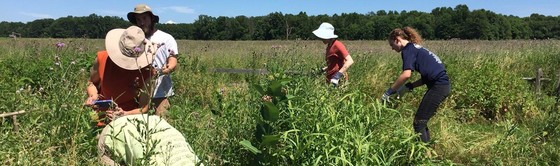 You may be familiar with iNaturalist, an app that helps you identify the plants, animals, and fungi we share the world with through uploaded photos. If you aren't familiar with it, download it right now, come back to this article, and then make your first observation in our parks!
The basic functions of iNaturalist is impressive enough, but the additional features that are accessible on the desktop version make it a powerful tool for decentralized citizen science. Years ago, our Senior Land Steward set up iNaturalist projects at Mercer Meadows, Mercer County Park, Baldpate Mountain, Roebling Park, and South Riverwalk Park. Every time someone made an iNaturalist observation in these parks, the observation became part of these projects. Our Stewardship team can use the date collected on iNaturalist to get a listing of observed plants and pollinators that would other wise have taken years for our department to collect. What did we find in that data and what can we infer about pollinator habitat quality in our parks?
Mercer Meadows had 120 unique observations of native plants on iNaturalist, a surprising number in and of itself. The seed mixes used in our meadow restorations typically have 20 - 30 species of native plants, so it is encouraging that there's so much species diversity. The Xerces Society Pollinator Habitat Assessment Guide for Natural Areas and Rangelands (there's one for home gardens too!) requires 10+ plant species blooming in each season to receive high marks on foraging habitat. Mercer Meadows blows this standard away with 90 species in bloom through spring and summer. Things get a little lighter in fall, with zero species blooming specifically in fall and 18 species blooming summer through fall. Based on this information, it seems that October and November (yes, some pollinators are still out that late) foraging resources are pretty light in Mercer Meadows, and any pollinator focused restoration practices should focus on fall bloomers.
Mercer Meadows had 104 unique observations of native insects, also a surprisingly high number. About 50% of these insects were moths or butterflies, order Lepidoptera. Before they become butterflies and moths, they eat the foliage of a plants as caterpillars, often relying on a single plant species to support the next generation. Thankfully, we have a listing of the Lepidoptera species that native plants support, allowing a comparison of the plant observations with the insect observations. I was surprised to see almost half of the observed Lepidoptera species did not have their host plant observed in Mercer Meadows. This doesn't mean that their host is not present, or that the park isn't a great resource for them - I'm confident in saying that Mercer Meadows is the best large pollinator habitat around, along with our other parks. For me, the takeaway is that if we know a butterfly or moth species is using Mercer Meadows for foraging resources, we can also provide host plants to help them complete their life-cycle in the same place they're foraging. Many Lepidoptera live short lives as adults, spending about a month in a frenzy looking for food, a mate, and their host plant. Why not make their short lives a little easier?
Using iNaturalist is simple, intuitive, and a wonderful resource that allows the Park Commission and other environmentally focused land managers to learn about their lands in a way that was previously unimaginable. It would have taken months of planning and coordination to get the information I spent a few hours working on from the comfort of my couch. Every time you're enjoying parks, and you see an interesting plant or animal, take a picture and upload it to iNaturalist, even if you think it has been seen before - you never know how helpful that information is! Stay tuned for more pollinator takeaways from the other parks, and information about how your iNaturalist observations help us make better land management decisions.
|