CENSUS BUREAU LAUNCHES COVID-19 DATA HUB

The U.S. Census Bureau has released a new resource page on Census.gov to help federal agencies, businesses, and communities make decisions related to the COVID-19 pandemic.
Similar to the Census Bureau’s resources pages created during natural disasters, this resource page includes information on population demographics, economic indicators and businesses.
The data hub provides four interactive features:
• The COVID-19 Impact Report allows users to browse dashboards with demographic and business data for the nation, states and counties. Information is presented in an interactive visualization that allows for further exploration and downloading.
• The Demographic and Economic Analysis feature provides selected statistics in an interactive map that can be incorporated into users’ own maps.
• The Highlighted Datasets allow users to access even more of these key data in an interactive map that includes further details down to the census tract level.
• The Categorical Datasets search allows users to select a data theme and to find and download (in map service and Excel formats) the census data that interests them.
Learn more about the Census Bureau’s COVID-19 Data Hub.
|
It’s not too late to complete your 2020 Census form! It's safe and easy, and it’s your opportunity to bring education, health care, housing and political power to your community.
People across America are keeping their families and communities safe and healthy by staying home, or serving the public by providing essential services. Responding to the Census yourself — is another way to do your part and help keep your community strong.
If the paper form you received in the mail doesn’t work for you, you can respond online or by phone. There are so many ways to count yourself in the 2020 Census -- don’t wait! To respond online, visit https://my2020census.gov/login; to respond by phone, call 844-330-2020 (English) or 844-468-2020 (Spanish).
Use cleaning products safely -- and don't drink bleach
Public health experts are asking people not to drink bleach to try and prevent COVID-19 infections. There is a lot of confusing, incomplete and inaccurate information circulating about how to prevent coronavirus from spreading, including drinking bleach, which is dangerous and could cause serious injury. Moreover, it will not prevent a coronavirus infection.
The U.S. Centers for Disease Control and Prevention (CDC) recommends using diluted bleach solutions on frequently touched surfaces. Hand sanitizer with an alcohol content of at least 60 percent is recommended for killing COVID-19 on the hands, especially when soap and water is unavailable.
However, these products and others used to clean and disinfect may have the potential to be toxic if used incorrectly. Exposure to cleaning products is the second leading cause of calls to poison centers nationwide. Children under age 6 are particularly at risk because they are naturally curious and may mistake cleaning products for food or drink. Some cleaning products (including bleach) are caustic, meaning they can cause burns when swallowed or when sprayed or splashed onto the skin or into the eyes.
Mixing certain cleaning products together is also dangerous. This could create a poisonous gas that causes coughing and serious breathing problems.
People are strongly encouraged to follow the CDC guidelines for careful cleaning and disinfecting practices to help stop the spread of COVID-19.
The New Jersey Poison Control Center offers the following advice for using and storing cleaning products safely:
• Keep all cleaning products in secured locations so children and pets cannot get to them.
• Make sure that spray nozzles are in the “off” position when not in use.
• Keep all products in their original labeled containers.
• Exposure to the skin and eyes require flushing with large amounts of water to prevent irritation.
• Do not use “industrial” cleaners found at work in the home. These cleaners have very high concentrations of the active ingredient and lead to more problems than those cleaning products intended to be used in the home.
Need help? Call the New Jersey Poison Control Center at 1-800-222-1222 if someone may have swallowed, touched or breathed a harmful substance.
Mercer County testing sites -- Quaker Bridge Mall and Trenton
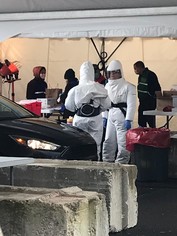
Mercer County, in collaboration with health care and municipal partners, is operating an appointment-only, drive-up testing site for COVID-19 at Quaker Bridge Mall in Lawrence, and appointment-only pop-up testing sites in Trenton for individuals who lack transportation to the mall location. The Trenton sites are now open in each city ward one day a week.
Testing will be provided for symptomatic Mercer County residents age 18 or older who have an appointment. Symptoms of COVID-19 include fever, cough and shortness of breath.
If you are symptomatic for COVID-19 and want to be tested, contact your primary health care practitioner. If a test is needed, your doctor will fax a prescription to the Mercer County health call center at 609-630-4031, and the center will contact you to schedule an appointment. If you voice an inability to get to Quaker Bridge Mall, you will be offered an appointment at a Trenton pop-up site along with instructions on when and where to go. If you do not have a doctor, call an urgent care facility or call the Henry J. Austin Health Center in Trenton (609-278-5900) to arrange for screening.
For the health, safety and security of staff at the Quaker Bridge Mall testing site, patients will not be permitted to leave their vehicles. Walk-ups are not permitted at that testing location.
You must have an appointment to be tested. Those who show up at a testing site without an appointment will not be able to be tested.
If you have questions about the testing process, call 609-337-4081 Monday through Friday between 8:30 a.m. and 4:30 p.m.
The testing sites are collaborative efforts between the County of Mercer, Robert Wood Johnson University Hospital Hamilton, Capital Health System, St. Francis Medical Center in Trenton, the Trenton Health Team, Henry J. Austin Health Center, the City of Trenton, Lawrence Township and Quaker Bridge Mall management.
If you believe you may have symptoms of COVID-19, the State of New Jersey’s COVID-19 Information Hub provides a self-assessment tool that will help you determine whether you should be tested. Visit self.covid19.nj.gov.
|
COUNTY CLERK OFFERS ONLINE SERVICES
Through the COVID-19 crisis, the Mercer County Clerk’s Office is still offering several key services. Timely recording of documents can continue online via njcountyrecording.com. However, due to the office closure, you will need to sign up using an outside vendor. Both Simplifile and CSC are established and responsible vendors. You can contact Simplifile at 1-800-460-5657 or simplifile.com. CSC can be reached at 1-866-652-0111 or erecording@cscglobal.com. If you are a member, you can access the NewVision Search System at records.mercercounty.org/ RecordsNG_Search. You can also search for any property in the county by starting a free account at pip.mercercounty.org.
HAVE GENERAL QUESTIONS ABOUT COVID-19?
The NJ Poison Control Center and 211 have partnered with the State to provide information to the public on COVID-19:
Call: 2-1-1
Call (24/7): 1-800-962-1253
Text: NJCOVID to 898-211
Visit covid19.nj.gov or nj.gov/health for additional information
PREVENTION
To ensure the lowest chance of obtaining the virus, and spreading the virus to others:
- Practice social distancing.
- Wash your hands often with soap and water for at least 20 seconds, especially after you have been in a public place or after blowing your nose, coughing or sneezing.
- Avoid touching your nose, eyes and mouth with unwashed hands.
- Cover your mouth and nose with a cloth face cover when you have to go out in public; for example, to the grocery store or to pick up other necessities. Do not use a facemask meant for a health care worker. The cloth face cover is not a substitute for social distancing.
- If you are in a private setting and do not have on your cloth face covering, remember to always cover your mouth and nose with a tissue when you cough or sneeze, or use the inside of your elbow. Throw used tissues in the trash and wash your hands or clean them with a hand sanitizer that contains at least 60 percent alcohol.
- Clean and disinfect frequently touched surfaces
|
SYMPTOMS
Symptoms can appear between 2-14 days after exposure, though some people may not have any symptoms while still being contagious. It's also important to consider whether you've been in contact with an infected person, as well as any symptoms you may be experiencing. In addition to fever, cough and shortness of breath, symptoms can include chills, muscle pain, headache, sore throat and new loss of taste or smell.
If you believe you've been infected and you are not in immediate danger, you should contact your doctor by phone. If you are experiencing a medical emergency, call 911, and notify the dispatch personnel that you may have COVID-19.
COVID-19 Symptom Checker.
|
COPING WITH STRESS
If you’re feeling stressed, anxious or depressed due to COVID-19, please call New Jersey's MentalHealthCares Helpline at 866-202-HELP (4357) or visit njmentalhealthcares.org for emotional support, guidance, and mental health referrals as needed. You also may call the SAMHSA Disaster Distress Helpline at 1-800-985-5990 or text TalkWithUs to 66746 (TTY 1-800-846-8517).
BUSINESS ASSISTANCE
For information on COVID-19/Novel Coronavirus and its impact on businesses – including resources, assistance and regulations -- visit the State of New Jersey business portal and the Mercer County Office of Economic Development.
JOBS AND HIRING
Did you lose your job or have your hours reduced as a result of COVID-19? Businesses across New Jersey need thousands of workers for immediate hire. Learn more about who is hiring in your community at jobs.covid19.nj.gov. The New Jersey Department of Labor & Workforce Development has prepared a frequently asked questions document for workers affected by the coronavirus emergency.
CONSUMER COMPLAINTS
If you receive a call from a scammer or suspect price gouging, please report it to the Division of Consumer Affairs at (973) 504-6240 or https://www.njconsumeraffairs.gov/.

CURRENT STATUS
The New Jersey Department of Health on April 28 announced 2,887 new positive cases, bringing the total of positive cases in the state to 113,856 with 6,442 deaths. The most positive cases are in Bergen County, which has 15,251; Mercer County has 3,605, with 212 deaths. To view Mercer County data by municipality, please visit the Mercer County COVID-19 Dashboard at https://arcg.is/1y1eHO. Please note that municipal data lags behind the state data and will update as information becomes available. Visit the New Jersey Department of Health's COVID-19 Dashboard for more statewide information.
The CDC on April 27 announced a total of 981,246 cases of COVID-19 in the United States, and a total of 55,258 deaths, with 55 locations (50 states, District of Columbia, Puerto Rico, Guam, North Mariana Islands and U.S. Virgin Islands) reporting cases. Total cases includes 3,587 probable cases and total deaths includes 5,654 probable deaths. For more information, visit cdc.gov.
|
|