
Summer Nature Programs Brochure
NOW AVAILABLE!
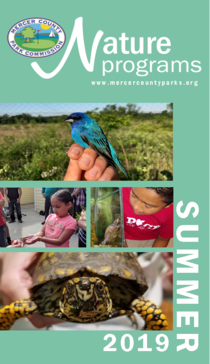
Our Summer Nature program brochure is now available and registration is open!
We have exciting news to share with you! We have partnered with REI to bring their expertise in all things outdoors to our parks!
Back this season are fan favorites like Kayak Nature Tours, Bird in Hand, Lichen Walk and installments of the Naturally Friends Series.
The Tulpehaking Nature Center will hold free activities throughout the summer, read more below.
Don’t forget about our fantastic volunteer opportunities!
CLICK HERE FOR OUR BROCHURE
|
Reminders of the Past:
The Green Roof at Mercer Meadows
 Walking the trails at Mercer Meadows can feel like strolling through the halls of a museum. The stray telephone pole laying beneath the shrubs, a tree slowly encapsulating twisted, rusty cattle fencing or those seemingly random red arches peppering the landscape; they all speak to the rich history of Mercer Meadows.
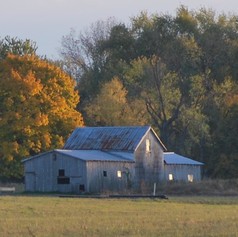
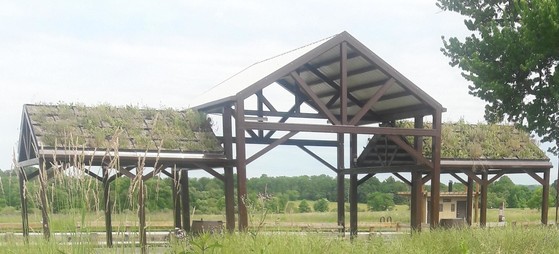
Amongst the recent enhancements to Mercer Meadows you can find tidbits of the past echoing through. The Green Roof structure at the Reed Bryan Farm may be a new addition to the park but it pays homage to property’s previous life. The design of the Green Roof mimics that of the wagon house that, for 164 years, stood across the parking lot stoically overlooking the surrounding fields.
The original structure was a 2 story wagon house built circa 1850 by the Reed family who owned and farmed the property, with the two wings added in the early 20th century.
|

This pre-civil war era relic collapsed in February of 2014, when a particularly fierce winter storm dropped six inches of snow, ice and sleet onto it’s fragile roof, buckling the support structures.
The Green Roof installed in 2016 is a replica of the now demolished wagon house. Equipped with rain barrels to collect rain water and reduce runoff, it provides park users a shade structure and is adorned with native plants such as Prickly Pear, Spiderwort, and Black-Eyed Susan that provide habitat for wildlife.
|
Free Summer Family Programs return to the Tulpehaking Nature Center !
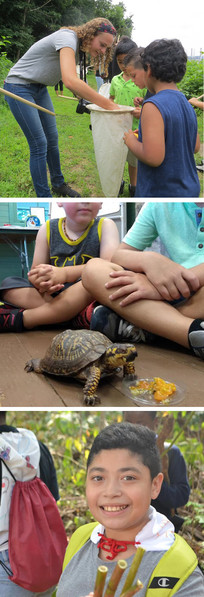
Our program leaders and educators at the Tulpehaking Nature Center have put together an exciting line up of free family activities every Friday, Saturday and Sunday throughout the summer.
Bring the whole family for fun, educational, and outdoor together-time!
Join us every Friday at 10:30 a.m. as our educators share a story worthy of the Abbott Marshlands followed by a nature inspired craft or activity!
Saturdays at 1:30 p.m. in June our naturalist will lead visitors on a leisurely hike to explore the history, plants and wildlife of the Abbott Marshlands.
On Sundays at 1:30 p.m., come Feed The Animals! See what it takes to keep our resident turtles and snakes healthy, clean, and fed. We may even enlist some willing hands to help us!
Registration is not required for these programs. Be sure to check the Summer Nature Programs brochure for more things to do at the Tulpehaking Nature Center this summer!
If you haven't visited the Tulpehaking Nature Center yet, now is the time!
The Tulpehaking Nature Center is located at 157 Westcott Avenue in Hamilton Township.
Summer Hours: Friday & Saturday: 10 a.m. – 4 p.m.; Sunday: noon - 4 p.m.
|
The American Kestrel
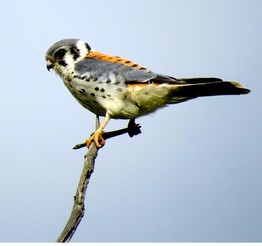
The tiny American Kestrel, a mourning dove sized falcon, looms large in grassland habitats throughout North America. Kestrel populations are declining in parts of their range due to habitat loss, but Mercer Meadows serves as an oasis for this species and many other grassland birds. Preferring open areas with low vegetation, Kestrels can often be found perched on the wires and telephone poles that outline Mercer Meadows.
While the American Kestrel is a cavity nester, they are not capable of excavating their own nest sites. To encourage a breeding population, numerous nesting boxes have been installed in Mercer Meadows. The nest boxes are monitored and hatchlings are banded by staff from New Jersey Division of Fish & Wildlife, Mercer County Park Commission, and Friends of Hopewell Valley Open Space. Since the boxes installation in 2012, 32 American Kestrels have been hatched and banded at Mercer Meadows.
Male American Kestrel: rusty top with slate gray wings, two vertical black slashes on side of face, long tail that bobs when perched.
|
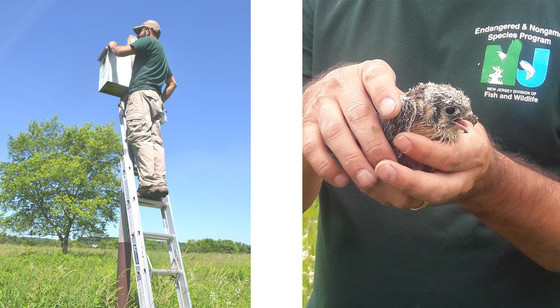 Pictured above is the NJ Division of Fish & Wildlife staff cleaning and monitoring the Mercer Meadows kestrel nesting boxes. American Kestrel nestlings will spend about a month in the nest boxes.
Trenton to Trails: Trenton High Creates, Trenton Rejuvenates!
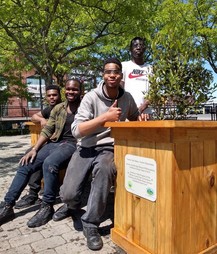
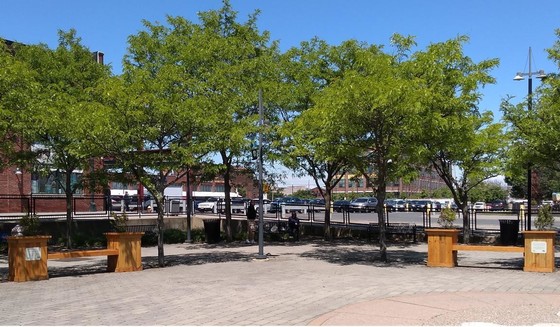 These two beautiful planter benches made by local students will benefit all Millyard Park users.
Once a month since September, the seniors of the Trenton High School STEM Academy Building and Design class have visited a different park with Park Naturalist, Christy Athmejvar as part of the Trenton to Trails program. On these monthly field trips, the students learned about nature, the environment, human impact, as well as the outdoor recreational and stewardship opportunities available to them within the county.
|
On the student’s trip to Baldpate Mountain they learned how to identify different tree species. At Howell Living History Farm the students used hand tools and 19th century techniques while learning about the properties and uses of lumber made from different species of trees. The students used the knowledge to build bench planters that have been installed at Millyard Park, next to Roebling Market.
This capstone project served as an opportunity for the students to give back to the community and apply what they learned by bringing a touch of nature to the city of Trenton.
|
|
 |
The Trenton to Trails program is facilitated by the Mercer County Park Commission Naturalist Division with funding provided by the Robert Wood Johnson Presidents Grant fund.
The benches have been planted with native bayberry shrubs, a fragrant evergreen and excellent food source for birds during winter months.
Putting Roots Down in Mercer County
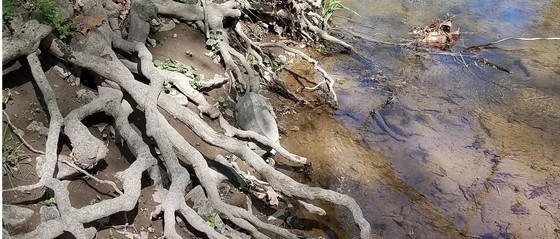 The stewardship efforts of the Naturalist Division continue to grow, in this case into a forest! We received the "Roots for Rivers" riparian reforestation grant from the Nature Conservancy and the Watershed Institute to plant 4,200 trees, stream-side, on two different County-owned properties this spring.
The first site at Moores Creek in the Pleasant Valley Historic District was completed in partnership with Sourland Conservancy, NJDEP's Watershed Ambassador Program, and Howell Living History Farm. 1,800 native trees and shrubs were planted with the help of approximately 250 volunteers over the course of two weeks.
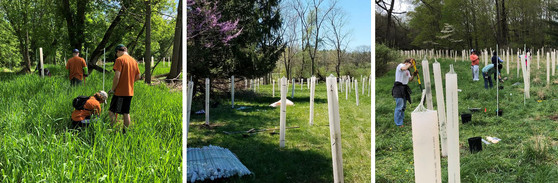
Our second site was the Stony Brook at Mercer Meadows, on Old Mill Road in Hopewell Township. Over 100 volunteers came to help restore the floodplain of the Stony Brook by planting trees, protecting them from deer - and having fun! These native trees and shrubs will protect our valuable water resources and provide critical habitat to our native wildlife.
It is estimated that between these two plantings, 55 tons of carbon will be sequestered in the first year alone, with that number increasing per year as the trees continue to grow.
We would like to thank the many members of the local community who came out to make these efforts possible, as well as the following organizations:
- Bank of America
- ETS
- Mercer County Community College Youth Corps
- Mercer County employees
- Goldman Sachs
- UPS
- Bloomberg
- Internet Creations
- Latin American Legal Defense and Education Fund (LALDEF)
- The Body Shop
- Princeton University
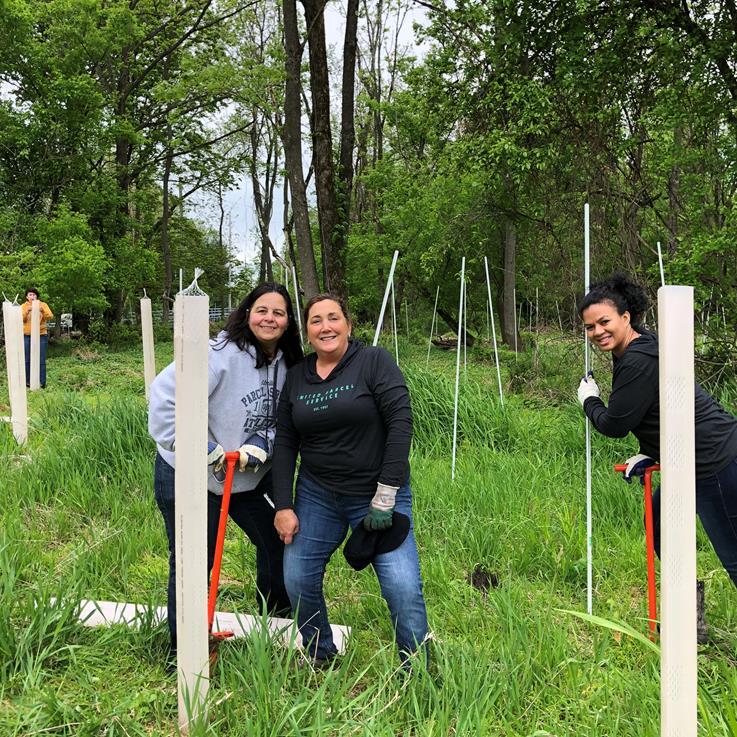 Community & corporate volunteers made this project possible by putting in 875 hours of hard work!
One of these birds IS NOT like the others!
Can you guess which one?
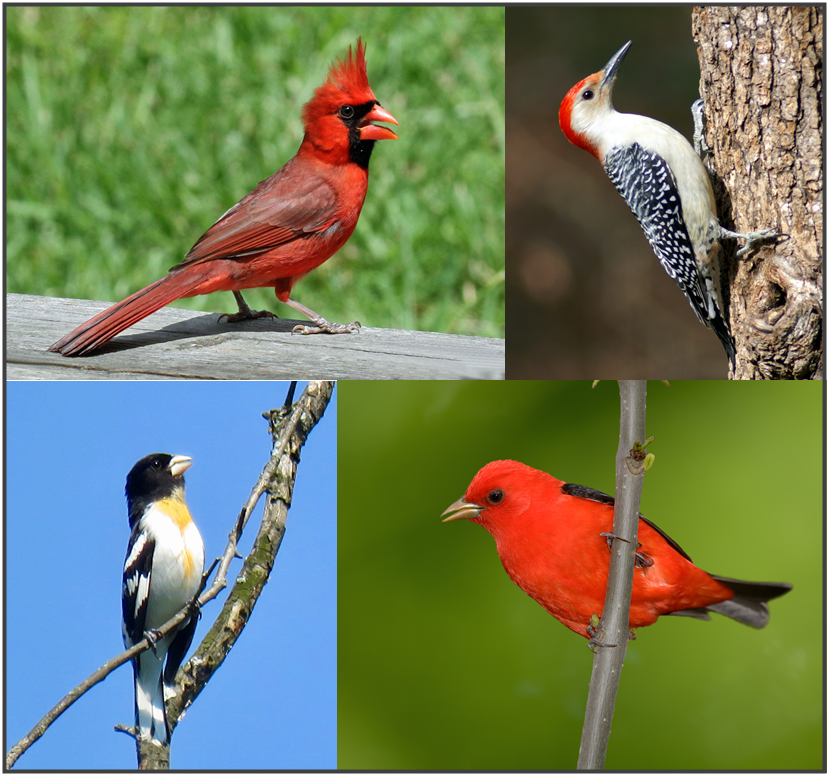 If you picked the bird in the bottom left corner, you are correct! But do you know why?
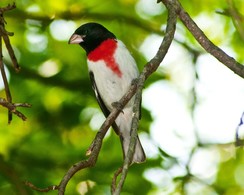
This bird, a rose-breasted grosbeak, has a pigment mutation called xanthochromism. This rare mutation causes birds to replace their regular red pigmentation with yellow. In a study performed by Cornell University, of all birds that have pigment mutations, xanthochromism accounts for 4% of occurrences, compared to albinism which was responsible for 76% of birds with pigment mutations. This individual was spotted and photographed in Mercer Meadows by one of our citizen scientists.
The birds pictured in this image; northern cardinal, red-bellied woodpecker, rose-breasted grosbeak and scarlet tanager (clockwise, beginning at the top left) are all susceptible to xanthochromism.
Throughout the park system we do see animals with pigment mutations. White-tailed deer are sometime seen exhibiting a color pattern called piebald which is an overabundance and partial replacement of typical pigment with white in their fur. Occasionally birds with leucism are observed too. This mutation prevents pigment from being properly deposited in bird feathers. Leucistic birds are typically all white and birds displaying white patches of feathers are called piebald. While you are birding in our parks, keep your eye out for these birds of a different feather and feel free to share your finds with us!
Thank you to Jack Hagan for spotting, photographing and sharing this rare find!
Picture above is a male Rose-breasted Grosbeak with typical plumage patterns.
|
|