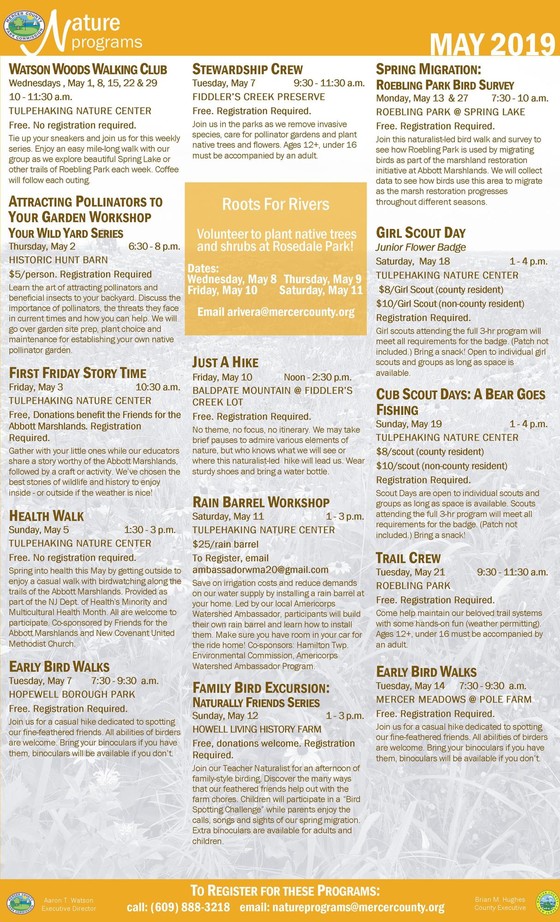
 To register for May Nature Programs, click here.
Back from the Brink: The Eastern Bluebird
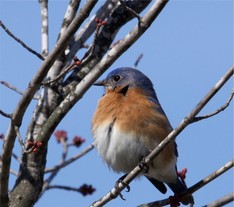
Spring brings a symphony of chirps, squeaks, and songs from the many songbird species that call New Jersey home. It’s easy to take for granted, but only 50 years ago one song could no longer be heard.
Due to habitat destruction, the Eastern Bluebird was on the brink of extinction through most of the 20th century, The collective actions of volunteers saved this species; a nesting box here, and some habitat there, over thousands of miles across the United States brought this species from close to extinction to a species of least concern.
The Naturalist Division continues this legacy of volunteer stewardship today through bluebird box monitoring in the spring and summer and bluebird box building in late winter. Look for our volunteers monitoring bluebird boxes in Mercer County Park, Mercer Meadows, Fiddlers Creek Preserve, and all of our golf courses. Be part of this initiative by setting up your own bluebird box in your backyard! Contact us for more information about bluebird boxes or to volunteer.
|
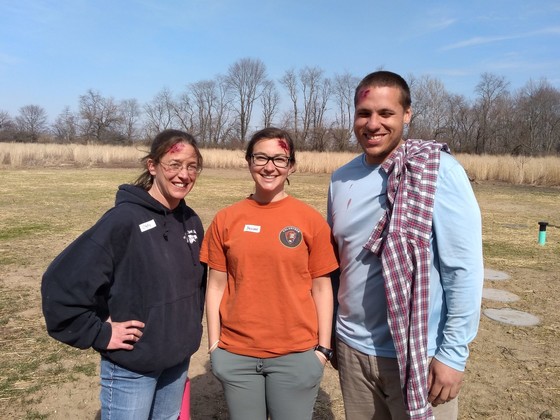 Our team of naturalists and land stewards after completing their Wilderness First Aid training. Left to Right: Teacher Naturalist, Christie Athmejvar; Senior Land Steward, Jillian Stark; Land Steward, Alex Rivera.
If you were out enjoying the park and one of your friends tripped and hurt their ankle, would you know what to do? Our program leaders do! While very rare, accidents do sometimes happen, so it’s always best to be prepared. Our naturalists and land stewards are trained to handle first aid emergencies that could happen in the great outdoors, so rest assured, you are in good hands while participating in one of the many naturalist-led educational programs, stewardship programs or citizen science projects in the parks. They had a blast during realistic mock scenarios where they learned how to treat head injuries, broken legs, and a variety of other first aid emergencies that could happen on the trail at the Wilderness First Aid Certification Training Course. Don’t worry, no naturalists were harmed during the training and they all received their Wilderness First Aid Certifications!
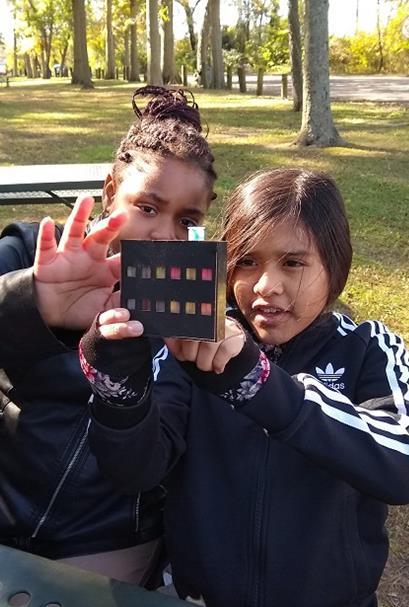
Students from Greenwood Elementary in Hamilton kicked off a busy season of field trips at Roebling Park.
By examining the aquatic insects they found in Spring Lake, students were able to draw conclusions about the quality of the water. This is part of our Watershed Moments field trip series, a program funded by the Alliance for Watershed Education. To date, eight schools and over 500 students have participated in the program, learning more about the health of our watershed and how it supports the plants, animals, and people that live within it.
Pictured on the left, students use samples drawn from Spring Lake to test water quality.
|
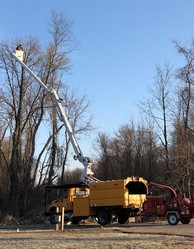
Tree crews are chipping away at Baldpate Mountain and Mercer Meadows, as the Mercer County Park Commission continues its efforts to mitigate damage to ash trees from Emerald Ash Borer (EAB). Data shows that this non-native invasive beetle pest kills 99% of the ash trees present within four to five years of infestation. EAB was first confirmed in the County in Ewing Township in 2014.
In order to proactively manage these infected trees, the Park Commission is coordinating the removal of ash trees from high use areas of the parks. The wood from these trees will be used at the Howell Living History Farm sawmill, chipped and cut into logs to be used for local habitat restoration projects, and left to decompose naturally on the forest floor. In the coming years, it will become a stewardship priority to monitor and address the impacts caused by the loss of ash in our forests.
Signs of EAB include tree crown dieback, increased woodpecker activity including signature bark “flecking,” (see photo) as well as epicormic branching, bark splits, and exit holes lower on the tree as infestation progressed.
|
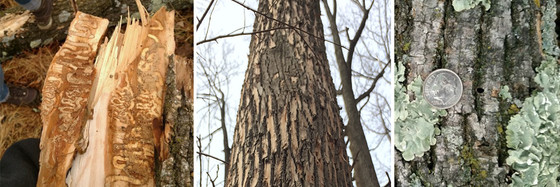 Photo 1: Cross section of an ash tree infested with EAB. The EAB larva’s signature “S” shaped galleries sever the tree’s internal transport system, killing the tree.
Photo 2: Bark “flecking” caused by woodpecker activity.
Photo 3: After using ash trees as their nursery, adult EAB emerge from the tree through barely visible, 1/8 inch, D-shaped holes.
Questions or comments? Email natureprograms@mercercounty.org
|