|
 November 13, 2026
Funding New Jersey’s Future
Putting Students First. Strengthening Schools Together.
|
|
Stakeholder Session Updates
We are grateful for the strong interest in our upcoming NJ School Funding Outreach forums and roundtables. As participation continues to grow, we wanted to share two important updates.
Virtual Public Forum Rescheduled for November 19: The November 12 Virtual Public Forum has been rescheduled. Due to a nationwide Microsoft 365 outage affecting the platform used to host the event, the forum will now take place Thursday, November 19, from 6:00–7:30 p.m. If you already registered or signed up to speak, no action is needed. Your registration will carry over to the new date.
Registration and Waitlists: In addition, some of our upcoming sessions are reaching capacity. If you receive an error message when clicking a registration link, the session has most likely reached capacity. Please email FundingOutreach@doe.nj.gov to be added to the waitlist. We will also use the waitlist to contact you if additional space becomes available.
We apologize for any inconvenience related to the rescheduled forum and appreciate the tremendous interest in participating in these conversations.
Action Item: Encourage Student Voice
Students are telling us what matters, and we are listening. At a recent public forum, Mainland Regional High School student Sa’Niyah Sims-Hackney told us, “Every number in a school budget represents something that affects a real person.”
Conversations about funding are conversations about the student experience. For students, funding decisions show up as their teachers, programs, supports, and opportunities.
We are hearing the same thing from attendees at our roundtables, and our student State Board representative, Emilia Reynolds, made the point well: the students affected by these decisions should help shape them.
That is why student voice is at the heart of the School Funding Outreach Project. As we focus on the statewide efforts to collectively decide what opportunities, resources, and supports students need to succeed, students themselves are critical to this conversation. Here is how you can help:
-
Share the survey with students. Send the survey link to the students you know, such as your children, neighbors, or young people you mentor or coach.
-
Ask schools to pass it along. Encourage principals, teachers, counselors, and student council advisors to share the survey in student and family communications.
-
Invite students to join a conversation. Register for a forum or public roundtable and bring a student with you.
-
Forward this newsletter and the survey flyer to friends, neighbors, and networks, especially those who work with young people.
|
|
A Student’s Perspective on School Funding
"When adults talk about school budgets, they often talk about numbers, taxes, and expenses. But as students, we experience those decisions in a different way. We experience them in our classrooms, our activities, and the people who help us every day.
"If our school has to make cuts, students can feel the effects immediately. I also want to talk about stability. Students need to know that the programs and resources we depend on will still be available. If funding keeps changing, schools have a harder time planning, and students can be the ones who feel the consequences.
"Every number in a school budget represents something that affects a real person... We are not asking for unlimited money. We are asking that you make sure that budget decisions don’t take away the opportunity students need to succeed.
"We are not just numbers on a spreadsheet. We are students with goals, talents, and futures. Please listen to the students sitting in those classrooms. And make sure every student has a fair opportunity to receive a quality education.
"Because when you invest in students today, you are investing in the future of New Jersey tomorrow. Thank you for listening!"
Sa’Niyah Sims-Hackney, Student
Mainland Regional
Excerpt from October 16, 2026 Public Testimony
|
|
School Funding Formula – Did You Know?
Schools with the same number of students may need a different amount of funding. Equal enrollment does not always mean equal cost. Imagine two schools that each serve 500 students. One serves relatively few students with additional needs. The other serves many more students living in poverty, multilingual learners, and students with disabilities. The second school may need more teachers, specialists, and other support staff to give its students the same chance to succeed.
Researchers have long found that it costs more to educate students with greater needs (Duncombe & Yinger; Bellwether; EdTrust). And the added resources pay off. A national study of school finance reforms found that a 10 percent increase in per-pupil spending, sustained across all 12 years of school, led to about 7 percent higher adult wages, and a 3.2 percentage-point drop in adult poverty. The effects were strongest for children from low-income families (Jackson, Johnson & Persico).
How New Jersey does it: An adequacy budget is the State’s estimate of what a district needs to provide an education that meets New Jersey’s learning standards, not the district’s actual spending plan. It starts with a basic cost per student, then adjusts for grade levels, student needs, and regional costs, including added funding for students from low-income families, multilingual learners, and special education services. The added funding per student rises as the concentration of students living in poverty in a district grows. See more information about this in the NJDOE State Aid 101 videos and resources. The estimate also helps determine how much a local community should raise, and the district decides how to spend its budget based on what its students need.
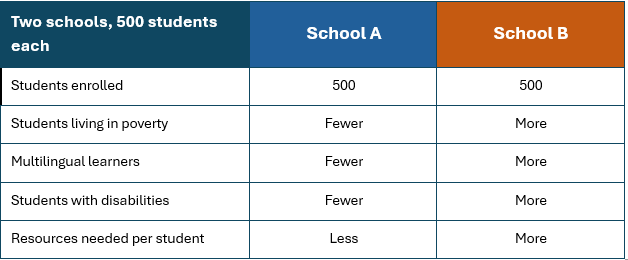 Why School B costs more: A multilingual student learning English must meet the same standards as everyone else while building her English skills, which takes added supports like English language instruction and extra time with a teacher. A high school student whose family is living in poverty may need additional time and support to prepare for college and career. When a school has many students like these, those supports add up. Used strategically, by matching the right support to the right student at the right time, funding goes further.
Learn the basics in School Finance 101, or visit NJDOE’s State Aid 101 for an overview.
Outreach, Feedback, and Next Steps
Since September, NJDOE leaders have been listening and learning from school board members, educators, parents, students, policy leaders, and broader community members. NJDOE has held forums and community roundtables across the state, hearing directly from hundreds of residents. These opportunities are being added on a rolling basis and will continue through December.
We know many districts are facing real and urgent budget pressures right now, and that local budget decisions are challenging. We are listening, and what we hear, including the pressures you are facing, will be summarized and shared publicly for review. Together, the ideas and priorities raised throughout this fall will offer policy leaders a collective understanding of what matters most to New Jersey’s students, families, and communities and help inform the work ahead.
Get Involved and Stay Connected
Follow project updates, access learning resources, and watch for future opportunities to participate through the NJDOE School Funding Outreach webpage. Additional updates will be shared through future newsletters, webinars, reports, and public engagement opportunities.
|
|
Together, we can build shared understanding and support a more transparent, predictable, and student-centered school funding system for New Jersey. |
|
|
|
|