|
Quarterly Newsletter - Fall 2025 |
|
Resilient NJ - NJ Coastal Management Program - Blue Acres |
|
In this issue...
...and something fun!
|
|

New Jersey’s Climate Week, held from September 22 to 26, provided an important opportunity to reinforce ongoing messaging around climate change. Throughout Climate Week, the State released several announcements, press materials, and social media updates highlighting efforts to address climate-related challenges. Two key reports were also published: Economic Risks of Climate Change for New Jersey 2025, which summarizes the economic risks associated with climate change, and the Ocean Acidification Action Plan 2025, which outlines steps to enhance understanding of current ocean conditions and to prepare for the impacts of ocean and coastal acidification.
|
 |
|
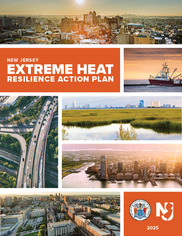
The Interagency Council on Climate Resilience released an update to the New Jersey Extreme Heat Resilience Action Plan, originally issued in July 2024. Organized across 20 focus areas, the plan details timelines, lead agencies, and next steps for each action. Since its initial release, four additional agencies—Children and Families, Corrections, Education, and Labor and Workforce Development—have joined the Council, contributing new perspectives and actions to the plan. The plan outlines 143 implementable actions that agencies are undertaking to strengthen New Jersey’s resilience to the growing impacts of extreme heat. |
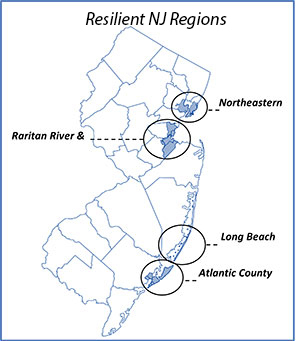
The Resilient NJ Program has officially concluded its inaugural round of regional resilience planning projects. The four original regional projects, consisting of 24 coastal municipalities – Atlantic County Coastal Region, Raritan River and Bay Communities, Northeastern New Jersey, and Resilient Long Beach Island– kicked off in 2020. They underwent comprehensive climate resilience planning processes across multi-municipal project areas. These efforts resulted in regional resilience action plans and the implementation of several actions from those plans, including successful grant applications, water resource master plans, concept designs, and site assessments. The total amount of additional funding for implementing actions in the original plans was approximately $26.5 million through the program’s efforts. We look forward to seeing what these regions will do next with their plans!
|

Blue Acres celebrated its 30th anniversary! Approved by the legislature in August 1995, the “Green Acres, Farmland and Historic Preservation, and Blue Acres Bond Act” allocated $340 million to acquire and preserve land in New Jersey. On November 7th, the ballot question set aside $30 million of the total allocation to fund the new “coastal Blue Acres” and “inland Blue Acres” (then focused explicitly on the Passaic River Basin), which received a 68% “yes” vote.
Over the past three decades, Blue Acres has evolved from a subset of Green Acres into its own distinct program, expanding to encompass all coastal and inland waters statewide. Including the earliest flood-mitigation buyouts in Lincoln Park, Blue Acres has now acquired over 1,200 properties statewide. These buyouts represent families across nearly 50 municipalities safely relocated and 360 acres preserved as natural flood storage and public open space. Thirty years later, Blue Acres continues to advance its mission of safeguarding people and property from repeat flooding.
|
All are welcome to join this three-day conference to learn about innovative coastal and climate resilience work happening throughout the state, network with other coastal and climate professionals, and contribute new ideas and perspectives on New Jersey’s climate future.
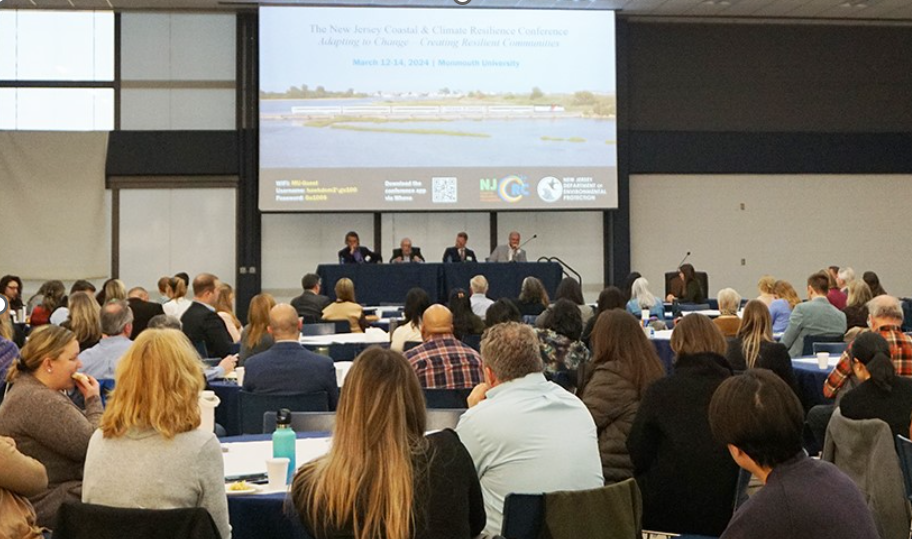 Image: 2024 NJ Coastal & Climate Resilience Conference, Monmouth University (West Long Branch, NJ)
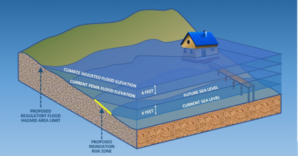
The NJ Climate Change Resource Center at Rutgers University recently released New Jersey’s Rising Seas and Changing Coastal Storm: Report of the 2025 Science and Technical Advisory Panel (STAP), including a Summary and FAQ companion document. The STAP is composed of 17 nationally and internationally recognized experts in climate science, oceanography, meteorology, coastal engineering, and public policy, charged by DEP to identify, evaluate, and summarize the most current science on sea-level change and changing coastal storms. The report presents the findings of this third iteration of the STAP and builds on previous STAP reports from 2016 and 2019—companion document.
Routine updates to state-specific sea-level rise projections are critical to ensure that DEP and all other state and local decision-makers have the information needed to plan for, mitigate, and adapt to sea-level rise.
|
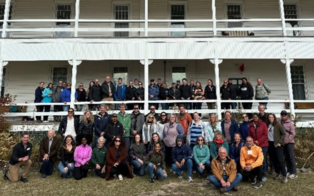
In October, the NJ Coastal Management Program (CMP) hosted the Coastal States Organization Fall Membership Meeting in Cape May, NJ. During the annual multi-day meeting, Coastal Management Programs from 33 U.S. states and territories gathered to discuss federal legislative, administrative, and policy issues relating to coastal, Great Lakes, and ocean management.
As the host, the NJ CMP shared its perspective on how the state is advancing resilience through project implementation, planning, relocation, and regulations- including presentations on the Green Acres Bay Point restoration project, NJ Fish & Wildlife Shell Recycling Program, the Resilient NJ initiative, the Blue Acres program, and a panel discussion on the beneficial use of dredged material.
The meeting also provided an opportunity for the CMP to showcase the beauty of NJ to members during a field trip portion. Staff from the Office of Coastal Engineering discussed the Shore Protection Program, the history of beach nourishment in NJ, and the ongoing coordination with municipalities to combat shoreline erosion. Members also visited the Cape May Point Arts and Science Center and listened to presentations on the history of Cape May and the Center, as well as on research initiatives, including Project Monarch. The field trip concluded with a tour of South Cape May Meadows to learn about the history of a former borough and to explore the nature preserve managed by The Nature Conservancy.
|
|
|
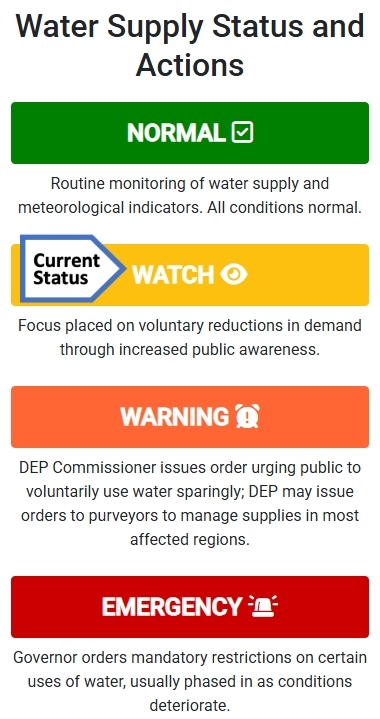
Drought is a prolonged period of abnormally low precipitation relative to local and regional averages, leading to a water shortage. - 2020 New Jersey Scientific Report on Climate Change
Climate change is a global challenge with effects experienced right here in New Jersey. Changes in precipitation patterns, particularly extended periods of low rainfall, are likely to make droughts more frequent. Droughts can stress existing infrastructure systems and likely trigger other emergencies, such as reduced water supply, economic losses, shortages in food production, and cracked roads and sidewalks. In fact, as of November 19th, over 50% of New Jersey is currently under drought conditions, with another 26% under Abnormally Dry conditions!
|
Why did the sun apply to work at OCR?
It wanted to shed some light on climate resilience!
|
|
 |
|
|
|
|
|