|
The following Morris County communities received their Letter of Final Determinations (LFD) on February 19th. The communities will have 180 days to update their ordinances with the effective Flood Insurance Rate Map (FIRM) and Flood Insurance Study (FIS). Ordinance updates and adoptions should occur prior to August 19th. The communities given these updates are:
| Borough of Butler |
| Township of East Hanover |
| Borough of Kinnelon |
| Township of Montville |
| Township of Parsippany-Troy Hills |
| Borough of Riverdale |
| Borough of Lincoln Park |
| Township of Pequannock |
FEMA held their Consultation Coordination Officer (CCO) meeting for Hunterdon/Somerset counties revised preliminary maps for portions of the North Branch and South Branch Raritan River on March 4th. The associated Flood Insurance Rate Map (FIRM) and Flood Insurance Study (FIS) will be made available for download here. There will be a 90-day appeal period once documents have been released. Paper maps will be mailed to the following communities:
| Hunterdon County |
Somerset County |
| Town of Clinton |
Borough of Raritan |
| Township of Clinton |
Township of Bedminster |
| Township of Franklin |
Township of Branchburg |
| Township of Raritan |
Township of Bridgewater |
| Township of Readington |
Township of Bridgewater |
| Township of Union |
Township of Hillsborough |
Back to Top
With this winter bringing consistently below freezing temperatures, many of our states waterways have seen ice this winter. This also opens a seasonal flood risk of ice jams in these areas. Ice jams are caused during thaws, where snowmelt runoff increases flow of rivers, which may break ice. This ice and added river flow can pile up, form an ice jam that can dam the river enough to induce flooding. This risk is heighted, especially as the weather warms with spring approaching. The best mitigation strategy for these emergencies is by keeping homes up to NFIP standards in building location and structure.
Back to Top
The U.S. Army Corps released an updated draft feasibility report in December 2024 to prepare NJ back bay areas for stronger storms, rising seas, and other weather events. The report lays out an adapted, scaled back version of a 2021 plan that should cost less and be more achievable in the near term. The plan recommends “the elevation of approximately 6,4000 residential structures: floodproofing 279 critical infrastructure facilities … and the implementation of nature-based solutions”. The project aims to reduce storm damages to NJ shore communities in the back bays region, which includes approximately 3500 miles of shoreline from Long Branch to Cape May Point. The plan is still subject to change and requires authorization and funding from Congress. Should the project be authorized and funded, construction could begin as early as 2030.
USACE | PBS WHYY
Back to Top
At the end of January 2025, the Natural Resource Conservation Service (NRCS) Emergency Watershed Protection (EWP) formally approved the funding agreement for $3.5M in Blue Acres buyout funding for five specific properties along the Orchard Brook in Cranford Township NJ. The funding is a response to a declaration of watershed impairment and property damage that resulted from 2021’s Hurricane Ida. Blue Acres as begun the technical work for the buyout of these five homes and homeowners have been assigned a case manager to guide them 1-1 through the process. On January 27th Blue Acres, the Township and representatives from Union County held a community engagement meeting to talk about the voluntary buyout effort, to solicit input for post buyout land use and to highlight other local flood mitigation projects such as planned culvert upgrade work along Orchard Brook. Engagement meeting attendees were encouraged to sign up for a dedicated list serve designed to offer updates and promote opportunities for Cranford residents to provide input on the post buyout open space restoration for the area.
Back to top.
 |
|
The State of New Jersey was awarded a total of $380M from the US Department of Housing and Urban Development in 2013 to put towards flood risk reduction project. These projects are meant to address impacts of inland and coastal flooding caused by Storm Hazards, such as Superstorm Sandy. The Rebuild by Design Meadowlands (RBDM) project aims to reduce flooding, cultivate endemic planting, and energize the community with public realm improvements within the Meadowlands of Bergen County. Presently, RBDM has scheduled a 500 cubic foot per second (CFS) pump station and force main construction within the East Riser Ditch in Carlstadt and Moonachie, as well as a green infrastructure project along the Southern portion of the Hackensack River.
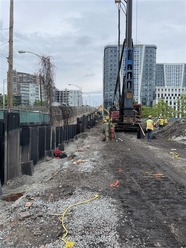
The Rebuild by Design Hudson (RBDH) project will address major storm surges, high tides, and heavy rain events within the City of Hoboken, Weehawken, and Jersey City. NJ has been adding hard infrastructure (bulkheads, floodwalls, seawalls) and landscaping features (berms and levees) to serve as coastal barriers during high tides or storm surge events, expected to be completed in 2027.
RBDM | RBDH
Back to Top
|
The NFIP Coordinators Office would love to hear from our subscribers about what they would like to see from our newsletter, as well as content they hope to continue.
Back to top.
The NFIP Review Course is a free, no-cost training for New Jersey municipal, county, and state officials, as well as the general public, looking to expand their knowledge of floodplain management and obtain their Certified Floodplain Manager (CFM) certification. This course was developed and sponsored by the NJDEP, Bureau of Flood Engineering.
Floodplain management is an important and required responsibility of local municipalities in New Jersey. NJDEP urges every community in the state to send their FPA, Building Code official, Zoning officer, Emergency Manager or other local officials to this very important training opportunity.
As the climate continues to change, the need for expertise at the local level will only grow. While all municipalities face impacts from climate change, some towns are at an increased risk and have less resources to address their vulnerabilities. Education of the local FPA is necessary to ensure an equitable increase in resilience across all municipalities in the state, regardless of size and capacity.
This course closely follows the FEMA 480 NFIP Floodplain Management Requirements: Study Guide and Desk Reference for Local Officials (February 2005). The course duration is about a month and features three in-person instructional days to complement online self-paced learning with two days focused on the NFIP and a third day focused on NJ requirements. Afterwards, students can arrange to take the CFM exam virtually. This course will be held at numerous locations in New Jersey through Summer 2025.
Pre-Registration is required through NJAFM's website prior to the start of the course.
Upcoming training will take place in Hudson County and Mercer County. If interested, register soon, as there are only 30 seats, with priority given to local officials and floodplain managers.

Back to top.
|