|
We value your input! Please take a moment to complete our short survey. Since the launch of our first newsletter in Fall 2023, our open rates have increased by 50%! We aim to keep improving and would love your feedback to help us enhance the newsletter. Your feedback is important to us.
Two projects identified through the Resilient NJ planning process have been awarded nearly $2 million through the National Fish and Wildlife Foundation’s National Coastal Resilience Fund, bringing federal funding of the program to $26.5 million since 2021. These newest funds provide $1.57 million for the restoration of 188 acres of wetlands and upland habitat along Sayreville’s South River, and $345,800 to design salt marsh restoration and a living shoreline in Long Beach Township. Both projects will allow local governments to restore critical wildlife habitat and increase flood resilience, with technical support provided by Resilient NJ staff.
To date, Resilient NJ has provided support to 32 municipalities, including an upcoming planning project in Burlington County spanning 11 municipalities and the four ongoing regional resilience projects in Northeastern NJ, the Atlantic County coastal region, the Raritan River and Bay region, and Long Beach Island. Chief Resilience Officer Nick Angarone says it best: “With 2024 marking the hottest year on record globally, and in light of the recent and ongoing climate-related disasters across the country, the importance and urgency of planning and preparing for climate change has never been clearer.”
For more information, see the funding award press release.
At the end of 2024, DEP’s Office of Climate Resilience launched an online Climate Resilience Funding Directory to help municipalities, community-based organizations and state agencies identify resources for funding climate resilience projects, including local infrastructure improvements, hazard mitigation efforts and community resilience planning opportunities. The Directory offers streamlined access to opportunities for state and federal grants, organized by criteria such as applicant type and cost-share requirements. In addition to connecting users with potential funding sources, the directory showcases success stories from resilience projects and examples of funded initiatives. The tool is especially useful for local entities seeking financial support for climate adaptation and mitigation projects, aligning with DEP’s commitment to building resilience across the state.
Click to explore the directory!
Following the November 2024 news release announcing Blue Acres’ partnership with the Natural Resources Conservation Service (NRCS) a funding award and project agreement between DEP and NRCS was signed in mid January of 2025. On February 3rd, the USDA NRCS announced a grant funding pause for all recent funding commitments. Two weeks later, Blue Acres received word that the pause was lifted, and NRCS confirmed that $3.5 million in funding approved for voluntary buyouts in Cranford could proceed. With 100% of funding provided by the federal NRCS Emergency Watershed Protection program, Blue Acres can acquire five Ida-damaged properties from willing sellers along Orchard Brook, a tributary of the Rahway River. Participating homeowners have been informed of the approval and are already working with a Blue Acres case manager.
On January 27, 2025, Blue Acres hosted a community engagement meeting in partnership with NRCS, Cranford Township, and Union County to inform community members of how the buyout and restoration project with the County’s planned culvert project will mitigate local flooding. Attendees were given the opportunity to ask questions, provide input on post-buyout land use, and sign up to receive future updates on the Blue Acres Cranford buyout project. A copy of the Blue Acres presentation is available for viewing.
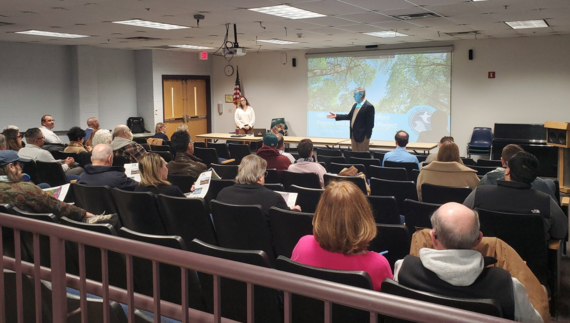 Blue Acres Program Manager Courtney Wald-Wittkop and Cranford Mayor Terrence Curran present to community members on January 27, 2025.
Member Agency Profiles
The Interagency Council on Climate Resilience consists of 26 member agencies, each contributing unique expertise to advance New Jersey’s climate resilience goals. While collaboration is central to the Interagency Council’s efforts, individual agencies play distinct roles by leveraging their specialized knowledge, which is highlighted through Member Agency Profiles. The Profiles provide brief overviews of agency-specific climate resilience activities.
Listening Sessions
In November 2024, the Interagency Council hosted the second of its Listening Sessions at the New Jersey League of Municipalities. The Listening Sessions aim to gather feedback and enhance public understanding of the Interagency Council’s work. Attendees received an overview of the Council’s purpose, structure, and current work plan. Following remarks by agency representatives, participants were invited to offer verbal and written feedback. This input is used to inform future IAC activities and commitments.
The Member Agency profiles, and summary of the Listening Session feedback are now available on the Interagency Council’s webpage.
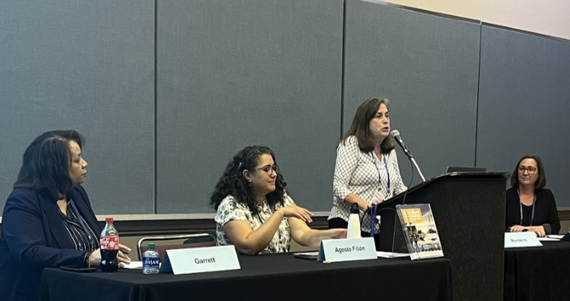 (Pictured left to right) Pamela Garrett, Director, Division of Environmental Resources, NJ Department of Transportation; Nathaly Agosto Filión, Deputy Chief Climate Resilience Officer, Office of Climate Resilience, NJ Department of Environmental Protection; Donna Rendeiro, Executive Director, State Planning Commission, NJ Department of State (ret.); Sarah Friend, Environmental Scientist, New Jersey Highlands Council.
On December 4, 2024, the Office of Climate Resilience (OCR) co-hosted the Beneficial Use of Dredged Material (BUDM) for Restoration Summit which gathered 70 participants representing regulatory agencies, local and state government, restoration practitioners, dredgers, and academia to discuss process, policy, and knowledge gaps around using dredged sediment for restoration. The Summit kicked off with a welcome from NJ Fish & Wildlife Assistant Commissioner Dave Golden on the importance of BUDM and how far the practice has come in the last decade. The morning session consisted of presentations from NJCRC work groups, practitioners, and researchers on the current state of BUDM planning, implementation, and monitoring efforts across New Jersey.
The second half of the day consisted of facilitated discussions on a path forward through the identified gaps, including matching dredge material with potential restoration sites through a new NJ Coastal Resilience Collaborative (NJCRC) work group, the Beneficial Use Restoration Task Force, which is still being developed. Reflecting on a decade of BUDM projects in NJ and the momentum generated from the Summit will help us and our partners improve the process and implement more BUDM projects in the future.
Thank you to our co-hosts The Nature Conservancy, Manomet Conservation Sciences, NJ Department of Transportation, NJ Fish & Wildlife, and U.S. Fish & Wildlife Service.
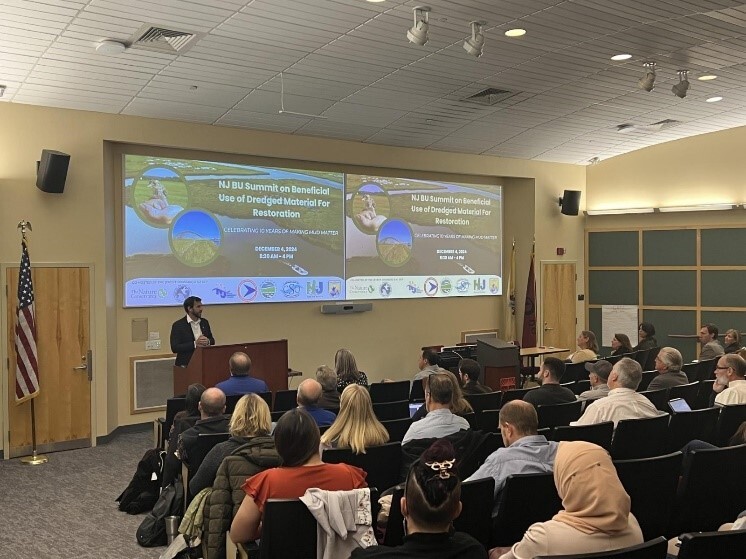 NJ Fish & Wildlife Assistant Commissioner Dave Golden opens the Summit with welcome remarks.
As New Jersey approaches the mid-March start of the 2025 wildfire season, Governor Murphy and DEP Commissioner Shawn LaTourette announced a new series of actions— NJ Wildfire SMART—to help reduce the risk and spread of wildfires statewide. Increased temperatures due to climate change are projected to lead to longer periods of hot, dry weather, which can, in turn, fuel forest fires. In the past 50 years, research nonprofit Climate Central has found that annual fire weather days have increased by ten days in northern NJ and four days in southern NJ. After an extended 2024 wildfire season due to the still-ongoing drought, DEP Forest Fire officials are preparing for the 2025 season. With the launch of the SMART website—highlighting fire safety, mitigation, awareness, response, and training—DEP is empowering NJ residents to stay informed about their wildfire risk.
|