|
This is a reminder that the NJ Coastal Resilience Collaborative (NJCRC) has opened submissions for abstracts for a one day, in person Coastal Flooding Technical Workshop to be held at Stevens Institute of Technology on March 29, 2025. The NJCRC is looking for stakeholders, researchers, practitioners and manager to present their latest work in science, engineering, and management systems to share and improve collective understanding of coastal flooding issues and solutions. These abstracts will be accepted for either a 20-minute oral presentation, 7-minute lightning presentation, or a poster. You can find more information on submission requirements at this link. All abstracts must be submitted by Friday, December 6th at 5pm.
Back to Top
The National Flood Insurance Program will soon give policyholders the option to make monthly payments on their flood insurance premiums, a change from the solely annual payment option. The rule becomes effective December 31, 2024 in the Federal Register. You can find more information about the installment plan here.
Back to Top
The Association of Floodplain Managers (ASFPM) Training team has just launched a lineup of asynchronous courses that will advance your skills and continue to develop professional growth. You can find these courses through the ASFPM learning management system. Topics include CFM exam preparation, industry trends, and more, created by experts across the ASFPM network. You can find the course offerings here.
Back to Top
There are several ways that you can access BFE’s that, while not official, can be helpful tools used to guide new development and projects when planning. For coastal areas, FEMA developed Advisory BFE’s across the new jersey coast after Hurricane Sandy. In areas like Union County, the ABFE map is still considered to be the best available data for floodplain management. You can also access preliminary and effective BFE’s by engaging in the Flood Hazard Area layer via the NJDEP’s Land Resource Protection web application. Another helpful resource is the NJDEP's Local Design Flood Elevation (LDFE) Worksheet in the NJ Floodplain Administrator Guidebook.
Back to top.
Last month, the State of New Jersey declared a drought warning for the first time in eight years. New Jersey American Water, the state’s largest water company, issued a "mandatory conservation notice" on November 13, urging customers to conserve water by pausing outdoor water usage until spring and to reduce indoor water usage where possible. The drought has contributed to increased wildfires in the state as well, with the state observing a 30% increase in fires this year, and a staggering 1300% increase in wildfires when directly compared to time of year. Along with the threat that droughts and wildfires present on their own, they both can eventually contribute dangerous ramifications to flash flooding as well. Drought alone can be a contributor in flash flooding, as dehydrated soil doesn’t absorb water as well, and will behave like concrete if dry enough New Jersey experienced a similar phenomenon in 1999 after Hurricane Floyd, which led to $250 million in flood damages and sixth deaths in the state, that occurred in close proximity to a drought emergency being declared. The National Integrated Drought Information System by NOAA reports that after wildfires, the loss of vegetation allows for intense rainfall to flow much faster than under normal circumstances. These floods are especially dangerous, as debris like soil, logs, large boulders, and other fire remains create a slurry in the floodwater. With flash floods being the number one weather related killer in the US, it is important to revisit your community’s emergency flood response measures. Now is a good time to make sure that sewage systems are not overly burdened with fall foliage and lawn cleaning to ensure stormwater management runs smoothly.
Back to top.
The NFIP Review Course is a free, no-cost training for New Jersey municipal, county, and state officials, as well as the general public, looking to expand their knowledge of floodplain management and obtain their Certified Floodplain Manager (CFM) certification. This course was developed and sponsored by the NJDEP, Bureau of Flood Engineering.
Floodplain management is an important and required responsibility of local municipalities in New Jersey. NJDEP urges every community in the state to send their FPA, Building Code official, Zoning officer, Emergency Manager or other local officials to this very important training opportunity.
As the climate continues to change, the need for expertise at the local level will only grow. While all municipalities face impacts from climate change, some towns are at an increased risk and have less resources to address their vulnerabilities. Education of the local FPA is necessary to ensure an equitable increase in resilience across all municipalities in the state, regardless of size and capacity.
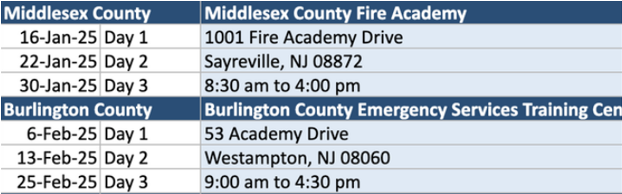
This course closely follows the FEMA 480 NFIP Floodplain Management Requirements: Study Guide and Desk Reference for Local Officials (February 2005). The course duration is about a month and features three in-person instructional days to complement online self-paced learning with two days focused on the NFIP and a third day focused on NJ requirements. Afterwards, students can arrange to take the CFM exam virtually. This course will be held at numerous locations in New Jersey through Summer 2025.
Pre-Registration is required through NJAFM's website prior to the start of the course.
Upcoming training will take place in Middlesex County and Burlington County. If interested, register soon, as there are only 30 seats, with priority given to local officials and floodplain managers.
 Back to top.
|