|
Quarterly Newsletter - Fall 2024 |
|
Resilient NJ - NJ Coastal Management Program - Blue Acres |
|
In this issue...
...and something fun!
|
|
|
With this issue, the DEP Office of Climate Resilience (OCR) team is celebrating the 1-year anniversary of sharing this quarterly climate resilience newsletter with you, and now we want to hear feedback from our readers. Are we including information and topics that matter the most to you? Are there ways that your newsletter experience can be improved? Let us know by filling out our brief survey. Thanks for helping us refine your newsletter experience!
New Jersey’s Coastal Management Program (CMP) is required to undertake a multi-phase, program-wide assessment every five years as per Section 309 of the Coastal Zone Management Act. This process is called the 309 Assessment & Strategy. The Office of Climate Resilience (OCR) administers the CMP and leads the assessment process, during which a network of coordinated DEP programs conducts a Phase I self-evaluation on nine NOAA-identified enhancement areas. One primary goal of 309 Assessment & Strategy process is to summarize the progress made over the previous 5-year assessment period (2021-25) and determine priority focus areas for the upcoming cycle of the CMP. Those enhancement areas that DEP determines to be high priority will undergo a Phase II assessment where we will create enhancement strategies to implement over the next 5 years (2026-30). the public webinar for more information on the process, how to be involved, and next
Come talk to OCR!

Office of Climate Resilience (OCR) staff will be at the DEP booth on the exhibitor floor all three days of the NJ League of Municipalities 2024 Annual Conference in Atlantic City, November 19-21. Stop by to discuss how your community can become more resilient to climate change impacts with support from programs, including Blue Acres and Resilient NJ.
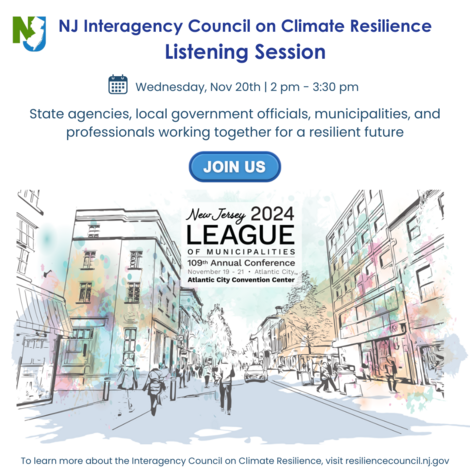
During the listening session, Interagency Council representatives will ask for participants input on the following key questions:
-
What would you like to see state agencies do more/less of?
-
How can state agencies best support municipal and local-level climate resilience actions?
-
What is the one action you believe state agencies should prioritize in the next five years to strengthen New Jersey’s overall resilience to climate change?
The Interagency Council is made up of 26 state agencies and departments working to develop short- and long-term action plans that will promote the mitigation, adaptation, and resilience of New Jersey’s economy, communities, infrastructure, and natural resources.
|
 |
ICYMI - since the last quarterly climate resilience newsletter, the Blue Acres program has:
-
received recognition from Grid Magazine as a national model for effective flood mitigation.
This comes in addition to Blue Acres' continued success in moving families out of harm’s way by purchasing flood-prone, storm-damaged homes from willing sellers.
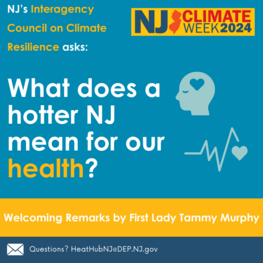
The NJ Interagency Council on Climate Resilience (IAC) hosted the second of its series of informational webinars on the impacts of climate-driven extreme heat during NJ Climate Week 2024. The webinar entitled “What does a hotter NJ mean for our health?” focused on the physical and behavioral health concerns related to exposure to extreme heat with a panel of NJ physicians, researchers and experts.
The webinar was moderated by the Department of Human Services, an IAC member agency, and featured an introductory message from First Lady Tammy Murphy. The IAC’s first extreme heat webinar focused on the meteorological and climatological drivers behind NJ’s increasing heat. To view the recordings and webinar highlights, visit the events page on Heat Hub NJ.
|
|
|
|
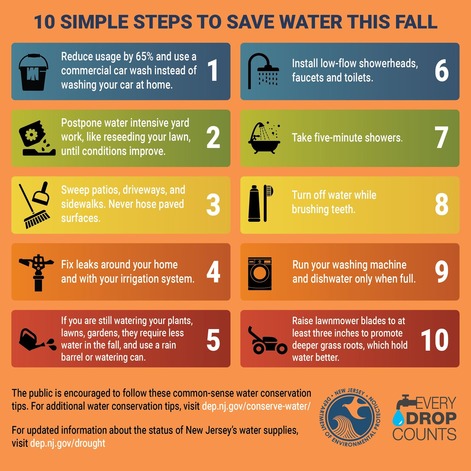
Amidst historic drought and multiple forest fires, the state has declared a drought warning. You can visit the DEP's drought information page for current conditions, frequently asked questions, and other helpful information related to droughts. Also, check out 10 simple steps to save water this fall below. For resources on forest fires in the state, check out NJ's Fire Danger Dashboard for fire danger ratings, restrictions, and more.
Climate resilience is the ability of social and ecological systems to absorb and adapt to the shocks and stresses of a changing climate, while becoming better positioned to respond in the future.
-2021 New Jersey Climate Change Resilience Strategy
Climate change is a global challenge, but the impacts are experienced locally. Community resilience refers to the dynamic and adaptive ability of a community to use available resources to withstand, respond to, and recover from adverse situations. Increasing resilience is accomplished through a combination of reducing exposure to hazards, managing existing vulnerabilities, and increasing a community's capacity to efficiently respond and recover after an event. It’s not merely bouncing back to a previous condition but “bouncing forward” to a better one. Climate resilience is not an end state, but a dynamic state-of-being, encompassing a community’s perseverance, strength, and resourcefulness.
|
|
|
What is it called when a tree takes some time off?
Paid leaf!
|
|
 |
|
|
Apply for free Climate Vulnerability Assessment technical assistance
|
|
|
|