|
The NFIP and FEMA are issuing a Request for Information (RFI) to receive the public’s input on potential future changes to the Community Rating System (CRS) under the NFIP.
FEMA is looking for changes and improvements to be made to the CRS program through a holistic perspective. They seek to improve the program by: incentivizing communities to take measurable actions and make sustained progress to reduce current and future flood risk; embed equity to the CRS programs foundation; incentivize property owners to purchase flood insurance to reduce financial risks to floods; and deliver community participant centered and modernized program.
General audience meetings will be held virtually Wednesday, August 21st from 2:00 PM to 3:30 PM and Thursday, August 22nd from 3:00 PM to 4:30 PM. There will also be a virtual meeting focused on issues specific to Indian Tribal governments on Tuesday, August 27th from 3:00 PM to 4:30PM. The deadline to register for these public meetings is Monday, August 19th.
Formal comments can also be submitted via the Federal eRulemaking Portal until Monday, September 9th.
More information on the redesign effort, registration information and formal comment submission can be found here.
Back to Top
Current projections show as much as 5.1 feet of sea-level rise is likely by 2100. The State has proposed the New Jersey Protecting Against Climate Threat Resilient Environments And Landscapes (NJ PACT REAL) rules as a means of modernizing the land resource protection rules in building resilience to the projected threat.
NJ PACT REAL rules plans to:
- Adjust the Coastal Flood Hazard Areas
- Introduce an Inundation Risk Zone
- Improve water quality and reduce flooding through stormwater management practices
- Encourage nature-based solutions
- Support renewable energy
- Improve State alignment with FEMA’s National Flood Insurance Program
- Improve DEP permitting processes
Public hearings concerning the proposal will be held Thursday, September 5th at 6:00 PM in Ocean County College, Toms River, as well as virtually on Thursday, September 12th at 2:00 PM and Thursday, September 19th at 10:00 AM.
Written comments can also be submitted before Sunday, November 3rd.
For a courtesy copy of the rules, public comment submittal, public hearing information and more, please visit the NJ PACT Real website.
Back to Top
Give the Federal Government a piece of your mind! Sounds appealing, right? FEMA and partners from the State NFIP Coordinator offices are seeking just that kind of input.
Collectively, we all understand that managing floodplains can be a challenging task with many responsibilities and actions to coordinate. For this reason, FEMA’s Floodplain Management Division is seeking to redesign the agency’s trainings to better serve the needs of our nation’s 22,668 NFIP Floodplain Administrators and the Participating Communities they represent. To have a meaningful impact, FEMA needs your input.
The survey inquires about your training needs as well as the obstacles and barriers you face in trying to meet and manage floodplain activities.
The results of this survey will be used to design a national Floodplain Administrator training strategy created by FEMA. In addition, the data will be consolidated by state in a public report and will be shared with each State NFIP Coordinator and State Floodplain Managers Association.
The survey is open from June 20th through August 30th, 2024. Only one survey can be completed from each NFIP participating community. A community’s Floodplain Administrator should be the person filling out the survey.
The survey can be accessed in several ways:
Back to Top
FEMA and the Federal Trade Commission (FTC) will be hosting a Webinar Wednesday, August 21st from 1:00 PM to 2:00 PM to help avoid scams post-disaster event. Scammers try to take advantage of the stressful environment that the threat or presence of extreme weather or natural disaster events present to individuals and communities. An attorney from the Federal Trade Commission’s Northeaster Regional Office will present on how to spot, avoid, and report these kinds of scams.
Whole Communities, individuals, families, Community and Faith Based organizations, state, local, tribal, and territorial government, and the private sector and welcome and encouraged to attend.
Registration Link:
Back to top.
The summer of 2024 has been predicted and already demonstrated to be a notable one. The National Oceanic and Atmospheric Administration (NOAA) provided an outlook that predicted an 85% chance of an above-normal Atlantic hurricane season. NOAA credited near record warm ocean temperatures in the Atlantic Ocean, reduced Atlantic trade winds, enhanced West African monsoons, and La Niña conditions to be the contributing factors for this prediction. This La Niña is predicted to be particularly intense, as its predecessor, El Niño, was one of the strongest ever observed. ()
The cold shore waters, however, have been unaffected by the record Atlantic temperatures. While the Atlantic trade winds have been reduced this summer, increased winds blowing from the southwest have been pushing warm surface water further away from shore. This makes the cold water from the ocean floor to surface in a process known as upwelling. This process is overall good for the mid-Atlantic food web and has been cycling nutrients from deep water. This phenomenon is unrelated to the hurricanes and tropical storms as of late. ()
The NOAA’s partner, Colorado State University, recently adjusted their forecast of the Atlantic storm season “from 25 to 23 named storms expected during the season”, however “did not change its prediction of the season producing 12 hurricanes, with six reaching Category 3 or higher status to qualify as major storms”. The Atlantic has already experienced four named storm this summer. As the hurricane season lasts from June 1 to November 30, it is important to stay vigilant with weather anticipation and preparation. NOAA has implemented “improvements to its forecast communications, decision support and storm recovery efforts this season” as well as introducing new tools for hurricane analysis, such as two new forecast models, and new Flood Inundation Mapping. ( and )
Back to top.
The NFIP Review Course is a free, no-cost training for New Jersey municipal, county, and state officials, as well as the general public, looking to expand their knowledge of floodplain management and obtain their Certified Floodplain Manager (CFM) certification. This course was developed and sponsored by the NJDEP, Bureau of Flood Engineering.
Floodplain management is an important and required responsibility of local municipalities in New Jersey. NJDEP urges every community in the state to send their FPA, Building Code official, Zoning officer, Emergency Manager or other local officials to this very important training opportunity.
As the climate continues to change, the need for expertise at the local level will only grow. While all municipalities face impacts from climate change, some towns are at an increased risk and have less resources to address their vulnerabilities. Education of the local FPA is necessary to ensure an equitable increase in resilience across all municipalities in the state, regardless of size and capacity.
This course closely follows the FEMA 480 NFIP Floodplain Management Requirements: Study Guide and Desk Reference for Local Officials (February 2005). The course duration is about a month and features three in-person instructional days to complement online self-paced learning with two days focused on the NFIP and a third day focused on NJ requirements. Afterwards, students can arrange to take the CFM exam virtually. This course will be held at numerous locations in New Jersey through Summer 2025.
Pre-Registration is required through NJAFM's website prior to the start of the course.
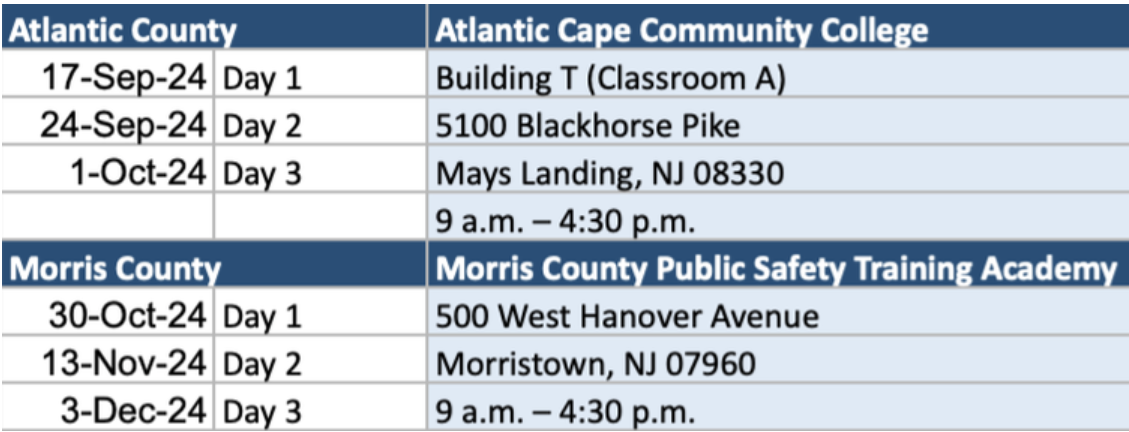
Upcoming training will take place in Atlantic County and Morris County. If interested, register soon, as there are only 30 seats, with priority given to local officials and floodplain managers.
 Back to top.
|