Flood Risk Notification Requirements Take Effect
The New Jersey law on flood risk notification, P.L. 2023, c.94, requires landlords and sellers of real property to make certain disclosures concerning known and potential flood risks.
Flood risks in New Jersey are growing due to the effects of climate change. Coastal and inland areas may experience significant flooding now and in the near future, including in places that were not previously known to flood. For example, by 2050, it is likely that sea-level rise will meet or exceed 2.1 feet above 2000 levels, putting over 40,000 New Jersey properties at risk of permanent coastal flooding. In addition, precipitation intensity in New Jersey is increasing at levels significantly above historic trends, placing inland properties at greater risk of flash flooding. These and other coastal and inland flood risks are expected to increase within the life of a typical mortgage originated in or after 2020.
In response to these increasing risks across the state, the New Jersey flood risk notification law was enacted on July 3, 2023. The law requires landlords and sellers of real property to make certain disclosures concerning known and potential flood risks. You can read the full text of the law here.
Individuals are encouraged to visit the DEP's website and read more about the guidance on this new law at: NJDEP| Flood Disclosure Law | Home
DEP has also developed a tool to assist individuals in providing the flood disclosures required by law. Individuals are encouraged to engage with this tool, which can be accessed in the webpage linked above, or by clicking the following link:
New Jersey Flood Notification Report Tool (arcgis.com)
Some highlights of this new law include:
For Real Estate Sales
Beginning March 20, 2024, every seller of real property must disclose specific flood risk information via a property condition disclosure statement before the purchaser becomes obligated under any property purchase contract, including:
- whether the property is located in FEMA's Special Flood Hazard or Moderate Flood Hazard Area, and
- actual knowledge concerning flood risks of the property.
For Landlords and Tenants
Beginning March 20, 2024, every landlord must provide notice to prospective renters, including:
- whether the property is located in FEMA's Special Flood Hazard or Moderate Flood Hazard Area, and
- actual knowledge that the rental premises or any portion of the rental premises, such as tenant parking spaces, have been subject to flooding.
- Information regarding this flood disclosure notice can be found at NJDCA's website here.
Back to Top
There are many instances where a community may need to request NFIP-related data, including Repetitive Loss/Severe Repetitive Loss data, National Violation Tracker properties, policies, claims, ICC payouts, etc. To obtain this data, your community must sign an Information Sharing Access Agreement (ISAA) with FEMA. For the latest ISAA Guidance for FEMA Region 2, please use the below link:
R2_ISAA_Guidance_07122023.docx
FEMA develops the ISAA, however they require two things from the community to do so:
- A signed letter on official letterhead documenting the request, for which you may use the template language on page one of the ISAA Guidance Document. Please tailor the yellow highlighted sections, as necessary.
- The completed questionnaire on pages 4-5 of the ISAA Guidance Document. Pages 2-3 include descriptions of the potentially applicable Routine Uses. Routine Use "T" covers repetitive loss data. Other Routine Uses are: Routine Use "M" for outreach; Routine Use "R" for research; and Routine Use "O" for floodplain management (including compliance and planning).
After signing the letter and completing the questionnaire, please submit both documents to fema-r2-nfip-datarequest@fema.dhs.gov.
Questions on this process may also be submitted to fema-r2-nfip-datarequest@fema.dhs.gov.
Back to top.
The NJDEP is providing valuable no-cost training opportunities on NJ specifics of the National Flood Insurance Program (NFIP) and floodplain management for local community officials. More information on current course availability and registration at: NFIP Review Course - NJAFM.
The NFIP Review Course is a free, no-cost training for New Jersey municipal, county, and state officials, as well as the general public, looking to expand their knowledge of floodplain management and obtain their Certified Floodplain Manager (CFM) certification. This course was developed and sponsored by the NJDEP, Bureau of Flood Engineering.
As you are aware, every municipality in NJ is required to have a Local Floodplain Administer (FPA) to participate in the NFIP. The NFIP provides flood insurance coverage to homeowners and businesses in the State within participating communities. Participation in the NFIP also allows the community to be eligible for Federal grants or loans under programs administered by Federal agencies such as HUD, EPA, and SBA; allows the community to receive Federal disaster assistance; and Federal mortgage insurance or loan guarantees may be provided in identified flood hazard areas for policies written by FHA, VA, and others.
Floodplain management is an important and required responsibility of local municipalities in New Jersey. NJDEP urges every community in NJ to send their FPA, Building Code official, Zoning officer, Emergency Manager or other local officials to this very important training opportunity.
As the climate continues to change, the need for expertise at the local level will only grow. While all municipalities face impacts from climate change, some towns are at an increased risk and have less resources to address their vulnerabilities. Education of the local FPA is necessary to ensure an equitable increase in resilience across all municipalities in the state, regardless of size and capacity.
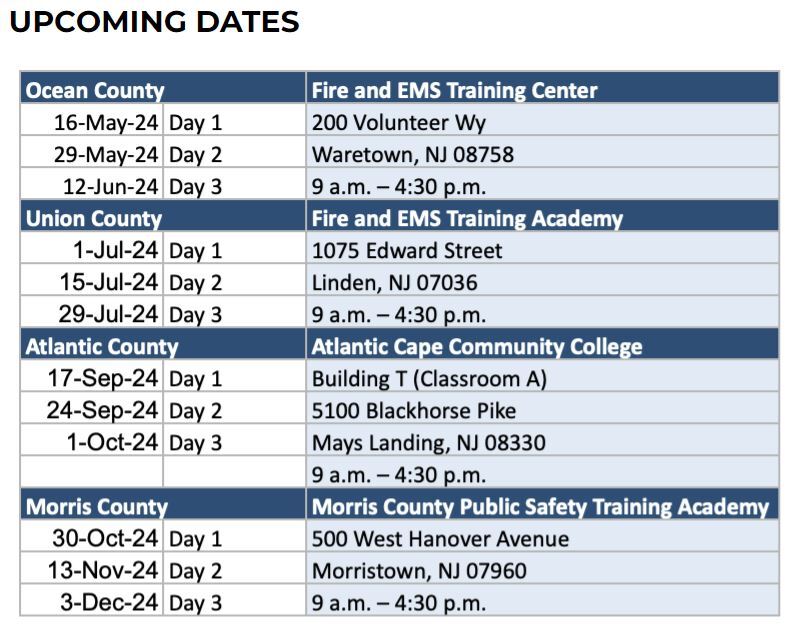
This course closely follows the FEMA 480 NFIP Floodplain Management Requirements: Study Guide and Desk Reference for Local Officials (February 2005). The course duration is about a month and features three in-person instructional days to complement online self-paced learning with two days focused on the NFIP and a third day focused on NJ requirements. Students can arrange to take the CFM exam virtually. This course will be held at numerous locations in New Jersey through Summer 2025. Although this course is open to the general public, priority will be given to government officials when registering.
Pre-Registration: required through NJAFM’s website https://www.njafm.org/nfip.html prior to the start of the course.
The following classes are currently scheduled and open for registration. This schedule will be continuously updated as training dates are finalized, and registration opens for future counties. Each set of trainings has about a two week break between each class day.
 Back to top.
The NJDEP wants to remind readers of the importance of being well-informed of and conforming to FEMA's NFIP requirements. Recently, a county in southwest Florida saw flood insurance rates rise after FEMA notified several communities that their CRS flood insurance discounts would be revoked. The decision occurred on the heels of the county's rebuilding and recovery efforts following Hurricane Ian's landfall in 2022.
According to FEMA, these communities failed to provide FEMA with the quantity of homes substantially damaged by Hurricane Ian and how many of these homes were elevated to the newest codes.
The requirements for rebuilding substantially damaged properties after a storm can be expensive, however the rules are necessary to keep properties that are in harm's way safe and help limit repetitive payments from the federal government to rebuild the same properties. While complying with FEMA's rebuilding requirements after substantial damage occurs can be costly, the example in Florida serves as a reminder that the alternative of potentially losing valuable flood insurance discounts through the CRS is a far-reaching consequence. Losing these flood insurance discounts can cost communities tens of millions of dollars a year and places unnecessary financial strain on residents.
You can read more about this story here.
For more information on Substantial Damage, visit FEMA's substantial damage Quick Guide here.
Back to top.
Effective April 1, FEMA announced the updated edition of the NFIP Program Insurance Manual. The updated manual can be accessed online at Current Flood Insurance Manuals | FEMA.gov.
The updates to this edition reflect the NFIP's existing underwriting requirements and its current rating methodology. For a full accounting of the NFIP changes and guidance updates being implemented, visit this link:
April 2024 NFIP Flood Insurance Manual Guidance Updates
Back to top.
|