|
Quarterly Newsletter - Winter 2024 |
|
Resilient NJ - NJ Coastal Management Program - Blue Acres |
|
 In this issue...
...and something fun!
|
|

The New Jersey Interagency Council on Climate Resilience (IAC) released the NJ Extreme Heat Resilience Action Plan Survey to enhance the IAC's understanding of the needs of New Jersey residents in building resilience against extreme heat. With the 2023 calendar year marking the warmest on record and New Jersey warming faster than our region, your input is crucial.
We invite you to share the survey with your network so that we can gather valuable input from those who are most affected. For your convenience, we have created the Extreme Heat Survey Promotion Kit webpage, which includes links to the survey in both Spanish and English, as well as resources such as email templates, social media posts, and flyers for in-person distribution.
We would appreciate if you would disseminate this information to your stakeholders by February 15th, as the survey will close on Thursday, February 29th. Feel free to tag us in your posts (@NJDEP) or copy us on any emails for assistance with questions.
|
|
|
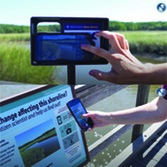
During Climate Week 2023, the New Jersey Coastal Management Program announced the installation of five Climate Change Learning Stations featuring MyCoast Photo Stations in four State Parks. A collaboration with the Jacques Cousteau National Estuarine Research Reserve and New Jersey State Parks, Forests & Historic Sites, the Climate Change Learning Stations are located along various shorelines and provide park visitors with information on how climate change is affecting New Jersey’s coasts. Each of the learning stations features a MyCoast Photo Station, a strategically located phone mount to encourage visitors to become citizen scientists and help us track shoreline changes over time by taking photos and uploading them to MyCoast via the QR code provided.
Climate Change Learning Stations can be found at Cheesequake State Park in Middlesex County, Cape May Point State Park in Cape May County, Island Beach State Park in Ocean County, and Liberty State Park in Hudson County.
|
|
|

Amidst and in the aftermath of severe floods in December 2023 and January 2024, dozens of homeowners have expressed interest in a voluntary buyout led by the Blue Acres program. In February, Blue Acres held three events offering one-on-one consultations for homeowners affected by the recent floods. These events were held in Passaic County, Bergen County, and online.
Blue Acres encourages local governments, community leaders and other disaster recovery partners to share Blue Acres’ informational flyer (available here in both English and Spanish) with homeowners in their network to ensure impacted homeowners are aware of the option to sell flood-prone or storm-damaged properties to the State for flood recovery and resilience purposes. Blue Acres is a long-standing program which always accepts applications from interested homeowners. To be evaluated for a State-led voluntary buyout through the Blue Acres program, homeowners must submit a Blue Acres application which serves as a non-binding expression of interest. Buyout funding criteria drive eligibility and property selection. Paper and online copies can be accessed here.
ICYMI: In January, the Federal Emergency Management Agency’s Hazard Mitigation Grant Program approved $6M in funding for Blue Acres to begin the buyout implementation process for 14 specific homeowners who were then notified and assigned Blue Acres case managers. Read more here. Additionally, in January, CBS News published an interview with a homeowner in Southampton (Burlington County) who underwent the Blue Acres buyout process after a severe rainstorm caused the Rancocas creek to overflow in 2019. New Jersey’s Chief Resilience Officer, Nick Angarone, and NJDEP Commissioner Shawn LaTourette are quoted. Watch the full story here.
|
|
|
Resilient NJ’s Municipal Assistance Program (MAP) provides municipalities with climate change-related hazard vulnerability assessments and resilience action plans, used by municipal governments to advance resilience efforts. The recently completed inaugural round of MAP projects include Ocean Township, Stafford Township, and Upper Township. A second round of projects, expected to launch in 2024, include the Town of Harrison, the City of Lambertville, and Montclair Township.
Resilient NJ’s MAP partners municipalities with DEP’s qualified contractors to engage with the community, develop resilience products, and assist with project implementation and grant applications for federal funding opportunities. Check the Resilient NJ website for funding announcements or sign-up for email updates.
|
|
|
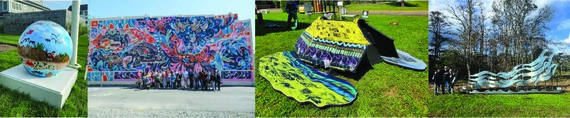
New Jersey’s Coastal Management Program has awarded its fourth round of funding in the Community-Based Art Grant Program to four community-based organizations (CBOs) and artist teams. Each CBO and artist will work together to create an art installation to help the community understand the risk of climate change and feel empowered to act. The CBO and artist teams for round four are To receive email updates related to the Community-Based Art Grant Program, subscribe here!
2023 Artist and Community Organization (left to right): Jessica Mungekar and Ocean City Arts Center, KeyDetail and City of Rahway, Juliacks and Northern New Jersey Community Foundation, Dorsey Lucas and Monmouth Conservation Foundation.
|
|
|
A new Rutgers primer provides a step-by-step framework for creating flood-resilient landscapes. Written in collaboration with the South Dakota State University School of Design and funded in part by Resilient NJ, the Creating Flood-Resilient Landscapes primer includes a compilation of design strategies (such as living shorelines and green infrastructure), as well as insights regarding community engagement, project costs, overcoming feasibility challenges, and long-term project maintenance. The document serves as a guide to aid homeowners and local government officials to restore ecological function to flood prone areas, safeguard human health by minimizing flood risks, and protect infrastructure and property through creation of natural habitats that act like a sponge for flood risks.
|
|
|
What are a snowman's favorite treats?
Ice Krispies!
|
|
 |
|
|
|
If you were forwarded this email, join the OCR - Climate Resilience mailing list here.
|
|
|
|
|