Resources & Information to Help Recover from a Storm
In the past few months, areas of New Jersey have been impacted by flooding caused by multiple winter storms. FEMA and its National Flood Insurance Program (NFIP) are prepared to assist communities as you work to help with recovery.
With this in mind, this issue of the Floodplain Communicator newsletter has compiled several resources to help local officials efficiently assist your communities with recovery.
Quick Resources
Filing Your Claim
- Fact Sheet: Starting Your Recovery: FEMA’s Flood Insurance Claims Process English | Spanish
- Fact Sheet: Wind Damage Versus Floodwater Damage English | Spanish
- Flyer: Identifying Your Advocates After a Flood English | Spanish
Recovering from a Flood
Social Media Tools
Additional Resources on NFIP
Contact FEMA
If you have questions about any of the above resources, please contact nfipcommunications@fema.dhs.gov.
For general inquiries about the NFIP, contact FEMA Mapping and Insurance eXchange (FMIX) center at (877) 336-2627 or by email.
Back to Top
The Bureau of Flood Engineering and Climate Resilience has recently updated the Local Design Flood Elevation Worksheets within our model Floodplain Development Permit and Floodplain Administrator Guidebook. These updates have been made to align the worksheets with the new NJDEP Inland Flood Protection Rule flood elevation requirements. With these current updates, the Bureau continues to support our local Floodplain Administrators in their efforts on determination of accurate Local Design Flood Elevations which are fundamental to designing NFIP compliant projects.
The updated worksheets can be found either in the
The changes have been made primarily to the worksheets and involved ASCE 24-2014 “Flood Resistant Design and Construction” clarification on the classification of Classes I-IV and the difference between critical structures and noncritical structures.
The process when dealing with Critical Structures is to compare the 500-year Flood Elevation, Base Flood Elevation with additional feet added due to state standards and freeboard (Design Flood Elevation – DFE), and the 500-year flood elevation with consideration of wave height for coastal flood zones. Once these elevations have been compared, the highest elevation will be chosen and used for design in order to be conservative in the design of flooding for these Class III and Class IV critical structures.
Upon review of the process for reviewing noncritical structures, the design flood elevation is compared with the 500-year flood elevation and the lower of values governs when compared. For example, if the 500-year flood elevation is 12 feet in elevation but the design flood elevation is 11 feet, these 11 feet would govern.
The State and Bureau are hopeful that these changes will make the process of filling out the model floodplain development permit less confusing and provide a clearer way to determine the lowest design floor elevation -- regardless of if the structure is in coastal/riverine flood zones or is a noncritical or critical structure.
Back to top.
The NJDEP is providing valuable no-cost training opportunities on NJ specifics of the National Flood Insurance Program (NFIP) and floodplain management for local community officials. More information on current course availability and registration at: NFIP Review Course - NJAFM.
The NFIP Review Course is a free, no-cost training for New Jersey municipal, county, and state officials, as well as the general public, looking to expand their knowledge of floodplain management and obtain their Certified Floodplain Manager (CFM) certification. This course was developed and sponsored by the NJDEP, Bureau of Flood Engineering.
As you are aware, every municipality in NJ is required to have a Local Floodplain Administer (FPA) to participate in the NFIP. The NFIP provides flood insurance coverage to homeowners and businesses in the State within participating communities. Participation in the NFIP also allows the community to be eligible for Federal grants or loans under programs administered by Federal agencies such as HUD, EPA, and SBA; allows the community to receive Federal disaster assistance; and Federal mortgage insurance or loan guarantees may be provided in identified flood hazard areas for policies written by FHA, VA, and others.
Floodplain management is an important and required responsibility of local municipalities in New Jersey. NJDEP urges every community in NJ to send their FPA, Building Code official, Zoning officer, Emergency Manager or other local officials to this very important training opportunity.
As the climate continues to change, the need for expertise at the local level will only grow. While all municipalities face impacts from climate change, some towns are at an increased risk and have less resources to address their vulnerabilities. Education of the local FPA is necessary to ensure an equitable increase in resilience across all municipalities in the state, regardless of size and capacity.
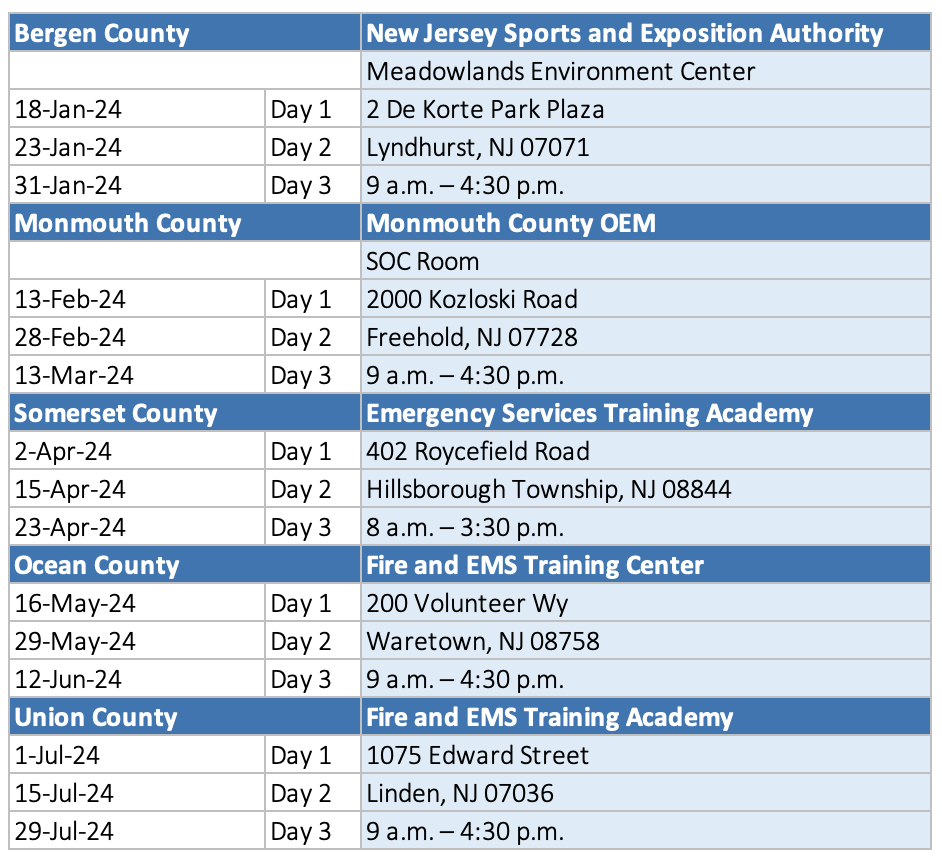
This course closely follows the FEMA 480 NFIP Floodplain Management Requirements: Study Guide and Desk Reference for Local Officials (February 2005). The course duration is about a month and features three in-person instructional days to complement online self-paced learning with two days focused on the NFIP and a third day focused on NJ requirements. Students can arrange to take the CFM exam virtually. This course will be held at numerous locations in New Jersey from November 2023 through Summer 2025. Although this course is open to the general public, priority will be given to government officials when registering.
Pre-Registration: required through NJAFM’s website https://www.njafm.org/nfip_review.html prior to the start of the course.
The following classes are currently scheduled and open for registration. This schedule will be continuously updated as training dates are finalized, and registration opens for future counties. Each set of trainings has about a two week break between each class day.
 Back to top.
FEMA is hosting a webinar series for the newly released Achieving Equitable Recovery: A Post-Disaster Guide for Local Officials and Leaders (“Equity Guide”).
Webinars will be held:
The goal of the Equity Guide is to help local officials and leaders incorporate diversity, equity, inclusion, and accessibility (“DEIA”) in their post-disaster recovery management work. Successful disaster recovery requires the whole community to rebuild in a thoughtful, equitable, and resilient manner. This guide supports local officials and leaders in their efforts to build equity into the recovery process by establishing more diverse partnerships, conducting inclusive strategic public engagement, identifying needs of the whole community, leveraging mitigation opportunities, and identifying opportunities to help leverage additional funding opportunities.
The Equity Guide provides actionable steps and includes, checklists, toolkits, case studies, and community examples on how to incorporate equity throughout the recovery management process and how to work toward achieving equitable outcomes.
Event Resources
Back to top.
The Hazard Mitigation Partners Virtual Workshop will bring together over 800 federal, states, local communities, tribes and territories, as well as private sector entities, private non-profit organizations, and individuals who work in emergency management, floodplain management and hazard mitigation positions.
Event Details
Registration is now open for the Hazard Mitigation (HM) Partners Workshop.
This year's workshop, All Together for Climate Resilient Communities, has been rescheduled and will run virtually February 5-8, 2024, 12:00 – 4:45 p.m. ET.
Daily themes:
Monday, February 5, 2024: Equity
Tuesday, February 6, 2024: Partnerships
Wednesday, February 7, 2024: Capacity & Capability Building
Thursday, February 8, 2024: Hazard Mitigation and Floodplain Management Training Sessions
More information, including an agenda for all three days of this virtual workshop, can be found here.
Back to top.
|