Career Opportunities
DEP Office of Environmental Justice is Hiring!
The Office of Environmental Justice is hiring a Program Specialist Trainee to develop and provide culturally competent community engagement and outreach support for the Department and the regulated community and to increase overburdened communities’ awareness of environmental issues. The Trainee will fill the role of EJ Community Relations Coordinator and will work on event planning, communications, outreach, and engagement training.
More information about this position is available online.
Announcements
DEP Launches Online Mapping Tool to Target
and Coordinate Coastal Resilience Projects
The Coastal Ecological Restoration and Adaptation Planning (CERAP) Tool provides the locations of at-risk areas, coastal resource restoration sites, and other data that will greatly assist in the targeting, development and coordination of projects needed to adapt communities to rising sea levels, increased flooding and more severe storms associated with climate change. Data obtained from the tool may also be used to provide supporting documentation for applications for federal and state funding opportunities. This tool can be a vital resource for overburdened communities that have challenges with flooding, and other climate related issues.
More information on the Coastal Ecological Restoration and Adaptation Planning Tool is available online.
DEP Finalizes Agreement with BASF Regarding
the Ciba-Geigy Superfund Site in Toms River
The DEP and BASF Corporation have reached a revised, final settlement agreement that secures natural resource restoration and resolves state-based natural resource damage claims for natural resource injuries at and related to the Ciba-Geigy Superfund Site in Toms River, Ocean County.
Under the settlement, BASF will permanently preserve approximately 1,000 acres and fully design and implement nine natural resource restoration projects on 375 acres of the preserved land to compensate the public for historic ecological and groundwater injuries caused by Ciba-Geigy.
EPA Releases Environmental Justice Toolkit for
Lead Paint Enforcement Programs
The Environmental Justice Toolkit provides strategies, examples, and other information for federal, state, Tribal and local government enforcement practitioners to use during all stages of environmental enforcement and compliance monitoring activities designed to eliminate harmful exposures to lead paint in housing. This resource is a compilation of best practices and supports commitments made in EPA’s Lead Strategy, which seeks to reduce lead exposures locally with a focus on underserved communities and promote environmental justice through a whole of government approach.
Staying Safe at the Shore This Weekend
Although Hurricane Lee will miss New Jersey, the storm will cause high surf, rip currents, and
minor flooding along the coast. If you are planning a day at the beach this weekend, be aware of weather & water conditions. Heed warnings to stay out of the water!

Participation Opportunities
Upcoming Environmental Justice Law Public Hearings
September 26 - East Jersey State Prison - AO25 Title V Renewal - Woodbridge (in-person)
September 28 - Mercer Group - Solid Waste/Air Application - Trenton (virtual)
October 23 - Atlantic County Utilities Authority - Title V Renewal - Egg Harbor (virtual) (español)
Facilities subject to the Environmental Justice Law must facilitate meaningful opportunities for overburdened communities to engage in permitting decisions for pollution-generating facilities through an enhanced public participation process. Subscribe to EJ Law notices by County
National Environmental Justice Community Engagement Call September 19, 2023
EPA invites Environmental Justice (EJ) advocates to participate in the next National Environmental Justice Community Engagement Call taking place on Tuesday, September 19 from 2 p.m. to 4 p.m.
The purpose of these calls is to inform the community and other stakeholders about EPA's EJ work and enhance opportunities to maintain an open dialogue with EJ advocates.
Agenda:
- Preview of Community Change Grants (CCG)
- Community focus Presentation Energy Justice Initiatives
- Water Infrastructure Planning Tool
- Regulatory Updates from the Office Air Quality Planning and Standards (OAQPS)
- New Source Performance Standards Kc: Volatile Organic Liquid Storage Vessels
- Title V Applicable Requirements Rule
WHEJAC Virtual Public Meeting
September 26, 2023
The White House Environmental Justice Advisory Council (WHEJAC) will convene a virtual public meeting Tuesday, September 26, 2023 from approximately 3:00 - 8:00 PM ET. The WHEJAC is interested in receiving public comments relevant to current charges, topics, and questions currently under consideration:
- Climate and Economic Justice Screening Tool
- Environmental Justice Scorecard
- Carbon Management
- Ways that the WHEJAC could recommend advancing environmental justice through a whole-government approach.
- Examples of environmental hazards of particular concern for Indigenous Peoples and Tribal Nations related to Federal activities that may affect sacred sites and areas of cultural significance, cultural or other traditions or practices, subsistence, and ways of life.
- Ways in which the Federal government can address community impacts on, and concerns of Indigenous Peoples and Tribal Nations.
- Ways in which the incorporation of Indigenous knowledge into Federal decision-making could help address environmental hazards and environmental justice concerns.
Registration to speak during the public comment period closes at 11:59 PM EDT, September 21, 2023. More information on WHEJAC and public meeting registration is available online.
Notice of Rule Proposal and State Implementation Plan
Revision to Air Pollution Control Rules
The DEP is in the process of publishing new Air Pollution Control rules along with a revision to NJ’s State Implementation Plan for the National Air Quality Standards for ozone. DEP proposes this rulemaking to reduce emissions of carbon dioxide (CO2) and local air pollutants, like nitrogen oxides (NOx) and fine particulate matter (PM2.5), from the transportation sector. For more information on the specific amendments, please reference Rule Proposal Notice bulletin. Additionally, a copy of the proposal is available on DEP’s webpage.
A public hearing concerning the proposal will be conducted virtually on September 21, 2023 at 9:30 A.M. Join the meeting online.
If you are interested in providing oral comments at the virtual public hearing, please email the DEP at monica.miranda@dep.nj.gov no later than 5:00 P.M. on September 19, 2023, with your contact information (name, organization, phone number, and email address).
Written comments are due by October 20, 2023.
EPA Launches Nationwide Series of
Community Lead Awareness Sessions
As part of the Biden-Harris Administration’s efforts to protect communities from childhood lead exposure and advance environmental justice, the EPA is announcing a series of free educational sessions on the dangers of lead and ways to reduce and prevent lead exposure. These sessions are based on the Lead Awareness Curriculum, an adaptable resource to protect communities from potential lead exposure, and will be held in English and Spanish.
The sessions will supplement EPA’s local lead training and outreach initiative, which has been implemented in 22 communities across the U.S. and Puerto Rico in 2021 and 2022.
Learn more about EPA’s upcoming community lead awareness sessions.
Funding Opportunities
Community Change Grant Program
EPA’s new Environmental and Climate Justice Community Change Grants program (Community Change Grants) will invest approximately $2 billion dollars in Inflation Reduction Act funds in environmental and climate justice activities to benefit disadvantaged communities through projects that reduce pollution, increase community climate resilience, and build community capacity to respond to environmental and climate justice challenges. Community Change Grants will open applications Autumn 2023.
Learn more about the upcoming Community Change Grants online.
Brownfields Redevelopment Incentive Program
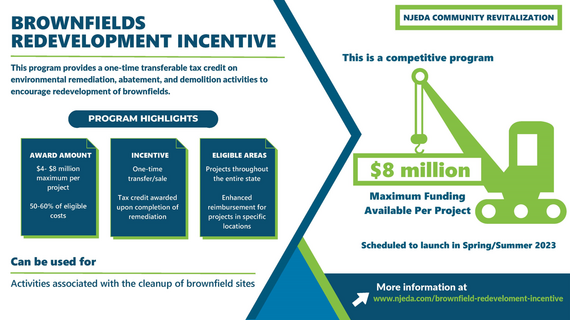
The New Jersey Economic Development Authority (NJEDA) is NOW accepting applications for the Brownfields Redevelopment Incentive Program. This $300 million competitive program offers up to $8 million in tax credits per project for environmental investigation, remediation, abatement, and demolition activities to allow for the redevelopment of brownfield sites in New Jersey. The overarching goal of this program is to redevelop blighted properties into community assets. This is a competitive program which is well funded. Applications are due by 5 pm on Thursday September 21, 2023.
A 2-minute survey is available at eligibility assessment tool to find out if your organization and site may qualify for the program.
Learn more and prepare to apply at Brownfields Redevelopment Incentive Program. If you have questions, please reach out to the NJEDA Brownfields Team at bftaxcredit@njeda.gov.
 Drinking Water System Infrastructure Resilience
and Sustainability Program
EPA announced $19 million in new grant funding that will work to improve the climate resilience of the nation’s water infrastructure. The funding available under this competitive grant opportunity will assist public water systems in underserved communities, small or disadvantaged, that are working to prepare for and reduce vulnerability to impacts from climate change ranging from extreme flooding to extreme drought. Applications due November 6, 2023.
More information about this grant opportunity is available online.
|
All New Jersey residents, regardless of income, race, ethnicity, color, or national origin, have a right to live, work, and recreate in a clean and healthy environment. Historically, New Jersey’s low-income communities and communities of color face a disproportionately high number of environmental and public health stressors and, as a result, suffer from increased adverse health effects. New Jersey seeks to correct these outcomes by furthering the promise of environmental justice.
DEP’s Office of Environmental Justice (OEJ) aims to improve the quality of life in New Jersey’s most vulnerable communities by educating and empowering communities who are often outside of government decision-making processes and guiding DEP’s programs and other state departments and agencies in implementing environmental justice.
|
|