BAAS NEWS
Recent General Memos and Policy Release and Forms:
 |
|
Provider Check-in on the 4th Tuesday of each month
View the BAAS Adult & Aging Care page for upcoming meeting details.
Please send email to BAAS@dhhs.nh.gov if you have any questions or want more information.
|
 Prioritize Your Brain Health: Free Resources from NH DHHS
Your brain health matters at every stage of life. The New Hampshire Department of Health and Human Services (DHHS) is making it easier to take charge of your cognitive well-being with the Brain Health webpage at dhhs.nh.gov/BrainHealth
This online resource provides tools to help you understand brain health, talk with your healthcare provider about early dementia detection, and take proactive steps to maintain cognitive function. You’ll find:
✅ A quick brain health quiz – Learn about key risk factors and how to support long-term brain health.
✅ Memory loss and dementia information – Understand the difference between normal aging and concerning symptoms.
✅ Tips for a brain-healthy lifestyle – Discover simple ways to boost mental wellness through diet, exercise, and social connection.
✅ Resources for caregivers and families – Get support and guidance for loved ones affected by dementia.
Real Stories from New Hampshire Residents
New Hampshire is launching a campaign to raise awareness around brain health and the importance of early dementia detection. To ensure this campaign reflects real experiences, DHHS partnered with New Hampshire residents living with early dementia to share their stories. Their insights helped to create a campaign that speaks to the realities of an early diagnosis—the challenges, the emotions, and, most importantly, the possibilities.
Leah and Kerry’s Stories
Leah first noticed memory issues at work, and hearing her diagnosis was scary. Yet over time, fear turned into empowerment as she discovered new ways to embrace life. Now, she’s traveling more, making plans, and redefining what’s possible.
When Kerry was diagnosed with early-onset dementia, she felt something unexpected—relief. After struggling with unanswered questions, she finally knew what was happening. And the way she embraced her diagnosis changed everything.
Hear the rest of Kerry and Leah’s stories at dhhs.nh.gov/BrainHealth.
Early detection can make a difference. Visit dhhs.nh.gov/BrainHealth today to explore the tools available and take the first step toward a healthier brain.
 |
|
Helping Grandchildren Understand Dementia and Alzheimer's
A recent Next Avenue article covers the important topic of helping children understand and cope with the changes they observe in a grandparent or loved one due to Alzheimer's Disease or related dementias. The article includes guidance and resources on how to talk to children about these changes while helping them maintain a connection with their loved one.
|
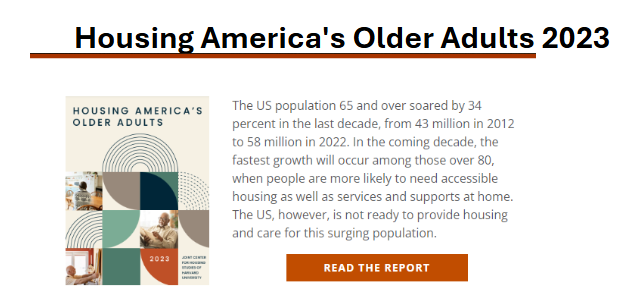 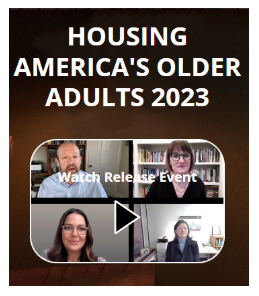 |
Samara expects that there will be a rising need for services, as mentioned in the 2023 report, Housing America’s Older Adults. The report focuses on equity and vulnerable older adults. She presented data on the housing needs and the demographics of aging adults. She discussed income statistics and the cost burdens of older adults, saying there will be an increased need for lower-income housing as many only have Social Security income. The number of households headed by a person age 80 and over is projected to double between 2025 and 2045. This growth will increase demand for affordable housing that is connected to services and supports because the majority of older adults live in the community in homes that they own or rent themselves. The median household income for older households was $50,000 in 2022 and that income falls with each successive older age group so for households 80 and over the median income was $37,000. Older adults receive income from varied sources but are lower income households; Social Security, Wages, Retirement, investments and public income subsidies. Delving further into the demographics she shared the income differences in race and ethnicity with the group. In 2022 older homeowners held nearly 50 times the net wealth of older renters.
Homeownership is a large component of older adult wealth however falling homeownership rates for 50–64-year-olds suggests there will be a change in the near future. An increasing share of older homeowners have mortgages. Between 1989 and 2022 the share of homeowners aged 65-79 with a mortgage on their primary residence increased from 24 to 41 percent with the amount of debt increasing 400 percent. Black owners have higher debt than white counterparts.
Over 12 million older adult households were cost burdened in 2023, meaning they paid 30 percent or more of their income for housing. More than half of these households were severely cost burdened, paying more that 50 percent of their income on housing. Rates of cost burden vary by geography. In NH, 2021 rates varied from 27% of older households in Laconia to 41 % in Rockingham and Strafford Counties.
Federal rental assistance is vital to the housing stability of many older adults, yet housing subsidy is not an entitlement. In 2021, just 37% of older households who were income-eligible for a housing subsidy received it. This left 2.3 million older residents with worst case housing needs such as paying more than half of their income for housing or living in severely inadequate conditions. This is an increase from 1.5 million in 2011.
Functional difficulties increase with age. This includes challenges with mobility, hearing, vision, cognition, self-care, and independent living. 37% of those 80 and over report an ambulatory difficulty, such as with walking and climbing stairs. On average, functional difficulties are experienced earlier for older adults with lower incomes and for people of color. Accessible housing can help people with mobility difficulties live with more independence, yet under 4% of housing offers three key features:
- A no-step entry, a bedroom and bathroom on the entry floor, and extra-wide hallways and doors.
- As of 2019, only around half of older adults occupied a house with single floor living and a no-step entry.
- This means that many older residents will need to modify their homes to improve accessibility. But this can be very costly.
Many live in homes built before 1980, therefore they have high housing costs due to the need for repairs. Fewer homes in the Northeast have AC, which will be problematic as heat waves become more prevalent.
Connecting Housing and Services: There is a dual burden for older adults who must pay for housing plus the care they need at home. Most people need this support for at least three years. Oftentimes these services are not affordable. Many wait years to receive a housing subsidy. Samara shared the AARP state scorecard that showed NH is the worst state for providing Home-Community-Based Services (HCBS). Many residents have insufficient income to afford the cost of care they need and she shared data about costs of care at home, citing annual costs of $40,000. This is unattainable for most NH residents. This is concerning for those with limited abilities.
Samara said there were opportunities to meet the care and assistance challenge, i.e. service-enriched housing, public long-term care, and house sharing. Access to transit services assists in keeping older adults with access to services. She mentioned the PACE-program for All Inclusive Care for the Elderly is a cost-effective, and a whole-person approach to care. Challenges around aging and housing in the US were discussed.
 Thursday, March 6, 2025
The Social Security Administration and the Office of the Inspector General are partnering with other government agencies for the 6th Annual Slam the Scam Day. Please join us, as part of National Consumer Protection week, as we work to raise public awareness of government imposter scams.
We encourage you to visit our Slam the Scam Resources page for more information on this year’s campaign. This page will also highlight organizations dedicated to helping us “Slam the Scam!”
Contact us at OEA.net.post@ssa.gov for more information.
 Join us on April 26, 2025 for this year’s Age of Champions Health and Wellness Fair, a FREE community-oriented intergenerational wellness event.
 The Center on Aging and Community Living is a collaboration of The Institute on Disability and the Institute for Health Policy and Practice at the University of New Hampshire.
Copyright (C) 2025 Center on Aging and Community Living*. All rights reserved.
Our mailing address is:
5 Chenell Drive, suite 301
Concord, NH 03301
REPORT ABUSE OR NEGLECT

|