|
Bureau of Developmental Services (BDS) Newsletter - December 2024 |
|
|
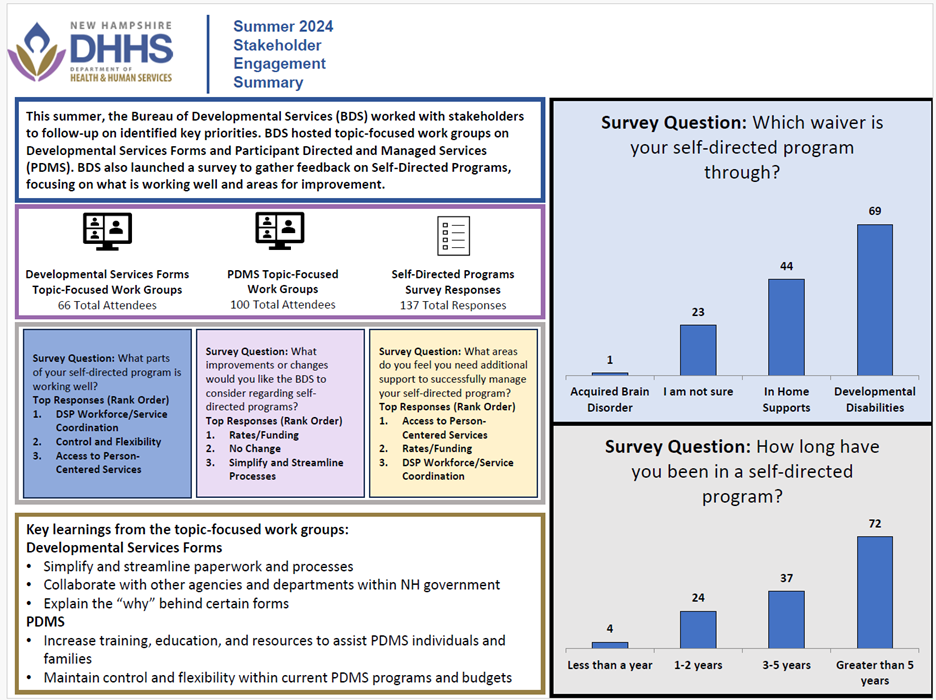
The Bureau of Developmental Services (BDS) would like to thank you for participating in our work groups and surveys this summer. Your feedback is important, and we have learned a lot from these engagements.
We have prepared a Summer 2024 Stakeholder Engagement Summary to share the key learnings from our recent engagements (click on the summary to enlarge). In response to the feedback from the PDMS work group and the Self-Directed Programs survey, BDS will be collaborating with Applied Self-Direction (ASD) over the next few months. ASD will facilitate discussions and share national best practices in self-directed services with the NH community. ASD previously worked with the NH community in 2018, and we are pleased to partner with them again. Below, you will find a brief introduction to ASD and their team.

Introducing Applied Self-Direction
Applied Self-Direction (ASD) is an organization dedicated to promoting and supporting self-direction services. Self-direction is a model of care that empowers individuals, particularly those with disabilities or chronic conditions, to have greater control over their own care and services. This approach allows individuals to make decisions about their care, including hiring and managing their own caregivers, who can often be family members or friends.
Applied Self-Direction provides resources, training, and advocacy to help individuals and families navigate self-direction programs. They work with state agencies, service providers, and other stakeholders to improve and expand self-direction options, ensuring that people have the support they need to live independently and with dignity.
|
|
|
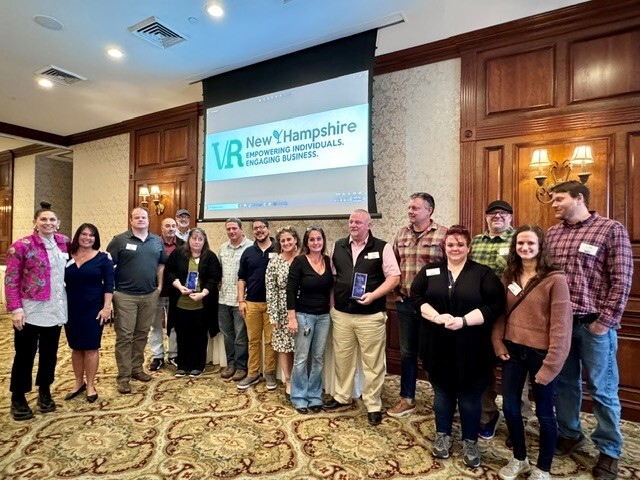
The Employment Leadership Awards are presented each year to New Hampshire businesses who demonstrate their commitment to the skills and contributions that people with disabilities bring to the workforce. These businesses are promoting and adopting inclusive policies and hiring practices that enable people with disabilities, to succeed and excel in paid, meaningful employment. This year there were 5 award recipients.
The 2024 award winners include DoubleTree by Hilton in Manchester, Subway in Gorham, Kendal at Hanover, The Home Depot in Littleton and Shaw’s in Littleton.
- “It is so important to understand that we all have abilities and challenges in everything that all of us do, and when you’re looking at a job, to dissect the job and figure out how we can work with other individuals,” – Ray Bewsher, Director of Human Resources at DoubleTree by Hilton Manchester.
- “These employees bring a lot of morale to the team. We look forward to seeing them every day. They always come in with a positive attitude. If you’re having a bad day, your bad day goes right out the door when they walk in because they’re always in such a good mood.” – Gwen McKinnon, Store Manager at Subway in Gorham.
- “I think we’ve had some great success stories here as far as thinking a little bit outside the box and where someone can be helpful. I think my philosophy is that everybody has value and can add value. I think it has a great impact on residents.” – Steven George, Director of Dining Services with Kendal at Hanover.
- “We all want to contribute in some way, right? We all have different abilities. The key is to find where ourselves, our team members, our family members feel that they can provide the most and feel good about it.” Peter Lauzon, Store Manager at The Home Depot in Littleton.
- “Customers have given us feedback about how they enjoy seeing that we have employees here with disabilities, especially with the young man that’s nonverbal. He gets excited when he sees somebody, and he’ll let the entire check-out know that he’s excited and everybody just loves it.” – Karen Shumann, Personnel Coordinator at Shaw’s in Littleton.
Award Videos:
|
|
|
HCBS Training
BDS is excited to announce a new partnership with Easterseals and Stepping Stones Pediatric Therapy Inc. to offer comprehensive training programs for family members, Direct Support Professionals (DSPs), and other staff members. After a review of responses to the Home and Community Based Services (HCBS) Requests for Proposals (RFP), these two providers were selected to deliver these trainings that will support the strengthening of our service system. To view the calendar for all trainings, visit https://bit.ly/ETCE-Course-Calendar.
Easterseals Training Programs: Easterseals is offering a variety of competency-based trainings that are free of charge and customizable to meet your needs. These trainings can be attended in person, online, or in a hybrid format. The areas of training include:
- State mandated (Human Rights, Quality of Life, Person Centered Thinking, etc.)
- Medication Administration
- Management of Aggressive Behavior (MOAB)
- Worksite Instruction
- Personal Care Lab
- Clinical trainings such as Intensive Treatment Services, Positive Behavior Supports, Trauma Informed Care
- Safely navigating the Internet and accessing modern technology
Easterseals is a National Alliance Direct Support Professional (NADSP) Accredited Education provider. They offer trainings in the following competencies to help staff earn NADSP accreditation:
- Code of Ethics
- Participant Empowerment
- Communication
- Assessment
- Community and Service Networking
- Facilitation of Services
- Community Living Skills and Supports
- Advocacy
- Vocational, Educational and Career Support
- Crisis Prevention and Intervention
- Organizational Participation
- Documentation
- Building and Maintaining Professional Relationships
- Providing Person Centered Supports
- Supporting Health and Wellness
Stepping Stones Pediatric Therapy Inc. Training Programs: Stepping Stones Pediatric Therapy Inc. in Londonderry, NH, in partnership with DHHS, is thrilled to offer FREE virtual training sessions led by licensed clinical professionals. These sessions are available to HCBS staff, providers, and family members of people with disabilities. Whether you are seeking professional development or looking to expand your knowledge, our expert-led courses are designed to provide invaluable insights and practical skills. For course descriptions, dates, and times, visit https://steppingstonesptnh.com/.
Key features of the training programs include:
-
Comprehensive Learning: Gain knowledge from licensed clinical professionals with years of experience.
-
Free of Charge: These exclusive training sessions are completely free for all participants who are HCBS staff, providers, and family members of people with disabilities.
-
Wide Range of Topics: Our courses cover a variety of relevant topics to support personal and professional growth.
-
Flexible Scheduling: Attend sessions at your convenience—many of our training options are available online.
Available trainings include:
- Diversity and Cultural Competence
- Trauma Informed Care
- Sensory Issues and Treatment
- Communication with Augmentative and Alternative Communication (AAC)
- DIRFloortime 101 and 102 Floortime therapy (also known as DIR/Floortime Therapy)
- Virtual Case Study Presentations
- Additional topics, dates, and times may be added based on interest
To view the calendar for all trainings, visit https://bit.ly/ETCE-Course-Calendar.
|
|
|
New Hampshire's 2026-2027 Budgeting Cycle
We are currently in New Hampshire’s Fiscal Year 2026-2027 budgeting cycle. We wanted to share some background information with you as we follow the cycle over the next few months. This process is very important, so there might be times when there are no updates. However, the goal is to keep you informed as we progress through the budgeting cycle.
What is a Biennium Budget? New Hampshire operates on a biennium budget, which means the state plans its budget for two years at a time. This two-year period is known as a biennium. The budget outlines how the state will allocate its funds for various services, programs, and projects over these two years.
Budgeting Process:
-
Agency Phase -The Operating Budget process starts in June of even-numbered years with initial planning by state agencies. From early August until September 30, the Agency Phase takes place. On October 1, agencies submit their budget requests to the Department of Administrative Services' Budget Office, marking the end of this phase.
-
Governor's Phase -The second phase, known as the Governor's Phase, begins on October 1 of even-numbered years and concludes on February 15 of the following year. During this time, the Governor reviews the agencies' requests and prepares recommendations, which are called the Governor's Recommended Budget. The Governor presents this budget to the legislature by February 15 of odd-numbered years.
-
Legislative Phase -The final phase, the Legislative Phase, starts on February 15 and ends on June 30 of odd-numbered years. During this period, both legislative bodies review the agencies' requests and the Governor's recommended budget. They then compile a final budget and present it to the Governor for approval.
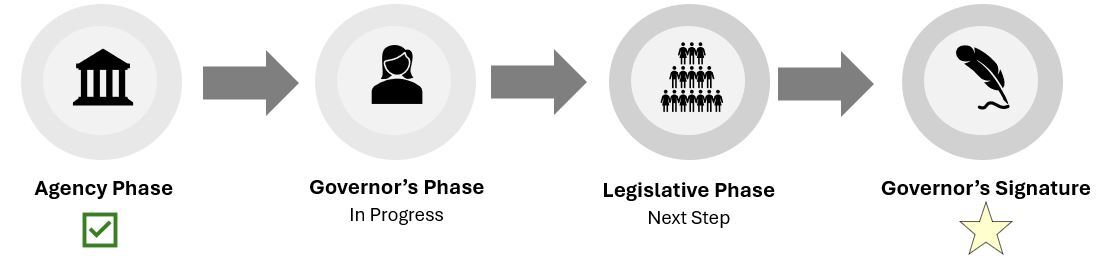 Timeline
Agency Phase – February to September 2024
Agency Budget Submitted September 2024
Included DHHS’ Efficiency Budget – Cost to continue operations
Included DHHS’ Prioritized Needs – New priorities
Governor Phase – October 2024 to February 2025
Must be released by February 15, 2025
Governor will present Governor’s Budget to Legislature
Reflects Governor’s Office Priorities
House Phase – February through April 2025
Work Sessions kick off the week of February 17th!
House Finance – 25 Members
Intensive Work Sessions through the end of March
Full House Must Pass Budget around the beginning of April
Senate Phase – April through May 2025
Work Sessions Begin in early April following “Crossover”
Senate Finance – 7 Members
More Accurate Revenue Projections Available
Full Senate must pass budget by end of May
Committee of Conference – June 2025
June – Generally around the 3rd week
House & Senate Finance Members
Platform to Negotiate HB1 & HB2 positions
House & Senate Sign off and send to Governor!
Senate Bill 409
BDS is excited to announce that SB 409, the recreational funding bill, was successfully passed in August 2024. This funding is a testament to the grassroots advocacy, collaboration, and support shared over several months to get this bill across the finish line.
|
|
|
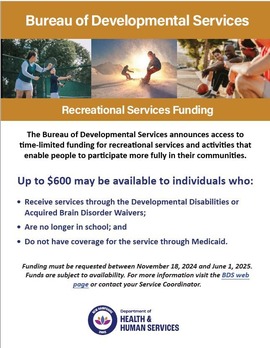
Recreational Services Funding Available
SB 409 provides access to time-limited funding for recreational services and activities that enable people to participate more fully in their communities. Funding must be requested between November 18, 2024 and June 1, 2025. Requests are subject to availability of funding.
To be eligible for funding, an individual must:
- Have exited school; and
- Be receiving services through the Developmental Disabilities or Acquired Brain Disorder Waiver
To access funding, an individual’s service coordinator will submit to BDS a completed:
Please contact your service coordinator for information or assistance in requesting recreational services funding.recreational-services-funding-flyer.pdf
|
|
|
The Supports Intensity Scale - Adult Version (SIS-A 2nd Edition™) is a valuable assessment tool focusing on identifying how supports can help a person achieve their goals.
About the SIS-A 2nd Edition™
The SIS-A has been used as an assessment tool to aid in service planning and delivery in New Hampshire for many years. The SIS-A 2nd Edition™ does not focus on identifying an individuals’ deficits, but rather on identifying the supports an individual needs to achieve their goals. The SIS-A 2nd Edition™ was developed by the American Association on Intellectual and Developmental Disabilities (AAIDD).
 |
|
In late 2023, BDS contracted with Public Consulting Group (PCG) to administer the Supports Intensity Scale – Adult Version (SIS-A 2nd Edition™) assessments in New Hampshire. For more information on the SIS-A and what to expect, please see the Frequently Asked Questions (FAQ). |
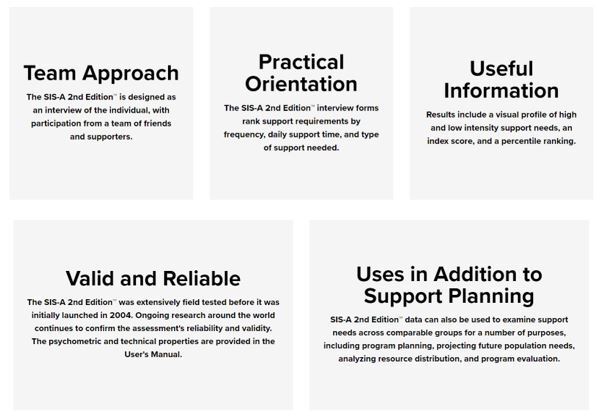
The SIS-A 2nd Edition™ is completed in an interview-like setting. A certified SIS-A assessor asks individuals (and people familiar with an individual’s needs) questions. The SIS-A assessor records information discussed in the interview and provides clarifying information about specific questions as needed.
SIS-A 2nd Edition™ results are normed and validated. An individual’s responses will be “scored” according to a standard protocol and the resulting score will be something that is comparable across individuals.
Components of the SIS-A 2nd Edition™
The SIS-A 2nd Edition™ is composed of three different sections that cover information about activities of daily living, personal advocacy, and exceptional medical and behavioral support needs. Some responses to certain questions will trigger additional supplemental questions. These supplemental questions collect additional information about medical and behavioral support needs.
|
|
|
Centers for Medicare & Medicaid Services (CMS) Ensuring Access to Medicaid Services Final Rule
The Ensuring Access to Medicaid Services Final Rule (also known as The Access Rule) advances access to care and quality of care and will improve health outcomes for people receiving home and community-based services (HCBS).
These improvements seek to increase transparency and accountability, standardize data and monitoring, and create opportunities for states to promote active engagement in their Medicaid programs with the goal of improving access to care. While New Hampshire is actively working on a plan to comply with these federal changes that span into 2030, BDS wanted to provide a broad overview of the changes. More information from the Department regarding the Final Rule will be communicated to all stakeholders in the coming months.
Green Mountain Self-Advocates, a disability rights organization in Vermont, has created a plain language “Introduction to the Medicaid Access Rule” document that you can access on their website.
The Access Rule focuses on the following areas:
Payment Adequacy
States must provide reporting to CMS on the percentage of total payments made to direct care workers and must ensure 80% of Medicaid payments go to compensation for direct care workers. Examples of direct care worker services include:
- Personal care attendants
- Homemakers or people who help with chores or doing household activities
- People who provide home health services
Transparency on Payment Rates
States must report on how much they pay providers and the average cost for each type of service. This includes what provider agencies pay for wages and benefits to direct care workers. The information must be easy to find and understand and posted on an accessible website.
Interested Parties Advisory Group
States must establish an Interested Parties Advisory Group to advise and consult to Medicaid on payment rates for direct care workers. The advisory group can only include people who receive services, their families, and paid and non-paid caregivers.
Grievance
States must have a process to receive and respond to complaints. States must communicate individual’s rights, provide directions on how to file a complaint, and provide help to make sure a complaint is filed correctly and followed up on timely and appropriately
Wait List Reporting Requirements
States must report information on how many people are waiting for HCBS services and how long they have been waiting for.
Person-Centered Planning
People receiving services will lead the person-centered service planning process. At least once a year, each person receiving services will participate in a needs assessment. This provides the necessary information and support to ensure that the person directs the process and is enabled to make informed choices and decisions.
Incident Management
States must operate and maintain an electronic incident management system that identifies, reports, triages, investigates, resolves, tracks and trends critical incidents. Clear definitions of critical incidents, timeframes for investigating and reporting must also be developed.
Quality Measures
States must establish performance targets, reviewed and approved by CMS, for HCBS services.
- Reporting: Every two years, states must provide CMS their “report cards” on the quality of services in each state.
- Setting Goals: States must set goals to improve services and describe how to improve the quality of services delivered.
- Individuals must have opportunities to tell CMS what they like and do not like about their services.
Medicaid Advisory Committee (MAC) & Beneficiary Advisory Committee (BAC)
States must establish and operate a Medicaid Advisory Committee (MAC) and a Beneficiary Advisory Committee (BAC) to serve as an opportunity for bi-directional feedback between interested parties and the state on matters related to the effective administration of the Medicaid program.
|
|
|
|
|