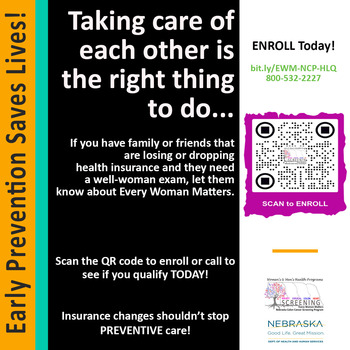
Every Woman Matters (EWM) is a federally funded program that pays for office visits associated with Pap tests, pelvic exams, clinical breast exams and lab fees for women aged 21-64. Age-appropriate mammography is covered as well as diagnostic tests. EWM provides screening and diagnostic tests, public education, and quality assurance activities. Find out more...
FREE Quit Medication Available
The Nebraska Tobacco Quitline is offering FREE quit medications to eligible Nebraskans through June 30, 2026 or while supplies last.
Participants may receive two free quit medication kits that include both a two-week supply of nicotine patches and an additional two-week supply of either nicotine gum or lozenges. Using more than one form of nicotine replacement therapy, known as combination therapy, has been shown to increase quit success.
To qualify, participants must be Nebraska residents age 18 or older, enroll in the Nebraska Tobacco Quitline, and complete at least one free coaching session. Eligible participants may receive quit medication kits following their first and second coaching sessions.
Individuals can enroll in free help or stay tobacco-free by calling 1-800-QUIT-NOW (784-8669) or by visiting QuitNow.ne.gov.
 |
|
Call 1-800-QUIT-NOW or visit QuitNow.ne.gov to reach a trained quit coach, get access to free quit-smoking medication, and make a plan to quit tobacco for good. |
April: Stress Awareness Month
April is Stress Awareness Month, a time to bring attention to negative impacts of stress. It’s also a time to check in with yourself and others. Take time to care for your physical and mental health needs. Managing stress is an important piece of living a healthy life. Knowing how to manage stress can improve mental and physical well-being and lower the effects of health-related issues.
We all experience stress, but experience it in different ways. Stress is a reaction to a situation where a person might feel anxious or threatened. Learning healthy ways to cope and getting proper care and support can help reduce stressful feelings and symptoms.
Stress is a normal part of life. Sometimes it’s not something we have the power to change. Try to recognize when you don’t have control and let it go. Control your reactions and focus your mind on something that helps make you feel calm and in control. Chronic stress can contribute to sleep problems, high blood pressure, weight gain, and increase the risk for conditions such as heart disease and type 2 diabetes.
Pay attention to how stress shows up in your daily life and take small steps to manage it. Small changes in daily routines can help reduce stress and support long-term health. Learning simple strategies to manage stress can improve sleep, energy, mood, and overall health.
Healthy Ways for Coping With Stress:
- Take care of yourself – eat healthy, exercise regularly, get plenty of sleep, give yourself a break if you feel stressed. Take a walk or spend time outdoors. Remember to focus on one small healthy habit at a time.
- Share your problems and how you are feeling and coping with a trusted family member, friend, doctor, pastor or counselor.
- Avoid drugs and alcohol. These can create additional problems and increase the stress you are already feeling.
- Recognize when you need more help – know when to talk to a psychologist, social worker or counselor if things continue.
- Pause and take slow, deep breaths when feeling overwhelmed. Notice and name what you are feeling before reacting. You could even practice mindfulness or relaxation techniques.
Strategies to Help you Stay on Track for Taking your Medication
Despite good intensions, many people find it difficult to keep up with their daily medications – whether it’s one pill or 10. In fact, an estimated 50% of people do not take their medications as prescribed.
Many people fall out of their routines. Busy schedules make it easy to overlook doses. Maybe your regimen is too complicated or maybe you have side effects that are uncomfortable. Sometimes people think they feel better so they stop their medications or maybe it’s the cost of medications. Regardless of the reason(s) you stop or forget to take your medications, it’s important to remember that taking medicines as prescribed is one of the most powerful steps you can take toward better health.
Skipping a dose may seem harmless but in the long-term, it can have an effect, even though it might not be apparent at first. Taking your medications is important because it:
- Maintains control of chronic conditions like high blood pressure, diabetes and heart disease
- Prevents complications – missing doses can lead to flare-ups and/or worsening symptoms
- Improves quality of life – when medicines work properly you’re less likely to experience pain, fatigue, or other symptoms that interfere with daily life
- Saves money in the long run – avoiding complications and ER visits reduce medical costs
Here’s a helpful list of tips and tools on how best to remember to take your medications:
- Keep a list, including over-the-counter ones – use a notebook or smartphone to track all changes
- Take your meds at the same time every day – maybe it coincides with morning coffee or breakfast meal, or maybe after brushing your teeth or at bedtime
- Leave yourself notes to help you remember – post-it notes on bathroom mirrors or your nightstand, maybe use a dry erase board
- Use a pillbox organizer with the days of the week – keep the pillbox in a visible place, like the kitchen counter
- Keep a calendar to write down doses and when refills are due – if you’re running low be sure to contact your provider or pharmacist
- Set an alarm on your phone or watch to remind you when to take your pills
- Involve family or friends – if you live with someone have them help remind you or check in about your medications
- Turn your bottle upside down after you take your pills, then turn it upright at the end of the day as a reminder to start fresh the next day
- Use an app on your phone to help track when medications are needed. Studies show that people who use apps are approximately twice as likely to take their medications as prescribed
Even though you have tips and tools to help you remember to take your medications, missed doses can still happen. If you’re missing doses be sure to look at ways to simplify your medication routine.
Talk to you health care provider about ways to help you stay on track especially before you stop taking any medications. Your pharmacist may also be a great resource in simpliying your routine.
WANT TO KNOW MORE??
QUESTION:
Will taking magnesium help with my mental health?
Maybe a little. It is difficult to tell if magnesium helps with mental health for most people. Why is magnesium important? Magnesium is a mineral that is present in the human body and generally taken in through food products. It is present in some medications and of course, can also be taken as a supplement. Read more…
QUESTION:
How can I prevent falls at home?
Keep yourself as active as you can and clear your home of fall hazards. Even if you don’t notice an injury, falls can be an early warning sign for many health issues. Don’t delay asking for help when you need it! Roughly 1 in 4 adults over age 65 fall each year. About 800,000 people Read more…
QUESTION:
Is it ok to get medical advice from an AI chatbot?
Any health decision or complex health question should always be discussed with a human clinician. However, AI chatbots can be helpful for answering some basic health questions, with some caveats. It seems like every industry nowadays wants a piece of the artificial intelligence (AI) pie. Healthcare has been no exception, with 2 out of 3 Read more…
QUESTION:
My bone mass is low - what can I do to protect my bones?
Lifestyle changes can help with low bone mass. Small steps like getting enough calcium-rich foods, moving more, and exercising your muscles can strengthen your bones. In some cases, osteoporosis medication may also be needed. Bones naturally become weaker as we age, but sometimes bone loss happens faster and becomes severe. Osteoporosis is Read more…
Source: Those Nerdy Girls and Chana Davis @FueledbyScience https://thosenerdygirls.org/posts/
Italian Sausage and Vegetables
Ingredients:
- 1 pound small red potatoes (8 to 10), halved
- 1/2 teaspoon kosher salt
- 2 tablespoons olive oil, divided
- 1 (12-ounce) package smoked Italian-style chicken sausage, cut into 1-inch pieces
- 1 medium red bell pepper, cored, seeded, and chopped
- 1 small head broccoli, cut into bite-size florets
Instructions:
- Arrange a rack in the middle of the oven and heat to 400ºF. Place a rimmed baking sheet in the oven while it is heating.
- Place the potatoes, salt, and 1 T of the oil in a medium bowl and toss to combine. Transfer to the baking sheet, add the sausages, and spread into an even layer.
- Roast for 15 minutes. Meanwhile, place the pepper, broccoli, and remaining 1 tablespoon of oil in the now-empty bowl and toss to coat.
- Stir the sausage and potatoes and push to one side of the baking sheet. Add the pepper and broccoli on the other side and spread into an even layer. Roast until the sausage is browned and the vegetables are tender, about 15 minutes more.
Source: https://www.thekitchn.com/italian-sausage-vegetables-268349
Nutrition: Recipe makes 4 servings.
Serving Size: 1
Calories: 377 | Carbohydrates: 29.7g
Protein: 18.8g | Fiber: 5.9g
|