|
Executive Director Corner
The Trust grant deadline is just around the corner, September 3rd at midnight. We have been busy visiting with a number of potential grant applicants and reading draft proposals. We recently held our third quarter board meeting in Beatrice and as you can see in articles below, a new chairman and vice-chairman were elected and the geo-points for 2020 were established. We learned a lot about soil health from Doug Peterson (NRCS) and coordinating burns from Kent Pfeiffer (Northern Prairies Land Trust). Our field trip took us around the Steinauer area and we visited with representatives from Wachiska Audubon at the Verlyn Beethe Tallgrass Prairie.
We have a number of events coming up including the State Fair, Heron Haven Wetland Festival, World O’ Water, Golden Rod Festival, and the Missouri River Outdoor Expo. If you are at any of these events, stop by our booth and say hello. We will be at our booth all 11 days of the Nebraska State Fair. Our booth is located inside the Nebraska Game and Parks pavilion in the Nebraska Building. Stop by and see the fish, shoot a pellet gun or a few arrows in the area.
The unpredictable weather continues in Nebraska. It seems like it starts to get hot and dry and then a storm comes through and drops heavy rain and hail in areas of the State. I’ve seen rainfalls over 5 inches and hail bigger than golf balls and then winds up to 90 mph. Nebraska has been spared multiple tornadoes so far, but there have been a few scattered across the State.
Many K-12 schools have started back and most of the colleges and universities begin in the next week or two. I can’t help but think back to two-a-day football practices in high school. Soon the Friday night lights will occur across the State and gymnasiums and bleachers will be filled. Get out and support your local high school football, volleyball and cross country teams.
The whole state is starting to buzz about the upcoming Husker football and volleyball seasons just a few weeks away now. The football team is ranked in the 20’s or just outside the top 20 in the various polls and the volleyball team is ranked number 2. Both teams should provide fans with some excitement this fall. A local internet provider (Allo) has a promotion going that if the football team wins the Big10 Conference, your service is free for a year. I guess that might even get that very small number of non-Husker fans to root for the red and white this season.
Go Big Red!
Mark A. Brohman
Executive Director
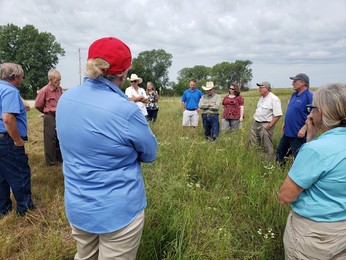 Trust Board visiting Verlyn Beethe Tallgrass Prairie, Northeast of Steinauer, Nebraska
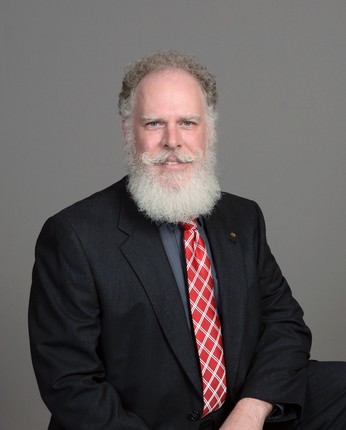 Paul Dunn, Chairman of the Nebraska Environmental Trust Board
Paul Dunn Elected as Nebraska Environmental Trust Chairman
Paul Dunn of Omaha was recently elected Chairman of the Nebraska Environmental Trust Board. The election was part of the Trust's August 6, Quarterly meeting held in Beatrice. Mr Dunn represents the State’s second congressional district on the Board. Governor Johanns first appointed him to the Board in April 1999. Now in his fourth six-year term, Mr. Dunn is the Trust's longest standing member on the board. Also elected at the August 6 meeting was Mr. Jeff Fassett, Director of the Department of Natural Resources, as Vice-Chairman.
Commenting on his election, Mr. Dunn said, “It is an honor to serve on the Nebraska Environmental Trust Board. We have a Board full of knowledgeable and committed conservationists. The conservation work completed with Trust funding has touched every citizen of Nebraska.”
Mark Brohman, Executive Director for the Trust said, “The Trust has gained from Mr. Dunn’s knowledge, and commitment to conservation. He is an asset to the Trust with a wealth of information on environmental issues—especially recycling. Mr. Dunn has served as Trust Board Chair several times and has always done an impeccable job in his duties.”
Mr. Dunn is currently the Solid Waste Section Supervisor for the Omaha Public Works Department. His responsibilities include writing and managing Omaha's solid waste contracts and the personnel that implement those contracts. Paul began his career with the City as Recycling Coordinator in 1994. From 1991 to 1994, Mr. Dunn was Commercial Recycling Coordinator for Orange Community Recycling in Chapel Hill, North Carolina.
Over the course of his career, he has established many recycling programs and environmental activities. For years, he wrote and designed the Omaha’s direct mail publication, Wasteline, and the related website, wasteline.org. A highlight of his career was being project lead in developing, UnderTheSink, metro Omaha's regional household hazardous waste facility.
Dunn was born and raised in Lincoln and has a bachelor’s degree from the University of Nebraska-Lincoln. While taking classes for a master’s degree in Community and Regional Planning, he served as an intern with Lincoln’s Recycling Office. Dunn has served on the National Waste Prevention Coalition’s Junk Mail Task Force, the board of the Nebraska State Recycling Association and been a presenter at the National Recycling Congress and Exhibition, the Nebraska Safety and Health Summit, and the Association of State and Territorial Solid Waste Management Officials.
The Trust Board is comprised of 14 members representing the State of Nebraska and its citizens. There are nine citizen representatives appointed by the Governor who serve without pay, three representatives from each congressional district. Citizen members represent a wide variety of natural resource interests. They serve six-year terms. Five agency directors make up the remaining seats on the board to provide coordination with existing state resources. A staff of five handles the day-to-day activities of the organization.
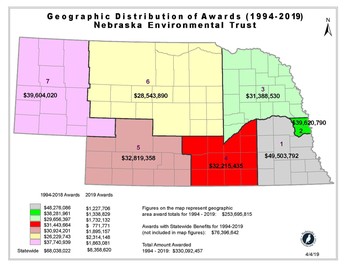
Nebraska Environmental Trust Awards Bonus Points to North Central Nebraska Projects for 2020 Grant Cycle
In a continuing effort to support natural resource projects across Nebraska, the board of the Nebraska Environmental Trust will award bonus points to 2020 grant applicants in only one of the seven geographical areas across the state. The geographical map of Nebraska showing the seven districts can be seen on the Trust website at: http://www.environmentaltrust.org/work/index.html
Projects based in District 6 (North Central) will be eligible for up to 20 bonus points in the 2020 grant cycle.
By law, the Nebraska Environmental Trust is required to ensure a geographic mix of projects over time. Geographic bonus points allow the Trust board to evaluate which areas are in need of Trust grant funds and provide an incentive to increase applications from deficient areas. District 6 has received $28,543,890 since Trust grants began in 1994. Applications for 2020 Nebraska Environmental Trust funding are due on or before midnight Tuesday, September 3, 2019. An online portal is now available at https://environmentaltrustgrants.org to submit grant applications.
The Nebraska Legislature created the Nebraska Environmental Trust in 1992. Using revenue from the Nebraska Lottery, the Trust has provided more than $305 million in grants to over 2,200 projects across the state. Anyone – citizens, organizations, communities, farmers and businesses – can apply for funding to protect habitat, improve water quality and establish recycling programs in Nebraska. The Nebraska Environmental Trust works to preserve, protect and restore our natural resources for future generations.
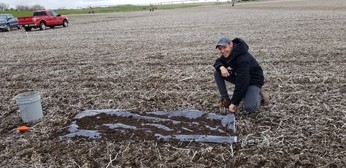 Agustin working on calibration of a manure spreader at an on-farm study site.
Engaging Farmers, Students and Stakeholders to Transform Manure and Cedar Mulch from “Waste” to “Worth”
Submitted by: Amy Millmier Schmidt, Associate Professor, UNL
Since first stepping foot on the University of Nebraska-Lincoln East Campus in August 2018 to pursue a master’s degree in the Biological Systems Engineering (BSE) Department, Agustin Olivo has been eager to learn – and teach – about the importance of soil health in cropping systems and the role of manure in soil health and agronomic productivity. While the funding for his master’s thesis project had already been awarded by the Nebraska Environmental Trust to his advisor, Dr. Amy Schmidt, when he arrived in Lincoln, the real work had not yet begun.
During his undergraduate studies in Agricultural Engineering at the Universidad Nacional de Córdoba in Córdoba, Argentina, Agustin became interested in the development and implementation of sustainable agricultural practices to address local and global food security and food safety challenges. After visiting UNL in 2017 as a member of the UNL-Argentina Friends of Fulbright Program and learning about research and outreach programs among faculty in BSE, Agustin decided that a master’s program where he could work closely with farmers and other stakeholders to conduct applied research and outreach to enhance the economic and environmental sustainability of farmers was a perfect fit for him. The NET-funded project, Transforming Manure and Cedar Mulch from “Waste” to “Worth”, is giving him the chance to do just that.
The conservation of all resources involved in agricultural activities is key to sustainable production of crops and livestock. Soils constitute the basic provision on which most plant and animal productions systems are based, making the preservation and improvement of soil integrity and health vitally important. “Healthy” soils sustain and support the continued production of food and fiber in sufficient quantities and qualities to meet our needs. The application of organic amendments to agricultural soils is one way to positively impact the chemical, physical and biological properties of the soil.
Two organic “waste” streams that are plentiful in most areas of Nebraska – livestock manure and cedar tree mulch generated during tree management – are being evaluated individually and in combination as agricultural soil amendments to improve soil health. Each provides unique individual benefits to soil. Mulch suppresses weeds, insulates soil from temperature fluctuations, helps retain moisture and provides organic matter. Manure contributes organic matter, plant nutrients and microorganisms. Increases in soil organic matter content and the abundance and diversity of soil microorganisms yields a long list of benefits, including more efficient nutrient cycling, soil aggregation, water holding capacity, porosity and infiltration, and reduced runoff and erosion potential due to improved soil structure.
In this project, Agustin is leading a collaborative effort among Nebraska Extension, the Nebraska On-Farm Research Network, Nebraska Forest Service, Natural Resources Conservation Service, six Natural Resources Districts and four crop farmers throughout the state to document and demonstrate the impacts of manure and mulch soil amendments on soil health and crop productivity. Four on-farm research studies are currently underway – near Ainsworth, Brule, St. Paul and Pierce, Nebraska. A late harvest last fall followed by a very cold winter with significant snowfall and then above average spring precipitation disrupted plans to conduct research at two additional sites.
Engagement of at least one high school agriculture program near each study site is providing students experience designing and conducting on-farm research, monitoring crop performance, evaluating soil health and conveying research results through innovative outreach methods. Agustin developed and published a soil health curriculum and a soil biology inspection guide that were delivered to participating high school classrooms this past spring to support student learning about research methods and soil health. Students also received microscopes that attach to the camera of a cell phone allowing them to view, photograph and record video of soil organisms. Because changes in soil properties, like organic matter content, can take several years to become measurable, methods of rapidly evaluating the health of soils – such as by monitoring changes in the quantities and diversity of soil organisms – are important to demonstrate positive changes over a short period of study.
One year into this project and his graduate program, Agustin is leading a successful research effort and engaging partners statewide to improve understanding and appreciation for the value of soil health to sustainable crop production, the roles of manure and mulch in enhancing soil health, and the opportunities for students to pursue conservation-minded agricultural careers. As the second year of this project begins, the efforts of Agustin and the rest of the project team will become focused on analyzing and interpreting soil and crop performance data from the first growing season of the study, planning for continuation of field research for a second growing season, and communicating key messages to farmers and their advisors about the value of manure and mulch as inputs to cropping systems.
Upcoming Events
- August 23 - Sep. 2, 2019 - Nebraska State Fair, Grand Island, NE.
- September 3, 2019 - Grants Deadline
- September 7, 2019 - World O Water Fest, Omaha, NE.
- September 14, 2019 - Wetland Festival, Heron Haven, Omaha NE.
- September 21-22, 2019 - Missouri River Outdoor Expo, Ponca State Park, Ponca NE.
- October 3, 2019 - Golden Rod Festival Lauritzen Gardens
- November 7, 2019 - 4th Quarter Board Meeting, 1:30 pm, Ferguson House.
|