|
Executive Director Corner
The Legislature has completed over three quarters of the
90 day session. The Trust continues to monitor
several bills including three bills (LB 452, 312 and 563) because they pertain
to repealing the tax exemption to lottery tickets. It appears none of these three bills will be
advanced to the floor, but the Revenue Committee has prioritized and advanced
LB 461 that contains parts of those bills, but not the language pertaining to
repealing the tax exemption on lottery tickets.
Another bill impacting the Trust is LB 331, which was introduced
by Speaker Scheer at the request of the Governor. LB 331 would transfer $3.3M a year for the
next three years to the Water Resources Cash Fund. This represents about 18% of the funds the Trust
has available for grants, so it would have a significant impact on the
Trust. We are hoping that the
Appropriations Committee at least reduces the take to two years instead of
three, as the Legislature is only securing matching General Funds for two years. These transfers were a negotiated settlement
six years ago and were to sunset this year with the Trust not funding the Water
Cash Fund after 2017.
On April 6th the Trust board met and the Board
approved the Recommendations for Funding Placed in Rank Order list. The Trust staff held three Grantee Seminars
(two in Lincoln and one in Grand Island) to discuss the grant reporting
requirements with the successful grantees.
We had several Senators join us at the Lincoln seminars and Senator
Quick joined us for lunch in his home District at the Grand Island seminar.
The spring game was a success in Lincoln on April 15. There were 78,310 Husker fans, including a
number of recruits. We have since
learned that Tanner Lee (transfer from Tulane) will be our starting quarterback
in the fall if he stays healthy. I know
all but a handful of Universities envy the numbers of attendees Nebraska gets
at their spring scrimmage. Only Ohio
State with 80,134 bested Nebraska this year with Clemson coming in a distant third
with 60,000 fans. This weekend the
Huskers volleyball team will play in front of a sold out crowd in Kearney. They will take on Colorado State in their
only spring exhibition game this year.
It is nice to see the gals go to the heartland. Again, with more than 2,000 tickets sold,
almost all college volleyball teams are envious of those kinds of numbers for a
exhibition game.
Travel safe, watch out for all of those kids about to
get out of school for summer and here’s to a safe planting season.
Mark A.
Brohman
Executive
Director
Nebraska Environmental Trust Announces 2017 Grants
At a meeting in Lincoln on April 6,
2017 the Board of the Nebraska Environmental Trust announced that 85 projects
will receive $16,680,000 in lottery proceeds for natural resource work in
Nebraska. Out of these, 33 are newly funded grants and 52 are carry-over
projects. This is the 24th year of grants from the Trust, which has provided
over $265 million dollars in lottery revenue to preserve and protect the air,
water and land of our state. Some of the projects receiving funding include:
Habitat for Humanity of Omaha ReStore Deconstruction
Program Phase 2
Nebraska Grazing Lands Coalition – Soil Health and
Water Conservation Through Grazing Cover Crops
Lincoln Children’s Zoo – Lincoln Children’s Zoo
Expansion
Rowe Sanctuary – Wetlands for Communities and Schools
Wachiska Audubon Society – Fertig Prairie Acquisition
Project
A complete listing of all approved
2017 grants and summaries can be found on the Nebraska Environmental Trust web
site at www.environmentaltrust.org.
The Nebraska Legislature created the
Nebraska Environmental Trust in 1992. Using the revenue from the Nebraska
Lottery, the Trust has provided grants to over 2,000 projects across the state.
Anyone can apply – citizens, conservation organizations, communities,
businesses and individuals that want to protect Nebraska’s natural habitat,
improve water quality and quantity or find ways to manage our waste. The
Nebraska Environmental Trust works to preserve, protect and restore our natural
resources for future generations.
Trust Will Move Towards An Electronic Grants Process with help from the School of Raikes Design Studio Team
The last quarter of 2016 and 1st quarter of 2017 marked an important milestone for the Trust. The School of Raikes Team, our Database Consultant (Marie Gregoire) and the staff of the Trust worked diligently to move towards a fully electronic grants process that will be launched in a few months.
We cannot thank the entire team from the School of Raikes enough for all the hard work that was put into the project. The Senior Design Team members consisting of Eric Policky, Kevin Allen, Jun Sun, Michael Marsh and Alex Sturtz, were dedicated, committed and a wonderful group to work with. They were always ready to offer input, provide new ideas and work independently in developing the grant portal.
A special thanks too, to our Database Consultant, Marie Gregoire; Jeremy Suing, the Project Manager; Frank Dolezal, Coach and the team from Stone Fin, Carl Steffen, Jesse Temple and Greg Hofman. They made it a breeze for the Trust! The Trust staff is excited about the next phase of this project.
The Electronic Grants Portal will be going through a testing phase and then "live" in time for the 2018 Grant Cycle due on September 5, 2017.
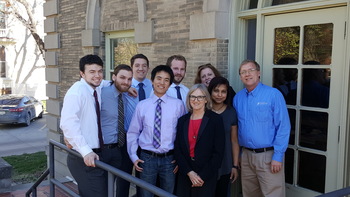
The School of Raikes Team with Trust staff and Database Consultant, Marie Gregoire. (Pictured above).
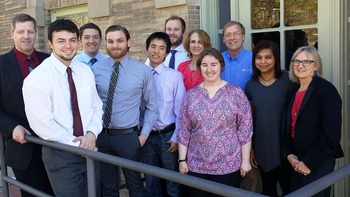
The School of Raikes Team with entire Trust staff.
(Pictured above). From left to right: Jeremy Suing (Project Manager)
Eric Policky (Squad Lead & Product Manager), Michael Marsh, Alex Sturtz, Jun Sun (all Software Developers), Kevin Allen (Devlepment Manager), Pam Deines (Administrative Assistant), Allison La Duke (Grants Assistant), Mark Brohman (Executive Director), Sheila Johnson (Public Information Officer), Marilyn Tabor (Grants Administrator).
Rainwater Basin Joint Venture - Divots in Pivots
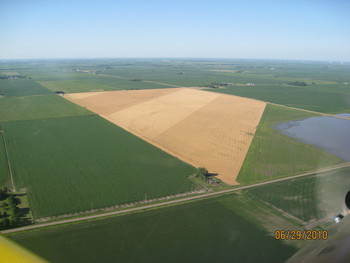
An aerial view of a Divots in Pivots Project
Background
Pivot
irrigation became established in the Rainwater Basin (RWB) in the 1960s. To maximize efficiency, pivots must complete
full rotations. As a result, many
wetlands were drained or modified to try
to maximize irrigated acres under the pivots.
Today, 72% of all historic playa wetlands are intersected by pivot
irrigation systems. Despite past
drainage attempts many historic wetlands continue to pond water during the
growing season.
Nebraska
Environmental Trust Grant
In
2015, the RWB Joint Venture (RWBJV) partners
were awarded a Nebraska Environmental Trust (NET) grant titled “Divots
in Pivots”. This grant was leveraged
with Natural
Resources Conservation Service
(NRCS) Regional Conservation Partnership
Program (RCPP) funding. Funding from the NET and RCPP will be
leveraged with partner contributions to support development of 10 demonstration
sites. At these sites the wetlands will
be restored and transitioned to irrigated pasture while the pivot irrigation
system will be upgraded with Variable Rate Irrigation (VRI) technology. VRI will allow the producers to monitor soil
moisture levels and strategically apply irrigation inputs on the adjacent
cropland based on crop water needs and
completely shut the pivot off over the
wetland. This allows natural hydrology
to be restored to the wetland and reduces excess irrigation over the entire
field.
Project
Delivery
The
RWBJV corporate partners (Lindsay, Valley, Rinke, and Cropmetrics) have taken the lead in the
initial marketing phase, identifying producers with priority wetlands in fields that would benefit from VRI. Project implementation has three elements. Element one is wetland restoration completed
by the RWBJV partners and protection through NRCS’s Agriculture Conservation
Easement Program (ACEP). Element two
includes installation of VRI upgrades to the pivot, field mapping, soil
moisture probe installation, crop water budget development, and generation of
irrigation prescriptions. Funding for
this element will be through RWBJV
partners including NET and NRCS’s Environmental Quality Incentives Program
(EQIP). Project element three is
installation of grazing infrastructure.
In 2016, two pilot projects, that included these project elements, were
completed. The University of Nebraska is
currently evaluating these sites against other fields with farmed wetlands and
conventional pivot irritation systems to quantify adoption of conservation practices on
net-farm income.
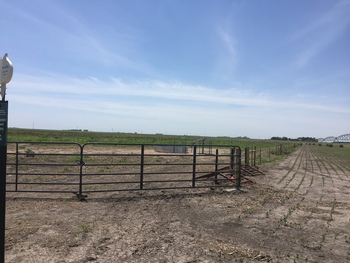
Fencing associated with a Divots in the Pivots site.
Upcoming Events
- April 21, 2017 (Friday) - Earthstock, UNL, Lincoln NE.
- April 21, 2017 (Friday) - Eco Fair, Wesleyan, Lincoln NE.
- April 22, 2017 (Saturday) - Earth Day Omaha, Elmwood Park, Omaha NE.
- April 22, 2017 (Saturday) - Lincoln Earth Day, Lincoln NE.
- April 24, 2017 (Monday) - Auburn School, Greenhouse Dedication, 1 - 2:30pm.
- April 27, 2017 (Thursday) - Sustainability Expo, UNMC/Nebraska Medicine, Omaha NE.
|