|
Executive Director Corner
At the April 7th
board meeting we approved the 2016 grants. We, then hosted Grantee Seminars on
April 11th and 14th.
We had great turnouts, including a couple of Senators and a staffer.
The Legislative
session is over and there were no “reallocations” of Trust funds. We were fortunate that there was no
legislation enacted that directly impacted the Trust after the dust
settled. We monitored several pieces of
legislation; two in particular involved the Trust. One piece was killed in committee and the
other was modified to our satisfaction.
Allison and
Sheila manned our booth at the Earth Day Omaha celebration in Omaha on April 16th,
and then Sheila had a booth at Gallup’s Earth Day event in Omaha on April 22nd
while Allison participated in Wesleyan University’s Earth Day the same
day. While Sheila and Allison were busy
with the booths, I was attending the Leopold events at the Capitol. The next day I set up the booth at Lincoln’s
Earth Day and got to visit with many folks about the Trust. Marilyn had a booth at the Environmental
Sustainability Celebration at First-Plymouth Church on April 24th.
On Earth Day,
Friday, April 22nd, Governor Pete Ricketts announced the Peterson
Family from Gordon as the Nebraska 2016 Leopold Conservation Award
winners. Rex and Nancy Peterson along
with their son Patrick and his wife Krista operate a 2,300 acre farm and ranch
near Gordon. Their work with cover
crops, no-till farming, rotational grazing and use of interns all contributed
to their recognition. The $10,000 award
and Aldo Leopold crystal are made possible by numerous partners, including the
Nebraska Environmental Trust, the Sand County Foundation, Nebraska Cattlemen,
Cargill and others.
I was privileged
to attend the Water for Food Global Conference in Lincoln at UNL's Innovation
Campus for two days. Not only did I
learn about some new technologies in agricultural water use in Nebraska, but
advances around the world. Sometimes it
is educational to visit with international citizens and see the world and our
backyard through their eyes.
As you can
see, we have been busy. Enjoy these
April showers and let’s hope they bring May flowers, bountiful crops and lots
of tall grass for the grazing.
Mark Brohman
Executive Director
Nebraska
Environmental Trust Announces 2016 Grants
At a meeting in
Lincoln on April 7, 2016 the board of the Nebraska Environmental Trust announced
that 118 projects will receive $18,799,900 in lottery proceeds for natural
resource work in Nebraska. Out of these, 69 are newly funded grants and 49 are
carry-over projects. This is the 23rd year of grants from the Trust,
which has provided over $250 million in lottery revenue to preserve and
protect the air, water and land of our state. Some of the projects receiving
funding include:
-
Northern
Prairies Land Trust – Expanding the Tallgrass Prairie Partnership
-
The
Nature Conservancy: Making A Place for Monarchs
-
Nebraska
Energy Office: Enhancing Access to Renewable Biofuels & Air Quality in
Nebraska
-
North
Platte NRD – DAMP Project
-
PrairieLand
Gold LLC – Wastewater Treatment & Nutrient Recovery
A complete listing of all approved 2016 grants and summaries can be found
on the Nebraska Environmental Trust web site at www.environmentaltrust.org.
2016 Board Approved Final Rank Order
A Preview of Successful 2016 Grantee Projects
North Platte Natural Resources District Receives Funding From the Trust for Telemetry Program
The North Platte Natural Resources
District (NRD) was awarded a $750,000 grant from the Nebraska Environmental
Trust to expand their telemetry pilot project, Data Access and Monitoring
Program (DAMP), to a total of 863 units in the next three years. The grant will be combined with a $250,000
grant from the Nebraska Department of Natural Resources and will bring $1
million of investment that will go directly to helping producers manage water
and save the NRD money.
The NRD’s telemetry project will
provide telemetry units to producers/landowners free of charge, with the goal
of reading ground water flow meters remotely.
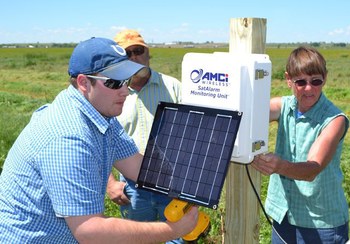
The AMCi MeterEye telemetry unit has a camera located under the hood and
will take a picture of the flow meter once a day. That image is then wirelessly
delivered to a website, through a cellular connection, where it is stored and
then converted to digital data. The stored images and data can be viewed by
both the producer/landowner and NRD staff and can be used to improve water
management practices. The first phase of
three phases will start approximately on May 1st with the
installation of 261 units.
The producers/landowners will benefit
because they will know exactly how much water they have pumped and can easily
figure out how much water they have used and have left in their
allocation. They will be given unique,
password protected login information, so their data will remain private. They will also be able expand the units to
include moisture sensors, evapotranspiration gauges, weather stations and
more. The add-ons will provide a more
complete picture of how much water is in the soil and will help in their water
management decisions.
The NRD will benefit greatly from
the telemetry units too. Each year, the NRD spends nearly $170,000 in salaries, fuel, wear and tear on vehicles and other expenses reading each of the district’s 1,800 flow meters in the over
appropriated portion of the district. That number will increase by nearly 400 flow meters once the NRD
starts reading the flow meters in the fully appropriated portion of the NRD. Many are difficult to get to
and some pose safety risks to staff.
Once the telemetry units are installed, the data will be automatically
downloaded at the end of the water year and reports can be generated more
quickly. The telemetry units will also
notify district staff when a potential problem has occurred with the flow
meter, allowing for more timely repair or maintenance.
The NRD hopes to have all the
regulated wells in the over appropriated and irrigation wells in the full
appropriated portions of the NRD installed with telemetry units in the
next five to eight years. For more
information on the telemetry project, go to www.npnrd.org.
Photo below shows the installation of a telemetry unit.
The Nature Conservancy - Making A Place For Monarchs
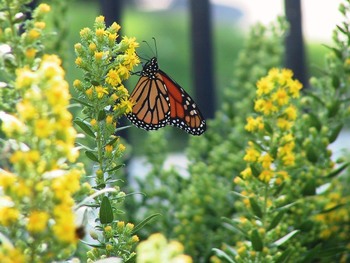
The population of monarch
butterflies, honey bees and other pollinators has been declining at an
alarming rate in recent years. The Trust grant to The Nature Conservancy (TNC)
will help to improve habitat conditions on TNC land, better evaluate and
distill key principles from successful management actions and then
share those principles with interested landowners/managers who would
like to improve pollinator and wildlife conditions on their land.
TNC has
broad expertise in grassland management for plant diversity, pollinators and
wildlife and proposes to improve management on approximately 30,000 acres of
its own land in the Platte and Niobrara River valleys.
Pollinator conservation is
critically important for both economic and ecological reasons. The key habitat
attributes needed by pollinators (plant diversity and a wide range of habitat
conditions) also cover the conservation needs for most wildlife species and for
ecological health.
Nebraska Pharmacists Association - Preventing Poisoning, Pollution and Prescription Drug Overdose for A Healthier Nebraska
The Nebraska Medication
Education for Disposal Strategies (MEDS) Coalition and the Nebraska Pharmacists
Association (NPA) have been addressing the safety concerns of unused medication
for over seven years.
This project is an expansion of
the 2012 pilot program currently supported by the Trust in Lancaster County. The NPA,
along with the Nebraska MEDS Coalition, continues to advocate for strong
educational approaches along with simple, cost effective options that allow for
the safe and legal disposal of unused medications across all Nebraska
communities.
Funding from NET will support
collection containers, shipping and disposal costs to expand the current pilot
and statewide efforts to address collection of both non-controlled and
controlled medications in 2016.

2016 Nebraska Leopold Conservation Award Recipient Announced
Governor Pete Ricketts
joined Sand County Foundation, the Nebraska Cattlemen, Cargill and the
Nebraska Environmental Trust to announce Plum Thicket Farms as the recipient of
the 2016 Nebraska
Leopold Conservation Award® on April 22nd. The annual award honors Nebraska
landowner achievement in voluntary stewardship and management of natural
resources.
Located on the northern
edge of the Nebraska Sandhills is Plum Thicket Farms, a diverse crop farm and
cattle ranch owned and managed by Rex and Nancy Peterson, and their son Patrick
and his wife Krista. Under Patrick's leadership, the farm was transformed
to a no-till operation to prevent erosion and improve water retention, despite
knowing the crop yields would initially take a hit. After eleven years,
their investment in no-till management is paying off.
Cover crops are an
important aspect of the Petersons' commitment to biodiversity. The family
uses a multispecies "cocktail" of annual forages for intensive
grazing. The mix contributes to the health of the soil, while also
providing a nutritional food source for the cattle and pollinator
habitat.
The Leopold Conservation
Award is presented in honor of renowned conservationist and author Aldo
Leopold, who called for an ethical relationship between people and the land
they own and manage. Award applicants are judged based on their
demonstration of improved resource conditions, innovation, long-term commitment
to stewardship, sustained economic viability, community and civic leadership
and multiple use benefits.
"The Nebraska
Environmental Trust was so honored to be a part of the Leopold Conservation Award
and to recognize great families like the Petersons and all the
applicants,"said Nebraska Environmental Trust Executive Director Mark
Brohman. "The Petersons are a very deserving family who make all
Nebraska landowners proud."
The Leopold Conservation
Award in Nebraska is possible thanks to generous contributions from many organizations,
including: Cargill, Farm Credit Services of America, Natural Resources
Conservation Service, The Nature Conservancy, Nebraska Audubon Society,
Nebraska Land Trust, U.S. Fish and Wildlife Service, Nebraska Association of
Resource Districts Foundation, Nebraska Department of Agriculture, Nebraska
Environmental Trust, Nebraska Game & Parks Commission, Rainwater Basin
Joint Venture, Sandhills Task Force, Tri-State Generation & Transmission
Assoc., World Wildlife Fund, DuPont Pioneer and The Mosaic Company.
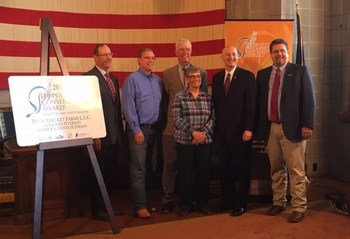
In the
photo: left to right, Homer Buell (Nebraska
Cattlemen), Mark Brohman (Executive Director, NE Environmental Trust), Rex
Peterson, Nancy Peterson, Governor Pete Ricketts, and Troy Stowater (Nebraska
Cattlemen)
Upcoming Events
- May
10, 2016 (Tuesday) - 8:00 am - 4:00 pm Nebraska Children's Groundwater
Festival, Grand Island, NE.
-
May
13 - 14, 2016 (Friday - Saturday) - Spring Into Spring at Lauritzen
Gardens, Omaha, NE.
- June 4, 2016 (Saturday) - Waterfest and Public
Works Day, Lincoln, NE
- August 8-9, 2016 (Monday/ Tuesday) - 3rd Quarter Board Meeting, Fort Robinson, Crawford, NE
|