Reminder: Carryover of 25-26 Eligibility should be ending soon in North Dakota schools.
-
Count School Days only…no weekends, holidays or Teacher in-service days.
-
Count to 30. On the 31st day, students who a new application for free/reduced-price meals has not been received must be rolled back to a ‘Paid’ status.
-
Reminder letters to households who have not applied are helpful to get those applications rolling in but notification is not a requirement. You notified the parent at the beginning of the school year in their Letter to Households.
-
Once an application has been received from a household, the application must be determined within 10 days and the eligibility applied immediately to the student. Do not hold applications for the 30 days.
Head Start Carryover Eligibility
In North Dakota, Head Start programs participate in the Child and Adult Care Food Program (CACFP), which means the Head Start operator—not the school—claims reimbursement for meals served to enrolled children. Even so, most Head Start centers in the state receive their meals through vended agreements with local school meal programs. Because of these partnerships, school districts are already aware of which children are enrolled in Head Start.
Under federal regulations, children enrolled in Head Start are considered categorically eligible for free school meals. The definition of a “Head Start child” in 7 CFR §245.2 establishes this automatic eligibility, allowing schools to certify these children for free meals without requiring a household application. [ecfr.gov]
In many states, this categorical eligibility transitions smoothly into kindergarten. When a Head Start child enters elementary school, their free eligibility status may be carried over into the new school year. USDA guidance on carryover permits school districts to extend a child’s prior-year meal eligibility for up to 30 operating days, or until a new eligibility determination is made. Please keep a copy of the Head Start documentation with your other Direct Certification lists.
North Dakota follows this federal carryover policy. As a result, children who were enrolled in Head Start begin kindergarten with free-meal eligibility based on their previous participation. The difference in North Dakota is administrative rather than procedural: because Head Start and K–12 meal programs operate separately, schools rely on shared documentation rather than a unified system. Even so, once the school receives confirmation of Head Start participation, the child’s free status is carried into the new school year consistent with federal rules.
This approach ensures continuity for families and supports children as they transition from Head Start into the K–12 environment, aligning state practice with national policy while accommodating North Dakota’s unique program structure.
See the attached Step by Step Verification Process to guide you through this important time.
Another helpful tool with timelines and checklists is the Verification Tracker. Find it under “Verification” at the bottom of: SNP Free & Reduced Price Information | North Dakota Department of Public Instruction Attach one to each application to be verified and follow the instructions to successfully complete your verification process.
When the Verification Report is to be submitted, use the Online Verification Summary Report Instructions found on the same tab of the website: SNP Free & Reduced Price Information | North Dakota Department of Public Instruction
Section 5 of the Eligibility Manual for School Meals contains all the information on confidentiality and disclosure of household application information including the release of their determined eligibility status. Parents must have confidence that the financial information that they are submitting will be held in strict confidence. If this information will be released to another entity other than a federal educational program or because of a program audit, the parent must be notified and their consent for disclosure must be received prior to disclosing. The school must also maintain a Disclosure agreement with the school department such as athletics or an outside organization such as the Bank of North Dakota in order to manage the process of sharing this information.
Parent consent forms and Disclosure agreements are available on our website under the SNP Free/Reduced Price Information at the end of the 2026-2027 Application Resources: SNP Free & Reduced Price Information | North Dakota Department of Public Instruction.
State legislators were interested in the unpaid meal charges accruing in schools across the state this summer therefore we will revisit the rules for this challenging issue. Data from a survey of schools showed a whopping $2 million + of unpaid meal charge debt on the books for those reporting. As long as the school is ‘actively working’ to collect the unpaid meal charge debt, the school may keep the negative balance on the books as an asset to be collected.
Once the school determines that the debt is no longer collectible, it becomes ‘bad debt’. Bad debt is not an allowable expense for the NonProfit School Foodservice Account (NPSFA) to absorb. In other words, unpaid meal charges maynot just be ‘zeroed out’ using the school foodservice account. Another non-federal source of funds such as ‘Angel Donations’ or the General fund must be used to make the NPSFA whole again. Please find this guidance in USDA – FNS memo SP 47-2016.
For more guidance on Unpaid Meal charges along with creative solutions to dealing with the debt, go to the USDA website: Unpaid Meal Charges | Food and Nutrition Administration.
For those schools who had more than a 10% error rate during last year’s Administrative Review or those who had numerous errors when submitting the final verification report (FNS-742 in ND Foods), a second review of all applications submitted must be performed to ensure the school’s procedures are followed with an outcome that error rates fall below 5%.
Those schools who must perform the Independent Review of all Applications were contacted in June before applications would have been sent out. This process must continue through October.
If you have any questions on the Independent Review of Applications, please contact Rhonda Amundson at rhondaamundson@nd.gov.
Over 130 School Food Authorities (SFAs) participated in the “Let’s Clean Up Procurement” session offered at the 2026 Back-to-School Workshops! These SFAs have now already completed their annual procurement training requirement per 7 CFR 210.21.
If your SFA has not yet completed annual procurement training, Authorized Representatives, Business Managers, and Food Service Directors or Head Cooks recently received procurement training options for the 2026-2027 school year. While only one person is required to complete this training, many SFAs benefit from having multiple people understand food service procurement requirements. These SFAs complete one of the options available and send documentation of completion if needed to dpicnfd@nd.gov.
Have procurement questions? Visit our website here:
Thanks to Faye Glover (Maddock) for identifying an update on the USDA website regarding the Nondiscrimination Statement: FNA Nondiscrimination Statements (NDS) | Food and Nutrition Administration.
There are no major differences other than the final statement that can be used as the shortened version: USDA is an equal opportunity provider, employer, and lender.
Faye’s question was: Which is the correct version to be used on our menus?
Our Mountain Plains Regional Office just finished their management evaluation of our School Nutrition Program and they commented that they had not received any information regarding updates to the nondiscrimination statement or the ‘And Justice for All’ posters at this time. Therefore, we will accept either the newly updated short version or the one we still have posted on our website: This institution is an equal opportunity provider.
If, and when, USDA officially changes their position on any portion of civil rights, we will alert you as soon as possible – usually with all notification possibilities and fanfare so everyone is aware.
One final note, about the inclusion of the nondiscrimination statement on menus:
- If the menu only lists the food that you will be offering for each meal, the statement does not need to be posted although it is not wrong to do so if you wish.
- If the menu contains any other information pertaining to program benefits such as the cost of meals, or where lunch applications are available, then the nondiscrimination statement must be included.
Beginning January 2025, all School Nutrition Programs may choose to serve whole, reduced‑fat (2%), low‑fat (1%), or skim milk. Key reminders:
- In the Special Milk Program, offering multiple milk choices is optional.
- Programs serving 2‑ to 5‑year‑olds must offer white milk only (any allowed fat type).
- Programs serving only 6‑year‑olds may offer flavored milk.
1. Remember that the meal pattern had significant changes last year:
- NEW: whole and 2% milk can be used.
- 80% of all grains offered over the week must be whole grain rich (WGR).
- Fruit and vegetable components are now separate. When either is menued, the portion size must be at least ¾ cup to count.
2. Check ND Foods for the At-Risk status of the Afterschool Snack Program. An “At Risk” site designation is based on the enrollment of the site in the previous year.
- If the site is eligible for the At Risk status then snacks may be counted with a tally system. An Attendance Roster is still mandatory. All sites that do not meet the At-Risk level of need must use student eligibility to count and claim Afterschool Snacks.
- At Risk eligibility is site based on enrollment of 50% or more qualifying for free or reduced-price meal benefits in the previous year.
- State 225 is not used in this status, nor can students be claimed for State 225 eligibility.
- Those students who do qualify for breakfast or lunch meals at no charge must be claimed as a ‘Paid’ student in the Afterschool Snack program.
3. The first of the two Site Monitoring worksheets should be completed by now. Remember that site monitoring must be done on the Afterschool Snack program within the first four weeks of program operation and again some time before the program ends. Two copies of the worksheet are included in the red-covered production record book.
Join us for our first Across the Desk webinar of the 2026-2027 School Year! This month’s topic is preparing for the start of the annual Verification Process and Meal Claims with State 225.
-
Verification Start – step-by-step guidance on this annual requirement. The process starts on October 1st and ends with the FNS 742 Verification Collection Report in ND Foods.
-
Alternative Sampling – Does this option for Verification make sense for your school?
- Meal Claims with State 225 update.
From Standards to Stronger Conversations: Supporting The School Nutrition Wellness Environment
What if understanding the standards could make conversations about school nutrition and the school wellness environment a little easier—and a lot more productive?
Join us for our monthly Kitchen Counter Conversation webinar focused on USDA Smart Snacks standards, local wellness policies, and building support for strong school nutrition programs.
Together, we’ll explore:
-
USDA Smart Snacks standards — what they mean and how to confidently put them into practice.
-
Local wellness policy requirements — understanding the requirements and identifying opportunities to make a positive impact.
-
Starting the conversation — practical strategies for talking with administrators, school boards, and those involved in purchasing food for school events.
This webinar will give you practical talking points, helpful strategies, and greater confidence for navigating these conversations. When we understand the standards and work together, we can create stronger, healthier school environments for everyone.
Come ready to learn, and leave with tools you can put to work right away.
📅 Date: Oct. 20, 2026
🕒 Time: 2 p.m. CDT
ND Team Nutrition Culinary Trainings Are Back - Reserve Your Spot Now!
Join us for one of our three in-person 6-hour culinary trainings of the 26-27 SY designed specifically for school nutrition professionals.
Meal Pattern Modernization: Reducing Sodium Culinary Training – Seasoning Without the Shaker will explore the latest meal pattern updates while focusing on practical, flavorful ways to reduce sodium without sacrificing flavor. Get hands-on in the kitchen as you brush up on culinary techniques, explore seasoning alternatives, and prepare delicious recipes that meet school nutrition dietary specifications.
- Hands-on culinary experience
- Reducing sodium while maximizing flavor
- Explore the latest meal pattern updates
- Earn a $150 incentive payment (for ND School Nutrition Professionals)
- Supplies for a student taste-testing experience
- Opportunities to apply for specific equipment grants
No cost to register!
|
ServSafe is a great way to obtain the 8-hour initial Food Safety and Sanitation certification required for each sponsors Foodservice Director and every kitchen manager in North Dakota. This session of ServSafe is being offered at the ND Dept of Health & Human Services in Bismarck, ND on Dec. 1 starting at 8 a.m.
Pre-registration is required by Nov. 2.
*Note, school nutrition professionals are always welcome to take the no-cost ‘Food Safety in Schools’ course online at the Institute of Child Nutrition to fulfill the 8-hour Food Safety certification. https://theicn.docebosaas.com/learn/courses/21/food-safety-in-schools

Farm to School
Harvest of the Month: Apples
Happy Farm to School Month
Apples pack a powerful punch in a small, crisp package. A medium apple delivers about 95 calories, immune‑boosting vitamin C, heart‑healthy fiber, and a mix of antioxidants like quercetin and catechin that help protect your cells and support digestion. Their natural sweetness and slow‑digesting carbohydrates make apples a smart, energizing snack for kids and adults alike.
October is National Farm to School Month and now North Dakota Farm to School Month too—a celebration of connecting students with fresh, local foods and hands‑on learning. Schools across the country highlight farm visits, taste‑tests, school gardens, and activities featuring local produce. This year’s theme, Creating Thriving Communities: Local Food in Every School, emphasizes healthier meals and stronger local economies through local purchasing. It’s the perfect time to showcase North Dakota growers and share events like the ND Crunch Off to bring fresh flavor into classrooms.
If you would like access to Harvest of the Month characters like the apple for coloring or crafting, please contact Amanda Olson.
You can check out this year’s Harvest of the Month lineup at Farm to Child Nutrition | North Dakota Department of Public Instruction
Tray of the Month
This fun activity aims to highlight school nutrition and the amazing work you do to feed students. It’s a fun way to showcase the delicious meals you serve. This is an optional activity. Please participate if you feel inspired.
- You can submit a photo corresponding to the theme each month. Photos are due on at the end of the month.
Criteria: You can take a picture of a full lunch on a plate or tray (all meal components, full tray showcased).
- The photo is a close-up of the tray and is well-lit. Any students in the photo should have a photo release form signed. We will assume that you went through the proper protocol for that photo release form.
- Lunch or breakfast meets monthly theme - one-photo limit, except for October and May (two themes, two photos allowed).
You can submit your photo to Amanda Olson at amolson@nd.gov before the end of each month to qualify. If you have any questions, please reach out to Amanda.
Here is next month's Tray of the Month initiative:
October - Farm to School Month & National School Lunch Week (NSLW): "Cafeteria Circus" is the theme for NSLW. Celebrate Farm to School Month with local foods—2 submissions allowed for the two themes. Pictures are due Oct. 30.
We are currently voting on September Tray of the Month winner, and will announce soon!
|
It’s Crunch Time! Events can occur between Oct. 1-31. This event celebrates local foods, supports farmers and ranchers, and promotes more fruits and veggies on our plates. Our goal: 80,000 bites into local foods!
How to Participate Anyone can join—schools, childcare centers, businesses, organizations, and families. Just crunch into fresh fruits and vegetables while supporting producers who feed us.
Eligible Crunch Items
- Locally-grown or raised: fruits, veggies, legumes, nuts, popcorn, and meat (beef, pork, poultry, lamb, jerky, roasts, etc.).
-
Not included: liquids (milk/juice), purchased value-added items (like salsa, ice cream, sauces), grains, or deep-fried foods.
- Scratch-made, value-added items do count. An example may include: local cucumbers with scratch-made tzatziki (the cucumbers count as your 'crunch' item).
- Regionally grown foods from programs like DOD Fresh or USDA Foods are also accepted. Even if you can’t find something local to bite into, you can still participate and register the event to help promote healthy eating habits.
When school is out for the summer, many children lose access to the healthy meals they depend on during the school year. The Child Nutrition and Food Distribution office oversees and assists with two summer programs that help fill the gap in access to food over the summer months. With food costs on the rise, these programs eased financial pressure on parents while ensuring children had access to nutritious food. Having access to food over the summer months supports healthy development so children can return in the fall with better focus and learning retention.
SUN Bucks (Summer EBT)
The Summer EBT program is a federal program that gives families food money to buy groceries when school is out for the summer. Each eligible school-age child gets a total of $120 for the summer. The money is loaded onto an Electronic Benefits Transfer (EBT) card. Families use the card like a debit card to buy food at grocery stores, farmers markets, and approved stores. Children who qualify for free or reduced-price school meals or children in households that already get help from programs like SNAP, TANF, Medicaid, or FDPIR would be eligible for Summer EBT benefits.
The office of CNFD assists NDHHS in offering this program to thousands of kids each year. This summer over 45,000 cards were mailed out to children in North Dakota. Just over 5.4 million in benefits were distributed. We want to thank our school partners for providing outreach to families, meal data and support for this program.
SUN Meals (Summer Food Service Program)
SUN Meals is a federally funded initiative that provides free, nutritious meals and snacks to children and teens aged 18 and under during summer breaks when school is not in session. The program helps bridge the nutrition gap for children in low-income areas who rely on school breakfast and lunch during the academic year. Schools and non-profit organizations serve meals at approved sites such as schools, parks, community centers, churches, and libraries across North Dakota.
Over 120 sites provided free meals in schools, parks, libraries, and through mobile delivery routes, making it easier for families to access meals close to home. Nearly 500,000 meals were served—a 3% increase from last summer, keeping kids fueled for summer activities and ready to return to school healthy and prepared to learn.
The program continues to grow each year thanks to strong partnerships with local schools and nonprofit organizations. Consider participating next summer! If your school is interested in participating in SUN Meals next summer, please contact our office for details on site eligibility and program operations.
A Food Safety Plan including Hazard Analysis and Critical Control Points (HACCP) was mandated in the Child Nutrition Reauthorization Act of 2005 with implementation expected by 2006. For twenty years, HACCP manuals have been a part of the school kitchen environment but how often are they actually looked at? A recent article in FoodSafety Magazine caught our attention, as it was a deep dive into how to make HACCP a key piece of kitchen operation: From Compliance to Capability: When HACCP Becomes a Living System | Food Safety Magazine , by Dr. Shingai Nyarugwe and Dr. Heidi Gough. The article argues that many organizations treat Hazard Analysis and Critical Control Points (HACCP) as a compliance requirement rather than a living, day‑to‑day management system. HACCP plans often sit in binders (can you find your kitchen copy?), reviewed annually for audits, but they may not truly guide frontline decision-making or operational reality. This is especially true in school kitchens with limited staffing, tight timelines, high turnover and diverse kitchen setups. These challenges make a living HACCP system especially important.
Check out the seven checkpoints from the article as well as some simple takeaways, here.
A parent says: ‘My student is still hungry after eating school lunch!'?
In a recent post on LinkedIn, a School Foodservice Director from Maine, Leah Botko says… “Both of these lunches “count” as a reimbursable school meal. Mac and cheese (crediting for grains & protein) + an apple? Reimbursable. A tray with locally sourced ranch roasted broccoli, Little Leaf lettuce with homemade croutons, garlic bread, a peach, apple, milk, AND baby carrots? Also reimbursable. Same cost to the student (In Maine, both are free.)
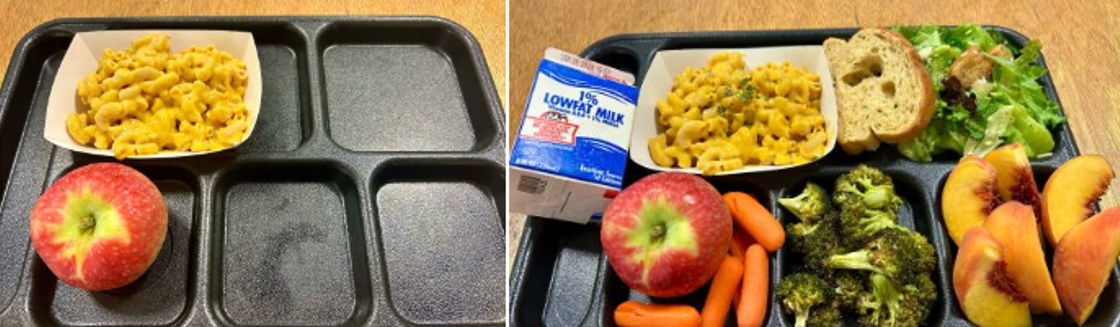 But they are NOT the same meal. The federal meal pattern sets a floor, not a ceiling. Grains, protein, fruit, veggies, milk. One of these trays will keep a kid full and focused until 2 p.m. The other might not. Here’s the thing: if your student comes home saying they’re still hungry after eating school lunch, before we assume they weren’t given enough food, let’s ask what they actually put on their tray. Our produce bars are stocked with local, fresh options every single day. The choice is there. Let’s help our kids learn to build the full plate.
So how would you answer this? One foodservice director response was: “it’s my favorite complaint to get, because you gotta know I have photo backup of the offerings most days.”
Another pointed out: “nutritious foods usually take a little longer to eat and teenagers are all about inhaling the food and running. I get it! But slowing down at meal time can be the difference between getting hungry at 4 p.m. or before the bell rings.” (Point – make sure every child has enough time to eat.)
More suggestions: included taking the visual and sharing with parents via the school website, helping educate parents on what’s for lunch and encouraging their student to make good choices at lunch; asking administrators to prioritize lunch rather than recess. Find Ms Botko’s post and all the comments here: Leah Botko, SNS | LinkedIn

A special thank‑you to Melissa Artlip, VP of Client Success at Agency MABU, for serving as keynote speaker at the 2026 Back to School Workshop. Melissa recently shared reflections from the event on LinkedIn, noting the meaningful conversations and the inspiring commitment shown by North Dakota’s school nutrition professionals.
In her keynote, Melissa walked participants through three core leadership principles:
-
Leadership is influence. Regardless of role—from dishwasher to head cook to office manager—every interaction shapes the school environment. Leadership comes from impact, not job titles.
-
Great teams communicate with understanding. Nutrition programs involve individuals with different responsibilities and perspectives. Recognizing the unique “lens” each team member brings strengthens trust and collaboration.
-
Never underestimate your impact. School nutrition staff often provide the first welcoming face of the day for many students. Those daily moments build consistency, connection, and a positive school experience.
Melissa expressed gratitude for the opportunity to speak at the North Dakota Department of Public Instruction School Nutrition Summer Conference, adding that leadership thrives where people consistently show up, care deeply, and make others feel seen.
To read Melissa’s complete notes about her experience for the LinkedIn audience, find it here: From Melissa Artlip
|
The USDA Department of Health and Human Services (HHS) has released a new $32.5 million initiative called Developing Evidence for Programs to Ensure Nutrition for Development (DEPEND) to help schools enhance the quality of their school meals. Through this program, schools can apply for grant funding to test innovative strategies for providing nutritious foods to school aged children.
The application for schools to apply is now open:
-
Decisions are anticipated: Oct. 23, 2026.
Food waste continues to be a visible concern across schools and communities. Many cooks, financial officers, administrators, and families are frustrated when perfectly good food ends up in the trash. Highlighting Food Waste Prevention Week is an opportunity to:
- Increase student awareness
- Promote waste‑reduction practices
- Strengthen communication between kitchens and classrooms
- Celebrate creative strategies that protect resources and reduce costs
This newsletter is reaching you after the week long celebration however, the topic is still relevant and you may decide to include food waste prevention as a goal this year or at least highlight its importance during a week of gratitude for our bountiful food; in April during the recycle, reduce and reuse push or any other time when there might be a need for education. Find resources for reducing food waste in our K-12 setting at: Schools | USDA
You still have time to plan and celebrate National School Lunch Week! Held Oct. 12-16, with the theme of 'Cafeteria Circus', use this week as a way to uplift your school meals program and have some fun while doing it! Find more information here: National School Lunch Week - School Nutrition Association
Share your celebration pictures with us at dpicnfd@nd.gov.
|