|
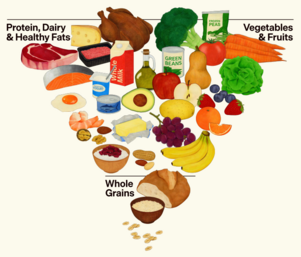
2025 Dietary Guidelines Food Pyramid
The USDA just dropped the Dietary Guidelines for Americans (DGA), 2025–2030, and they’re calling it a historic reset. The new motto? “Eat Real Food.”
What does the latest DGA mean for us in School Nutrition Programs? Here’s what we know so far:
- Whole milk is possibly coming back next school year (unsweetened only!)
- Whole grains and added sugar limits are still a big deal
- Sodium target will remain
Potentially added to our list:
- Ultra-processed foods: Strongly discouraged; however, definitions still need to be clarified
- Artificial sweeteners? Not recommended
The new guidelines put the spotlight on protein, whole fruits and veggies, healthy fats, and minimally processed foods. Think: real food first, less packaged stuff.
This is a big shift toward common sense eating. It’s all about real food, real health—and yes, it will impact what’s on our trays in the coming years.
Stay tuned as we learn more about how these changes will shape school meals. One thing’s for sure: the food pyramid just got flipped upside down!
Interested in the history of the food guide? Read a brief article here.
Read the DGA for yourself below.
NSBW Theme: The Quest for School Breakfast
March 2-6 is National School Breakfast Week (NSBW). Let your students take a quest through the breakfast line, selecting the nutritious items that make a winning meal to fuel their adventures.
We hope you take the time to celebrate this fun week in March to promote the School Breakfast Program that you offer in your schools.
Find out more information at the SNA NSBW website.
The NSBW shop is open! Find posters, stickers, student give aways, decorations, themed t-shirts, and more.
It may be winter, but summer is just around the corner and it’s time to start thinking about the USDA Summer EBT Program. There are many ways that schools can help ensure families can participate and receive benefits under the Summer EBT program in North Dakota.
From now until February, schools can focus on verifying that the following information is up to date and accurate in their enrollment systems/databases:
- Household Mailing Addresses – many families in rural areas use P.O. Boxes to receive mail. Families living in rural areas may have provided a physical address (receives no mail) instead of a mailing address when enrolling their child. Updating household data to include a mailing address will help ensure benefits can be mailed directly to the family.
- Household contact information – make sure to have complete and accurate phone numbers and email addresses for parents and/or guardians.
The Child Nutrition and Food Distribution office will pull STARS data and use submitted enrollment information to push out SEBT eligibility lists to schools. Schools using STARS will be able to access their specific list in the system while other schools not using STARS will receive an email with a Summer EBT eligibility listing.
More information to come on how you can participate in the Summer EBT program and ensure that children receive benefits this summer. To learn more about the North Dakota Summer Nutrition Programs please visit our website: Summer Nutrition Programs for Kids or contact our office.
Each year, the Child Nutrition and Food Distribution office evaluates the School Finance Report to determine if districts are maintaining their nonprofit School Food Service Account (05 Fund) according to the requirements in 7 CFR 210.19(a)(1).
School districts have already been contacted if their 05 Fund had either at the beginning of the 25-26 school year:
- A negative beginning balance, or
- More than 6 months of expenditures
If districts have any questions about the maintenance of their School Food Service Account, they should contact the Office of Child Nutrition and Food Distribution.
Feb.1 is more than just a date – it’s your checkpoint for program success. If your district operates multiple serving sites, USDA requires an On-Site Monitoring Review by Feb. 1. Single-site districts benefit from this review as well even if it is not required. It’s your district's chance to catch issues before they become findings. Monitoring isn’t just paperwork. It protects your reimbursement and ensures program integrity. An eyes-on review is the best safeguard against noncompliance.
Production Records Matter
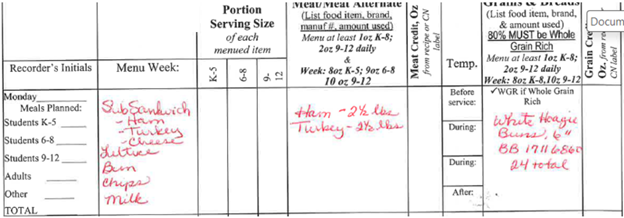
As the authorized representative, have you checked your kitchen’s production records? Missing details can mean lost reimbursement. These records are USDA’s proof that you served a reimbursable meal. Records like the one below will be subject to fiscal action in an Administrative Review. All areas on the production record must be completed to document that reimbursable meals were served.
Example of Incomplete Production Records
If the person filling out production records does not know where to find the information, please have them contact dpicnfd@nd.gov for help!
We recently received a question about serving breakfast on two-hour late start days since the students would be eating two meals fairly close together.
The answer from our regional manager was: “Yes, you can serve breakfast, even after 10 a.m.” Here are the details from their response:
-
No strict time cutoff for breakfast. Unlike lunch, breakfast doesn’t have a set service window. The only rule is that it should be served “at or near the beginning of the school day” (7 CFR 220.8(b)(1)).
-
State Agency oversight stays the same. Whether breakfast is at 8:00 a.m. or 10:30 a.m., the monitoring requirements don’t change. The meal count is taken at the end of the service line and production records and tracking documents are still key for reimbursement.
-
Weather delays? Plan ahead. While FNS Instruction 788-2 discusses some situations where breakfast service can be adjusted, late starts due to weather aren’t specifically listed. It’s a good idea for schools to have a clear policy for delayed starts so staff, parents, and students know what to expect.
-
Flexibility is your friend. Alternate service options like grab-and-go or classroom delivery could be used if time is tight for students to get started with their day. Grab-and-go bags could even be prepared the day before anticipated weather delays. That way, kitchen staff would not need to brave the weather earlier than necessary, and breakfast could still be served.
-
Remember all required components must be offered. A reimbursable breakfast menu must offer at least four items from the following food components:
- At least 1 ounce of grain or creditable meat
- 1 cup of milk
- At least 1 cup of fruit
- Most schools split the 1 cup of fruit into two ½-cup servings to meet the “4 items offered” requirement.
Bottom line: Breakfast should be served daily, but this is a local decision. With a solid plan and good communication, you can keep students fueled and ready to learn—no matter what time the day starts!
Some districts are choosing to work with Food Service Management Companies (FSMCs) to run their meal programs. If your district is considering this option, it’s important to remember one thing: the “buck” still stops with the School Food Authority (SFA).
Even if you hire an FSMC or another vendor, the SFA remains fully responsible for the School Nutrition Programs. The agreement for participation in the school nutrition programs with the State Agency is between you (the SFA) and the State—not the meal contractor. So, what does that mean in practice? Here are the big points:
What You Can’t Hand Off
Under 7 CFR 210.16, SFAs must keep control of key responsibilities, even when contracting for the services.
-
Procurement & Contracts: You create the solicitation documents, set evaluation criteria, and get State Agency approval before signing anything. Contractors can’t write the specs and then bid on the job (see 2 CFR 200.319(a)).
-
Program Oversight: Stay involved. Make sure the food service follows all program rules and your agreement with the State Agency. You can’t “set it and forget it.”
-
On-Site Monitoring: Visit schools regularly to check meal counting and claiming, and USDA Foods usage (7 CFR 210.16(a)(3)). Retain documentation to prove that the required visits were done.
-
Financial Control: The nonprofit school food service account stays under your control. You set meal prices and manage all funds (7 CFR 210.14).
-
Signature Authority: Only the SFA can sign official documents like the permanent agreement and reimbursement claims (7 CFR 210.16(a)(5)).
-
Free & Reduced-Price Meal Process: You are responsible for eligibility determinations and verification, even if the contractor helps with paperwork (7 CFR Part 245).
-
USDA Foods: You retain title to all USDA Foods, and you ensure proper crediting (7 CFR 250.50–250.54).
-
Health & Safety: Confirm the contractor meets all health certifications and local regulations (7 CFR 210.16(a)(7)).
-
Advisory Board: Maintain a board of parents, teachers, and students to help with menu planning (7 CFR 210.16(a)(8)). Document meetings with minutes to track this required activity.
-
Professional Standards: Even with an FSMC, you must have a Food Service Director on staff who meets USDA training requirements (7 CFR 210.30).
Contracting with an FSMC can help with operations, but it doesn’t transfer your responsibility. The SFA is still accountable for compliance, monitoring, and financial integrity. Think of the FSMC as an assistant—not a replacement.
For more details, check out 7 CFR 210.16 and USDA’s FSMC Guidance.
Our monthly Across the Desk session—highlighting the Administration of School Meal Programs—taking place on the second Tuesday of each month. Join us for the first Across the Desk of the New Year!
🕒 Time: 2 p.m. CST
January's Theme: Getting Ready for Procurement
We’ll be diving into key procurement topics, including:
- Procurement policies
- Forecasting for your menu
- Getting the most out of USDA Commodities
Go ahead and get the February Across the Desk session on your calendar as well.
📅 Date: Feb. 10, 2026
🕒 Time: 2 p.m. CST
February's Theme: Interdepartmental Communication
We’ll look at key communication topics, including:
- The Role of an Auth Rep
- Food Service Management Companies
- Vended Meal Contracts
- Summer-EBT
Your Voice Matters
Have a topic you’d like us to cover? Send it our way or bring your questions to the session. We’re here to support your program with clarity, compliance, and collaboration.
January 2026 Kitchen Counter Conversations: Menu Planning + Procurement: A Winning Formula for Child Nutrition Operations
Join us for our first Kitchen Counter Webinar of 2026! On Jan. 20, 2026, at 2 p.m. CST, we’ll dive into the essentials of effective menu planning and smart purchasing. This session will explore how to make the most of cycle menus, including practical tips, tricks, and techniques to streamline menu writing and enhance consistency, creativity, and compliance in your meal programs.
We’ll also cover procurement best practices, helping you strengthen your purchasing process, ensure compliance, and support cost-effective operations.
Whether you’re new to menu planning or looking to refine your current approach, this webinar will offer actionable insights you can put to use right away.
Mark your calendars now to enjoy the following professional development opportunities:
New Kitchen Manager Boot Camp
📅 June 3–4, 2026: Pioneer Room, North Dakota's State Capitol, Bismarck
Two days of immersion into school nutrition—from menus and production records to professional development.
School Nutrition Association Annual National Conference (ANC)
📅 July 12–14, 2026: Charlotte, NC
Theme: Power of School Meals
Enjoy unparalleled education and networking. For more info: Annual National Conference - School Nutrition Association
North Dakota SNA Annual Conference
📅 July 28–29, 2026: Hilton Garden Hotel, Fargo
For more info: North Dakota School Nutrition Association
NDDPI Child Nutrition & Food Distribution
Back-to-School Workshops
📅 July 30, 2026: Hilton Garden Hotel, Fargo
📅 Aug. 5, 2026: Sleep Inn, Minot
📅 Aug. 6, 2026: University of Mary, Bismarck
Full-day updates on: Added sugar limits, State 225 program updates, Procurement training & Buy American provision, Infinite Campus rollout and POS impacts
Tell us what else you’d like covered!
ServSafe is hosting an in-person class on Feb. 10, 2026, at the Southwest District Health Unit in Dickinson. The training runs from 8 a.m. to 4 p.m. MST and testing starts immediately after. Registration is due by Jan. 16, 2026.
Those who cannot make the ServSafe training or are comfortable taking the training and testing online, “Food Safety in Schools” is available at any time through the Institute of Child Nutrition. Enroll in the course here.
Please remember to email us the completion certificate!
Has the health inspector told you that you need to clean your hood system? Maybe you already have that on an annual maintenance schedule, but it is tough work to do. Kitchen grease combined with dirt and other contaminants usually take serious elbow grease, powerful chemicals and protective equipment to wipe it away. Climbing ladders and disassembling the filters also provides challenges.
We were recently asked if there were any companies that specialize in exhaust system cleaning. NDDPI does not endorse any company or product but it can be hard to find one of these companies. Click below to view the list of companies that we are aware of:
If you know of other companies, please send us business name and contact information to complete the list for other schools needing the service.
Remember to complete the procurement process if the cost to clean all the hoods in your district will be over $10,000. A small purchase procurement requires at least two quotes, and the lowest bid is awarded your business. The State of North Dakota recently awarded a contract for hood cleaning. Find North Dakota's solicitation here for ideas to put together your own bid!
|