|
Please check ND Foods to see if you need the initial 8-hour sanitation or the 5-year update to your certification. Click on ‘Individuals’ in ND Foods and then the name of the person to check the date of last training. If either the initial 8-hour or the 3-hour update is needed, check our website to find the options to obtain the training: SNP Food Safety and Sanitation Training | North Dakota Department of Public Instruction
If the initial 8-hour sanitation training is needed, ServSafe has a class coming up on Oct. 7. Registration for the class must be done by Sept. 12. Registration is attached.
The school foodservice has been designed to be self-sustaining and in this day of elevated food costs, please make sure you are recouping the cost to serve meals.
Many schools in North Dakota take advantage of the Offer Versus Serve provision, which allows students to select the foods they want or will eat, while ensuring they meet the meal pattern, by selecting a reimbursable meal. This helps reduce food waste and food cost while offering student choice. The OVS serving provision is required for grades 9-12 at lunch but is highly encouraged for all grades and meals. Check out CNFD’s Offer Versus Serve Infographic for information on implementation requirements and how to count combination items.
They’re here! Starting July 1, 2025, cereals, yogurts, and flavored milks now have added-sugar limits. These new limits target the products that were the leading sources of added sugars in school meals, especially at breakfast. The new limits also help shift school meals to better align with the Dietary Guidelines for Americans, which recommends that less than 10% of daily calories come from added sugars. When menu planning, you must ensure that cereals, yogurts, and flavored milks meet the following added sugar limits.
|
Cereal
|
No more than 6 grams of added sugar per 1 dry ounce
|
|
Yogurt
|
No more than 12 grams of added sugar per 6 ounces
|
|
Flavored Milk
|
No more than 10 grams of added sugar per 8 fluid ounces
|
- Check the nutrition label. Look specifically for grams of ‘Added Sugars’ and compare this to the Product-based Added Sugar Resource card.
- Download CNFD’s Added Sugar Auditing Tool from the website. This tool will help you review the products in inventory to ensure that they comply with the added sugar limits.
- Review the ingredients list. Many sugars have the suffix -ose (e.g. lactose, sucrose, fructose). Be on the lookout for keywords like syrup, nectar, agave, and honey. If sugar is one of the first three ingredients, the product is likely high in added sugars.
Transitioning to 10% Added Sugars by July 2027
If your school nutrition team has already reviewed the cereals, yogurts, and flavored milks for product-based added sugar limits, it is never too early to start planning ahead for USDA’s second phase, a 10% maximum allowed of calories from added sugars starting on July 1, 2027.
The easiest place to start is by reviewing your menu! Identify items and products that are higher in added sugars. Start thinking about small changes that can have a big impact. Begin planning now so you, your staff, and your students can make a slow and steady transition.
- Compare products: Switch out high-added-sugar items with those lower in added sugars. Don’t forget to compare different brands of condiments, too!
- Limit the number of prepackaged sweeteners or other extras like jams, jellies, and syrups instead of allowing students to take as many as they want.
- Reduce the number of days per week that a sweet breakfast entree is menued; add more savory breakfast entrees instead.
- Use fruit as a natural sweetener. Adding powdered sugar to pancakes? Switch to ½ cup fruit compote instead! Making a quick bread? Replace some or all the sugar with applesauce!
- Consider reducing the number of days that chocolate milk is offered. Remember to still offer two varieties and discuss ordering changes with your vendors.
Finally, register for our upcoming Added Sugar Intensive & Culinary Training and attend our monthly Kitchen Counter Conversations (KCC) as we will also have recurring topics related to added sugars.
It’s Crunch Time! The 2025 Mountain Plains Region Crunch Off runs Sept. 15-Oct. 31. This event celebrates local foods, supports farmers and ranchers, and promotes more fruits and veggies on our plates. Our goal: 750,000 crunches across Colorado, Nebraska, Kansas, Missouri, North Dakota, South Dakota, and Montana!
🥒 How to Participate Anyone can join—schools, childcare centers, businesses, organizations, and families. Just crunch into fresh fruits and vegetables while supporting producers who feed us.
🥕 Eligible Crunch Items
- Locally-grown or raised: fruits, veggies, legumes, nuts, popcorn, and meat (beef, pork, poultry, lamb, jerky, roasts, etc.).
-
Not included: liquids (milk/juice), purchased value-added items (like salsa, ice cream, sauces), grains, or deep-fried foods.
- Scratch-made, value-added items do count. An example may include: local cucumbers with scratch-made tzatziki (the cucumbers count as your 'crunch' item).
- Regionally grown foods from programs like DOD Fresh or USDA Foods are also accepted. Even if you can’t find something local to bite into, you can still participate and register the event to help promote healthy eating habits.
REGISTRATION IS OPEN! Events can occur between Sept. 15 and Oct. 31!
Event ideas: School & Childcare Events
- 🥕 Lunchtime Crunch – Host a special lunch featuring local produce, then all students crunch together at the same time.
- 🍏 Classroom Taste Tests – Teachers bring in local apples, cucumbers, or snap peas for students to taste and vote on their favorites.
- 🎨 Veggie Art Contest – Kids create artwork using local fruits and veggies, then do a big group crunch.
- 📚 Storytime Crunch – Pair a farm to school themed storybook with a crunch snack in early childhood classrooms.
Community & Workplace Events
- 🥒 Community Crunch Day – Partner with libraries, farmers markets, or parks for a public group crunch.
- 🍿 Popcorn & Movie Crunch – Show a family-friendly movie and hand out locally grown popcorn for the crunch moment.
- 🥩 Farm-to-Fork BBQ or Picnic – Feature local foods, then gather everyone for a crunch at once.
- 👩🌾 Meet the Farmer Crunch – Invite a local grower to share their story, then crunch on their produce together.
Creative & Competitive Ideas
- 🥦 Crunch Challenge – Each classroom, workplace department, or community group logs their crunch numbers, competing for the largest participation.
- 📸 Crunch Selfie Contest – Encourage participants to snap a picture or video of their crunch and share on social media with the Crunch Off hashtag.
- 🎶 Musical Crunch – Pair the crunch with music or a countdown over the intercom.
- 🏫 Principal/Mayor Crunch – Invite a community leader or school principal to lead the group crunch
Harvest of the Month: Watermelon
Our new feature for September Harvest of the Month is watermelon.
If you work in school nutrition, then you know kids love watermelon. Vibrant, juicy, and delicious, watermelon is always a popular fruit option in the cafeteria. Watermelon is certainly a nutritious food: it is high in vitamin C (providing 25% DV) and has 6% of the daily value for magnesium per serving. Plus, watermelon contains more of the antioxidant lycopene (12.7 mg per 2-cup serving) than any other fresh fruit or vegetable.
Even so, watermelon provides essential nutrients that students need for healthy growth and development. Plus, watermelon is hydrating, made up of 92% water. And it’s no secret that watermelon in school is beneficial: 89% of professionals agree that this fruit is a nutritious food for their students. Even more participants (90%) agree that students enrolled in K-12 enjoy fresh watermelon. Refreshing, sweet, and juicy, what’s not to love?

We are looking for volunteers to be featured in the Harvest of the Month on social media. If you are interested in having your school featured for serving a Harvest of the Month food, please contact Amanda Olson at amolson@nd.gov
|
2025 Garden Webinars
Thank you to everyone who joined our summer garden webinar series. Participants learned practical tips for starting and maintaining garden spaces in schools and childcare settings. Topics included choosing kid-friendly crops, safe gardening practices, integrating garden activities into learning, produce safety, and using harvests in meals and snacks. If you have any questions about starting, expanding, or maintaining a garden with children, please contact Amanda Olson at amolson@nd.gov.
This fun activity aims to highlight school nutrition and the amazing work you do to feed children. It’s a fun way to showcase the delicious meals you serve. This is an optional activity. Please participate if you feel inspired 😊
-
You can submit a photo corresponding to the theme each month. Photos are due on the last day of each month.
Criteria: You can take a picture of a full lunch on a plate or tray (all meal components, full tray showcased).
-
The photo is a close-up of the tray and is well-lit. Any students in the photo should have a photo release form signed. We will assume that you went through the proper protocol for that photo release form.
-
Lunch or breakfast meets monthly theme - one-photo limit, except for October and May (two themes, two photos allowed).
You can submit your photo to Amanda Olson at amolson@nd.gov before the end of each month to qualify. If you have any questions, please reach out to Amanda.
For more information about the Tray of the Month initiative, please see our handout here:
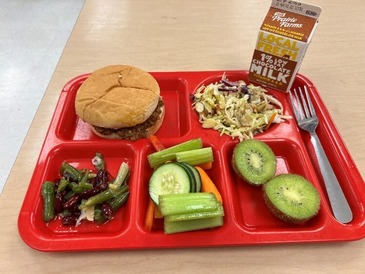
Courtesy of Bowbells Public School. Local beef featured for Beef Month in May 2025.
Procurement training is now required annually. If you did not attend a procurement session at our Back to School workshop, we have another opportunity to check the "SY2026 Procurement training" box for professional development.
Register and plan to come to the "Team Up for Procurement" on Oct. 15 daylong event led by the professionals from the Urban School Food Alliance. Funding from a USDA grant allows them to provide this training for free. Register on Eventbrite here: https://www.eventbrite.com/e/teamup-for-procurement-workshop-tickets-1416955946379?aff=oddtdtcreator
Check out the latest update of our ND School Food Service Procurement manual here: SNP Procurement | North Dakota Department of Public Instruction
We hope to see you in Bismarck on Oct. 16-17 for NDSNA Conference. We will have a Farm to School panel, and looking for your input on the questions and topics you would like our panel to discuss.
Please fill out the survey here: https://forms.office.com/g/wKmGDjrCCe
Join us in person for a day filled with learning and delicious food. This event will focus on the latest updates in meal patterns, with a special emphasis on reducing added sugars. Our culinary training will provide hands-on experience and tips for creating delicious recipes that fit the dietary specifications. Don't miss this opportunity to enhance your skills and knowledge - Register now to secure your spot!
Additional training will be held in Spring 2026 (Wahpeton, Bismarck, and in South Dakota).
|
USDA Team Nutrition Resources Available AT NO COST to any school that wants to order them. Check out the posters for your cafeteria, recipe books for the kitchen and lots of communication pieces to help households understand the program. These resources are free for a school to use; they even ship them to your doorstep at no charge! School Nutrition Professionals Publications
The Buy American provision requires School Food Authorities (SFAs) to purchase domestic commodities and products to the maximum extent practicable. Certain items are not available domestically; these are listed in the Federal Acquisition Regulations (FAR) 25.104 Nonavailable Articles List. Any other non-domestic purchases must be competitively procured, with proper justification and documentation. Use the USDA Buy American Tracking Tool or the NDDPI-CNFD Justification Form to record these purchases.
What’s New for SY 2025–26
Starting in SY 2025–26, SFAs must ensure that no more than 10% of their total commercial food purchases are non-domestic, even for items listed on the FAR 25.104 Nonavailable Articles List. This rule supports U.S. agriculture and aims to increase the use of American-grown foods in school meals. The USDA Buy American Tracking Tool will assist SFAs in calculating compliance with this threshold.
A product is considered domestic if:
- At least 51% of the ingredients are grown in the U.S.; and
- The product is processed in the U.S.
Accommodation Option for SY 2025–26
If your school cannot meet the 10% limit despite reasonable efforts, USDA allows SFAs to apply for an accommodation.
How to Apply:
- Find the accommodation form on the NDDPI CNFD SNP Procurement page: SNP Procurement | NDDPI.
- Identify which product categories require accommodations (Fruit, Vegetables, Juice, Cereal, or Other).
- Provide reasons for continued non-domestic purchases.
- Outline a plan to achieve the 10% compliance threshold in future years.
- Submit the signed form to dpicnfd@nd.gov.
Best Practices to Support Buy American Compliance
-
Include Buy American Language in Solicitations: Add the Buy American clause to all bids and contracts to ensure vendor compliance and reduce administrative review findings.
-
Set Up Domestic-Only Order Guides: Work with distributors to list domestic items first, streamlining purchasing and compliance.
-
Identify Suitable Substitutions: Establish approved domestic substitutions to avoid last-minute product changes.
-
Budget for Potential Price Differences: Be prepared for possible cost increases for domestic products.
-
Check Product Origins Carefully: When price shopping, verify product country of origin to stay within the 10% cap.
USDA encourages schools to prioritize U.S.-grown foods while recognizing potential challenges. This new accommodation process offers flexibility while ensuring progress toward full compliance.
For help determining if a product is domestic or not, refer to the Buy American Factsheet.
Have a great start to your year!
|